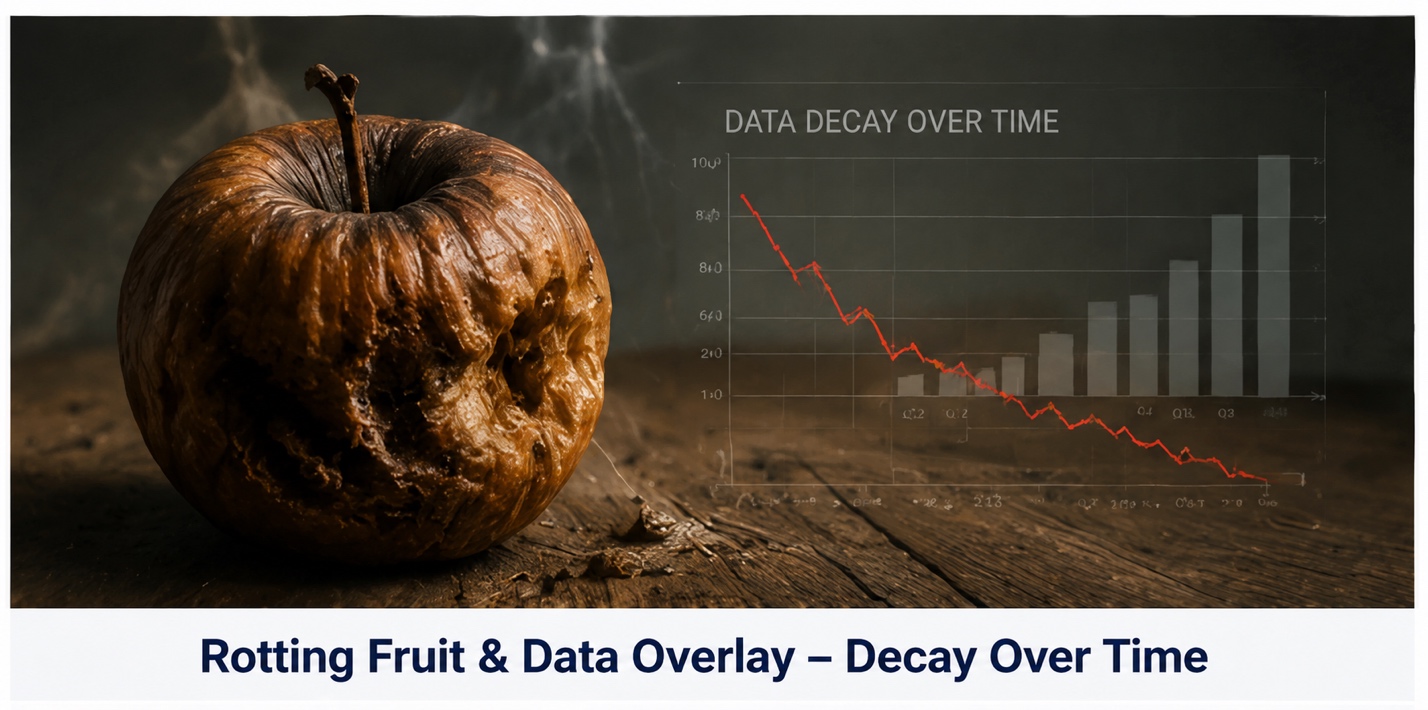
Stale Data Lies — Why an Inventory Is Never “Done”
Executive Summary: Article Overview
IF4ITThe Bottom Line
Core Article Pillars
| Article Pillar / Focus Area | Strategic Business Outcome & Intent |
|---|---|
| Inventory Currency | Treat freshness as a measurable quality attribute so leaders can distinguish current, decision-ready inventory data from information that has silently diverged from operational reality. |
| Continuous Maintenance | Establish inventory work as an ongoing operational capability with accountable ownership, defined review cadences, and sustained funding rather than a one-time data-collection project. |
| Silent Data Decay Risk | Recognize that stale inventories fail quietly and can produce confident but incorrect decisions about systems, costs, security, compliance, capacity, and ownership. |
| Automation and Stewardship | Connect inventories to authoritative operational sources, automate discovery and reconciliation where practical, and reinforce human stewardship for changes that require contextual judgment. |
Quick Q&A (Macro Executive Reference)
Question: Why can a stale enterprise inventory be worse than having no inventory?
Question: Why is building an inventory only the beginning of the work?
Question: What disciplines keep [enterprise inventories](https://if4it.org/best-practices/enterprise-inventory-management/) accurate over time?
Read Full Article Below
Author: The International Foundation for Information Technology (IF4IT)
The Project That Never Ends
Enterprises love completable work. A project has a start, a delivery, a celebration, and a close. The team disbands. The funding ends. The progress chart shows green to the right of the line. There is something deeply satisfying about a problem that can be finished.
Enterprise inventories resist this satisfaction, and that is the source of most of the trouble they cause. An inventory is not a project. It is not a thing the enterprise can complete and walk away from. The world the inventory describes — the applications, the systems, the data, the vendors, the contracts, the people — is changing continuously, and the inventory must change with it or stop telling the truth. There is no version of inventory work that is done. There is only inventory work that is being kept current and inventory work that is rotting.
This is the part the celebratory framing hides. The team that built the inventory, the consultants who structured it, the leadership that funded it — all of them are inclined to declare victory at the moment the inventory exists, because existence is what gets reported up the chain. But existence is the start of the work, not the end of it. The harder, less visible, less celebrated work is the maintenance that follows. And it is precisely the work that determines whether the original investment pays off or evaporates.
The Quiet Failure Mode
Most enterprise failures announce themselves. A system crashes. A bill goes unpaid. A deadline is missed. Someone notices. The failure is named, the cause is investigated, the response is mounted.
A stale inventory does none of this. It fails silently — and the silence is what makes the failure dangerous.
Consider how it actually goes wrong. The inventory was built carefully. Owners were assigned. Attributes were defined. Data was populated. Then, over the months and years that followed, the enterprise kept doing what enterprises do. New systems were stood up. Old ones were decommissioned. Ownership changed hands as people left the company. Vendors were renegotiated. Cloud accounts proliferated. Each of these changes happened in someone’s day-to-day work, was reflected in the operational system where it happened, and never made it into the inventory. Each gap, individually, looked minor. Together, they accumulated.
At no point did the inventory raise its hand and say “I am no longer accurate.” It went on looking the way it had always looked. People continued to consult it, trust it, and make decisions on it. And every decision made on the basis of stale data carried a small, invisible error. Sometimes the errors were inconsequential. Sometimes they weren’t.
This is the failure mode that the lifecycle of an inventory must be designed to prevent. Not catastrophic failure — quiet failure. The kind that doesn’t announce itself, that doesn’t trigger a response, and that erodes the value of the original work without ever giving anyone the chance to defend against it.
Stale Is Worse Than Absent
The counterintuitive point — and the one most worth internalizing — is that a stale inventory is often worse than no inventory at all.
This is hard for many people to accept on first hearing. Surely a partly-accurate inventory is better than no inventory? Surely some data is better than no data? The reasoning seems airtight. It is also wrong.
When an inventory does not exist, the people who need its data know they must go and find the truth elsewhere. The gap is visible. It prompts the right behavior — verification, investigation, a careful sourcing of facts from systems of record. The absence is a signal, and the signal triggers caution.
When an inventory exists but is out of date, the gap is invisible. People consult it, trust it, and act on it, unaware that it no longer reflects reality. They do not verify; they have no reason to. The cause-and-effect of any resulting error is detached by months or years from the error itself. The absent inventory produces caution. The stale inventory produces confident error. And confident error is much harder to defend against than acknowledged ignorance.
A concrete example makes this vivid. An enterprise that decommissions a system but leaves it in the inventory will keep paying to secure and audit a thing that no longer exists — money spent on a phantom. An enterprise that adds a system but never records it will make security, capacity, and compliance decisions that silently omit it — risk carried, unmeasured, on a thing nobody is governing. In both cases, the stale inventory is the reason the wrong thing happens. A missing inventory would have forced the question. A wrong inventory let everyone proceed in confident error.
The principle generalizes beyond examples. An inventory whose currency cannot be trusted cannot be relied upon. An inventory that cannot be relied upon will be quietly abandoned by the people who need it most — and when it is abandoned, the entire investment that produced it is lost.
The Discipline of Maintenance
So what does it take to keep an inventory honest over time?
The work isn’t glamorous. It is the assignment of clear ownership for each inventory and each row in it — naming a specific person or role accountable for accuracy. It is the scheduling of reviews on a defined cadence, so that currency does not depend on someone happening to remember. It is the connection of inventory data to the operational systems that already know about changes — automated discovery, reconciliation, integration — so the inventory does not have to be updated manually for every event. It is the measurement of currency itself as a quality attribute of the inventory, surfaced and reported alongside coverage and accuracy, so that staleness is visible before it becomes corrosive.
None of this is technically difficult. All of it is operationally demanding, because it requires that an organization care about something whose value is invisible until it disappears. The discipline of inventory maintenance is the discipline of taking an asset seriously before it has stopped working — which is harder than responding after the fact, and exponentially less expensive.
Where to Go Next
The full treatment of how to keep inventories accurate and useful over time — including currency as a measured dimension, the lifecycle stages of inventory management, the role of automation and AI in maintaining freshness, and the stewardship culture that makes the work sustainable — is in the IF4IT Enterprise Inventory Management Best Practices document. The document devotes a specific section, “Recognize that an inventory is never ‘done’ — and that stale data actively misleads”, to the argument this article distills.
Enterprises that internalize the decay problem stop treating inventory work as a project with an end date and start treating it as an operational capability with an indefinite life — which is what it is. The investment pays back in inventories that are still trustworthy years after they were built, still being used, and still earning the maintenance that keeps them so. The alternative is the investment that quietly evaporates, one unnoticed gap at a time, while everyone using it continues to trust what it says.
Back to Articles PageHow to cite this page
When referencing this page in academic work, internal standards, or external publications, include the page title, IF4IT as author and publisher (The International Foundation for Information Technology (IF4IT), LLC), the URL, and your access date.
Example (informal web citation):
The International Foundation for Information Technology (IF4IT), LLC. Stale Data Lies — Why an Inventory Is Never “Done”. https://if4it.org/articles/2023-02-02-stale-data-lies-why-an-inventory-is-never-done/ (accessed 2026-10-05).
See About Us for content governance and site-wide citation guidance.