One Source of Truth — How Inventories End the “Whose Numbers Are Right?” Debate
Executive Summary: Article Overview
IF4ITThe Bottom Line
Core Article Pillars
| Article Pillar / Focus Area | Strategic Business Outcome & Intent |
|---|---|
| Authoritative Enterprise Inventories | Establish a recognized source of truth for each governed data domain so decisions begin from shared facts rather than competing spreadsheets. |
| Cross-Functional Decision Alignment | Separate factual reconciliation from substantive decision-making, allowing leaders to focus on trade-offs, priorities, and outcomes. |
| Shared Enterprise Vocabulary | Standardize identifiers, definitions, ownership, and lifecycle status so business and technology functions discuss the same assets consistently. |
| Governance and Stewardship | Sustain trust through explicit authority, accountable ownership, defined currency, and ongoing maintenance of inventory data. |
Quick Q&A (Macro Executive Reference)
Question: Why do cross-functional meetings often become debates about whose numbers are right?
Question: How does a governed inventory change executive and operational decision-making?
Question: What makes an inventory a credible shared source of truth?
Read Full Article Below
Author: The International Foundation for Information Technology (IF4IT)
The Meetings That Go in Circles
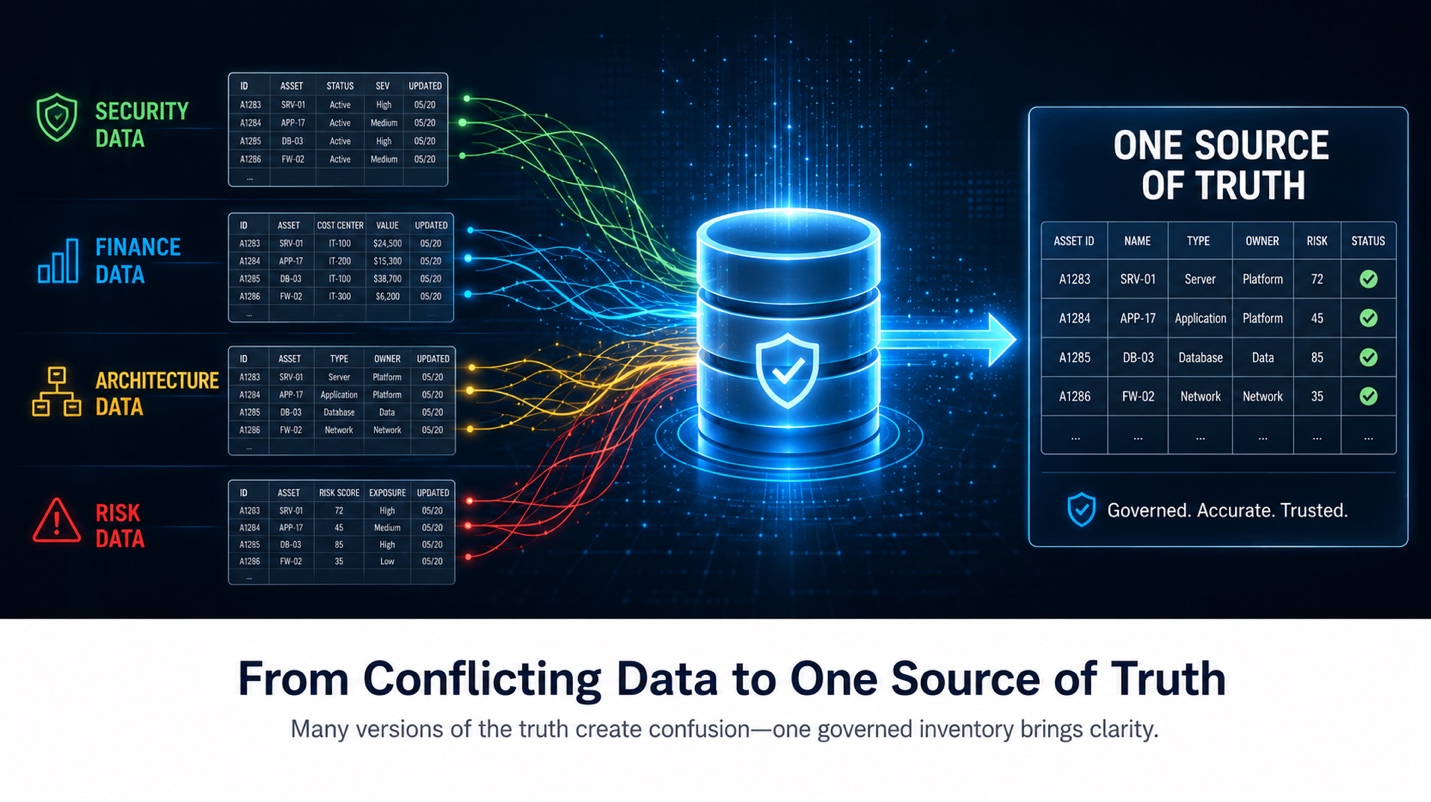
Every enterprise has them. The cross-functional meeting that was supposed to make a decision instead becomes a fight about which spreadsheet to believe. Security has one count of the systems that process customer data. Finance has another count of the applications the enterprise pays for. Architecture has a third count of what is actually running. Risk has a fourth count of what’s exposed. The four counts are all “right” by their respective owners’ definitions, and all different. The decision the meeting was called to make recedes; the discussion turns to reconciling the numbers. By the end of the hour, nothing has been decided, and another meeting is scheduled to “align on the data.”
This pattern is so common that most enterprises treat it as the unavoidable cost of doing business. It isn’t. It is the symptom of a specific, addressable problem: the enterprise has no governed, shared source of truth about itself. Every function maintains its own partial picture, optimized for its own purpose, with no recognized authority sitting above them. When those pictures meet, they collide. The collision feels like disagreement; underneath, it is something different and worse.
Unrecognized Disagreement About What Is True
The hidden insight is that most of what looks like organizational disagreement is unrecognized disagreement about what is true.
Two functions debating whether to retire a system are not really debating the retirement. They are operating from different facts about the system — what it does, who uses it, what it costs, what depends on it — and they don’t realize their facts diverge. Each believes the other is being unreasonable or political, when in reality both are reasoning correctly from incompatible inputs. The argument cannot be resolved at the level of the decision because the disagreement is one layer down.
This is a different kind of problem than the one most leaders think they are solving. When a leader sees cross-functional friction, the instinct is to mediate, build consensus, run another meeting, escalate. None of these works well, because none of them addresses the layer where the disagreement actually lives. The participants don’t know they’re using different facts. The mediator doesn’t know it either. The whole conversation proceeds as if the disagreement is substantive, and it cannot be resolved as substantive disagreement because it isn’t one.
The cost of this misdiagnosis is enormous. It shows up as slow decisions, fractured alignment, decisions made on the loudest voice rather than the best information, and a steady erosion of trust between functions that should be collaborating. None of these failures gets attributed to its actual cause, because the cause is invisible.
What Changes When There Is a Shared Source of Truth
A governed inventory changes the conversation in a single, specific way: it shifts the question from “whose numbers are right?” to “what does the inventory say?”
This is not a minor reframing. It is the structural change that makes everything downstream different.
When the question is “whose numbers are right?”, the participants are arguing about authority — my data versus yours, my count versus yours — and there is no impartial arbiter, so the argument either drags on or gets resolved by power rather than by fact. When the question becomes “what does the inventory say?”, the participants are no longer arguing about whose data; they are consulting a recognized authority outside themselves. The dispute about facts ends. What remains is the actual decision, and the actual decision is what the meeting was supposed to be about.
This requires that the inventory be authoritative, not merely available. An inventory that exists as one of several competing lists carries no more weight than any of the others. An inventory that the enterprise has designated as the source of truth for its kind of data — and that it governs accordingly, with clear ownership, defined currency, and recognized authority — is different. It is the place the enterprise has agreed to look. The shift from one of several lists to the recognized authority is what gives the inventory its power to end the debate.
This is also why the technical excellence of an inventory matters less than its political standing. A perfectly-built inventory that the enterprise has not designated as authoritative is just another data set. A modestly-built inventory that the enterprise has designated as authoritative — and that it actively maintains as such — does the work. The difference is governance, not engineering.
The Inventory as a Shared Language
Beyond ending arguments about facts, a governed inventory does something subtler and arguably more valuable: it gives every function a common language for talking about the enterprise.
Security, finance, architecture, procurement, and risk care about different things. They have different priorities, different audiences, different success metrics. None of that has to change for them to collaborate effectively — but they do need to be talking about the same things in the same terms. When each function has its own private list of applications, its own private definitions of what a “system” is, its own private categorization of vendors, the conversation between them is bilingual at best. Translation has to happen at every interface, and meaning gets lost in the translation.
A governed inventory imposes shared vocabulary. The applications all five functions discuss are the applications, defined the same way, with the same identifiers, the same ownership, the same lifecycle status. The vendors are the vendors. The data assets are the data assets. The five functions can disagree as much as they want about what to do about a given application — but they cannot disagree about which application they are talking about, because they are all looking at the same row of the same inventory. That alone removes a significant share of cross-functional friction, and what’s left is the substantive disagreement that matters.
Where to Go Next
The full treatment of how to establish governed inventories that serve as a shared source of truth across the enterprise — including the governance practices that make an inventory authoritative, the role of ownership and stewardship in sustaining that authority, and the broader discipline of treating the connected set of inventories as the Enterprise Model — is in the IF4IT Enterprise Inventory Management Best Practices document. The document devotes a specific section, “Use inventories to establish a single, shared source of truth across the enterprise”, to the argument this article distills.
The enterprises that decide well are not the ones with the smartest people in the room. They are the ones whose people are arguing about the right things — the decisions themselves, not the facts beneath them. A governed inventory is what makes that possible. It does not eliminate disagreement. It moves disagreement to where it can do useful work.
Back to Articles PageHow to cite this page
When referencing this page in academic work, internal standards, or external publications, include the page title, IF4IT as author and publisher (The International Foundation for Information Technology (IF4IT), LLC), the URL, and your access date.
Example (informal web citation):
The International Foundation for Information Technology (IF4IT), LLC. One Source of Truth — How Inventories End the “Whose Numbers Are Right?” Debate. https://if4it.org/articles/2024-05-22-one-source-of-truth-how-inventories-end-the-whose-numbers-are-right-debate/ (accessed 2026-10-05).
See About Us for content governance and site-wide citation guidance.