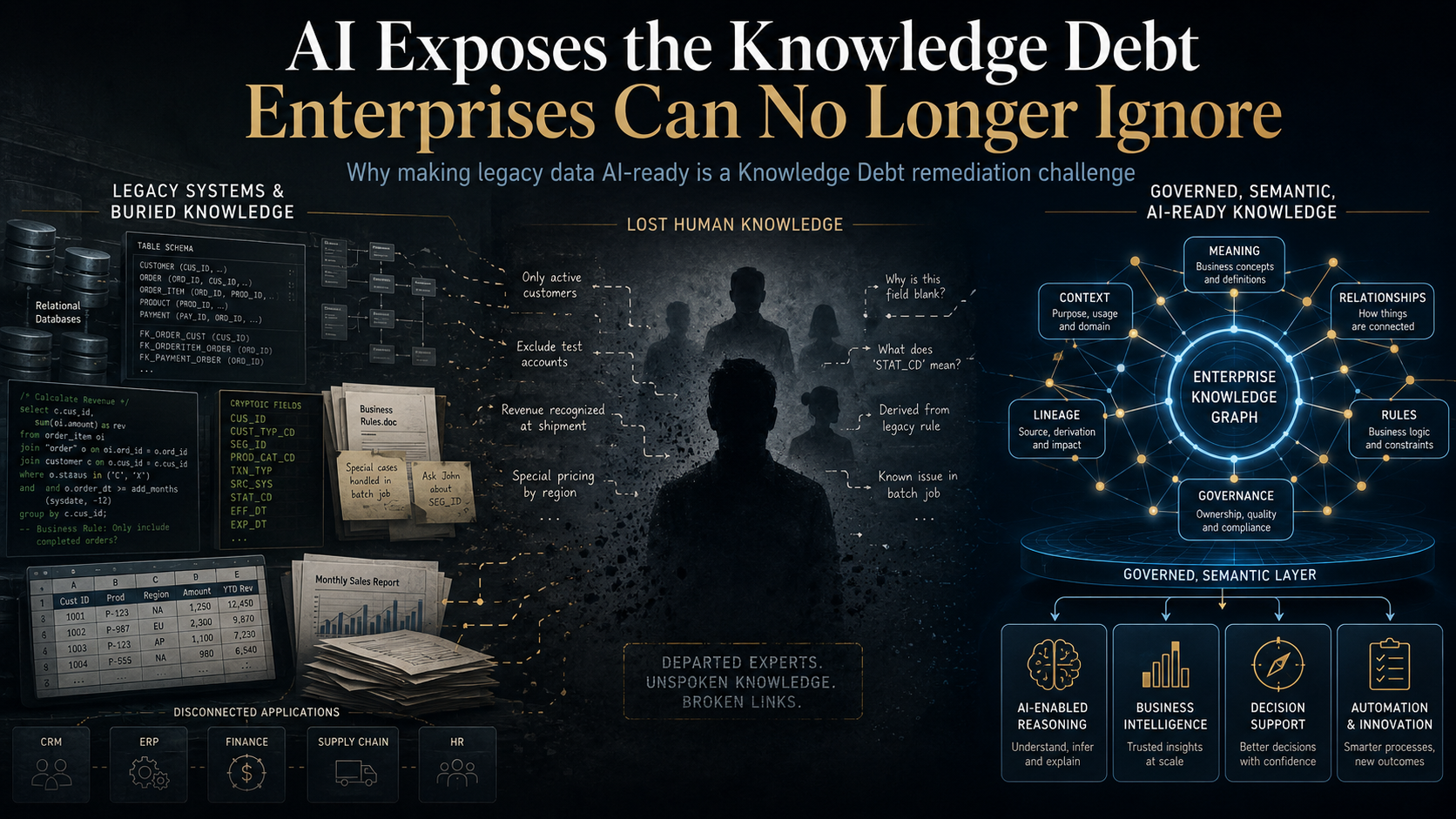
AI Exposes the Knowledge Debt Enterprises Can No Longer Ignore
Executive Summary: Article Overview
IF4ITThe Bottom Line
Core Article Pillars
| Article Pillar / Focus Area | Strategic Business Outcome & Intent |
|---|---|
| Knowledge Debt | Recognize the hidden enterprise risk created when meaning is lost, fragmented, undocumented, or trapped in human memory. |
| Legacy Knowledge Reconstruction | Recover and validate the meaning embedded in schemas, codes, keys, reports, integrations, application behavior, documentation, and expert knowledge. |
| Semantic AI-Ready Data | Convert machine-readable legacy data into semantic, governed knowledge that AI can retrieve, interpret, traverse, and reason over. |
| Human-Governed AI Acceleration | Use AI to accelerate discovery and enrichment while preserving human ownership, stewardship, validation, and auditability. |
| Competitive Force Multiplication | Prepare enterprise knowledge so AI can amplify analysis, decision support, automation, and complex problem solving across domains. |
Quick Q&A (Macro Executive Reference)
Question: What is Knowledge Debt?
Question: Why does AI expose Knowledge Debt?
Question: Why is making legacy data AI-ready a Knowledge Management problem?
Read Full Article Below
Enterprises are moving quickly toward AI. They want AI to analyze information, answer questions, automate decisions, improve services, detect risks, accelerate delivery, and uncover new opportunities.
But many are discovering a hard truth.
AI cannot reliably reason over enterprise knowledge that the enterprise itself has not made explicit.
Legacy data may be available in databases, files, applications, reports, APIs, data warehouses, data lakes, and document repositories. It may even be machine-readable.
But machine-readable is not the same as AI-ready.
Making legacy data AI-ready is not just about moving, indexing, or exposing data. It is about reconstructing decades of embedded enterprise knowledge that was never explicitly captured in natural-language, semantic, governed form.
This is not only a data problem. It is a Knowledge Management problem.
More specifically, it is a Knowledge Debt problem.
From Technical Debt to Knowledge Debt
In IT, most leaders understand Technical Debt.
Technical Debt accumulates when systems age, architectures become brittle, shortcuts compound, documentation falls behind, modernization is deferred, and old design decisions make change slower, riskier, and more expensive.
AI is exposing a related but different problem: Knowledge Debt.
Knowledge Debt is the accumulated loss, fragmentation, or implicit capture of enterprise meaning across systems, data structures, rules, terminology, documentation, and human memory.
For decades, enterprises have allowed critical knowledge to remain buried in schemas, column names, code values, foreign keys, stored procedures, application logic, integration mappings, reports, spreadsheets, ticket histories, operating procedures, and the minds of long-tenured employees.
As long as the systems continued to run, that debt was often tolerated.
AI changes that.
Technical Debt made systems hard to change.
Knowledge Debt makes enterprise data hard for AI to understand.
Knowledge Debt Has Always Appeared When Critical People Leave
Enterprises have always experienced Knowledge Debt when important people leave.
A senior developer retires. A database administrator moves on. A business analyst leaves. A system owner changes roles. A long-tenured operations expert departs.
When that happens, the enterprise often discovers that the person did not merely perform work. The person carried meaning.
They knew why a table existed, which codes were current, which reports could be trusted, which field names were misleading, which integrations mattered, which jobs quietly corrected data, and which exceptions were normal or dangerous.
When those people leave, the enterprise does not just lose labor. It loses interpretive knowledge.
Historically, that kind of loss was often painful but bounded. It might affect one system, application, process, domain, team, product, or service. New people could reverse engineer the missing knowledge over time. Work might slow down. Risk might increase. But the problem was usually scoped.
AI changes the scale.
To make enterprise data AI-ready, enterprises may need to confront Knowledge Debt across many systems, domains, processes, data structures, rules, and decades of institutional history at once.
AI turns localized Knowledge Debt into an enterprise-scale problem.
Legacy Data Contains Knowledge, But Not in AI-Ready Form
Legacy systems often contain enormous enterprise knowledge. The problem is that much of it is not expressed in a form AI can reliably interpret.
A relational database may store customers, products, applications, vendors, contracts, policies, services, assets, incidents, orders, claims, accounts, transactions, or regulatory obligations.
But the meaning behind that data may be hidden.
A field named CTR may mean customer, counter, center, contract, control, or something else depending on the system. A code such as P1443XS3 or 4446233 may be meaningful inside one application but meaningless outside it. A foreign key may define a technical join without explaining the business relationship. A status value may carry different meanings across systems.
The data exists.
The meaning may not.
This is where Knowledge Debt becomes visible. The enterprise has data that systems can process, but not enough explicit knowledge for AI to retrieve, interpret, traverse, reason over, or use responsibly.
The People Who Understood the Data Are Often Gone
For many legacy systems, the greatest knowledge asset was never the database itself. It was the people who understood why the database was designed the way it was.
Many of those people are gone.
They retired, changed roles, moved to other companies, or were replaced through outsourcing, restructuring, mergers, acquisitions, modernization programs, or cost-reduction efforts.
New teams are often asked to recover missing knowledge by reverse engineering schemas, data values, foreign keys, reports, interfaces, stored procedures, ETL jobs, tickets, documentation, and operational behavior.
That work is slow, expensive, uncertain, and risky.
It is also exactly the kind of work that becomes necessary before AI can reliably reason over legacy enterprise data.
AI-readiness requires enterprises to convert implicit, fragmented, and often lost institutional knowledge into explicit, validated, semantic knowledge structures.
Y2K, Enterprise Search, and AI
Enterprises have seen versions of this problem before.
During Y2K, enterprises had to locate high-risk date structures, understand where date logic was embedded, correct systems and data, test outcomes, and prove that critical business processes would continue to work.
Y2K was not only a technical remediation effort. It was also a knowledge-discovery exercise.
Enterprise search exposed a related Knowledge Management problem. Enterprises wanted better access to documents, records, policies, procedures, project artifacts, technical knowledge, and institutional memory. But search quality depended on metadata, taxonomy, ownership, permissions, freshness, terminology, content quality, and governance.
In many enterprises, the remediation effort required to make enterprise search truly effective was larger than the perceived return. So many accepted mediocre search, fragmented repositories, stale documents, weak metadata, and inconsistent taxonomies.
AI changes the economics.
Poor semantic knowledge no longer means only poor search results. It can mean weak reasoning, bad recommendations, incorrect automation, poor decision support, low trust, regulatory exposure, and lost competitive advantage.
With AI, enterprises do not have the same luxury of ignoring the problem.
AI as a Force Multiplier
Technology history repeatedly shows that certain capabilities become force multipliers. They change the scale, speed, reach, and economics of work.
| Technology Force Multiplier | What It Changed | Why It Matters to the AI and Knowledge Debt Argument |
|---|---|---|
| Automated transportation | Expanded trade, distribution, mobility, and supply-chain reach. | Enterprises that moved goods faster and farther gained structural advantage. |
| Electrification | Enabled modern factories, extended operating capacity, and changed how work was organized. | Enterprises that adapted could scale production and redesign operations. |
| The internet | Allowed individuals and small enterprises to create global storefronts and reach customers directly. | Digital reach reduced the advantage of size and location. |
| Cloud computing | Made elastic infrastructure, rapid provisioning, and scalable experimentation broadly available. | Enterprises could move faster without owning all infrastructure. |
| Enterprise AI | Can augment analysis, synthesis, classification, reasoning, decision support, content generation, monitoring, and automation. | Enterprises with semantic, governed, AI-ready data may compound advantage faster. Enterprises without it may be constrained by Knowledge Debt. |
The pattern is consistent: force multipliers reward enterprises that are prepared to use them and expose the limitations of those that are not.
AI is different because it does not merely improve movement, production, reach, or infrastructure. It can multiply knowledge work itself.
But AI can only multiply what it can understand.
That is why Knowledge Debt matters.
Making Legacy Data AI-Ready Is Knowledge Debt Remediation
Making legacy data AI-ready requires more than connecting AI to existing systems.
It requires the enterprise to reconstruct and govern meaning.
That may include:
Preserving legacy identifiers and source-system traceability.
Defining the Semantic Layer and the meaning model AI should use.
Creating Semantic IDs for important enterprise objects.
Making attributes and traits semantic with definitions, context, constraints, and controlled meanings.
Creating semantic relationships using descriptive predicates.
Discovering relationships from foreign keys, shared values, lineage, integrations, documentation, and human knowledge.
Using ontologies and rules to govern semantic conversion.
Preparing Semantic Instance Documents for AI retrieval and reasoning.
Enriching, indexing, and publishing semantic representations for AI use.
Managing refresh, drift, lineage, validation, and governance over time.
Each of these activities requires knowledge.
Some knowledge can be extracted from systems. Some can be inferred from data patterns. Some can be discovered in documentation, lineage, integrations, reports, and application behavior. Some can be proposed by AI.
But some still requires human review, validation, and governance.
AI can help remediate Knowledge Debt, but it cannot own the truth.
The enterprise still needs ownership, approval, stewardship, validation, and auditability. It must decide which meanings are correct, which relationships are trusted, which sources are official, which rules are authoritative, and which representations are safe for AI use.
AI can propose.
Humans must govern.
The Competitive Consequence
The enterprises that succeed will not simply be the ones that buy AI tools.
Many enterprises will buy AI tools.
The differentiator will be whether those tools can reason over reliable enterprise knowledge.
Enterprises that convert legacy data into semantic, governed, AI-ready knowledge may accelerate analysis, improve decision support, automate complex workflows, strengthen governance, reduce operational friction, and unlock insights trapped in fragmented systems.
Enterprises that do not may remain constrained by their own Knowledge Debt.
They may have AI tools, but not enough AI-ready enterprise knowledge for those tools to create durable advantage.
This is why the AI data problem is not merely technical.
It may become an existential enterprise issue.
The Practical Path Forward
Enterprises should start by acknowledging Knowledge Debt as a real enterprise risk.
Then they should identify where AI-ready knowledge matters most.
Not all legacy data needs to be semantically enriched at once. The practical path is to prioritize high-value and high-risk domains where AI could create meaningful advantage or where poor AI reasoning could create material harm.
Good starting points may include customer knowledge, product and service knowledge, application and technology portfolios, policies and controls, contracts and obligations, regulatory requirements, operational incidents, data assets, lineage, business capabilities, processes, and critical enterprise inventories.
For each domain, enterprises should identify the data sources, source identifiers, owners, definitions, rules, relationships, lineage, governance requirements, and validation methods needed to make the data semantically understandable.
Start small. Preserve source traceability. Add semantic meaning. Validate with humans. Publish for AI use. Monitor results. Correct errors. Manage drift. Expand to additional domains.
The goal is not to boil the ocean.
The goal is to create a disciplined operating model for turning hidden enterprise meaning into explicit, governed, AI-ready knowledge.
The Real Goal
The real goal is not simply to connect AI to more enterprise data.
The goal is to make enterprise knowledge explicit enough, semantic enough, governed enough, and trusted enough for AI to use responsibly.
AI exposes Knowledge Debt because it forces enterprises to confront a long-standing reality:
Much of what enterprises know has never been fully captured in a form that systems, people, and AI can share.
Making legacy data AI-ready is therefore not just a modernization effort.
It is Knowledge Debt remediation.
And for many enterprises, it may become one of the most important Knowledge Management challenges of the AI era.
Learn More
Back to Articles PageHow to cite this page
When referencing this page in academic work, internal standards, or external publications, include the page title, IF4IT as author and publisher (The International Foundation for Information Technology (IF4IT), LLC), the URL, and your access date.
Example (informal web citation):
The International Foundation for Information Technology (IF4IT), LLC. AI Exposes the Knowledge Debt Enterprises Can No Longer Ignore. https://if4it.org/articles/2026-07-08-ai-exposes-the-knowledge-debt-enterprises-can-no-longer-ignore/ (accessed 2026-09-11).
See About Us for content governance and site-wide citation guidance.