Legacy Data That Is Machine-Readable Is Not Automatically AI-Ready
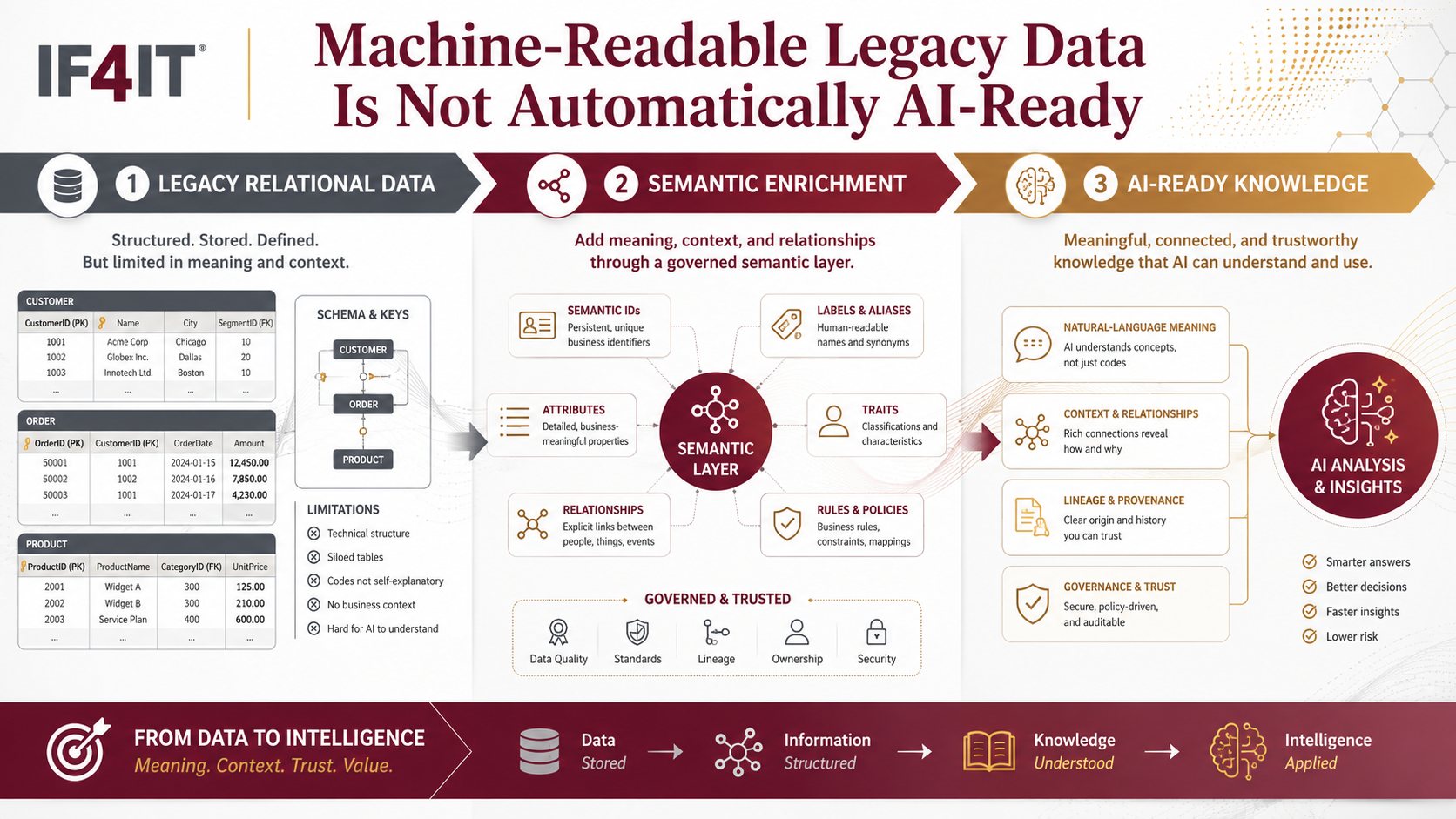
Executive Summary: Document Overview
IF4ITThe Bottom Line
Core Pillars & Document Modules
| Document Pillar / Focus Area | Strategic Business Outcome & Intent |
|---|---|
| Access vs. Understanding | Clarifies that machine readability, connectivity, and data movement do not automatically provide AI with durable meaning, context, or trust. |
| Semantic Layer and Semantic Instance Pattern | Shows how Semantic IDs, semantic attributes, semantic traits, semantic relationships, rules, and Semantic Instance Documents can turn legacy records into AI-usable knowledge. |
| Governance and Lifecycle Management | Frames AI-ready data as a maintained enterprise discipline involving lineage, refresh, drift management, validation, ownership, and evidence. |
Quick Q&A (Macro Executive Reference)
Question: Why is machine-readable legacy data not automatically AI-ready?
Question: What is the first practical step toward making legacy data AI-ready?
Read Full Article Below
Many enterprises are moving quickly to connect AI tools to databases, data warehouses, APIs, files, applications, and document repositories. That connectivity may be necessary, but it is not sufficient.
Just because AI can read data does not mean AI can understand it. AI works best when machine-readable data is enriched with natural-language meaning, context, relationships, and rules.
This distinction matters because much of the data enterprises want AI to use was never designed for AI. It was designed for applications, transactions, reporting, integrations, workflows, audits, and operational processing. It may be structured, machine-readable, and well managed inside its original system.
But that does not automatically make it ready for AI consumption.
Legacy relational data often depends on technical identifiers, table structures, column names, codes, abbreviations, foreign keys, and application logic that make sense to the systems and teams that created them. AI can ingest those structures, but ingestion is not interpretation. AI still needs to understand what the data represents, how one thing relates to another, what values mean, where the data came from, how current it is, and what rules govern its use.
Making legacy data AI-ready is therefore not just an integration problem. It is a semantic-readiness problem.
Machine-Readable Is Not the Same as Meaningful
Most legacy data is already machine-readable. Databases can be queried. Tables can be exported. Files can be parsed. APIs can be called. Reports can be generated. Data can be moved into warehouses, lakes, catalogs, indexes, and vector stores.
Those capabilities address access and movement.
AI-ready data requires more.
AI needs data that can be identified, interpreted, related, traversed, summarized, validated, governed, and explained. It needs to understand not only that a record exists, but what kind of thing the record represents. It needs to understand not only that two records are connected, but what that connection means.
A relational table may tell AI that `APP_ID = 10483`.
It may not tell AI that the value represents a revenue-critical customer-facing application, owned by a specific business capability, dependent on regulated data, supported by a third-party vendor, subject to availability requirements, and connected to downstream services.
That missing meaning is the gap between machine-readable data and AI-ready data.
Legacy Relational Data Was Designed for Systems
Relational data models are powerful. They organize data into tables, columns, rows, keys, constraints, and relationships. They help applications store and retrieve information consistently. They support reporting, transaction processing, and operational control.
But relational structure is not the same as semantic understanding.
A database may contain primary keys and foreign keys, but those keys often express technical joins rather than business meaning. A column may be named `status`, but the values in that field may mean different things in different systems. A code may be valid inside one application but meaningless outside it. A table name may reflect an old system design rather than the business object it now represents.
This problem is common in older environments, where years of system changes, acquisitions, integrations, workarounds, and local naming conventions have accumulated. Data may remain usable by applications while becoming difficult for people and AI to interpret outside its original context.
AI does not automatically solve that problem. In many cases, it exposes it.
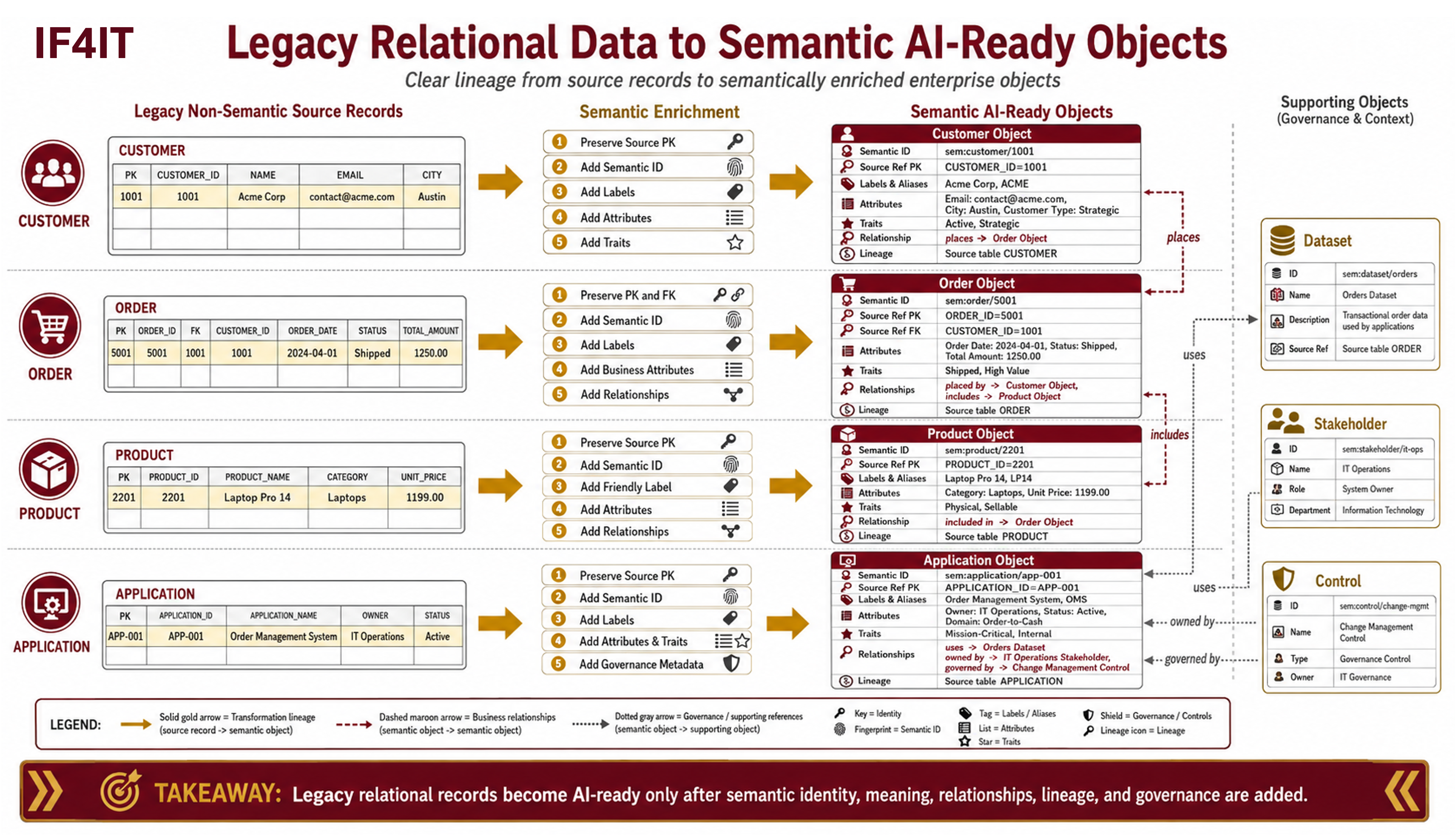
Figure: Example transformation of legacy relational source records into semantic AI-ready objects, showing preserved source keys, semantic IDs, attributes, traits, relationships, lineage, and governance context.
AI-Ready Data Needs a Semantic Layer
A practical way to close the gap is to introduce a governed Semantic Layer.
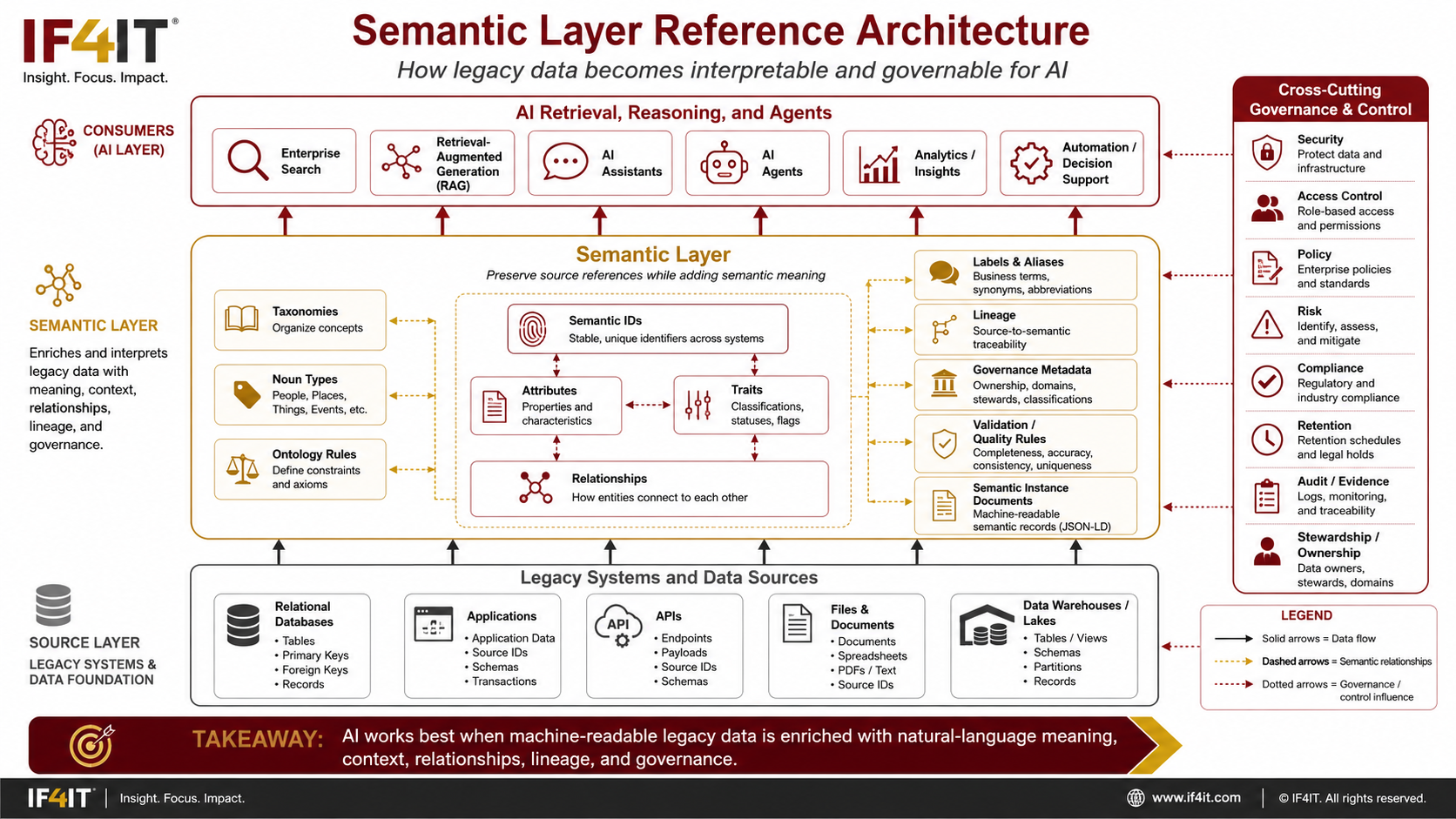
Figure: Semantic Layer reference architecture showing how legacy systems and data sources are enriched through taxonomies, ontology rules, semantic IDs, attributes, traits, relationships, lineage, and governance to support AI retrieval, reasoning, and agents.
A Semantic Layer adds meaning around legacy data. It helps define what the data represents, how it should be described, how it relates to other data, and what rules or constraints govern its use. It can include Taxonomies, Noun Types, Semantic IDs, Semantic Attributes, Semantic Traits, Semantic Relationships, predicates, descriptions, aliases, rules, and governance metadata.
The point is not to discard the legacy data model.
The point is to preserve what legacy systems need while adding the semantic meaning that AI needs.
Legacy identifiers, source keys, table structures, and system-specific fields should not be casually destroyed or replaced. They provide lineage, traceability, reconciliation, and operational continuity. But they should be complemented with semantic identifiers, semantic descriptions, and semantic relationships that make the data easier for AI and humans to understand.
The enterprise should not simply translate legacy data into another technical format. It should enrich legacy data with meaning.
What Makes Data AI-Ready?
AI-ready data is data that can be used responsibly and reliably by AI systems. At minimum, it needs several characteristics.
semantic identity, so AI can understand what a thing is and refer to it consistently across systems, inventories, models, documents, and workflows.
semantic attributes, so fields and values include definitions, examples, constraints, controlled vocabularies, and usage context.
semantic traits, so AI can understand meaningful characteristics such as type, role, lifecycle state, ownership, criticality, regulatory relevance, risk posture, or operational context.
semantic relationships, so AI can understand how things connect: applications to data, data to owners, owners to obligations, obligations to controls, controls to evidence, vendors to services, services to customers, and systems to risks.
lineage and source context, so AI can understand where data came from, when it was refreshed, how it was transformed, and how much confidence should be placed in it.
governance, so the data is maintained, validated, refreshed, secured, reviewed, and controlled according to its use, risk, sensitivity, and business importance.
Without these characteristics, AI may still produce answers, but the enterprise may not be able to trust, explain, validate, or govern those answers.
From Records to Semantic Instance Documents
One useful pattern is to package legacy records into Semantic Instance Documents.
A Semantic Instance Document is a semantically enriched representation of a real enterprise object or instance, such as a customer, product, application, service, vendor, contract, dataset, control, policy, or regulatory obligation.
Instead of exposing AI only to isolated rows, columns, and codes, a Semantic Instance Document can package an object with its identity, attributes, traits, relationships, lineage, source context, definitions, and governance metadata.
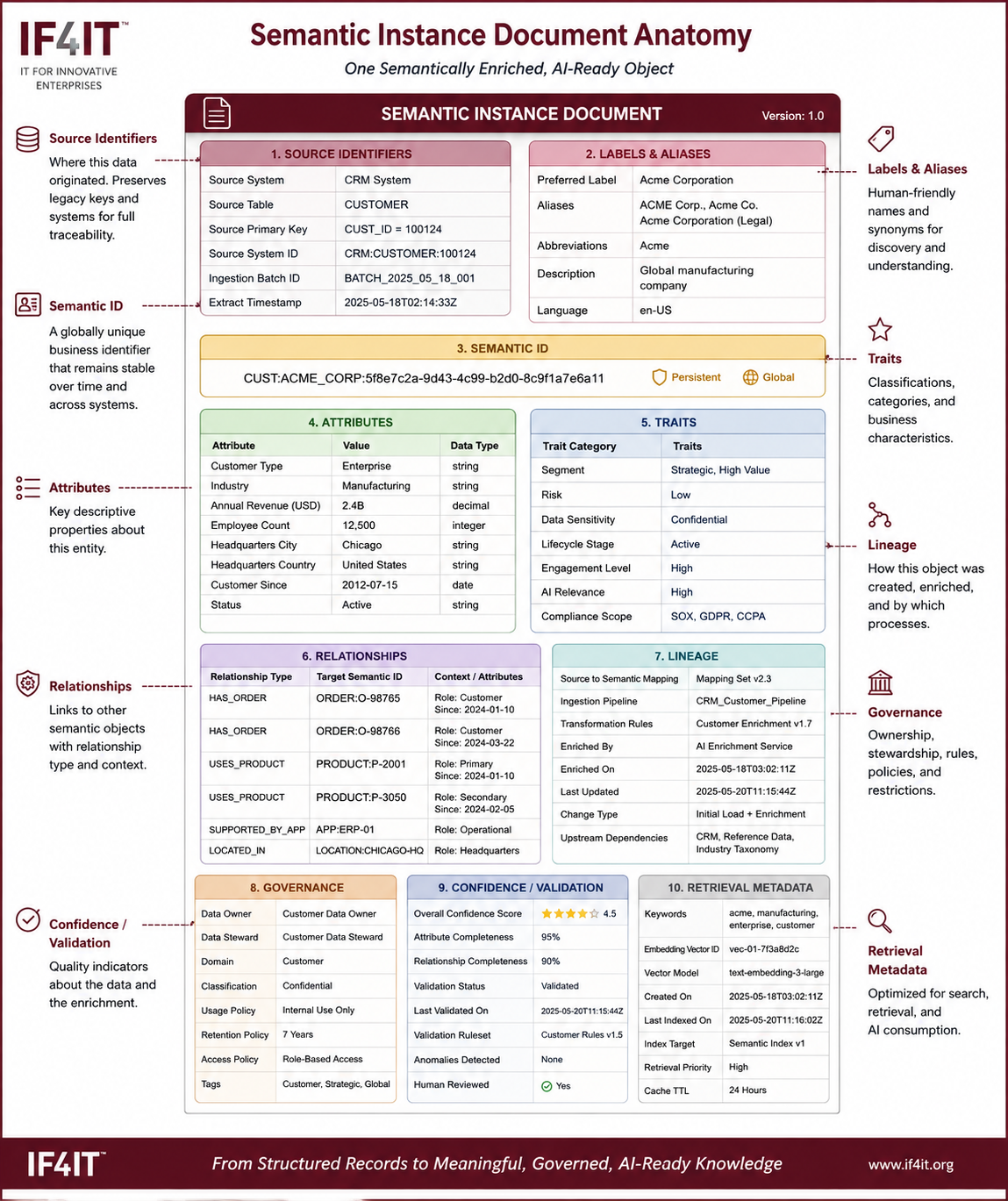
Figure: Anatomy of a Semantic Instance Document showing how one legacy record is enriched with source identifiers, semantic ID, labels, attributes, traits, relationships, lineage, governance, validation, and retrieval metadata for AI consumption.
This gives AI a more complete and interpretable unit of knowledge.
For example, instead of giving AI a raw application record, the enterprise can provide a semantically described application instance that explains what the application is, who owns it, what capabilities it supports, what data it uses, what vendors support it, what risks apply, what controls govern it, and what other enterprise objects it depends on.
That is more useful than simply exposing another table, export, or API response.
A Practical Conversion Path
Making legacy data semantic and AI-ready does not require every enterprise to rebuild every system. It does require discipline.
A practical path includes:
Preserving legacy identifiers and source-system traceability.
Defining the Semantic Layer and the meaning model AI should use.
Creating Semantic IDs for important enterprise objects.
Making attributes and traits semantic with definitions, context, constraints, and controlled meanings.
Creating semantic relationships using descriptive predicates.
Discovering relationships from foreign keys, shared values, lineage, integrations, documentation, and human knowledge.
Using ontologies and rules to govern semantic conversion.
Preparing Semantic Instance Documents for AI retrieval and reasoning.
Enriching, indexing, and publishing semantic representations for AI use.
Managing refresh, drift, lineage, validation, and governance over time.
This is not merely a data-engineering exercise. It is an enterprise information-management discipline.
AI Can Help, But It Must Be Governed
AI can help make legacy data semantic. It can analyze schemas, infer meanings, propose mappings, normalize values, identify possible relationships, generate descriptions, detect inconsistencies, and accelerate documentation.
But AI should not be treated as an uncontrolled authority.
AI-generated mappings, relationships, descriptions, and classifications still need review, validation, and governance. Human experts must confirm whether inferred meaning is correct, whether relationships are valid, whether sensitive data is handled properly, and whether semantic representations align with business reality.
The best pattern is not AI instead of governance.
The best pattern is AI accelerating semantic conversion under governance.
AI-Ready Data Must Be Maintained
Even after legacy data has been made semantic, the work is not finished.
Systems change. Ownership changes. Business capabilities change. Regulations change. Vendors change. Risks change. Controls change. Application portfolios change. Data quality changes. AI use cases change.
Semantic readiness must therefore be maintained.
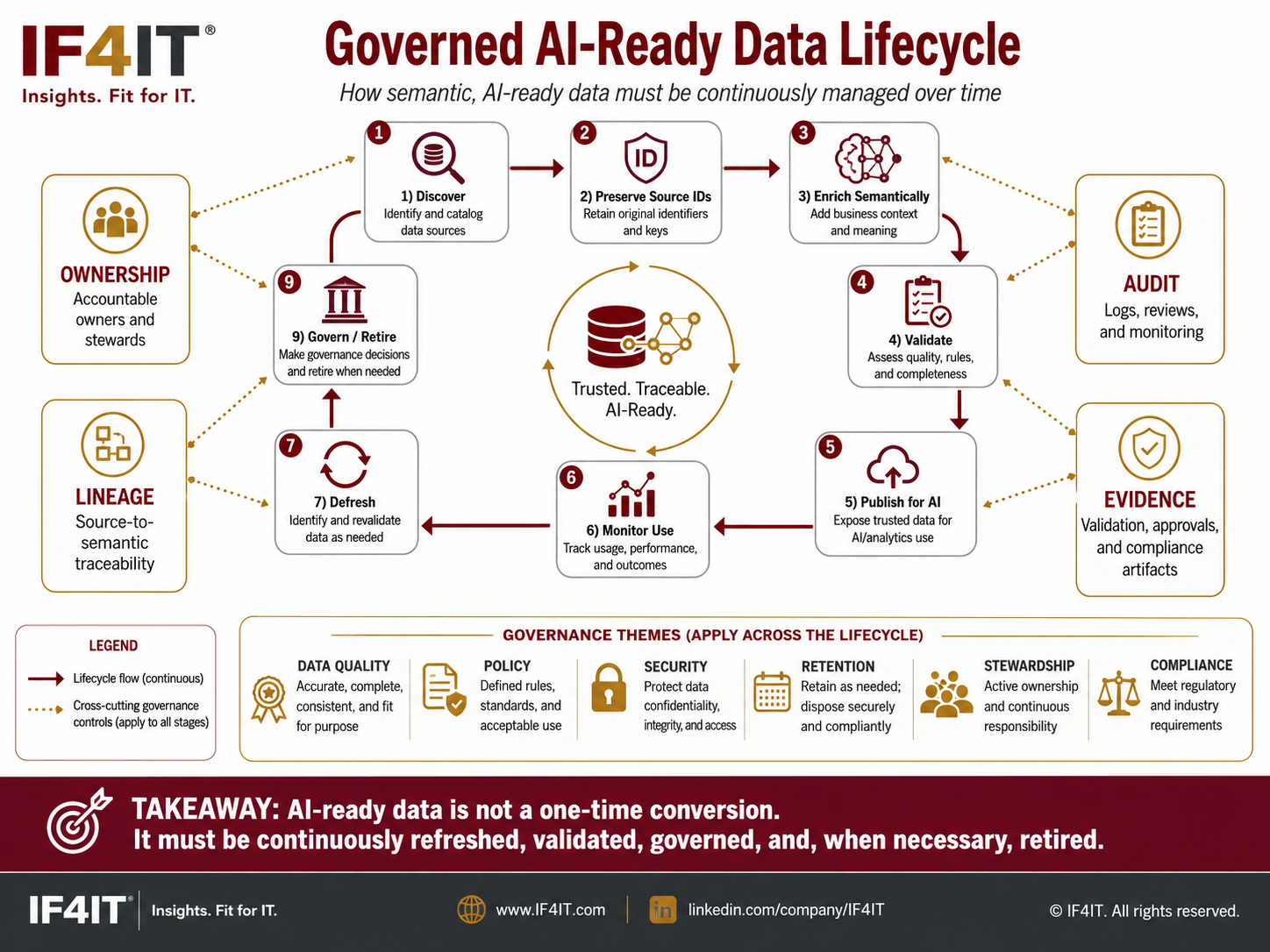
Figure: Governed AI-ready data lifecycle showing how semantic data is discovered, enriched, validated, published, monitored, refreshed, checked for drift, and governed or retired with ownership, lineage, audit, and evidence controls.
That means managing refresh cycles, monitoring drift, preserving lineage, validating relationships, reviewing ownership, correcting errors, retiring stale representations, and maintaining evidence that the data is governed.
AI-ready data can decay if it is not managed as a living asset.
The Real Goal
The goal is not simply to connect AI to more data.
The goal is to make legacy data understandable enough for AI to retrieve, interpret, traverse, reason over, and use responsibly.
That requires more than machine readability. It requires semantic identity, semantic meaning, semantic relationships, source context, lineage, and governance.
Enterprises that recognize this distinction will be better positioned to use AI effectively. Enterprises that ignore it may connect AI to more data while still struggling with unreliable answers, weak traceability, inconsistent interpretation, and poor governance.
Machine-readable legacy data is a starting point.
Semantic, governed, AI-ready data is the goal.
Learn More
Feedback, challenges, and suggestions are welcome from IT leaders, architects, data professionals, AI practitioners, and others working through these same issues.
Back to Articles PageHow to cite this page
When referencing this page in academic work, internal standards, or external publications, include the page title, IF4IT as author and publisher (The International Foundation for Information Technology (IF4IT), LLC), the URL, and your access date.
Example (informal web citation):
The International Foundation for Information Technology (IF4IT), LLC. Legacy Data That Is Machine-Readable Is Not Automatically AI-Ready. https://if4it.org/articles/2026-07-08-legacy-data-that-is-machine-readable-is-not-automatically-ai-ready/ (accessed 2026-07-17).
See About Us for content governance and site-wide citation guidance.