Making Legacy Data AI-Ready Is Knowledge Debt Remediation
Executive Summary: Article Overview
IF4ITThe Bottom Line
Core Article Pillars
| Article Pillar / Focus Area | Strategic Business Outcome & Intent |
|---|---|
| Knowledge Debt Recognition | Makes hidden, fragmented, outdated, inconsistent, inaccessible, or poorly governed enterprise meaning visible as a governed liability that can be assessed, prioritized, funded, and remediated. |
| Semantic Conversion as Remediation | Converts opaque legacy identifiers, fields, codes, relationships, rules, and context into explicit, traceable, governed knowledge that AI can retrieve, interpret, traverse, and use responsibly. |
| Multidisciplinary Operating Model | Unites Business Analysis, domain expertise, architecture, Knowledge Management, governance, engineering, and AI roles so semantic decisions are evidence-based, approved, implementable, and accountable. |
| AI-Friendly Design and Prevention | Prevents new Knowledge Debt by making semantic clarity, lineage, ownership, explicit relationships, and governed meaning upstream requirements for future systems and data. |
| Continuous Validation and Governance | Keeps remediated meaning current, trustworthy, authorized, and aligned with source data, business change, AI use, regulatory obligations, and evolving enterprise context. |
Quick Q&A (Macro Executive Reference)
Question: Why is making legacy data AI-ready a form of Knowledge Debt remediation?
Question: What does legacy-data semantic conversion produce?
Question: Which capabilities are required to remediate Knowledge Debt in legacy data?
Read Full Article Below
Making Legacy Data AI-Ready Is Knowledge Debt Remediation
Enterprises are moving quickly toward Artificial Intelligence (AI). They want AI to analyze information, answer questions, summarize complex topics, automate decisions, assist workers, improve services, detect risks, accelerate delivery, and uncover new opportunities.
But many enterprises are discovering a hard truth:
AI cannot reliably reason over enterprise knowledge that the enterprise itself has not made explicit.
Legacy data may be available in databases, files, applications, reports, Application Programming Interfaces (APIs), data warehouses, data lakes, and document repositories. It may be structured. It may be accessible. It may be machine-readable.
But machine-readable is not the same as AI-ready.
Making legacy data AI-ready is not just about moving, indexing, or exposing data. It requires legacy-data semantic conversion: reconstructing and governing the meaning hidden in identifiers, fields, codes, relationships, rules, lineage, and source-system context.
Legacy-data semantic conversion is Knowledge Debt remediation.
That remediation requires intimate knowledge of the legacy data, its data model, its source-system context, and what its tables, fields, codes, relationships, rules, and values actually mean.
For example, a legacy table attribute named CSTR may be perfectly valid inside a legacy application. A query can retrieve it. A report can display it. An interface can move it. But AI cannot reliably know whether CSTR means customer, customer segment, customer status reason, cost center, or something else unless that meaning is explicitly defined and governed.
Someone must know what CSTR means in that specific system and expose the intended meaning to AI through semantic labels, definitions, aliases, relationships, lineage, interpretation rules, discovery rules, governance rules, and usage controls.
The challenge is therefore not merely technical. It is a Knowledge Management obligation because the missing asset is explicit, governed enterprise meaning.
Machine-Readable Legacy Data Is Not Automatically AI-Ready
Most legacy data was not designed for AI.
It was designed for applications, transactions, reporting, storage, integration, compliance, operational control, and business processing. Codes, keys, table structures, field names, relationships, and application logic helped systems perform specific functions.
But AI requires more than technical access to data.
A table may store customers, applications, contracts, products, vendors, services, assets, incidents, claims, transactions, or regulatory obligations. But the meaning of those records may still be unclear.
A field named CTR may mean customer, counter, center, contract, control, or something else depending on the system. A code such as P1443XS3 or 4446233 may be meaningful inside one application but meaningless outside it. A foreign key may define a technical join without explaining the business relationship. A status value may carry different meanings across systems.
The data exist but the meaning may not.
That is the gap AI exposes.
Enterprises may have data that systems can process, but not enough explicit knowledge for AI to retrieve, interpret, traverse, reason over, and use responsibly.
AI-Ready Data Does Not Mean Everything Becomes Prose
AI-ready data does not require everything to become literal natural-language text.
Modern AI can consume structured data, graphs, JavaScript Object Notation (JSON), Resource Description Framework (RDF), vectors, documents, APIs, and many other representations. The issue is not whether the data is stored as text. The issue is whether the data carries enough explicit meaning, identity, context, relationships, lineage, rules, and governance for AI to interpret and use it reliably.
A semantic representation may include natural-language definitions, structured metadata, Ontologies, taxonomies, graph relationships, labels, aliases, controlled vocabularies, lineage records, semantic rules, governance metadata, embeddings, or retrieval-ready documents.
The goal is not to turn all enterprise data into prose.
The goal is to make enterprise data semantic enough for AI to understand what it represents, how it relates to other data, where it came from, how much it can be trusted, and how it should be used.
Knowledge Debt Is Different from Technical Debt
In Information Technology (IT), most leaders understand Technical Debt, but Knowledge Debt is a different liability.
Technical Debt is the backlog of structural, design, code, architecture, infrastructure, data, documentation, or operational weaknesses that must eventually be remediated because they increase the cost, risk, complexity, or delay of changing and operating systems.
Knowledge Debt is the backlog of missing, hidden, fragmented, implicit, outdated, inconsistent, inaccessible, or poorly governed enterprise meaning and know-how that must eventually be remediated because it increases cost, risk, complexity, delay, misunderstanding, and poor decision-making.
Technical Debt makes systems harder, riskier, or more expensive to change and operate.
Knowledge Debt makes enterprise meaning harder to discover, interpret, validate, transfer, govern, and use by people, systems, and AI.
The two forms of debt can overlap—for example, inadequate documentation may contribute to both—but they are not interchangeable. Technical Debt concerns weaknesses in how systems are designed, built, or operated; Knowledge Debt concerns weaknesses in how enterprise meaning and know-how are made explicit, trustworthy, accessible, and reusable.
Legacy data carries Knowledge Debt when its meaning depends on opaque identifiers, compressed field names, undocumented codes, implicit relationships, hidden business rules, uncertain authority, incomplete lineage, obsolete documentation, or the memory of long-tenured employees.
AI does not create that debt. It exposes it because reliable retrieval, reasoning, automation, and decision support require meaning that is explicit, contextual, traceable, validated, and governed.
When an enterprise reconstructs and governs that meaning, legacy-data semantic conversion pays down Knowledge Debt. When the work is deferred, the debt remains outstanding and may grow as systems change, documentation drifts, and knowledgeable people leave.
Semantic Conversion Is Knowledge Debt Remediation
Every legacy data asset that an enterprise expects AI to retrieve, interpret, or reason over carries a choice: remediate the hidden meaning that makes it unreliable, or allow that meaning to remain part of the enterprise’s Knowledge Debt.
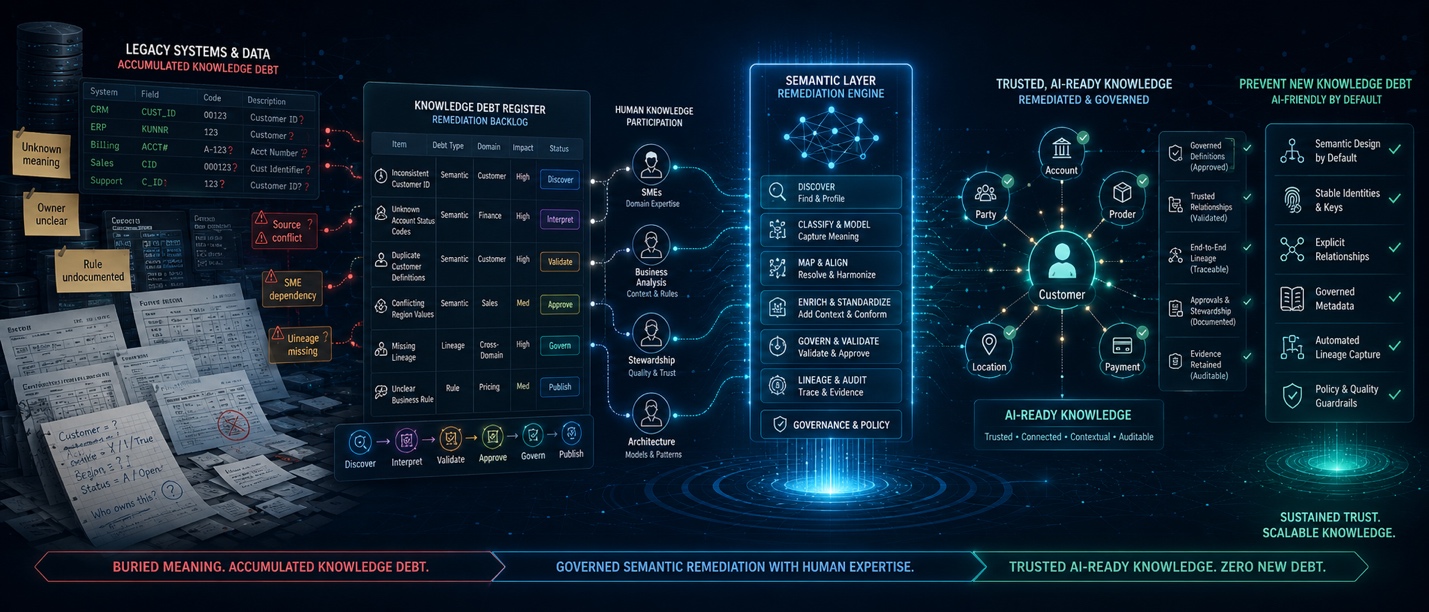
Legacy-data semantic conversion pays down that debt by making identity, meaning, context, relationships, lineage, rules, authority, and governance explicit. Each activity addresses a specific form of Knowledge Debt:
Preserve legacy identifiers and source-system traceability. This remediates provenance debt by retaining the evidence needed to connect every semantic representation to its original system, table, field, key, value, and transformation history.
Define the Semantic Layer and the meaning model AI should use. This remediates interpretation debt by establishing the concepts, definitions, boundaries, and approved meanings through which AI should understand the domain.
Create Semantic IDs for important enterprise objects. This remediates identity debt by giving customers, products, applications, contracts, services, assets, and other objects stable identities that can be recognized across systems.
Make attributes and traits semantic. This remediates definition and context debt by attaching clear labels, aliases, descriptions, constraints, controlled values, and usage context to otherwise opaque fields and codes.
Create Semantic Relationships using descriptive predicates. This remediates relationship debt by replacing unexplained joins and keys with explicit statements about how enterprise objects are connected and what those connections mean.
Discover and corroborate hidden relationships. This remediates undocumented-knowledge debt by triangulating foreign keys, shared values, lineage, integrations, documentation, reports, application behavior, and human expertise rather than relying on a single source.
Use Ontologies and semantic rules to govern conversion. This remediates inconsistency and ambiguity debt by defining approved concepts, predicates, mappings, constraints, inference patterns, and interpretation rules.
Prepare Semantic Instance Documents and other AI-usable representations. This remediates accessibility and retrieval debt by packaging governed meaning in forms that AI systems can find, ground, traverse, and reason over.
Enrich, index, and publish semantic knowledge for controlled use. This remediates discoverability and reuse debt by making approved semantic representations available through governed indexes, graphs, APIs, metadata services, or retrieval mechanisms.
Manage refresh, drift, validation, access, lineage, and governance over time. This remediates obsolescence and trust debt by keeping semantic meaning current, reviewable, traceable, authorized, and aligned with changing systems and business practices.
The result is not merely transformed data. It is governed enterprise knowledge whose meaning can be examined, validated, traced, reused, and maintained by people, systems, and AI.
That is why making legacy data semantic and AI-ready is a knowledge transformation—and why legacy-data semantic conversion is Knowledge Debt remediation.
The transformation is complete only when the remediated meaning is accepted by accountable human authorities, supported by retained evidence, and governed through its operating life.
This Is Not Just a Data-Engineering Problem
Data engineering is necessary, but it is not sufficient.
Data engineers can move data, transform data, expose data, pipeline data, index data, and prepare data for processing. Those activities matter. But making data AI-ready also requires reconstructing enterprise meaning.
The harder questions are often not purely technical:
What does this field actually mean? Which source is authoritative? Which codes are current, obsolete, local, overloaded, or misused? Which relationships are business relationships and which are only technical joins? Which reports are trusted? Which rules are hidden in application logic or Extract, Transform, Load (ETL) pipelines? Which interpretations are safe for AI to use? Which uses should be allowed or restricted? Which semantic representations require human approval?
These are Knowledge Management questions.
They require governance, stewardship, domain expertise, semantic modeling, enterprise architecture, data architecture, information architecture, business ownership, and Business Analysis.
Making legacy data AI-ready is therefore not merely data engineering. It is Knowledge Debt remediation.
Business Analysis Is Central, but Knowledge Debt Remediation Requires a Multidisciplinary Operating Model
Business Analysis is central because semantic conversion begins with discovering and clarifying enterprise meaning.
Business Analysts elicit definitions, rules, mappings, exceptions, ownership, source authority, lineage, and intended use. They translate what domain experts and legacy systems know into requirements and semantic specifications that architects, governance teams, engineers, and AI practitioners can implement and test.
A Data Business Analyst, Business Systems Analyst, or Information/Data Requirements Analyst may therefore be one of the most important roles in making legacy data AI-ready. These roles operate at the intersection of business meaning, system behavior, data structures, process flows, stakeholder needs, and implementation constraints.
However, Business Analysis cannot independently declare reconstructed meaning authoritative. Knowledge Debt remediation requires a multidisciplinary operating model with explicit responsibilities, decision rights, evidence standards, approvals, and controls.
The Operating Model Requires Distinct but Coordinated Responsibilities
Domain Subject Matter Experts (SMEs), business owners, system owners, data stewards, operations experts, and long-tenured practitioners contribute source knowledge. They explain why data exists, what fields and codes mean, which exceptions are legitimate, which reports are trusted, where business rules are hidden, and how meaning varies across systems or contexts.
Business Analysis structures that knowledge. Analysts document definitions, aliases, mappings, rules, exceptions, unresolved questions, acceptance criteria, and source-to-semantic traceability so that meaning can be reviewed and implemented rather than remaining informal or person-dependent.
Data Architecture aligns source structures, keys, mappings, lineage, transformations, and source-to-target patterns. Information Architecture organizes metadata, taxonomies, controlled vocabularies, findability, and semantic navigation.
Ontology and semantic modeling define concepts, Semantic IDs, attributes, traits, relationships, predicates, constraints, and meaning models. Knowledge Management captures, preserves, connects, and reuses institutional knowledge and the evidence supporting semantic decisions.
Data Governance establishes ownership, stewardship, approval authority, policy, access, accountability, and trust. Enterprise Architecture aligns semantic remediation with enterprise models, capabilities, processes, applications, information assets, and strategic priorities.
Engineering implements mappings, pipelines, metadata, graph structures, APIs, Semantic Instance Documents, retrieval indexes, controls, refresh mechanisms, and monitoring. AI Architecture determines how governed semantic knowledge will be grounded, retrieved, indexed, vectorized, traversed, tested, and consumed by AI systems.
Semantic Authority Must Be Explicit
The people who know a legacy system best are essential sources of evidence, but familiarity alone does not make every interpretation authoritative. The operating model must identify who may propose meaning, who must review it, who can approve it, who implements it, and who remains accountable after publication.
Semantic authority may reside with a business owner, data owner, designated steward, governance body, or another accountable role appropriate to the domain. The authority should be recorded with the approved definition, scope, source evidence, effective date, and known limitations.
When sources conflict, the enterprise should not silently choose the most convenient interpretation. Conflicts should be documented, escalated to the appropriate authority, resolved where possible, and retained as evidence of why the approved meaning was selected.
Meaning Should Be Triangulated from Evidence
Knowledge Debt remediation should not rely on a single interview, schema, report, or document when the meaning is material. Reconstructed meaning should be triangulated across multiple evidence sources whenever practical.
Evidence may include database schemas, data profiles, code values, application logic, stored procedures, ETL pipelines, integration mappings, reports, policies, procedures, tickets, historical documentation, production behavior, lineage records, and interviews with domain and system experts.
The semantic record should preserve the evidence used, the interpretation reached, assumptions made, conflicts found, confidence level, validation performed, and approval obtained. Retained evidence makes future review, audit, correction, and revalidation possible.
Separation of Duties Reduces Semantic Risk
The same person or team should not automatically discover, approve, implement, and validate high-impact semantic meaning without independent review. Separating these duties reduces confirmation bias, undocumented assumptions, implementation errors, and the risk that a technically convenient interpretation becomes an enterprise fact.
A practical pattern is for analysts and domain experts to propose meaning, accountable owners or stewards to approve it, architects and engineers to implement it, and independent reviewers or testers to validate both the semantic representation and representative AI outcomes.
The rigor should be proportional to risk. Low-impact reference data may need lightweight review, while regulated, safety-critical, financially material, or decision-driving data may require formal governance, documented approvals, controlled testing, and periodic revalidation.
The Work Requires Three Complementary Capabilities
First, enterprises need people who understand the legacy data and the business context in which it is created and used.
Second, enterprises need people who can convert opaque data into explicit, governed semantic knowledge using Business Analysis, Knowledge Management, architecture, Ontology, taxonomy, semantic modeling, governance, and engineering.
Third, enterprises need people who can design future systems and data to be semantic and AI-friendly by default so the enterprise does not continually recreate the same Knowledge Debt.
These capabilities must operate as one governed remediation system. Source knowledge without semantic methods remains implicit; semantic models without domain evidence become guesswork; implementation without approval creates unmanaged meaning; and remediation without AI-friendly design allows new Knowledge Debt to accumulate.
AI-Friendly Design Prevents New Knowledge Debt
Semantic conversion and AI-friendly design address related but different obligations. Legacy-data semantic conversion remediates Knowledge Debt that already exists; semantic and AI-friendly design prevents new Knowledge Debt from being created as systems and data change.
Historically, systems optimized data for application processing, transaction efficiency, relational integrity, storage, reporting, integration, compliance, and operational control. Those requirements remain essential, but they are no longer sufficient when enterprise data must also support trustworthy AI retrieval, reasoning, decision support, and automation.
Prevention requires important meaning to be captured when data is designed, created, integrated, and changed. Systems should preserve durable business names and definitions, stable identities, explicit relationships, controlled vocabularies, source provenance, lineage, ownership, authoritative-source designations, interpretation rules, access constraints, and lifecycle responsibilities.
These semantic requirements should be built into architecture standards, data models, schemas, Application Programming Interface contracts, event definitions, metadata, documentation, integration mappings, development practices, and acceptance criteria. They should not be treated as optional enrichment that another team must reconstruct years later.
AI-friendly design does not mean replacing efficient technical structures with prose or designing every system around a particular AI model. It means preserving the structures applications need while exposing a governed semantic contract that people, systems, and AI can interpret consistently and trace back to authoritative evidence.
A future system should not force the enterprise to rediscover what CSTR means after the experts, documentation, and original design context are gone. By making meaning explicit at the point of design and maintaining it through change, enterprises prevent new Knowledge Debt while reducing the future cost of making data AI-ready.
Recommended Lifecycle for Remediating AI-Specific Knowledge Debt
Enterprises do not need to convert all legacy data at once. They need a governed lifecycle that turns a large, ambiguous liability into prioritized, bounded, testable remediation work.
A practical Knowledge Debt remediation lifecycle includes the following steps:
1. Select and bound the domain
Choose a legacy-data domain where AI use would create meaningful value or where incorrect retrieval, reasoning, automation, or decision support would create material risk. Define the systems, data assets, business processes, use cases, stakeholders, and exclusions that establish the initial boundary.
2. Assess the Knowledge Debt and AI risk
Evaluate where meaning is missing, hidden, fragmented, outdated, inconsistent, inaccessible, weakly governed, or dependent on key individuals. Identify the consequences for AI reliability, compliance, operations, customer outcomes, financial decisions, safety, and enterprise trust.
3. Register the remediation backlog
Record material findings in a governed Knowledge Debt Register or equivalent backlog. Each item should identify the affected data, the missing or unreliable meaning, supporting evidence, accountable owner, impacted AI use cases, risk, dependencies, and current disposition.
4. Prioritize by value, risk, and dependency
Sequence remediation according to expected business value, potential harm, regulatory or contractual exposure, reuse across AI use cases, data criticality, dependency chains, and the availability of authoritative experts and evidence. Not all debt deserves equal urgency.
5. Inventory and triangulate source knowledge
Identify systems, tables, fields, codes, reports, integrations, business rules, owners, SMEs, documentation, lineage, production behavior, and known data-quality issues. Corroborate important meanings across multiple evidence sources rather than relying on one interview, document, schema, or report.
6. Define bounded work packages and acceptance criteria
Break the backlog into manageable semantic-conversion work packages with explicit scope, deliverables, responsible roles, dependencies, review points, and completion criteria. Acceptance criteria should state how meaning, identity, relationships, rules, lineage, governance, and representative AI behavior will be validated.
7. Preserve source traceability and evidence
Retain source-system names, tables, columns, keys, values, timestamps, transformations, ownership, assumptions, conflicts, confidence levels, and approval records so every semantic representation can be traced to its origin and the reasoning behind it.
8. Define and implement semantic meaning
Create and govern labels, aliases, definitions, controlled terms, Semantic IDs, attributes, traits, Semantic Relationships, mappings, Ontologies, and interpretation rules. These constructs should resolve the specific forms of Knowledge Debt identified in the work package rather than merely add descriptive metadata.
9. Package and publish for governed AI use
Expose approved meaning through fit-for-purpose representations such as semantic metadata layers, Ontologies, taxonomies, knowledge graphs, RDF, JavaScript Object Notation for Linked Data (JSON-LD), APIs, Semantic Instance Documents, vectorized documents, or retrieval-ready indexes. Publication should preserve lineage, authorization, and intended-use constraints.
10. Validate, approve, and retain results
Have domain owners, stewards, Business Analysts, architects, engineers, and independent reviewers test meanings, mappings, relationships, rules, access controls, and representative AI outputs. Retain the evidence, test results, exceptions, approvals, and rejected interpretations needed to demonstrate why the semantic representation is trustworthy enough for its intended use.
11. Treat residual risk and reassess continuously
Document unresolved ambiguity, unavailable evidence, accepted exceptions, restricted uses, compensating controls, and deferred work. Monitor usage, source changes, model behavior, semantic drift, ownership changes, incidents, and regulatory obligations so completed items can be revalidated and new Knowledge Debt can be added to the backlog.
This lifecycle treats semantic conversion as governed debt remediation rather than an open-ended data-enrichment program. Work is complete only when the required meaning is explicit, traceable, validated, approved, usable for the intended AI purpose, and supported by retained evidence.
The goal is not to boil the ocean but to reduce Knowledge Debt through a repeatable sequence of bounded work packages while continuously reassessing what remains.
AI Turns Localized Knowledge Debt into an Enterprise-Scale Problem
Enterprises have always incurred Knowledge Debt when critical knowledge remains concentrated in a few people.
A senior developer retires. A database administrator moves on. A Business Analyst leaves. A system owner changes roles. A long-tenured operations expert departs.
Historically, this kind of loss was often painful but bounded. It might affect one system, application, process, domain, team, product, or service. New people could reverse engineer the missing knowledge over time. Work might slow down. Risk might increase. Projects might take longer. But the problem was usually scoped.
AI changes the scale because enterprise AI often depends on meaning distributed across many systems, domains, processes, data structures, rules, and decades of institutional history.
What was once localized knowledge loss can therefore become an enterprise-wide constraint on retrieval, reasoning, decision support, and automation.
Historical Precedents Show Why Semantic Remediation Matters
Earlier enterprise remediations show a consistent pattern: technology initiatives expose hidden knowledge dependencies, and technical change succeeds only when enterprises reconstruct and govern the meaning needed to execute it safely.
During Year 2000 (Y2K) remediation, enterprises had to find embedded date logic, determine how it affected business processes, correct systems and data, test outcomes, and retain evidence that critical operations would continue.
The technical defect was date handling, but remediation depended on discovering where the relevant knowledge lived, who understood it, which interpretations were authoritative, and how corrected behavior would be validated.
Enterprise search exposed a related lesson. Access to documents and records did not produce trustworthy knowledge when metadata, taxonomy, ownership, permissions, terminology, freshness, and content quality were weak.
Many enterprises tolerated poor search because the cost of semantic and governance remediation appeared greater than the immediate return.
AI changes that calculation because it uses enterprise meaning not only to find information, but also to synthesize, recommend, reason, decide, and automate.
Unremediated Knowledge Debt can therefore produce weak retrieval, incorrect conclusions, unsafe automation, regulatory exposure, and low trust at enterprise scale.
The lesson from both precedents is narrow but important: connecting a new technology to existing information does not eliminate hidden knowledge problems. The required meaning must be made explicit, validated, governed, and maintained.
AI Is a Force Multiplier Only When Enterprise Meaning Is Ready
Force-multiplier technologies increase the scale, speed, reach, or economics of work, but their value depends on the readiness of the environment in which they operate.
| Technology Force Multiplier | Readiness It Required | Lesson for AI and Knowledge Debt |
|---|---|---|
| Automated transportation | Routes, distribution networks, standards, and operating coordination. | The multiplier produced advantage where supporting systems and knowledge were ready. |
| Electrification | Redesigned equipment, facilities, processes, and work practices. | Access to the technology alone did not create value; enterprises had to adapt how work was designed. |
| The internet | Digital content, connectivity, usable information structures, and new operating models. | Reach expanded when information could be found, understood, trusted, and used. |
| Cloud computing | Applications, security, automation, governance, and operating models suited to elastic infrastructure. | Infrastructure flexibility created value only when enterprises redesigned for it. |
| Enterprise AI | Semantic, governed, traceable, current, and AI-ready enterprise knowledge. | AI can compound value when meaning is explicit and trustworthy; otherwise it can compound Knowledge Debt and risk. |
Transportation required usable routes and distribution networks; electrification required redesigned equipment and operations; the internet required digital content and connectivity; cloud computing required applications and operating models that could exploit elastic infrastructure.
Enterprise AI has the same dependency. It can multiply analysis, synthesis, classification, reasoning, decision support, monitoring, and automation only when the data it uses carries explicit, governed, trustworthy meaning.
AI can multiply well-structured enterprise knowledge, but it can also multiply ambiguity, inconsistency, outdated interpretation, and ungoverned assumptions.
Semantic conversion is therefore what turns legacy data from a constraint into a usable AI asset: it remediates the Knowledge Debt that would otherwise limit or distort the multiplier.
Conclusion: Making Legacy Data AI-Ready Is Knowledge Debt Remediation
Making legacy data AI-ready is not simply a matter of connecting AI to more databases, files, applications, reports, or repositories. It is the governed work of reconstructing and making explicit the enterprise meaning that legacy systems were never designed to expose.
That work addresses Knowledge Debt embedded in opaque identifiers, compressed field names, undocumented codes, implicit relationships, hidden rules, uncertain authority, incomplete lineage, obsolete documentation, and human memory. Semantic conversion remediates that debt by turning hidden or unreliable meaning into traceable, validated, approved, and governed knowledge.
The operational equation is direct: legacy-data semantic conversion is Knowledge Debt remediation.
Data engineering remains essential, but it cannot determine authoritative business meaning by itself. Effective remediation requires a multidisciplinary operating model in which domain experts, Business Analysts, architects, Knowledge Management and Data Governance practitioners, engineers, and AI specialists discover, corroborate, approve, implement, test, and maintain semantic meaning.
Enterprises should therefore treat Knowledge Debt as a managed backlog rather than an informal documentation problem. They should identify and prioritize debt, execute bounded remediation work packages, define acceptance criteria, retain evidence, validate representative AI behavior, document residual risk, and reassess meaning as systems, data, policies, and business conditions change.
The same lesson applies to future design. Semantic and AI-friendly systems prevent new Knowledge Debt by making identity, definitions, relationships, lineage, ownership, interpretation rules, and usage constraints explicit from the start.
AI did not create the hidden meaning problems in legacy data. It made their cost, risk, and strategic importance impossible to ignore.
Enterprises that remediate Knowledge Debt can convert legacy data into governed AI-ready knowledge and build a stronger foundation for trustworthy reasoning, retrieval, decision support, and automation. Enterprises that continue to leave meaning implicit will constrain the value of AI and compound the very debt that AI has exposed.
Learn More
Back to Articles PageHow to cite this page
When referencing this page in academic work, internal standards, or external publications, include the page title, IF4IT as author and publisher (The International Foundation for Information Technology (IF4IT), LLC), the URL, and your access date.
Example (informal web citation):
The International Foundation for Information Technology (IF4IT), LLC. Making Legacy Data AI-Ready Is Knowledge Debt Remediation. https://if4it.org/articles/2026-07-11-ai-exposes-legacy-data-knowledge-debt-that-cannot-be-ignored/ (accessed 2026-09-11).
See About Us for content governance and site-wide citation guidance.