AI Agents Inventory vs. Registry vs. Catalog: What's the Difference?
Executive Summary: Article Overview
IF4ITThe Bottom Line
Core Article Pillars
| Article Pillar / Focus Area | Strategic Business Outcome & Intent |
|---|---|
| Inventory and Registry as Synonyms | Establishes that an AI Agents Inventory and an AI Agents Registry are the same governed system of record, removing a common source of terminology confusion. |
| The Catalog as a Facade | Clarifies that an AI Agents Catalog is a self-service view built on top of a mature inventory, not a system of record and not a starting point. |
| Inventory Before Catalog | Frames the correct sequence, governing from the inventory first and exposing a catalog only once the inventory is mature, so enterprises invest in the right order. |
Quick Q&A (Macro Executive Reference)
Question: Is an AI Agents Inventory the same as an AI Agents Registry?
Question: How is an AI Agents Catalog different?
Question: Which one should an enterprise build first?
Read Full Article Below
AI Agents Inventory vs. Registry vs. Catalog: What’s the Difference?
The terms AI Agents Inventory, AI Agents Registry, and AI Agents Catalog are often used as if they were interchangeable. Two of them are. One of them is not, and the difference matters for how an enterprise governs its AI agents.
This is a short, practical guide to what each term means, how they relate, and when to use which.
AI Agents Inventory and AI Agents Registry Are the Same Thing
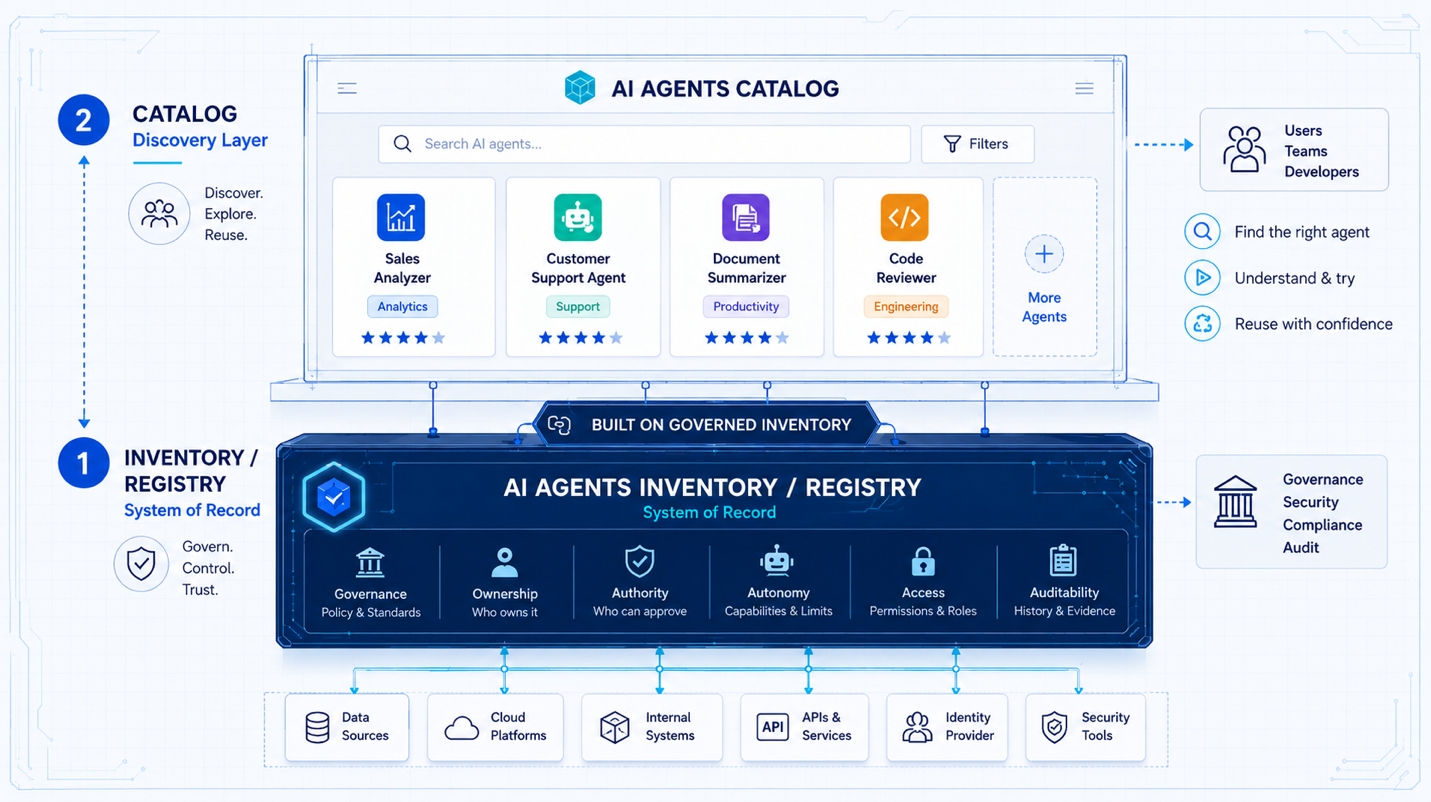
An AI Agents Inventory is a governed record of the AI agents an enterprise has: each agent, who owns it, what it is permitted to do, how autonomous it is, and which systems and data it can reach. It is the authoritative system of record for the enterprise’s AI agents.
An AI Agents Registry is the same thing. The two terms are used interchangeably across the industry. Registry is the word many teams reach for first, especially those coming from a security or identity background, while inventory is the word used across the broader discipline of governing enterprise assets. The word changes; the discipline does not.
What makes either one real is not the label but the governance behind it. A genuine inventory, or registry, is not merely a list of agents that exist. It is a governed record in which every agent has a named owner, a defined scope of authority, and traceable relationships to the models, data, and systems it touches.
An AI Agents Catalog Is Something Different
An AI Agents Catalog is not a synonym for the inventory. It is a consumable, self-service view built on top of one.
Where the inventory exists to govern agents — to record, own, assess, and control them — the catalog exists to help people find and use agents. A catalog presents agents in a browsable, requestable form for the teams that want to reuse them, in much the same way a service catalog presents services to the people who need them.
The key point is the direction of dependence. The catalog is a facade over the governed inventory. It shows a curated, user-friendly slice of what the inventory already contains. It is not a system of record, it does not replace the inventory, and it cannot exist meaningfully without a governed inventory beneath it.
Why the Order Matters
Because the catalog depends on the inventory, the sequence is not a matter of preference. The inventory comes first.
An enterprise that tries to build a catalog without a governed inventory beneath it ends up with a directory of agents it cannot actually account for — a storefront with no stockroom behind it. The catalog looks helpful, but the ownership, authority, and reach that make an agent governable are missing, because those live in the inventory the enterprise skipped.
The right sequence is to establish the inventory first, mature it until the records are trustworthy, and only then build a catalog on top to make those governed agents easy to discover and reuse. You govern from the inventory. You shop from the catalog. The catalog is a reward for having done the inventory work, not a shortcut around it.
When to Use Each
Use the inventory, or registry, when the goal is governance: knowing what agents exist, assigning ownership, assessing risk, controlling authority and access, and retiring agents that should no longer run. This is the foundation every other AI governance control depends on.
Use the catalog when the goal is consumption: helping teams discover, understand, and reuse the agents the enterprise already governs, without each team rediscovering or rebuilding what already exists. The catalog turns a governed inventory into something the wider organization can use safely.
Most enterprises need both eventually, but they need them in order. The inventory is the system of record and the starting point. The catalog is the consumable view and the later addition.
Learn More
For the full treatment of how the AI Agents Inventory, the AI Agents Registry, and the AI Agents Catalog relate, including the attributes that make an inventory governable, see the IF4IT AI Agents Inventory and Attributes document, and in particular its chapter Understand the AI Agents Inventory, the AI Agents Registry, and the AI Agents Catalog.
AI Agents Inventory and Attributes
Enterprise AI Governance Best Practices
Enterprise Inventory Management Best Practices
Back to Articles PageHow to cite this page
When referencing this page in academic work, internal standards, or external publications, include the page title, IF4IT as author and publisher (The International Foundation for Information Technology (IF4IT), LLC), the URL, and your access date.
Example (informal web citation):
The International Foundation for Information Technology (IF4IT), LLC. AI Agents Inventory vs. Registry vs. Catalog: What's the Difference?. https://if4it.org/articles/2026-07-21-ai-agents-inventory-vs-registry-catalog/ (accessed 2026-09-11).
See About Us for content governance and site-wide citation guidance.