AI Governance Is an Inventory Problem: Why Enterprise AI Governance Starts With an AI Agent Inventory
Executive Summary: Article Overview
IF4ITThe Bottom Line
Core Article Pillars
| Article Pillar / Focus Area | Strategic Business Outcome & Intent |
|---|---|
| AI Governance as Inventory Governance | Reframes AI governance from a novel discipline to be invented into an established one to be applied, lowering the barrier for enterprises that already govern inventories. |
| The Inventory-First Principle | Establishes that an enterprise cannot govern what it has not inventoried, making visibility the precondition for every other AI control. |
| The AI Agent as a Governed Noun Type | Positions AI agents as a new type of enterprise asset that fits the existing inventory model rather than requiring a separate governance world. |
| The AI Agents Inventory as Foundation | Identifies the AI Agents Inventory, also called an AI Agents Registry, as the concrete starting point for enterprise AI governance. |
| The Inventory-Mature Advantage | Shows why enterprises with existing inventory discipline hold a structural head start in governing AI. |
Quick Q&A (Macro Executive Reference)
Question: Why is AI governance an inventory problem?
Question: Where does enterprise AI governance start?
Question: What does an enterprise need in order to govern AI well?
Read Full Article Below
AI Governance Is an Inventory Problem: Why Enterprise AI Governance Starts With an AI Agent Inventory
Ask most enterprises how many AI agents are running inside them right now, taking actions on their behalf, and they cannot answer. Assistants, automations, and increasingly capable AI agents are being deployed faster than anyone is recording them — and almost as quickly, enterprises are discovering that they need to govern it all.
So they reach for a new discipline. They stand up AI governance committees, draft AI governance policies, and search for an AI governance framework to adopt, often treating AI governance as something entirely new that must be built from the ground up.
But most of that effort is aimed at the wrong problem. There is a simpler and more useful way to see it:
The difficulty enterprises have governing AI is rarely about AI itself. It is about not knowing what AI they have — an old problem with a well-understood discipline behind it.
The Problem Is Not Policy — It Is Visibility
Put the question directly to an enterprise — govern your AI — and the first honest answer is usually another question: what AI do we actually have?
Which teams are using AI. Which tools are approved and which arrived quietly. How many automations are running. Whether anything is acting autonomously, and if so, under whose authority and with access to what.
Until those questions can be answered, every other AI control is built on sand. An enterprise cannot assess the risk of an AI agent it has not recorded, assign an owner to an agent it cannot see, or retire an agent it never knew was running.
And the gap is the norm, not the exception. Research from the IBM Institute for Business Value, presented at its Think 2026 conference, found that only about one in five organizations maintain a current and complete inventory of the AI they are running. Most enterprises, in other words, cannot see the very thing they are being asked to govern.
This is why AI governance is, at its core, an inventory problem. The failure is rarely a missing policy. Most enterprises can write a sensible AI policy in an afternoon. What they cannot do is apply it, because they do not know what it applies to. The gap is not intent. It is visibility. And visibility is exactly what a governed inventory provides.
You Cannot Govern What You Have Not Inventoried
There is a principle underneath all enterprise governance: an enterprise cannot govern what it has not inventoried.
Governance requires knowing what exists, who owns it, and what it affects. A control that is not attached to a known, owned, governed thing is a statement of intent, not a control. This is as true for AI as it is for applications, vendors, data, and every other class of enterprise asset.
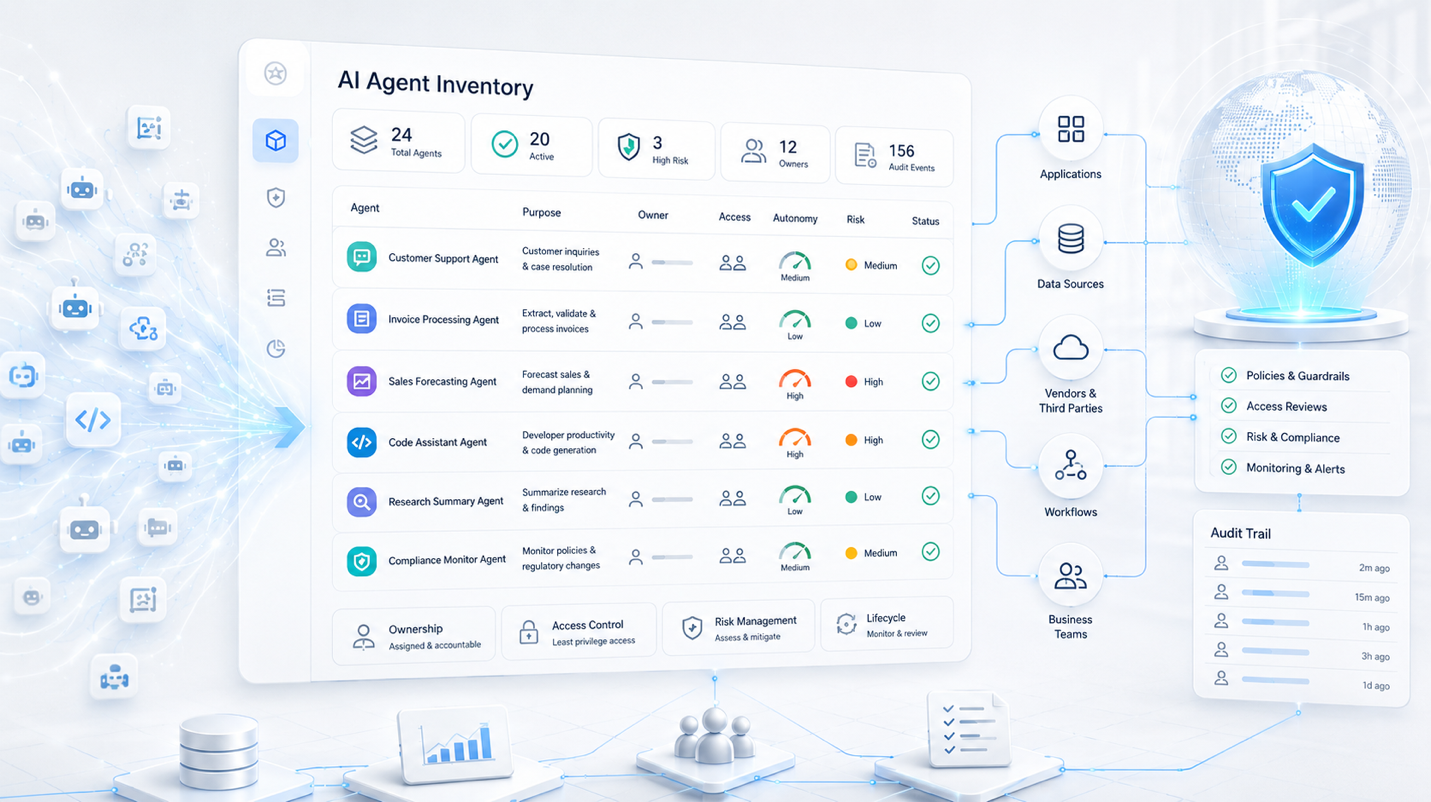
It is worth being precise about the word. An AI Agents Inventory is, in the sense used here, an AI Agents Registry — a governed record of what exists. The terms are used interchangeably across the industry: what some call an AI agent registry, IF4IT calls an AI Agents Inventory. The distinction that matters is not the word but the discipline behind it: a genuine AI Agents Inventory is not merely a list of the agents that exist, but a governed record of each agent’s ownership, authority, and reach.
More broadly, an inventory and a registry are the same idea: a governed account of what the enterprise has, whether the subject is applications, vendors, or AI agents. The value is never in the list itself. It is in the governance the list makes possible.
An AI Agent Is a New Noun Type, Not a New Discipline
What makes AI feel like a governance emergency is that AI agents are genuinely new. An AI agent is a software actor that can pursue goals and take actions, sometimes with a degree of autonomy that traditional software never had.
That novelty is real. But it does not require a new governance world. It requires recognizing the AI agent as a new type of thing to inventory — a new noun type — within a governance model the enterprise may already have.
Enterprises already inventory applications, vendors, capabilities, data, and other classes of asset. Each is a type of thing the enterprise governs by recording it, owning it, and relating it to everything around it. The AI agent joins that model as a new entry type, not as an exception to it.
This is more than a comforting analogy. It has a practical consequence: everything the enterprise already knows about governing a noun type carries over. Ownership models, review cadences, lifecycle states, relationship mapping, and the habit of treating an unrecorded instance as a finding all apply to AI agents without reinvention. The agent has new attributes worth governing, such as its autonomy and the authority under which it acts, but the machinery that governs it is not new.
Seen this way, the task shrinks to something manageable: the enterprise adds AI agents to a discipline it already understands, then attends to the few attributes that make agents genuinely different.
Why Enterprise AI Governance Starts With an AI Agent Inventory
Of everything an enterprise might inventory about its AI, the AI agents matter most and are hardest to see.
Agents act. They call tools, move data, trigger workflows, and increasingly invoke one another. An agent that can act is an agent that can cause harm, incur cost, and create obligations — often at machine speed, with no one watching.
Agents are also the AI most likely to exist without anyone having recorded them. They are created inside platforms, spun up by builders, and sometimes generated by other agents. Left unrecorded, they become the enterprise’s largest source of ungoverned AI.
This is already happening at scale. In the Cloud Security Alliance’s 2026 report Autonomous but Not Controlled: AI Agent Incidents Now Common in Enterprises, more than four in five organizations said they had discovered at least one AI agent or automated workflow that their security or IT teams had not previously known about.
The pattern is easy to picture. A team builds an agent to reconcile invoices, gives it credentials to a finance system and a shared mailbox, and moves on. Months later no one remembers it exists, its owner has changed roles, and its credentials still work. It is still acting. Nothing in the enterprise records that it is there, what it can reach, or who is answerable for it. That is not a hypothetical edge case — it is the ordinary result of deploying agents without an inventory to record them.
That is the reason enterprise AI governance starts with an AI Agents Inventory. It is the point of highest risk and lowest visibility, which makes it the point where inventory discipline pays off first. Establish the inventory, and the rest of AI governance has something solid to attach to.
Start Small and Mature: A Crawl, Walk, Run Approach
The most common reason enterprises never build an AI Agents Inventory is that they imagine it must be complete and perfect before it is worth anything. It does not. A useful inventory starts small and matures, and the discipline is designed to be adopted in stages.
A practical way to think about it is Crawl, Walk, Run — the same maturity approach IF4IT applies to inventory attributes across the enterprise.
Crawl is identity and ownership: every agent gets a record with a name, an accountable owner, and its purpose. That alone converts invisible sprawl into a governed list, and it is the foundation everything else attaches to.
Walk adds authority and reach. Record what each agent is permitted to do, how autonomous it is, and which systems and data it can touch. These are the attributes that let real controls — risk, oversight, access review — attach to something concrete.
Run adds assurance and relationships. Capture attestation, behavioral controls, and the typed relationships from each agent to the models, applications, data, and regulations it touches, turning the inventory into a governed node in the wider Enterprise Model rather than a standalone list.
The IF4IT AI Agents Inventory and Attributes document tags its attributes to exactly these stages, so an enterprise can see which attributes belong to Crawl, which to Walk, and which to Run, and adopt them in an order that matches its own priorities and tooling. It is the map of what to capture at each level of maturity.
Once an inventory reaches a workable level of maturity, an enterprise can build an AI Agents Catalog on top of it — a self-service facade over the governed inventory for the people who need to find and use agents. The catalog is not the starting point and not a substitute for the inventory beneath it; it is something a mature record makes possible later.
Where to Start
The first moves are smaller than most enterprises expect. None require a finished program, a new tool, or a reorganization — only the decision to begin.
Start with a scope you can finish. Rather than trying to capture every agent everywhere, pick one platform, team, or business area and inventory the agents there first. A small, complete inventory is worth more than a large, aspirational one. The IF4IT Enterprise Inventory Management Best Practices document covers how to stand up and run a governed inventory, and those mechanics apply directly to AI agents.
Find the agents and record the Crawl essentials. Go looking in the places agents are created — the platforms, low-code tools, and integrations teams use — and give each one a governed entry. The IF4IT AI Agents Inventory and Attributes document lists the specific attributes to capture at each stage, so you are recording against a defined baseline rather than guessing at what belongs in the record.
Make ownership non-negotiable. Of everything in the record, the owner matters most: a named human answerable for what each agent does, what it can reach, and when it should be retired. An agent without an owner is the orphaned, credentialed liability described earlier. If you do nothing else on this list, do this.
Connect agents to what you already track. An agent is not an island. Relate each one to the applications, data, and vendors it depends on, most of which the enterprise may already inventory. The IF4IT Enterprise Model and Modeling Best Practices document explains how these typed relationships turn separate inventories into a connected model you can actually reason over.
Add governance as the inventory matures. Once agents are recorded and owned, layer on oversight, risk assessment, and lifecycle control. The IF4IT Enterprise AI Governance Best Practices document describes how to govern what the inventory has made visible, so control grows with the record rather than waiting on a perfect one.
None of these steps waits on the others to be perfect. The enterprise that records ten agents this week, with owners, is in a materially stronger position than the one still designing the ideal program. Start the record, and let it grow.
Enterprise AI Governance Is Inventory Governance Applied to AI
With the agents inventoried, what follows looks remarkably like the governance disciplines the enterprise already practices.
Risk is assessed against known agents. Ownership is assigned to real entries. Authority and access are scoped deliberately. Change is tracked, incidents are traced, and retirement removes what is no longer worth running. None of this is unique to AI. It is inventory governance, applied to a new kind of asset.
This is what a mature enterprise AI governance practice actually is: not a separate empire of AI-specific rules, but the enterprise’s existing governance disciplines extended to cover AI agents, models, and use cases as first-class inventoried things.
The AI agent even inherits the enterprise’s existing relationships. An agent connects to the applications it uses, the data it touches, the vendors behind it, and the capabilities it supports — all of which the enterprise may already inventory. Recording the agent is partly a matter of connecting a new entry to entries that already exist, which is exactly what an enterprise model is for.
The framing matters because it changes the size of the task. What looked like an overwhelming new frontier turns out to be familiar work, pointed somewhere new.
The Enterprises That Will Govern AI Best Already Do
This points to an uncomfortable truth. For many enterprises, the AI governance crisis is not really about AI at all. It is a bill coming due for years of skipped discipline — the same enterprises that never built reliable inventories of their applications, vendors, or data are now unable to inventory their AI, and AI is simply the first problem urgent enough to force the reckoning. That is sobering for some and encouraging for others.
The enterprises best positioned are the ones that already govern their inventories well; they know what an inventory is, how to own entries, and how to keep them current, so governing AI is a matter of extending a working discipline to a new noun type. The enterprises that will struggle are the ones for whom AI is exposing an old gap rather than creating a new one. AI simply raises the stakes and the speed.
That is the real lesson. AI governance is not a reason to panic and invent something new. It is a reason to build, or finally take seriously, the inventory discipline that enterprise governance has always depended on.
Conclusion: AI Governance Is an Inventory Problem
The enterprises that treat AI governance as an entirely new discipline will spend years reinventing what they already know. The enterprises that recognize AI governance as an inventory problem will move faster, because they will apply a discipline they already have.
AI governance is inventory governance applied to a new kind of asset. It starts with seeing what exists — and for AI, what exists that matters most is the population of AI agents acting on the enterprise’s behalf.
Start with an AI Agents Inventory. Record the agents, own them, bound them, and relate them to the rest of the enterprise. Everything else in enterprise AI governance has somewhere to attach once that foundation is in place.
Learn More
AI Agents Inventory and Attributes
Enterprise AI Governance Best Practices
Enterprise Inventory Management Best Practices
IF4IT Enterprise Model and Modeling Best Practices
Back to Articles PageHow to cite this page
When referencing this page in academic work, internal standards, or external publications, include the page title, IF4IT as author and publisher (The International Foundation for Information Technology (IF4IT), LLC), the URL, and your access date.
Example (informal web citation):
The International Foundation for Information Technology (IF4IT), LLC. AI Governance Is an Inventory Problem: Why Enterprise AI Governance Starts With an AI Agent Inventory. https://if4it.org/articles/2026-07-21-ai-governance-is-an-inventory-problem-why-enterprise-ai-governance-starts-with-an-ai-agent-inventory/ (accessed 2026-09-11).
See About Us for content governance and site-wide citation guidance.