Shadow AI Agents: Why You Can't Govern the Agents You Can't See
Executive Summary: Article Overview
IF4ITThe Bottom Line
Core Article Pillars
| Article Pillar / Focus Area | Strategic Business Outcome & Intent |
|---|---|
| Shadow AI as an Ungoverned Asset | Reframes shadow AI agents from a novel threat into a familiar governance gap, so enterprises apply a discipline they already have rather than inventing a new one. |
| Visibility as the Precondition | Establishes that no control, policy, or safeguard can attach to an agent the enterprise has not recorded, making a governed inventory the first move. |
| Ownership as the Antidote | Positions a named, accountable owner for every agent as the single most effective step for converting shadow AI into governed AI. |
Quick Q&A (Macro Executive Reference)
Question: What is a shadow AI agent?
Question: Why are shadow AI agents dangerous?
Question: How does an enterprise get rid of shadow AI?
Read Full Article Below
Shadow AI Agents: Why You Can’t Govern the Agents You Can’t See
Somewhere inside most enterprises, an AI agent is doing work that no one is watching. It was built by a team to solve a problem, given credentials to a system or two, and then left running. Months later, no one remembers it exists, but it is still acting, still reaching into data, still making decisions on the enterprise’s behalf. It is a shadow AI agent, and it is almost certainly not alone.
Shadow AI has become one of the most anxious topics in enterprise technology, and for good reason. But the anxiety often points in the wrong direction. The problem is not that AI agents are uniquely dangerous. The problem is that the enterprise cannot see them, and an enterprise cannot govern what it cannot see.
What a Shadow AI Agent Actually Is
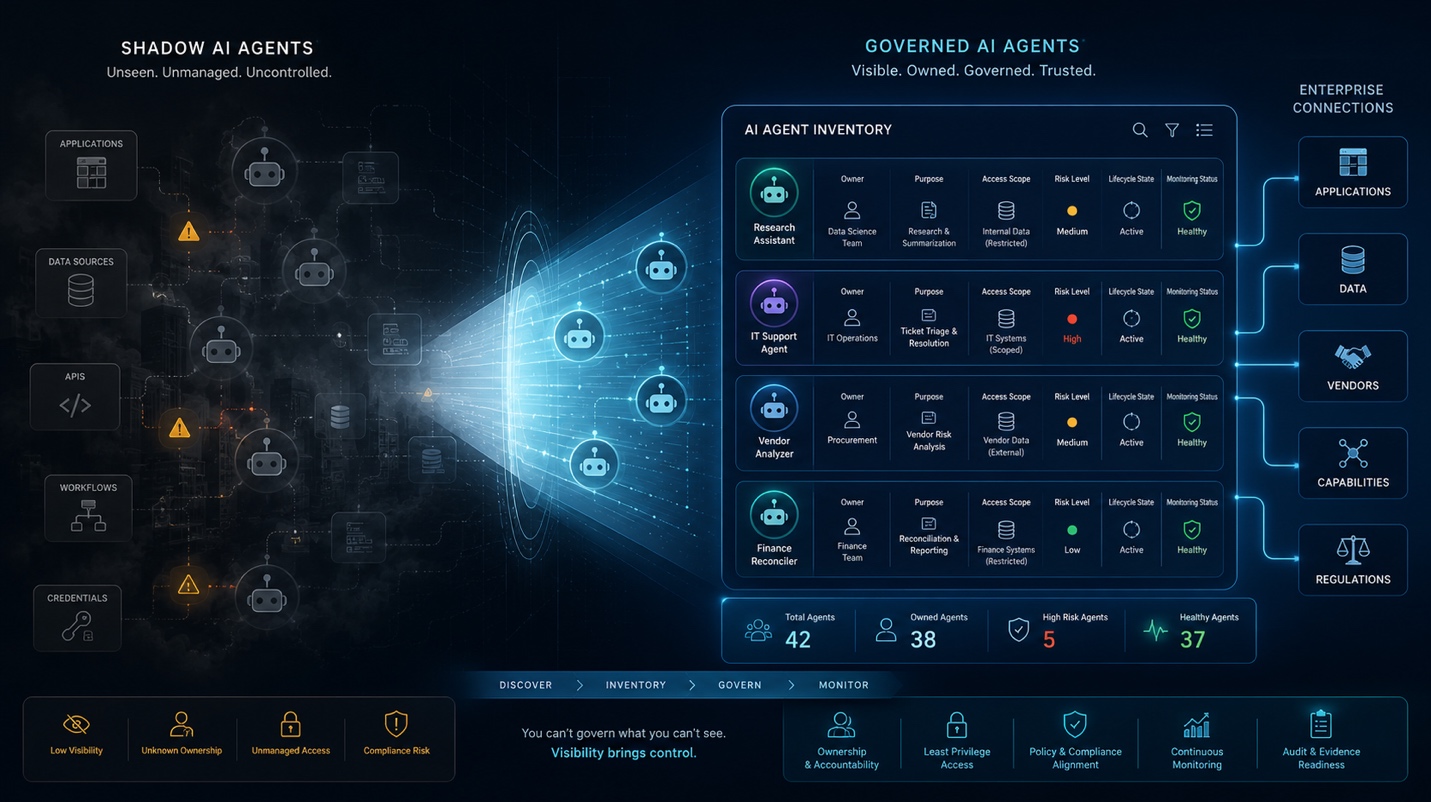
A shadow AI agent is an AI agent running inside an enterprise that has not been recorded, owned, or governed. Someone created it, put it to work, and moved on, without it ever entering a governed record or being assigned an accountable owner.
These agents rarely arrive through a formal process. They are spun up inside platforms, assembled with low-code tools, embedded in applications an employee adopted without review, and increasingly generated by other agents. Each one begins as a reasonable local solution to a real problem. The trouble is that the enterprise as a whole never learns they exist.
This is not a new kind of problem. It is the newest instance of a very old one. Shadow IT has always arisen the same way: when something is easy to create and hard to track, it multiplies faster than anyone can govern it. Shadow AI agents are that pattern applied to a new kind of asset, and they behave exactly as the pattern predicts.
Why the Shadow Is the Dangerous Part
What makes shadow AI agents matter is not that they are AI. It is that they act, and that no one can see them acting.
An AI agent can move data, call other systems, trigger workflows, incur cost, and create obligations, often autonomously and at a speed no human is watching in real time. An agent that can act is an agent that can cause harm. When that agent is also invisible, every control an enterprise would normally apply is impossible. Risk cannot be assessed against an agent no one has recorded. Access cannot be scoped for an agent no one can see. An agent no one knows about cannot be reviewed, cannot be corrected, and cannot be retired.
The result is an enterprise that discovers its shadow agents only after one of them does something visible, which usually means something has already gone wrong. And the scale of the blind spot is not hypothetical. In the Cloud Security Alliance’s 2026 report Autonomous but Not Controlled: AI Agent Incidents Now Common in Enterprises, more than four in five organizations said they had discovered at least one AI agent or automated workflow that their security or IT teams had not previously known about. The shadow is not an edge case. For most enterprises, it is the normal state.
Policy Is Not the Fix
The instinctive response to shadow AI is to write a rule against it, to declare that all AI agents must be approved and governed. The intent is right, but a policy alone changes nothing, because a policy can only govern what the enterprise can identify.
An enterprise can write a sensible AI policy in an afternoon. What it cannot do is apply that policy to agents it does not know exist. A rule that says every agent must have an owner does no work if no one knows which agents are out there to be owned. The gap that lets shadow AI grow is not a missing rule. It is missing visibility. Close the visibility gap and the policy suddenly has something to attach to; leave it open and the best policy in the world governs only the agents that were never the problem.
Visibility Comes From an Inventory
If the problem is that the enterprise cannot see its agents, the remedy is to make them visible in a durable, governed way. That is precisely what an inventory is: a governed record of what exists, who owns it, and what it can affect.
A governed AI Agents Inventory turns shadow AI from a blind spot into a managed population. Every agent the enterprise can find is given a record with a name, a purpose, and an accountable owner. Each record captures what the agent is permitted to do, how autonomous it is, and which systems and data it can reach. Once an agent is recorded, owned, and scoped in this way, it is no longer shadow AI. It is a governed agent, and every other control the enterprise wants to apply now has something concrete to attach to.
This is not a special new discipline invented for AI. It is the same inventory discipline enterprises already use to govern applications, vendors, data, and other assets, pointed at a new kind of thing. The agent is simply a new type of entry in a governed record the enterprise may already know how to keep.
Ownership Is the Antidote
Of everything captured in that record, one attribute does the most to dissolve the shadow: a named, accountable owner.
An agent with an owner has someone answerable for what it does, what it can reach, and when it should be retired. That single fact converts an anonymous, ungoverned actor into a governed one. The invoice-reconciliation agent that everyone forgot, still holding live credentials, is dangerous precisely because no one owns it. Give it an owner and the danger largely evaporates, because now someone is responsible for reviewing it, bounding it, and shutting it down when its purpose ends.
This is why ownership, not detection tooling, is the heart of the answer. Finding shadow agents matters, but a found agent with no owner is still ungoverned. If an enterprise did only one thing about shadow AI, the highest-leverage move would be to ensure that every agent it can find is given an accountable human owner.
From Shadow to Governed
Shadow AI feels like a crisis because it is invisible, autonomous, and growing. But stripped of the drama, it is a familiar problem wearing new clothes: an ungoverned asset multiplying because it is easy to create and hard to track. Enterprises have faced that problem before, and they already have the discipline that answers it.
The path out is not a new rule or a new fear. It is to make the agents visible, record them in a governed inventory, give each one an owner, and connect them to the rest of what the enterprise governs. Do that, and the agents that were running in the dark are simply part of what the enterprise knows about itself, which is where governance was always going to have to begin.
Learn More
For the governed record that turns shadow AI agents into managed ones, including the specific attributes to capture for each agent, see the IF4IT AI Agents Inventory and Attributes document. For the broader discipline of establishing and running any governed inventory, see the IF4IT Enterprise Inventory Management Best Practices document. For how to govern the AI the inventory makes visible, see the IF4IT Enterprise AI Governance Best Practices document.
AI Agents Inventory and Attributes
Enterprise Inventory Management Best Practices
Enterprise AI Governance Best Practices
Back to Articles PageHow to cite this page
When referencing this page in academic work, internal standards, or external publications, include the page title, IF4IT as author and publisher (The International Foundation for Information Technology (IF4IT), LLC), the URL, and your access date.
Example (informal web citation):
The International Foundation for Information Technology (IF4IT), LLC. Shadow AI Agents: Why You Can't Govern the Agents You Can't See. https://if4it.org/articles/2026-07-22-shadow-ai-agents-govern-what-you-cannot-see/ (accessed 2026-09-11).
See About Us for content governance and site-wide citation guidance.