Use Non-Functional Requirements (NFRs) to Expose Critical Gaps in AI Generated Software Like Vibe Code
Executive Summary: Article Overview
IF4ITThe Bottom Line
Core Article Pillars
| Article Pillar / Focus Area | Strategic Business Outcome & Intent |
|---|---|
| Functional Completeness vs. Production Readiness | Prevents working demonstrations from being mistaken for secure, resilient, scalable, and supportable production systems. |
| NFR-Driven Architecture | Uses explicit quality attributes and operating constraints to shape architecture before late discovery forces expensive redesign. |
| Measurable Validation and Evidence | Converts vague expectations into testable requirements with defined validation methods, ownership, and retained evidence. |
| AI-Assisted Requirements Discovery | Uses AI to identify missing NFR categories and improve requirements while preserving qualified human review and accountability. |
| Practitioner Enablement | Helps vibe coders and delivery teams recognize what they do not know and obtain the expertise needed for production readiness. |
Quick Q&A (Macro Executive Reference)
Question: Why can AI-generated software appear complete while still being unsafe for production?
Question: How do Non-Functional Requirements expose gaps in vibe-coded software?
Question: Can AI help create better Non-Functional Requirements?
Read Full Article Below
Use Non-Functional Requirements (NFRs) to Expose Critical Gaps in AI Generated Software Like Vibe Code
Why AI Generated Software Can Look Complete While Remaining Unsafe
The most dangerous AI-generated software is not the software that fails immediately. It is the software that appears to work while its security, resilience, performance, recoverability, and operational weaknesses remain undiscovered.
Artificial Intelligence (AI) has become remarkably effective at synthesizing software from the requirements it receives. A user can describe a screen, workflow, report, database, integration, or Application Programming Interface (API), and an AI coding tool may produce a functioning implementation in minutes.
That capability is real, valuable, and increasingly accessible. The primary risk is not that AI cannot generate code. The risk is that the person directing the AI may not know all the requirements that should be provided.
This is one of the most important gaps exposed by AI-assisted development and vibe coding: AI can implement the requirements a person knows how to express, but it cannot reliably compensate for requirements the person does not know exist.
Functional Requirements Describe What the Software Should Do
Software requirements generally fall into two broad categories: Functional Requirements and Non-Functional Requirements (NFRs).
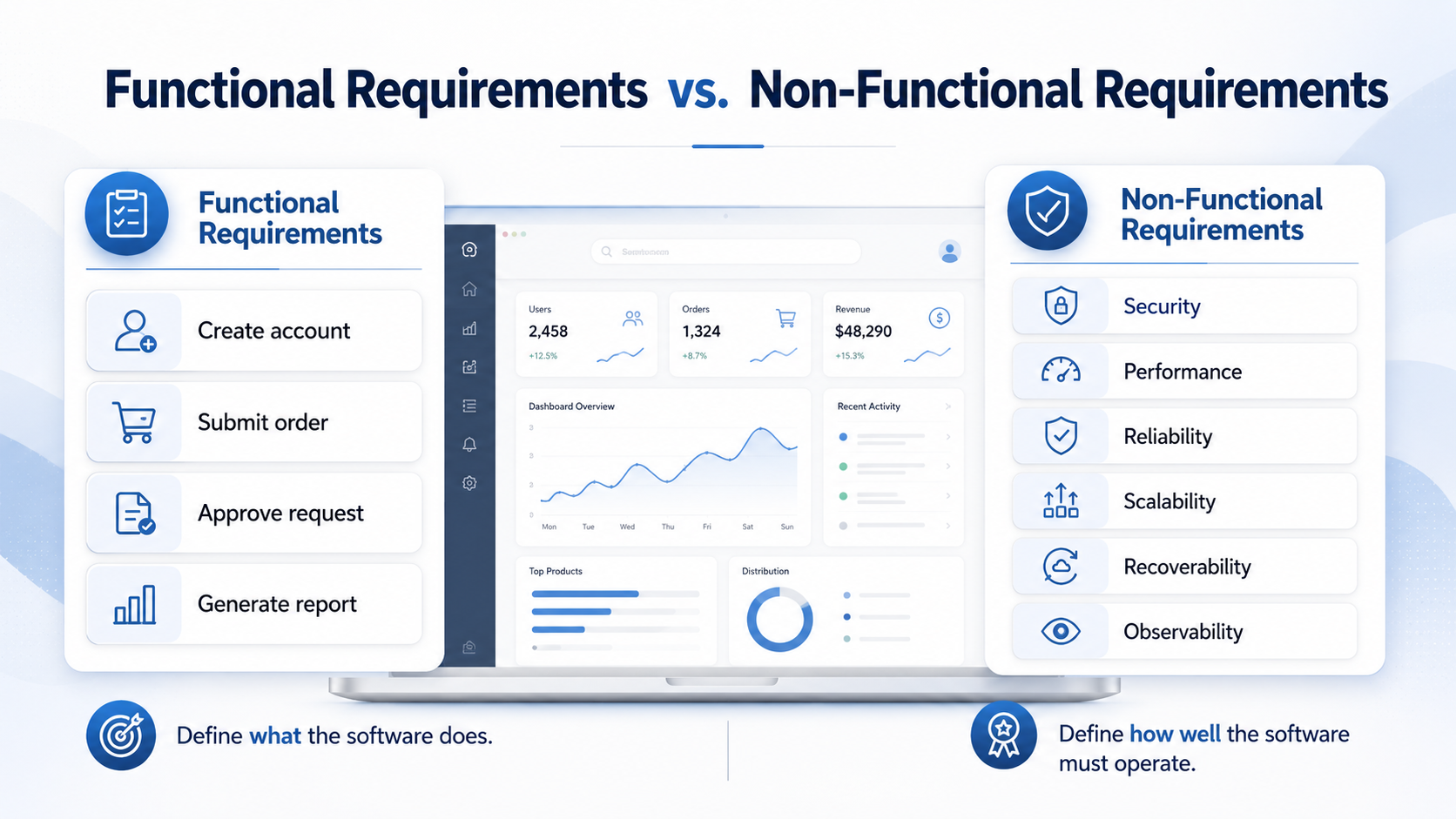
Functional Requirements describe what the software should do. They define visible behaviors, transactions, and business outcomes such as creating an account, submitting an order, approving a request, generating a report, sending a notification, or retrieving data from another system.
These are the requirements that most naturally appear in vibe-coding prompts. A user might ask AI to build an application that allows customers to browse products, add items to a cart, submit an order, and receive an email confirmation. The AI tool may generate each of those capabilities successfully.
The screens may work. The database may store the order. The confirmation may arrive. The application may appear complete. But functional completion is not the same as production readiness.
Non-Functional Requirements Determine Whether the Software Is Fit for Use
Non-Functional Requirements describe how well the software should operate, the conditions under which it should operate, and the qualities, constraints, and operating expectations it should satisfy.
NFRs address concerns such as security, privacy, performance, availability, reliability, resilience, recoverability, scalability, accessibility, interoperability, maintainability, supportability, observability, auditability, data integrity, regulatory compliance, usability, portability, and cost efficiency.
These qualities often shape the architecture more significantly than individual features. A Functional Requirement might state that a customer can submit an order. Related NFRs might specify that the order should be processed within two seconds under an agreed workload, that payment information should be protected, that duplicate orders should not be created during retries, that the service should recover within an agreed period after failure, and that every status change should be auditable.
The Functional Requirement defines the behavior. The NFRs determine whether that behavior can be delivered securely, reliably, performantly, recoverably, and sustainably.
A Successful Demonstration Does Not Prove Production Readiness
Vibe-coded software can create a powerful illusion of completeness. A demonstration may show that screens load, buttons work, data can be entered, records are stored, reports are generated, and integrations return responses.
The demonstration may not reveal how the software behaves under heavy load, whether sensitive data is adequately protected, whether access controls are correctly enforced, whether failures can be detected and diagnosed, whether transactions can be safely retried, whether the system can recover from an outage, or whether regulatory and accessibility obligations are satisfied.
A demonstration proves that software can perform a function under a limited set of conditions. It does not prove that the software is secure, scalable, reliable, recoverable, supportable, compliant, or fit for production.
The Code Can Be Correct While the Architecture Is Wrong
Missing NFRs do not merely leave a few unfinished details. They can produce fundamental architectural mistakes.
An application designed for one hundred users may not scale to one hundred thousand. A synchronous integration may work during normal conditions but fail when a dependent service slows down. A database transaction may create duplicate financial activity when a request is retried. A single-region deployment may satisfy a demonstration but violate business-continuity expectations.
Security added after implementation may require identity, authorization, data-access, logging, and integration designs to be reworked. A solution without defined Recovery Time Objective (RTO) and Recovery Point Objective (RPO) expectations may have backups but no evidence that the business can recover within acceptable limits.
When NFRs are discovered late, teams may have to replace technologies, redesign data, restructure services, introduce queues or caches, rebuild integrations, add monitoring, and rewrite significant portions of the software. Without explicit NFRs, software may appear functionally complete while remaining architecturally incomplete, operationally fragile, and unfit for production.
Vibe Coding Makes Missing Engineering Knowledge More Dangerous
Many people using AI coding tools know how to describe the behavior they want. They may be business professionals, citizen developers, occasional programmers, junior developers, product managers, Business Analysts, entrepreneurs, or experienced developers working outside their usual domain.
They may understand the Functional Requirements very well while having limited experience defining architectural, security, performance, reliability, resilience, recoverability, supportability, governance, and operational requirements.
This creates a dangerous asymmetry: AI makes it easier to implement the requirements a person knows how to express. It does not ensure that the person knows which requirements are missing.
Vibe coding can therefore accelerate both software creation and false confidence.
NFRs Expose What the Prompt Did Not Include
NFRs force teams to ask questions that may never appear in a typical AI coding prompt:
| NFR Category | Question the Vibe-Coding Prompt May Have Omitted |
|---|---|
| Performance | How quickly should the software respond, and under what workload or data volume? |
| Availability | How much downtime is acceptable, and during which operating periods? |
| Security | Who can access what, how are identities verified, and how is misuse prevented? |
| Recoverability | How quickly should service and data be restored after failure? |
| Scalability | What happens when demand increases substantially? |
| Observability | How will failures be detected, diagnosed, and traced? |
| Maintainability | Can another team safely understand, change, test, and support the software? |
| Accessibility | Can people with applicable disabilities use the software effectively? |
| Compliance | What controls, records, approvals, and evidence should be retained? |
| Cost Efficiency | What operating-cost limits should the solution satisfy during normal and peak use? |
These questions do more than improve generated code. They shape architecture, testing, governance, deployment, operations, and support.
Every Important NFR Should Be Measurable and Validated
A vague NFR is often only an aspiration. Statements such as ’the application should be fast,’ ’the solution should be secure,’ or ’the system should be highly available’ are too imprecise to guide design, testing, or approval.
A useful NFR should be specific enough to influence architecture and produce an objective acceptance condition. For example, ’the application should return 95 percent of customer-search responses within two seconds while supporting 5,000 concurrent users under the defined production workload’ establishes a measurable target, a defined workload, and a basis for performance testing.
Each important NFR should also identify at least one validation method. Validation may include performance testing, security testing, failure-injection testing, disaster-recovery exercises, backup-restoration testing, accessibility testing, architecture review, code analysis, operational-readiness review, compliance assessment, evidence inspection, production monitoring, or accountable human approval.
Without validation, an NFR may be documented but remain unproven.
AI Can Help Identify and Improve Missing NFRs
AI is not only part of the risk. It can also be part of the solution.
Given sufficient system context, AI can help identify applicable NFR categories, detect missing quality expectations, improve vague requirements, propose measurable targets, identify affected architecture decisions, recommend validation methods, generate test scenarios, identify evidence sources, detect conflicts, and create an initial NFR backlog.
Instead of asking AI only to build an order-processing application, a team can also ask it to identify the security, privacy, performance, availability, reliability, resilience, recoverability, scalability, observability, maintainability, accessibility, interoperability, compliance, and cost-efficiency requirements that should be considered. The prompt can request a measurable target, validation method, accountable role, and evidence expectation for each proposed NFR.
AI-generated NFRs should still be reviewed and tailored to the enterprise, the system’s criticality, its users, data sensitivity, operating environment, architecture, regulatory obligations, risk tolerance, business objectives, support capabilities, and cost constraints.
AI can propose requirements. Qualified people should determine whether those requirements are correct, complete, feasible, approved, and appropriate. The answer to incomplete AI-generated software is not less AI. It is better requirements discipline, supported by AI and validated by experienced practitioners.
The IF4IT NFR Framework Helps Practitioners Know What They Do Not Know
The IF4IT Non-Functional Requirements (NFRs) Framework for Software Systems was created in part to help vibe coders, citizen developers, Business Analysts, product teams, architects, engineers, and other practitioners identify requirements they may not know to ask for.
The framework provides structured guidance across a broad range of NFR categories. It also helps practitioners improve requirement quality, make requirements measurable, define validation methods and evidence expectations, assign ownership and accountability, connect NFRs to architecture decisions, map them to lifecycle and testing stages, use AI to generate and improve them, and govern them over time.
The purpose is not to turn every vibe coder into a security architect, performance engineer, reliability specialist, or disaster-recovery expert. The purpose is to help practitioners recognize when those concerns exist, ask better questions, obtain qualified review, and avoid treating incomplete software as production-ready.
What Should Be Asked Before AI Generated Software Is Called Production-Ready?
Before AI-generated or vibe-coded software is accepted for production use, reviewers should ask whether both Functional Requirements and NFRs have been defined, whether the NFRs are specific enough to influence the architecture, and whether performance, capacity, security, privacy, availability, reliability, resilience, recoverability, observability, accessibility, interoperability, supportability, and cost expectations are explicit.
They should also confirm that each important NFR has an accountable owner, an appropriate validation method, and credible evidence showing that the requirement has been satisfied. Someone with the appropriate experience should review and approve the result, and ownership should be established for operating and supporting the software.
A functioning demonstration answers one question: does the software appear to perform the requested function? Production readiness requires answering a much larger question: can the software perform that function securely, reliably, performantly, recoverably, supportably, and sustainably under real-world conditions?
Call to Action: Treat NFRs as First-Class Requirements
Enterprises should not ask AI only to generate software. They should ask what qualities, constraints, operating conditions, validation methods, and evidence the software should satisfy before anyone depends on it.
NFRs should be treated as first-class requirements from the beginning — not as technical details to be discovered after the software has already been generated. AI should be used to help identify NFRs that may be missing, while qualified practitioners review, approve, and validate them before the software is declared production-ready.
Vibe coding can help people build software faster. NFRs determine whether what was built is fit for purpose.
Learn More
The IF4IT Non-Functional Requirements (NFRs) Framework for Software Systems provides the authoritative, detailed guidance behind this article.
Readers exploring AI-assisted requirements work should also review the chapter titled Use Artificial Intelligence (AI) to Generate, Improve, and Validate Non-Functional Requirements (NFRs).
Readers preparing software for implementation and production should also review the chapters titled Improve the Quality of Non-Functional Requirements (NFRs) and Validate Non-Functional Requirements (NFRs) with Evidence Across the Software Development Lifecycle (SDLC).
Back to Articles PageHow to cite this page
When referencing this page in academic work, internal standards, or external publications, include the page title, IF4IT as author and publisher (The International Foundation for Information Technology (IF4IT), LLC), the URL, and your access date.
Example (informal web citation):
The International Foundation for Information Technology (IF4IT), LLC. Use Non-Functional Requirements (NFRs) to Expose Critical Gaps in AI Generated Software Like Vibe Code. https://if4it.org/articles/2026-07-28-use-nonfunctional-requirements-nfrs-to-expose-critical-gaps-in-ai-generated-software-like-vibe-code/ (accessed 2026-09-11).
See About Us for content governance and site-wide citation guidance.