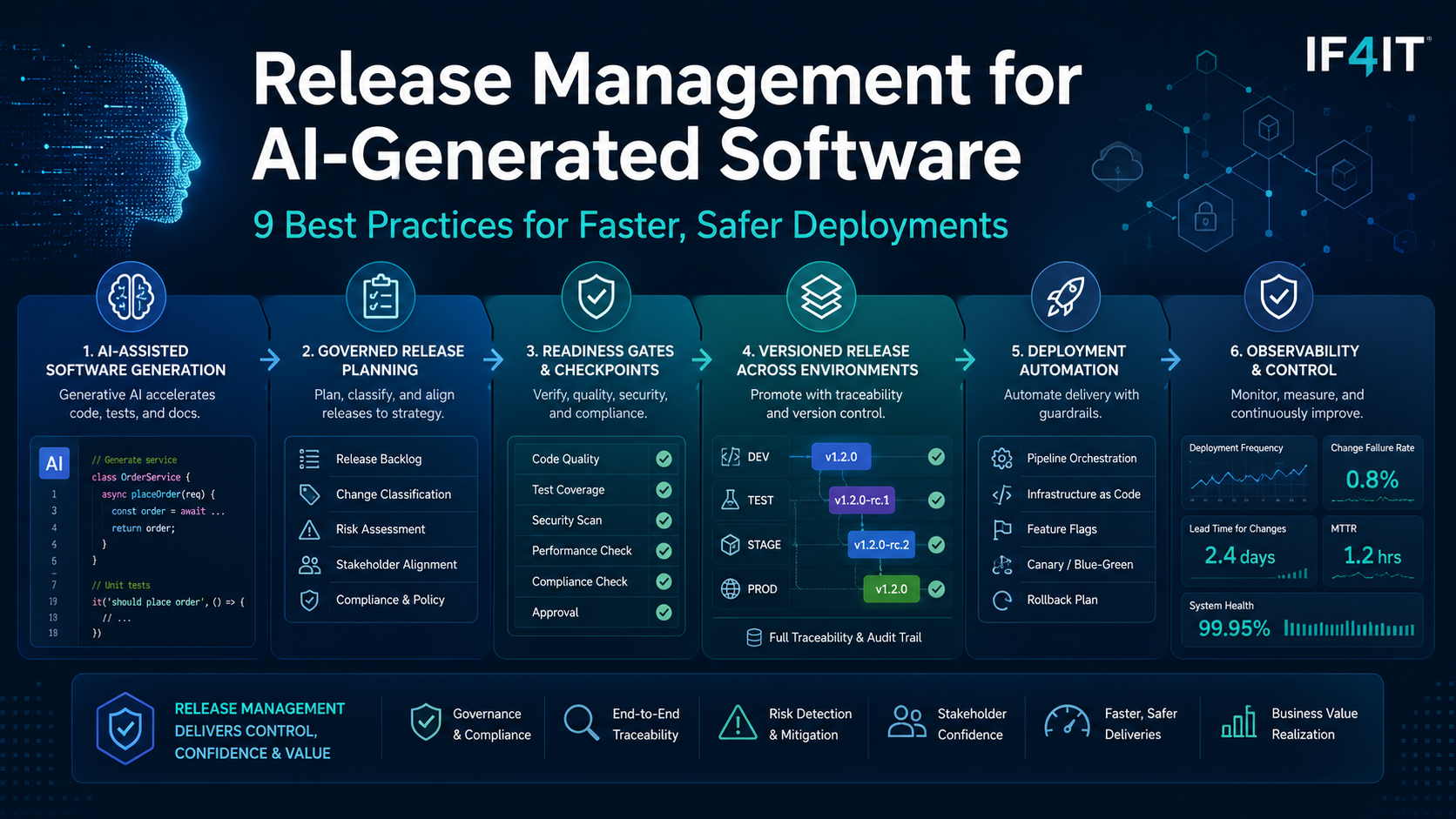
Release Management for AI-Generated Software: 9 Best Practices for Faster, Safer Deployments
Executive Summary: Article Overview
IF4ITThe Bottom Line
Core Article Pillars
| Article Pillar / Focus Area | Strategic Business Outcome & Intent |
|---|---|
| AI-Assisted Change Governance | Treat AI-generated software as a Change Set that requires formal Release identification, ownership, scope, and governance before delivery. |
| Evidence-Based Release Readiness | Use validation, Readiness Gates, dependency records, and Risk Classification to determine whether generated software may progress. |
| Controlled Deployment and Recovery | Separate Releases from Deployments, preserve Iteration lineage, and preplan Rollback and Remediation paths. |
| Human Accountability and Traceability | Retain named ownership, approvals, evidence, decisions, and outcomes even when generative AI produces part of the solution. |
| Balanced Delivery Performance | Evaluate delivery velocity and operational stability together rather than rewarding speed alone. |
Quick Q&A (Macro Executive Reference)
Question: Is AI-generated software ready for Production when the code works?
Question: Does faster software generation justify fewer Release Management controls?
Question: Who is accountable for software created with generative AI?
Read Full Article Below
Release Management for AI-Generated Software: 9 Best Practices for Faster, Safer Deployments
Generative AI is changing how quickly enterprises can create software. It can help produce code, configurations, tests, integration logic, infrastructure definitions, data mappings, and Documentation in far less time than traditional delivery methods.
That acceleration can create a dangerous misconception: if software can be generated quickly and appears to work, it can also be released quickly and safely.
Software creation and Release readiness are not the same thing.
A generated component may still contain incomplete requirements, hidden dependencies, weak error handling, security exposures, incompatible configurations, undocumented operational assumptions, or behavior that has not been validated in representative Environments. The Change Set may work in isolation while remaining unsafe for the broader enterprise.
The governing principle is simple:
Generative AI accelerates software creation. Release Management governs whether that software is ready, traceable, recoverable, and safe to deliver.
The following nine Release Management practices help enterprises deploy AI-generated software faster without sacrificing safety, traceability, recoverability, or control.
1. Treat AI-Generated Software as a Change Set, Not as a Release
Generative AI can produce software artifacts, but those artifacts do not automatically constitute a governed Release.
A Release should have a unique identity, defined scope, accountable ownership, a target Environment, known dependencies, readiness criteria, Documentation expectations, and a recovery strategy. It should identify the Assets being changed and the business or technical outcome the Change Set is intended to deliver.
Without that structure, generated software can move through delivery processes as an anonymous collection of files and configurations. Teams may know that something changed without being able to establish precisely what changed, why it changed, who authorized it, or which Versions were involved.
The Release Owner should remain accountable for what belongs in the Release and why. The Release Manager should remain accountable for coordinating how the Release is planned, governed, communicated, and moved toward its target.
2. Keep Releases and Deployments Distinct
A Release and a Deployment are related, but they are not interchangeable.
The Release is the governed Change Set moving toward a defined target. A Deployment is a technical execution that places that Change Set into a specific Environment. One Release may require multiple Deployments as it progresses through Development, testing, staging, Production, or other selected Environments.
This distinction becomes especially important when AI-assisted teams generate rapid corrections.
If a Deployment fails because the procedure, tooling, connectivity, or Environment failed, retrying the same unchanged Change Set may remain the same Deployment attempt. If the software or configuration changes, the Release has entered a new Iteration that should be identified, rebuilt, retested, and traced separately.
Conflating these conditions hides whether the failure was technical or functional and weakens Release lineage.
3. Return Every Correction to Development or Engineering
Generated software should not be corrected directly in a downstream testing, staging, or Production Environment.
Any defect fix, configuration correction, or enhancement should return to Development or Engineering. The Change Set should then be updated, versioned, rebuilt, validated, and redeployed through the required Environments.
This preserves a reproducible source of truth and prevents downstream Environments from containing undocumented changes that cannot be recreated elsewhere.
Direct downstream fixes may solve an immediate problem, but they create a larger governance failure. The enterprise loses confidence that the tested Change Set, approved Change Set, deployed Change Set, and recorded Change Set are the same.
4. Use Evidence-Based Readiness Gates
Generative AI does not remove the need for Readiness Gates. It increases the importance of defining what evidence is required before a Release may advance.
Gate criteria should reflect the Release, Asset, target Environment, and Risk Classification. Evidence may include functional validation, security testing, dependency verification, architectural conformance, data-quality checks, Non-Functional Requirement validation, Documentation completeness, operational readiness, and recovery testing.
A Gate should answer a concrete question:
Is there sufficient evidence that this Release is ready to enter or leave this Environment?
Schedule pressure, executive interest, generation speed, and confidence in the AI tool are not substitutes for evidence. When criteria are unresolved or undocumented, the Release should not advance merely because the intended delivery date is approaching.
5. Record Every Dependency and Version
AI-generated software rarely operates alone. It may rely on internal services, external services, shared libraries, data sources, interfaces, models, prompts, configurations, platforms, and infrastructure components.
The Release should record the exact Versions of the dependencies it contains or requires.
Dependency traceability supports reproducibility, impact analysis, testing, incident response, auditability, and Rollback planning. It also helps teams determine whether unexpected behavior originated in the generated Change Set or in a dependency that changed independently.
A Release that cannot establish what it depends on cannot reliably establish what was tested.
6. Classify Risk Independently of Generation Speed
Software generated in minutes can still create severe business impact.
Release Risk Classification should consider factors such as Asset criticality, blast radius, reversibility, target Environment, Release Type, dependency complexity, data sensitivity, regulatory exposure, and prior rejection or failed-Deployment history.
The time required to generate the Change Set is not a reliable risk factor.
A small configuration change to a critical shared platform may carry more risk than a large feature added to an isolated internal tool. Similarly, a Release categorized as low risk from its own perspective may still create significant impact when introduced into an Environment shared with other Assets.
Fast to generate does not mean low risk to release.
7. Preplan Rollback and Remediation
Every Production-bound Release should have a defined recovery approach before Deployment begins.
Rollback returns the Asset to the previous successfully reached Version. Remediation fixes forward through a new Release Iteration or, when justified, an Emergency or Hotfix Release.
The correct path depends on the severity of the problem, business impact, reversibility, availability of a tested Rollback, complexity of the forward correction, and Release Risk Classification.
These decisions should not be invented during an active incident. Trigger criteria, responsibilities, communication paths, evidence requirements, and validation steps should be established during Release planning.
A recovery plan that has never been validated is an assumption, not a control.
8. Preserve Human Accountability and an Evidence Chain
Generative AI may create an artifact, but it cannot absorb enterprise accountability for that artifact.
The Release should preserve a traceable record of who requested the change, who reviewed it, what was tested, who approved progression, which Deployment occurred, what evidence supported each Gate, and what outcome followed.
Evidence should remain correlated to the Release ID, Asset, Environment, Iteration, Gate, Deployment, timestamp, actor, and outcome. Its retention, tamper-evidence, attestation, and accessibility should scale with Release Risk Classification.
Named accountability remains essential even when automation performs much of the work. The enterprise should be able to explain what happened, why it happened, who authorized it, and how the result was validated.
9. Measure Delivery Speed and Operational Stability Together
Generative AI can increase the volume of software produced and potentially increase Deployment Frequency. Neither measure proves that Release Management is improving.
Enterprises should evaluate velocity and stability together.
Deployment Frequency, Total Release Delivery Time, and Average Release Time provide indicators of delivery speed. Change Failure Rate provides an essential indicator of operational stability.
Optimizing speed while ignoring failed Gates, repeated Deployment attempts, Rollbacks, Remediation, Incidents, and rejected Iterations can reward teams for moving risk downstream.
The objective is not merely to release AI-generated software faster. The objective is to deliver valuable software faster without losing reliability, control, or trust.
AI Changes the Speed of Creation, Not the Responsibilities of Release Management
Generative AI introduces powerful new ways to create software, but it does not eliminate the disciplines required to govern delivery.
The enterprise still needs to know what is changing, who owns it, which Assets and dependencies are involved, where the Release is going, what evidence supports readiness, how failures will be handled, and whether delivery performance is improving without sacrificing stability.
Enterprises that remove Release Management controls to match AI generation speed may create more output while weakening traceability, recoverability, and accountability.
Enterprises that strengthen Release Management can convert rapid software generation into faster, safer, and more controlled delivery.
Generative AI can help produce the Change Set. Release Management determines whether the enterprise should release it.
Learn More
The complete governance model behind these practices is covered in the following IF4IT document and its related chapters:
Release vs. Deployment — How a Single Release Is Deployed Many Times on Its Way to Production
Release Readiness Gates — Entry and Exit Criteria for Every Environment
How to cite this page
When referencing this page in academic work, internal standards, or external publications, include the page title, IF4IT as author and publisher (The International Foundation for Information Technology (IF4IT), LLC), the URL, and your access date.
Example (informal web citation):
The International Foundation for Information Technology (IF4IT), LLC. Release Management for AI-Generated Software: 9 Best Practices for Faster, Safer Deployments. https://if4it.org/articles/2026-08-01-release-management-ai-generated-software/ (accessed 2026-10-05).
See About Us for content governance and site-wide citation guidance.