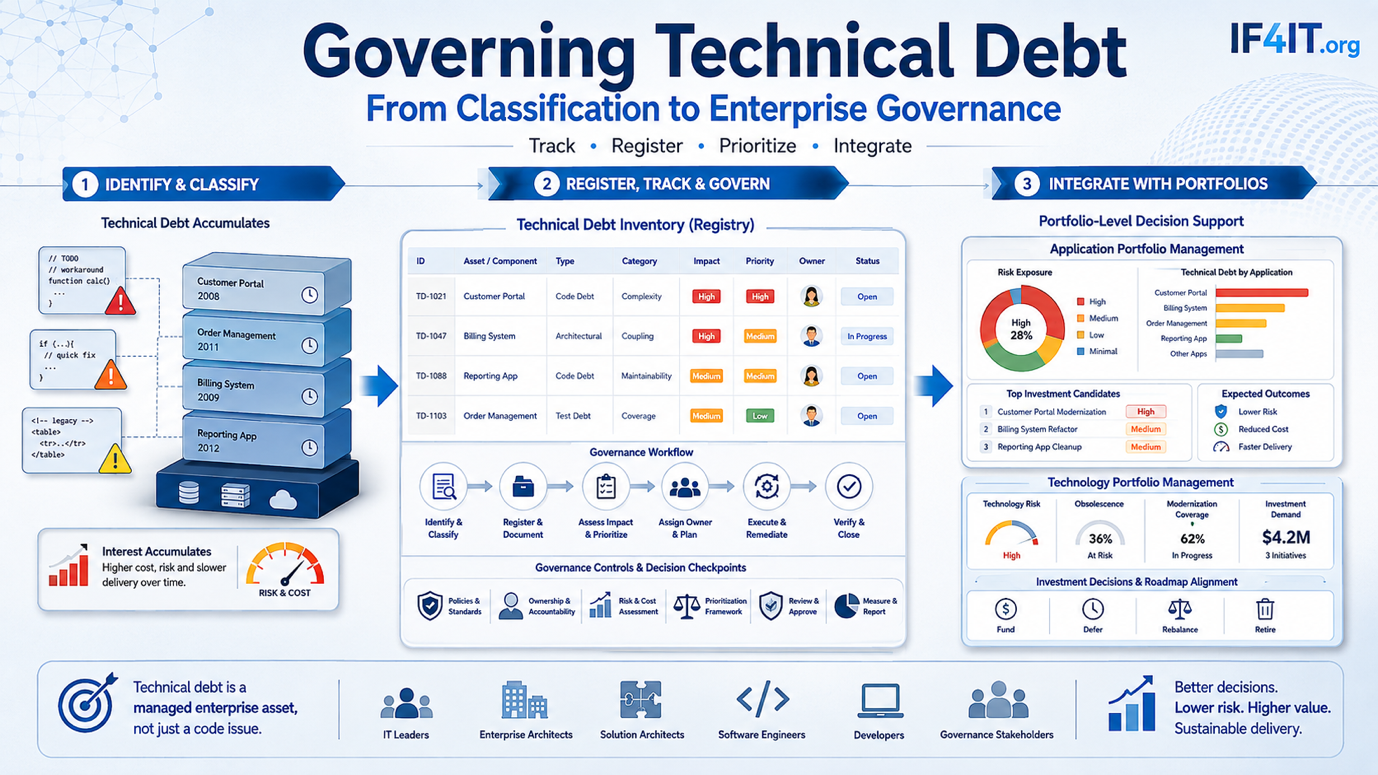
Governing Technical Debt as an Enterprise Discipline — The Framework That Helps IT Leaders Establish Technical Debt Tracking and Governance
Executive Summary: Article Overview
IF4ITThe Bottom Line
Core Article Pillars
| Article Pillar / Focus Area | Strategic Business Outcome & Intent |
|---|---|
| The Classification Gap | Establishes that existing technical debt frameworks address classification and understanding but leave the governance discipline unaddressed, creating a persistent gap for IT leaders. |
| Technical Debt as Enterprise Governance Concern | Reframes technical debt from a code quality issue to a financial liability, portfolio risk, strategic constraint, and governance indicator, elevating it to the IT leadership agenda. |
| Portfolio Integration | Demonstrates how technical debt governance connects to Application Portfolio Management and Technology Portfolio Management, making both disciplines more complete and investment decisions better informed. |
| IF4IT’s Governance Framework | Introduces the Technical Debt Management Best Practices and Technical Debt Inventory and Attributes documents as the first comprehensive free governance framework for technical debt management at enterprise scale. |
| Getting Started | Provides a practical eight-step path for IT leaders to establish a Technical Debt Management discipline within their organization. |
Quick Q&A (Macro Executive Reference)
Question: What is the difference between technical debt classification and technical debt governance?
Question: How does technical debt governance connect to Application Portfolio Management and Technology Portfolio Management?
Question: Where can IT leaders find a free framework for governing technical debt as an enterprise management discipline?
Read Full Article Below
Some History
Ward Cunningham introduced the term “technical debt” in 1992 to describe the implied cost of rework caused by choosing an expedient solution now instead of a better-considered approach. The metaphor was apt then and remains apt today: like financial debt, technical debt accumulates interest over time. Left unmanaged, it compounds. Left unacknowledged, it eventually constrains or collapses the systems it inhabits.
In the three decades since, the software engineering community has built a rich body of knowledge around the concept. Martin Fowler’s Technical Debt Quadrant — distinguishing deliberate from inadvertent debt, and reckless from prudent debt — provides a genuinely useful taxonomy for classifying the nature of an organization’s debt. The agile and DevOps communities have developed practices for addressing debt incrementally. Published industry research has quantified the problem at a scale exceeding one trillion dollars in deferred rework globally, with independent studies estimating that between twenty and forty percent of developer effort is consumed by technical debt rather than new value delivery.
The scale of the problem is not in dispute. The governance framework for addressing it has been absent.
The Problem Has Been Named but Not Governed
Despite three decades of classification, quantification, and community discourse, most IT organizations still do not govern technical debt systematically. They acknowledge it exists. They estimate it is significant. They address it reactively when it produces an incident or blocks delivery — and they leave it unmanaged between those events.
The reason is not ignorance of the problem. It is the absence of a governance framework that tells IT leaders precisely how to identify, register, assign, prioritize, integrate, and report on technical debt as a managed enterprise concern. The software engineering literature tells practitioners what technical debt is and how it accumulates. It does not tell IT leaders how to govern it.
Classification Is Not Governance
Fowler’s Technical Debt Quadrant is the right tool for what it does: it helps practitioners name and understand the nature of the debt they carry. Knowing that a particular decision was deliberately reckless — made with full awareness that it incurred debt — is different from knowing that debt accumulated inadvertently because the team did not understand the better practice at the time. The classification matters for understanding root cause and for having an informed conversation about accountability.
But classification without governance produces the same outcome as diagnosis without treatment. Knowing an organization has reckless inadvertent debt does not establish who owns it. It does not establish what it is costing the organization in delivery velocity, incident frequency, or system fragility. It does not inform application portfolio rationalization decisions — whether to invest in, sustain, or retire a particular application. It does not provide a mechanism for prioritizing resolution against competing delivery demands. And it does not produce the reporting framework that translates technical reality into business impact for the IT leaders who make investment decisions.
Technical Debt Is an IT Leadership and Governance Concern
Part of what has kept technical debt from being governed at the enterprise level is a framing problem. In most organizations, technical debt is discussed primarily as a code quality concern — something engineers care about and something leadership hears about only when it produces a crisis. This framing keeps technical debt governance at the team level, where it competes directly with feature delivery and almost always loses.
The right frame for IT leadership is different. Technical debt is simultaneously a financial liability — representing future rework costs that are certain to be incurred, deferred to a later accounting period — a portfolio risk, a strategic constraint, and a governance indicator. An IT leader who makes a rationalization decision about an application without understanding that application’s debt profile is making that decision with incomplete information. A technology sunset decision that ignores the debt that technology contributes understates the value of the sunset. An enterprise architecture roadmap that does not account for the debt constraints of the current state is a roadmap built on incomplete assumptions.
When IT leaders understand technical debt through this frame, the case for systematic governance becomes self-evident.
What IF4IT Has Published to Address This Gap
The International Foundation for Information Technology (IF4IT) has published two documents that together provide the governance framework for technical debt management that has not previously existed as a free, open, vendor-neutral resource.
The Technical Debt Management Best Practices document provides the comprehensive governance framework — covering how IT organizations establish, operate, and continuously improve a Technical Debt Management discipline at enterprise scale. It addresses the full governance lifecycle: how to define technical debt in an organization’s specific context, how to identify and classify debt instances, how to assign ownership and accountability, how to assess cost and impact, how to prioritize resolution against delivery demands, how to integrate technical debt governance into application and technology portfolio management, how to establish a governance cadence, and how to report to IT leadership in terms of business impact rather than technical complexity.
The Technical Debt Inventory and Attributes document defines technical debt instances as first-class governed entities with a comprehensive attribute taxonomy. Each technical debt instance has attributes that must be tracked to govern it effectively — the affected asset, the debt type, the originating decision and its rationale, the current owner, the estimated resolution cost, the business impact of deferral, the priority relative to other debt items, and the lifecycle state from identification through resolution or conscious deferral. Without this attribute model, technical debt management remains informal — acknowledged but not systematically tracked.
Together these documents form a complete, free, practitioner-depth governance framework. Both are available at if4it.org. No registration required, no paywall, no vendor affiliation.
The Critical Intersection with Application and Technology Portfolio Management
Technical debt does not exist in isolation. It lives inside applications and technologies, and governing it effectively requires that technical debt governance be formally integrated with Application Portfolio Management and Technology Portfolio Management.
Within Application Portfolio Management, every application in the enterprise portfolio should carry a technical debt profile as a standard governance attribute. Application rationalization decisions — invest, sustain, or retire — are fundamentally incomplete without understanding the debt burden each application carries. An application with significant unresolved technical debt that leadership is considering investing in for new capability development carries hidden delivery costs that will materialize as delays and higher-than-expected change costs. An application being considered for retirement may carry debt that makes retirement more complex than the surface assessment suggests.
Within Technology Portfolio Management, every technology in the portfolio has a debt dimension. Technology approaching end-of-life, operating outside current standards, or dependent on deprecated capabilities represents a form of technical debt that creates risk across every application that depends on it. Technology portfolio decisions about currency, standardization, and sunset planning are substantially informed by the debt profile of the technologies being governed.
IF4IT’s Technical Debt Management Best Practices and Technical Debt Inventory and Attributes documents are designed to integrate with IF4IT’s existing Application Portfolio Management Best Practices and Technology Portfolio Management Best Practices content. Formal bidirectional integration — making the relationships between technical debt governance and portfolio management disciplines explicit — is being developed and will be reflected in updated IF4IT documents in the near term.
Eight Steps to Establish Technical Debt Management
The following steps provide a practical starting point for IT leaders who want to establish a Technical Debt Management discipline. These operate at the leadership and governance level — the detailed implementation guidance resides in the IF4IT Technical Debt Management Best Practices document.
Step 1: Establish the governing definition. Before an organization can govern technical debt, it needs a shared authoritative definition of what counts as technical debt in its specific context — one that IT leadership, architecture, engineering, and portfolio management teams all agree on. Fowler’s quadrant provides the classification taxonomy; the governing definition establishes the scope boundary.
Step 2: Create the Technical Debt Inventory. Establish the governed record of every identified technical debt instance. Each instance needs at minimum: what it is, where it lives, who is accountable for resolution or conscious deferral, and what the estimated cost of carrying it is. The IF4IT Technical Debt Inventory and Attributes document provides the full attribute taxonomy.
Step 3: Assign explicit ownership. Every technical debt item must have a named individual accountable for the resolution decision — not a team, not an abstraction. Debt items without named owners are debt items that will not be resolved.
Step 4: Integrate with Application Portfolio Management. Require that every application rationalization decision includes a technical debt assessment of the application in question. Making debt profile a standard input to the APM governance process is the single integration that most quickly elevates technical debt governance from engineering concern to leadership visibility.
Step 5: Integrate with Technology Portfolio Management. Flag every technology in the portfolio that contributes technical debt — end-of-life platforms, deprecated standards, unsupported dependencies — and include that debt contribution in technology currency and sunset decisions. Technology governance that ignores the debt dimension is incomplete.
Step 6: Establish a governance cadence. Technical debt that is not reviewed on a regular cadence is being monitored, not governed. A monthly or quarterly Technical Debt Governance review at which debt items are prioritized, resolution decisions are made explicitly, and the aggregate debt trend is assessed is what separates governance from acknowledgment.
Step 7: Measure cost and trend. Debt that cannot be costed is likely being undercounted. Establishing the measurement approach for debt cost — delivery velocity impact, incident frequency correlation, and estimated future resolution cost — and tracking whether the aggregate backlog is growing, stable, or shrinking provides the most important governance indicator available.
Step 8: Report to leadership in business terms. Technical debt governance fails when it stays within the engineering function. IT leaders need reporting that translates technical reality into business impact — what the organization is paying to carry this debt, which decisions are being constrained by it, and what investment would be required to resolve the highest-priority items.
On IF4IT’s Contribution and Its Relationship to Prior Work
The software engineering community, through the work of Ward Cunningham, Martin Fowler, and a broad practitioner literature, has given IT organizations a strong foundation for understanding and classifying technical debt. IF4IT’s contribution is different in kind and complementary in nature: it provides the enterprise governance and management framework that tells IT leaders what to do with that understanding.
While no single prior public authority has addressed technical debt management as a first-class enterprise governance discipline — connecting it to portfolio management, inventory governance, and the broader Enterprise Model — the classification foundation from the software engineering community remains the right starting point for understanding the nature of debt instances. IF4IT’s documents build on that foundation rather than replacing it.
The IF4IT Technical Debt Management Best Practices and Technical Debt Inventory and Attributes documents represent the first comprehensive, free, vendor-neutral governance framework for technical debt management at enterprise scale. They are designed for IT leaders, managers, and practitioners responsible for governing technology investments — not solely for engineering teams optimizing code quality, though those practitioners will find the governance framework valuable context for leadership conversations.
Learn More
Practitioners ready to establish a Technical Debt Management discipline in their organization should begin with the IF4IT Technical Debt Management Best Practices document, which provides the comprehensive governance framework from establishing the discipline through operating and continuously improving it at enterprise scale.
For application and technology portfolio governance practitioners, the IF4IT Technical Debt Inventory and Attributes document provides the attribute model for governing debt instances as first-class entities within the broader Enterprise Model. The IF4IT Application Portfolio Management Best Practices and Technology Portfolio Management Best Practices documents provide the portfolio governance context into which technical debt visibility integrates.
All documents are freely available at IF4IT.org.
How to cite this page
When referencing this page in academic work, internal standards, or external publications, include the page title, IF4IT as author and publisher (The International Foundation for Information Technology (IF4IT), LLC), the URL, and your access date.
Example (informal web citation):
The International Foundation for Information Technology (IF4IT), LLC. Governing Technical Debt as an Enterprise Discipline — The Framework That Helps IT Leaders Establish Technical Debt Tracking and Governance. https://if4it.org/articles/2026-08-02-governing-technical-debt-enterprise-discipline/ (accessed 2026-10-05).
See About Us for content governance and site-wide citation guidance.