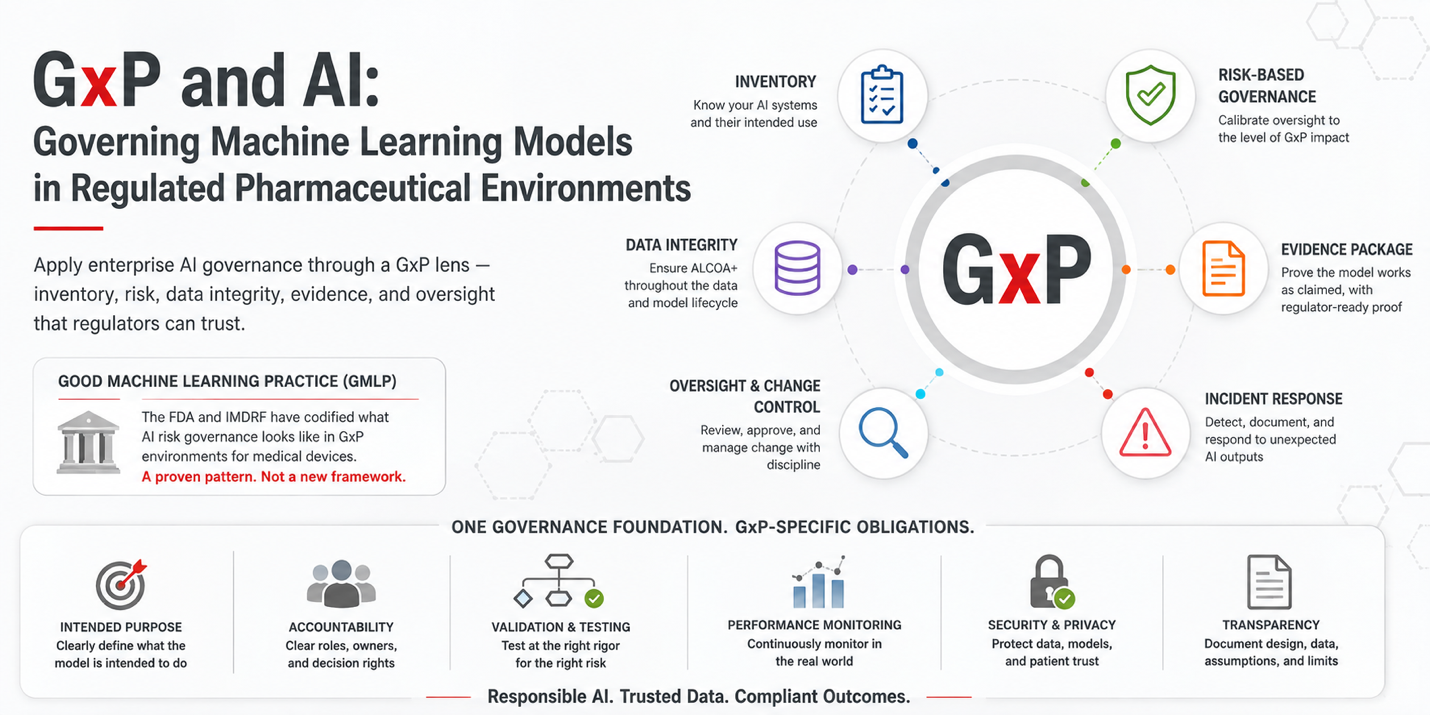
GxP and AI: Governing Machine Learning Models in Regulated Pharmaceutical Environments
Executive Summary: Article Overview
IF4ITThe Bottom Line
Core Article Pillars
| Article Pillar / Focus Area | Strategic Business Outcome & Intent |
|---|---|
| AI Agent Inventory | Tags GxP-relevant models into the existing AI Agents Inventory’s Compliance and Regulatory attributes rather than standing up a parallel, GxP-specific AI registry. |
| Risk-Based Governance | Applies IF4IT’s existing AI risk governance discipline through a GxP lens, with GMLP as the concrete, regulator-codified instance of what that looks like. |
| Evidence Package | Treats the AI Governance Evidence Package as the AI-system equivalent of a computer system validation summary report. |
| Data Provenance | Extends GxP’s ALCOA+ data integrity requirements backward to the data a model is trained and validated on. |
| Incident Response | Treats an unexpected AI output in a GxP-relevant process as a deviation to document, not a failure to hide. |
Quick Q&A (Macro Executive Reference)
Question: Does governing AI in a GxP-regulated environment require a completely new governance framework?
Question: Is Good Machine Learning Practice a separate governance framework from IF4IT's general AI governance approach?
Read Full Article Below
Machine learning models are entering GxP-regulated processes fast — flagging anomalies in manufacturing batch data, helping identify candidate compounds in early drug discovery, triaging adverse event reports for pharmacovigilance signal detection. The instinct, when a new technology touches a regulated process, is to build governance for it from scratch: a dedicated AI compliance committee, a bespoke review process, a parallel set of controls that exists nowhere else in the organization’s governance structure.
That instinct is understandable and usually wrong. IF4IT’s enterprise AI governance discipline already covers the shape of the problem — an inventory of what AI exists and what it does, risk-based governance calibrated to how much a given system actually matters, an evidence package proving a system works as claimed, governance over the data it’s trained on, and a defined way to handle it when something goes wrong. What’s missing for a GxP-relevant AI system isn’t governance; it’s the GxP-specific detail layered onto governance that already exists. Good Machine Learning Practice — the guiding principles the FDA and IMDRF have published for AI in medical devices — is proof this layering already happens in practice, not just in theory.
This article maps that layering, discipline by discipline.
Why GxP-Relevant Models Belong in the Existing AI Agent Inventory
A model that flags likely manufacturing deviations, or ranks candidate compounds by predicted efficacy, or scans adverse event narratives for a pharmacovigilance signal — each of these is an AI agent, in IF4IT’s terms, whether or not the team that built it thinks of it that way. The first governance step is the same one that applies to every other AI agent in the enterprise: it goes into the inventory.
That doesn’t mean building a separate GxP AI registry. It means tagging GxP-relevant models into the existing AI Agents Inventory’s Compliance and Regulatory attributes — the same fields IF4IT’s Compliance and Regulatory attributes for the AI Agents Inventory chapter already defines for every AI agent in the enterprise, GxP-relevant or not. A model doesn’t need a special inventory because it happens to touch a regulated process; it needs the regulatory attributes on its existing inventory record populated correctly.
How GMLP Shows What Risk-Based AI Governance Looks Like in Practice
Not every GxP-relevant AI system carries the same risk. A model that drafts a first pass at a batch record summary for a human reviewer to check carries a different burden than a model whose output directly determines whether a batch releases. IF4IT’s Govern AI Risk Across the Enterprise chapter already establishes this as a general discipline — risk governance calibrated to what a system actually does, not a flat rule applied to every AI system equally.
Good Machine Learning Practice is what that general discipline looks like once a regulator has written GxP-specific detail into it. The FDA and IMDRF’s guiding principles cover exactly the categories a risk-calibrated governance discipline would already ask about — data quality, model design transparency, human oversight, real-world performance monitoring — specialized for medical device software specifically. GMLP isn’t a separate framework sitting next to IF4IT’s AI risk governance; it’s a worked example of what that governance produces when a specific industry’s regulator does the specializing.
Why the AI Governance Evidence Package Is the AI Equivalent of a Validation Summary Report
Every GxP discipline eventually asks the same question: how do you prove this actually works, to someone who wasn’t in the room when you built it? For a computer system, that proof is a validation summary report. For an AI system, IF4IT already has a name for it: the AI Governance Evidence Package.
The two play the same structural role. A validation summary report ties requirements, design decisions, and test results into one artifact a regulator can independently verify. IF4IT’s Establish the AI Governance Evidence Package chapter does the same for a model — the training data, the validation approach, the performance monitoring results, tied together into something that turns “we’re confident this works” into something provable. A GxP-relevant AI system’s evidence package needs GxP-specific additions — which discipline the model supports, what regulatory obligation its outputs feed into — but the underlying artifact, and the discipline of assembling it, already exists.
What GxP’s Data Integrity Requirements Mean for the Data That Trains a Model
GxP has a name for what a trustworthy record requires: ALCOA+ — attributable, legible, contemporaneous, original, accurate, and more. A model is only as trustworthy as the data it was trained and validated on, which means that same discipline has to extend backward, to the data itself, before a model ever produces an output.
IF4IT’s Govern the Data and Information That Feeds AI chapter already treats this as a governance requirement — knowing where training data came from, whether it was complete, whether it’s been altered since. For a GxP-relevant model, that general requirement gets a specific answer: the data feeding the model has to meet the same ALCOA+ standard the GxP discipline it supports already requires of every other record.
Why an Unexpected AI Output Is a Deviation, Not a Failure to Hide
Every GxP discipline has a name for something that didn’t go as expected: a deviation, formally documented and investigated, not quietly corrected and forgotten. A model that produces an unexpected or incorrect output in a GxP-relevant process deserves the same treatment, not a quiet retrain and a hope nobody asks.
IF4IT’s Respond to AI Incidents and Preserve Governance Evidence chapter already establishes the general discipline: preserve the evidence, investigate what happened, document the resolution. Applied to a GxP-relevant model, that discipline has a regulatory audience waiting on the other end of it — the same one that already reviews every other deviation in the process the model supports.
Learn More
This article draws on three documents in the IF4IT library. For the complete enterprise AI governance discipline this piece draws five specific chapters from, see IF4IT’s Enterprise AI Governance Best Practices document. For the complete attribute structure of the AI Agents Inventory beyond the Compliance and Regulatory fields discussed here, see AI Agents Inventory and Attributes.
For how GMLP fits into the GxP Compliance Framework’s own method for identifying emerging disciplines — the method GMLP is used as a worked example of — see “Identify Additional or Emerging Forms of GxP Relevant to Your Enterprise” in the GxP Compliance Framework.
Back to Articles PageHow to cite this page
When referencing this page in academic work, internal standards, or external publications, include the page title, IF4IT as author and publisher (The International Foundation for Information Technology (IF4IT), LLC), the URL, and your access date.
Example (informal web citation):
The International Foundation for Information Technology (IF4IT), LLC. GxP and AI: Governing Machine Learning Models in Regulated Pharmaceutical Environments. https://if4it.org/articles/2026-08-17-gxp-and-ai-governing-machine-learning-models-in-regulated-pharmaceutical-environments/ (accessed 2026-09-11).
See About Us for content governance and site-wide citation guidance.