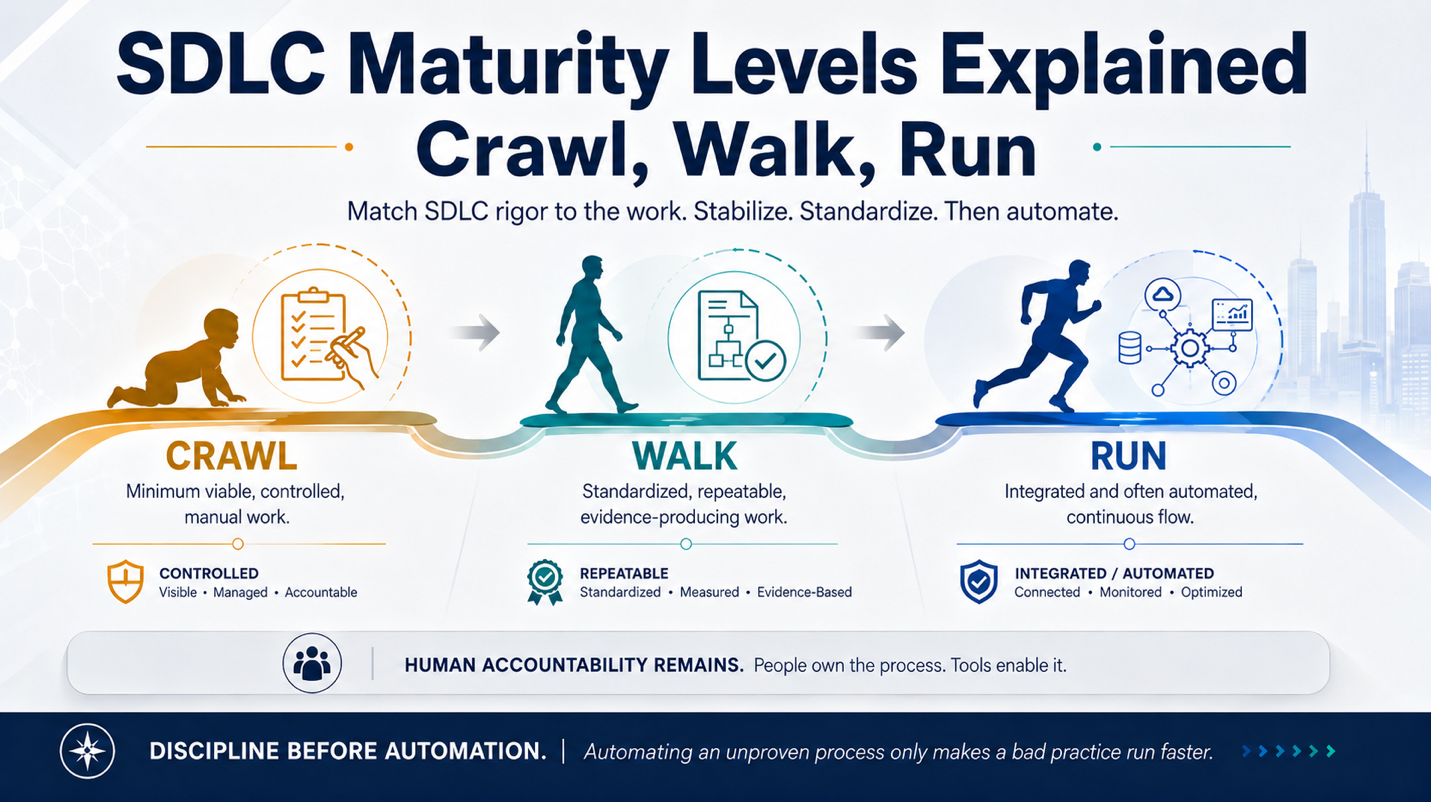
SDLC Maturity Levels Explained — Crawl, Walk, Run
Executive Summary: Article Overview
IF4ITThe Bottom Line
Core Article Pillars
| Article Pillar / Focus Area | Strategic Business Outcome & Intent |
|---|---|
| Plain-Language Maturity Levels | Replaces vague maturity jargon with three concrete, working definitions of Crawl, Walk, and Run that a team can apply the same day. |
| Correcting Common Misreadings | Corrects the four most common misreadings of Crawl, Walk, Run, including the dangerous assumption that Crawl-level work is inherently careless. |
| Sequencing Discipline Before Automation | Exposes why automating an unproven process only lets a bad practice run faster, and shows how properly earned automation instead funds the next stage of maturity. |
| A Five-Minute Self-Diagnostic | Equips readers with a short, practical set of questions to assess their own team’s real maturity level per discipline, not per enterprise. |
Quick Q&A (Macro Executive Reference)
Question: Does reaching Crawl maturity mean an SDLC practice is careless or unreliable?
Question: How does an enterprise actually move from Crawl to Walk to Run?
Read Full Article Below
Ask an IT leader to explain their organization’s SDLC maturity level, and many will struggle — not because the concept is complicated, but because most explanations reach for five-level charts and consulting jargon instead of a plain answer.
Crawl, Walk, and Run are the three levels that actually matter, and each one answers a single practical question: how much process rigor does this specific piece of work actually need right now? Not a score to chase. Not a badge for a slide. A working lens IT leaders and practitioners can apply to a single team, a single discipline, or a single Release, starting today.
What Crawl, Walk, and Run Actually Mean
The three levels need plain definitions first, not organizational archetypes, but descriptions of how a specific piece of work gets done.
Crawl is the minimum viable, controlled way to do the work. It is manual, but it is not sloppy — every outcome the work requires still has to be met, just without standardized tooling or repeatable process behind it.
Walk is standardized and repeatable. The same work gets done the same way regardless of who is doing it, and it produces real evidence, not just a memory of what happened, but something a reviewer could actually check.
Run is integrated, and often significantly automated. The practice runs continuously rather than as a discrete event, but a human remains accountable for what it produces — automation removes toil, not ownership.
A simple, non-technical example makes the distinction concrete…
A single home cook checking a recipe by eye is Crawl.
A restaurant kitchen following a written, tested recipe card for every dish is Walk.
A commercial food line with calibrated equipment, continuous monitoring, and a line supervisor who still owns the outcome is Run.
Nothing about Crawl is careless, since the dish still has to come out right, just without the standardization or instrumentation later stages add.
What the Levels Do Not Mean
Understanding what the three levels mean is only half the explanation — knowing what they do not mean is what keeps this from collapsing into guesswork the moment someone misapplies it.
Myth: Crawl means risky or careless. Crawl still has to satisfy every non-negotiable outcome the work requires; it simply does so informally rather than through tooling. The actual risk is not operating at Crawl — it is using Crawl as an excuse to skip an outcome, or letting a deferred decision go untracked rather than being governed. An SDLC practice that defers something at Crawl maturity still needs a named owner and a plan for that obligation. Left ungoverned, a deferred decision quietly becomes exactly the kind of invisible liability that Technical Debt Management Best Practices exists to catch before it compounds.
Myth: higher maturity is always better. Maturity should improve outcomes, not maximize process for its own sake. Pushing a low-stakes, one-off task to Run-level rigor is its own antipattern — proportionality matters as much as progression.
Myth: an enterprise has a single maturity level. Maturity is assessed per discipline, not per organization. A team’s security controls can be at Run-level maturity while its IT Operating Environment provisioning is still at Crawl, and that is a legitimate allocation of limited attention, not a contradiction to fix.
Myth: maturity and delivery methodology are the same axis. Agile, Waterfall, and Hybrid delivery are a fit-for-purpose choice, not a maturity ladder — treating one as inherently more mature than another conflates two different questions and leads teams to chase a methodology instead of the rigor the work needs.
The Discipline That Makes or Breaks Automation
This is where the framework earns its keep, and where most of its value gets missed.
The risk runs one direction: enterprises reach for Run-level tooling before the underlying Crawl-level practice was ever solid. Automating an unverified process does not produce a mature practice — it produces a broken one running faster, and further, before anyone notices.
The payoff runs the other direction, and it depends entirely on getting the first part right. Automating a process that has genuinely earned trust at Walk does not just reduce manual toil — it releases the exact human capacity that funds the next advance. A team that stops manually reconciling deployment evidence gets that time back to standardize the next discipline, or support another team’s Crawl stage. The flywheel only spins in the right direction when what gets automated was actually earned first.
A Five-Minute Self-Diagnostic
Applying this to a real team needs no formal assessment — a few plain questions, asked honestly about one discipline, usually surface the real answer faster than any survey:
Is there a named owner for this practice, or does it depend on whoever happens to be available?
Is the work done the same way regardless of who does it, or does quality depend on which person is doing it this week?
If something goes wrong, is there evidence of what actually happened, or only someone’s memory of it?
Is anything here being automated because it is genuinely reliable, or because automating it felt like the next thing to do?
That last question is the one worth sitting with longest. It is the fastest way to catch a team automating its way past a problem instead of solving it.
Moving From One Level to the Next
Advancing maturity is not a transformation program. It is a small, deliberate sequence, repeated per discipline: stabilize minimum control at Crawl, standardize the same practice with real evidence at Walk, then integrate, and automate at Run where it makes sense.
The capacity that funds each move is the one earned above. A discipline does not advance to Walk because a calendar says it is time; it advances because the Crawl-level practice is solid enough to standardize, and because someone has the bandwidth to do it — bandwidth that, more often than not, came from properly automating something else first.
The same lens applies just as directly to how a Release itself gets managed, not only to the lifecycle work that surrounds it — a Release process can be every bit as Crawl, Walk, or Run as the discipline producing what gets released.
Learn More
This is a focused explanation of the three levels, not the complete framework. The full, phase-by-phase treatment of SDLC maturity is covered in the Systems Development Lifecycle (SDLC) Best Practices document, particularly its chapter Crawl, Walk, and Run Maturity Across the Systems Development Lifecycle (SDLC) — which covers how maturity applies across security, testing, evidence, environments, and dozens of other disciplines. Enterprises ready to plan the next stage deliberately can turn to its companion chapter, Develop an SDLC Maturity Improvement Roadmap.
The same lens governs Release Management Best Practices, since how a Release itself gets planned, evidenced, and closed is its own maturity question, separate from the lifecycle work around it.
This pattern is not unique to software delivery. IF4IT applies the same underlying philosophy to other disciplines as a matter of course, including a dedicated treatment in The IF4IT Service Management Maturity Framework (IF4IT-SMMF) for Small, Midsized, and Large Enterprises, for readers whose next question is about service delivery rather than the SDLC.
Back to Articles PageHow to cite this page
When referencing this page in academic work, internal standards, or external publications, include the page title, IF4IT as author and publisher (The International Foundation for Information Technology (IF4IT), LLC), the URL, and your access date.
Example (informal web citation):
The International Foundation for Information Technology (IF4IT), LLC. SDLC Maturity Levels Explained — Crawl, Walk, Run. https://if4it.org/articles/2026-08-18-sdlc-maturity-levels-explained-crawl-walk-run/ (accessed 2026-10-16).
See About Us for content governance and site-wide citation guidance.