Value Streams Depend on Enterprise Capabilities
Executive Summary: Article Overview
IF4ITThe Bottom Line
Core Article Pillars
| Article Pillar / Focus Area | Strategic Business Outcome & Intent |
|---|---|
| Why Naming Isn’t Governing | Shows why a value stream that exists only as a name in a workshop diagram cannot answer the one question every executive eventually asks about it. |
| Two Inventories, One Relationship | Establishes exactly where Value Streams and Capabilities should be recorded, and why the connection between the two inventories carries more governance value than either alone. |
| Where AI’s Advantage Is Sharpest | Distinguishes AI’s routine help building either inventory from its more valuable, harder-to-replicate advantage: surfacing the scattered relationships between value streams and the capabilities that deliver them. |
| A Narrow, Practical Starting Point | Gives readers a deliberately small, practical first step: a handful of business-critical value streams, rather than an overwhelming attempt to map the entire catalog at once. |
Quick Q&A (Macro Executive Reference)
Question: Isn't naming and mapping value streams just a workshop exercise IT already did once?
Question: Where should an enterprise actually start if neither inventory exists yet?
Read Full Article Below
Ask an enterprise to produce its authoritative list of value streams, and the conversation usually stalls somewhere around a workshop diagram from eighteen months ago. Everyone recognizes the names — Order to Cash, Hire to Retire — but no one can produce a governed record with a real owner, a stable definition, and a defensible reason it belongs on the list.
A value stream that only exists as a name on a slide isn’t governed. It’s remembered. Those are not the same thing, and the difference matters the moment someone asks what it would take to improve one.
What a Value Stream Actually Is
A value stream is the end-to-end flow of activity that delivers a specific outcome to a customer or stakeholder — not a department, not a system, a sequence of work. Order to Cash is a value stream because it moves work across many teams and systems toward one outcome: a customer’s order becomes fulfilled revenue. No single department owns that outcome alone, which is exactly why value streams are so easy to name informally and so hard to govern formally.
A Value Stream Without Capabilities Is Just a Name
Naming a value stream costs nothing. Writing “Order to Cash” on a slide, in a strategy deck, or in a governance charter proves nothing about whether the enterprise understands or controls it.
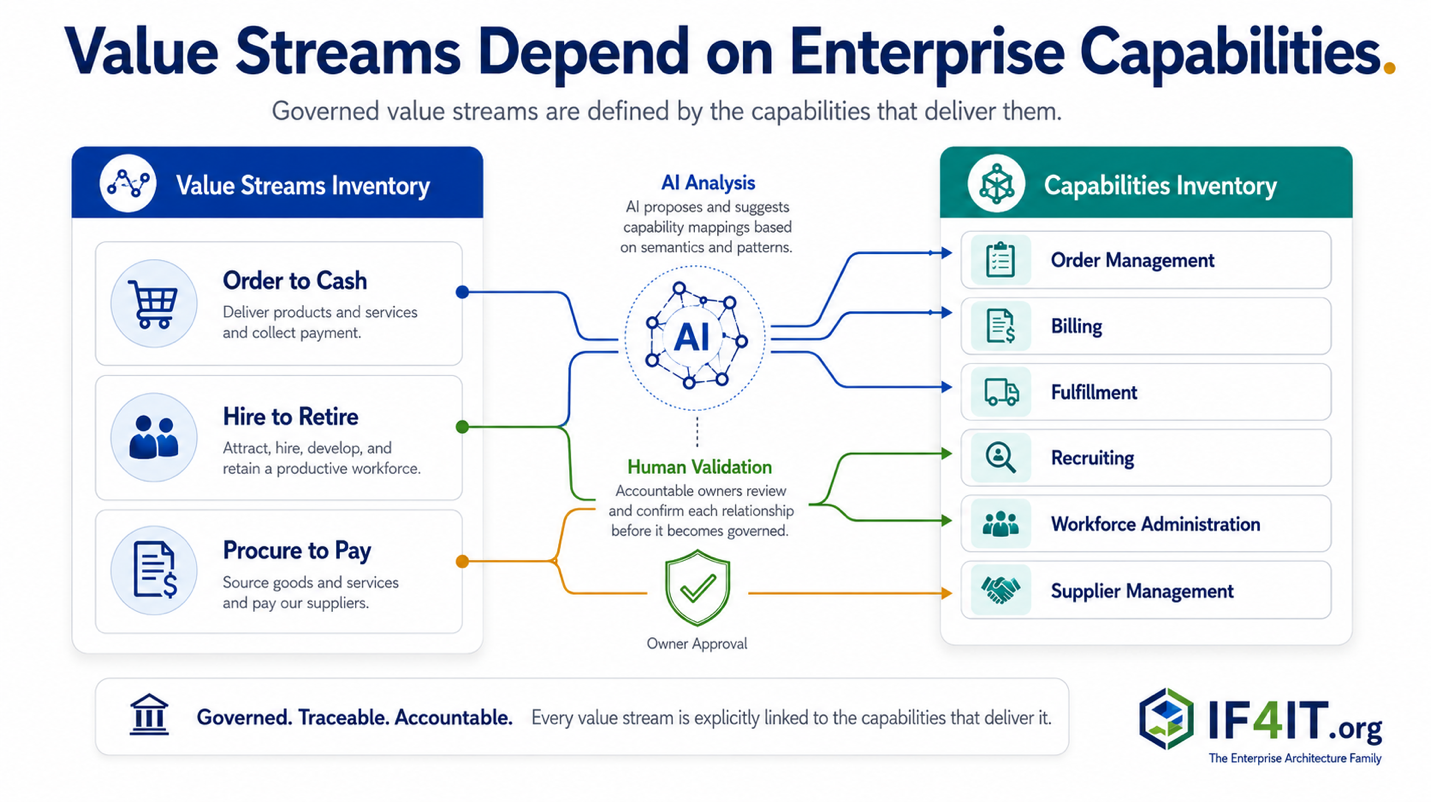
A value stream becomes governable only once it is tied to the specific capabilities that actually deliver it — the discrete, ownable pieces of enterprise ability that do the work the value stream describes. Order to Cash, for example, does not run on its own. It runs on capabilities such as Credit Risk Assessment, Order Fulfillment, Invoicing, and Accounts Receivable Management, each with its own owner and maturity. Without that capability link, an enterprise cannot answer the one question every executive eventually asks: which capability, specifically, needs investment to improve this outcome? A name on a slide has no answer. A value stream mapped to its capabilities does.

Where Each Inventory Lives, and Why the Relationship Matters Most
The mechanics are simple to state, even though they are rarely done well. Enterprise Value Streams belong in the Value Streams Inventory and Attributes document — a governed record of every value stream, its definition, and its accountable owner. Enterprise Capabilities belong in the Capabilities Inventory and Attributes document, held to the same governance standard.
Neither inventory means much on its own. A Value Streams Inventory without capability links is a list of names with better formatting. A Capabilities Inventory without value-stream links is a catalog of abilities nobody has connected to outcomes. The governance value that actually matters sits in the relationships between the two inventories — specifically, which capabilities deliver which value streams. Those relationships need to be recorded as explicit, maintained links, not inferred from a diagram nobody has opened since the workshop that produced it.
Where AI Actually Helps, and Where It Doesn’t
AI can help build and maintain either inventory on its own. It can read process documentation, capability catalogs, and organizational records to draft a first pass at a Value Streams Inventory or a Capabilities Inventory, then help keep either current as the underlying business changes. That is a genuinely useful application of AI to enterprise inventories, and IF4IT has covered it in more general depth in Using AI to Build and Maintain Enterprise Inventories and Models.
Building each inventory in isolation, though, is the easier half of the problem. The harder, more distinctive problem is the mapping between them: knowing exactly which capabilities are behind each value stream. That mapping, not either inventory alone, is what determines whether the whole exercise means anything. That relationship knowledge, however, rarely lives in one place. It is scattered across process documentation that describes how work flows, capability definitions that describe what the enterprise can do, and the tribal knowledge of whoever has worked across enough of the organization to see both sides at once. No single person usually holds all of it.
This is exactly the kind of cross-source synthesis AI is well-suited to accelerate. Given a reasonably complete Value Streams Inventory and a reasonably complete Capabilities Inventory, AI can propose the links between them by reading the same fragmented documentation a human would otherwise have to track down manually. That lets it surface candidate relationships far faster than an enterprise could produce them by convening the right people in one room.
What AI should not do is own the result. A proposed relationship between a value stream and a capability is a draft, not a governed fact, until an accountable owner confirms it holds. The moment an unverified AI-proposed link gets treated as authoritative, the inventory stops being governed and becomes exactly what it was trying to replace: something everyone assumes is accurate because no one has checked.
A Practical Way to Start
Trying to inventory and map every value stream and every capability at once is a reliable way to stall before starting. A better first step is deliberately narrow: pick three to five value streams the business already considers critical, not the full catalog.
For each one, ask two plain questions. Who owns this value stream — a real, named, accountable person, not a department? And which capabilities, each with their own named owner, deliver it? For Order to Cash, that second question means naming who owns Credit Risk Assessment, who owns Order Fulfillment, who owns Invoicing — not just whoever is associated with the value stream’s name. Where the answer to either question is unclear or contested, that is not a gap to paper over. It is useful information in its own right: it means the value stream was never actually governed, no matter how long its name has been circulating in strategy decks.
Learn More
This article covers the relationship between two governed inventories, not the complete methodology for either one. The Value Streams Inventory and Attributes document is the authoritative source for how a value stream itself should be defined and recorded. The Capabilities Inventory and Attributes document does the same for capabilities.
Both inventories are governed within the broader discipline covered in Enterprise Inventory Management Best Practices, which treats connected, cross-referenced inventories as the goal rather than isolated lists maintained independently of each other.
Readers who want the general treatment of AI-assisted inventory building, beyond the cross-inventory mapping problem this article focuses on, can find it in Using AI to Build and Maintain Enterprise Inventories and Models.
Back to Articles PageHow to cite this page
When referencing this page in academic work, internal standards, or external publications, include the page title, IF4IT as author and publisher (The International Foundation for Information Technology (IF4IT), LLC), the URL, and your access date.
Example (informal web citation):
The International Foundation for Information Technology (IF4IT), LLC. Value Streams Depend on Enterprise Capabilities. https://if4it.org/articles/2026-08-18-value-streams-depend-on-capabilities/ (accessed 2026-09-11).
See About Us for content governance and site-wide citation guidance.