Successful Knowledge Management Requires Enterprise Inventories
Executive Summary: Article Overview
IF4ITThe Bottom Line
Core Article Pillars
| Article Pillar / Focus Area | Strategic Business Outcome & Intent |
|---|---|
| The KM Blind Spot | Establish why inventories fall outside where Knowledge Management programs typically look, and why closing this gap expands KM’s effective scope. |
| Inventories as Knowledge Assets | Show that structure, consistency, and relationships make inventories a distinct and complementary knowledge asset class, not administrative data. |
| Freshness and Efficiency by Design | Explain why inventories resist the staleness that affects documents, and how each instance functions as an efficient, prose-free knowledge record. |
| From Inventories to the Enterprise Model | Demonstrate how governed, connected inventories enable cross-domain reasoning that no single document can answer. |
Quick Q&A (Macro Executive Reference)
Question: Why should Knowledge Managers care about enterprise inventories?
Question: What is the difference between a collection of inventories and an Enterprise Model?
Read Full Article Below
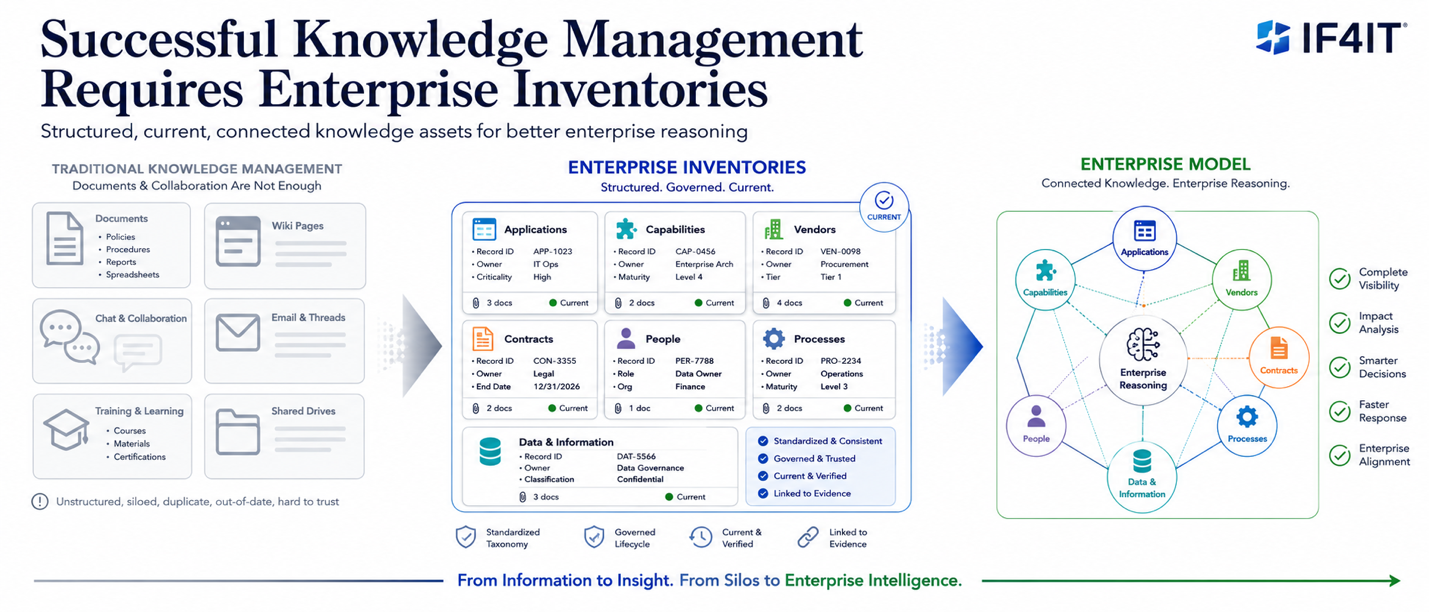
Knowledge Management is not short on subject matter. Practitioners in the discipline speak fluently about documents and documentation systems, communications platforms, collaboration tools, and teaching-and-learning programs — the visible surface of how knowledge moves through an organization. What Knowledge Managers rarely name — and even more rarely bring under Knowledge Management governance — are the enterprise’s inventories: the governed, structured lists of applications, capabilities, vendors, contracts, people, processes, and dozens of other categories of things the enterprise depends on.
That gap matters: inventories are not administrative side records; they are knowledge, expressed in a form that is more consistent, more current, and more connective than much of what traditional Knowledge Management already manages. An enterprise that practices Knowledge Management without extending it to inventories is managing only part of what it knows about itself — and, increasingly, only part of what its own AI systems can reliably reason over. Successful Knowledge Management requires enterprise inventories, not as a peripheral concern, but as a core knowledge asset class the discipline has largely left unclaimed.
Where Knowledge Management Stops Looking
Ask a Knowledge Manager to describe the scope of their discipline, and the answer is fairly predictable. It includes document and documentation management: policies, procedures, runbooks, and reference material. It includes communications and collaboration platforms: wikis, intranets, messaging tools, shared workspaces. It includes teaching and learning: onboarding material, training programs, certification tracking. All of this is legitimate and necessary Knowledge Management territory.
What is consistently absent from that scope is the enterprise’s inventories. Customer relationship management systems, product management systems, contract management systems, human resources systems, vendor management tools, and — eventually, once an organization matures its practice — configuration management databases all hold governed, structured records of things the enterprise depends on. These systems sit outside where Knowledge Management programs typically look, because they were built and are owned by other functions: sales operations, product organizations, legal and procurement, human resources, and IT operations.
That ownership boundary is an organizational accident, not a statement about whether the content inside these systems is knowledge. A Contracts inventory record, a Vendor record, an Application record — each is a governed, current, structured account of something the enterprise needs to understand and manage. The fact that Knowledge Management does not currently claim this territory does not mean the territory falls outside Knowledge Management’s proper scope. It means the discipline has an opportunity in front of it that most practitioners have not yet recognized.
Why Inventories Are Knowledge Assets
An inventory earns the label “knowledge asset” for reasons that go beyond simply holding data. The first reason is structural: knowing that an inventory is organized around a specific Noun Type — Applications, Vendors, Capabilities, Contracts, and so on — tells a reader what kind of thing they are looking at and how its instances relate to those in other inventories. Structure is not incidental to the data; it is part of what the data means.
Consistency is the second reason. Because every instance within an inventory shares the same governed attributes, an inventory makes it possible to compare, aggregate, and score every instance of a given type using the same measures. A single well-written document can describe one application in useful detail. An inventory can describe every application the enterprise operates, using the same attributes, the same scoring logic, and the same metrics for each one — and it is precisely that consistency across instances that makes enterprise-scale comparison, benchmarking, and decision-making possible in the first place.
This creates two distinct and complementary forms of cross-cutting knowledge. The first is cross-cutting within a Noun Type: comparing, aggregating, or ranking every instance of a single inventory — every Application, every Vendor, every Contract — using consistent attributes. The second is cross-cutting across Noun Types: connecting different inventories to one another through shared attributes and semantic relationships. This works the way relational data has long connected records, pairing primary and foreign keys with descriptive attributes, so a question can be answered by traversing multiple inventories at once rather than reading any single one in isolation.
Neither form of cross-cutting knowledge is available from a document, however well-written. A document can describe a single thing thoroughly. Only a governed, structured, connected inventory can describe every instance of a thing consistently, and only a set of connected inventories can answer a question that spans more than one kind of thing at once.
Freshness Is Structural, Not Aspirational
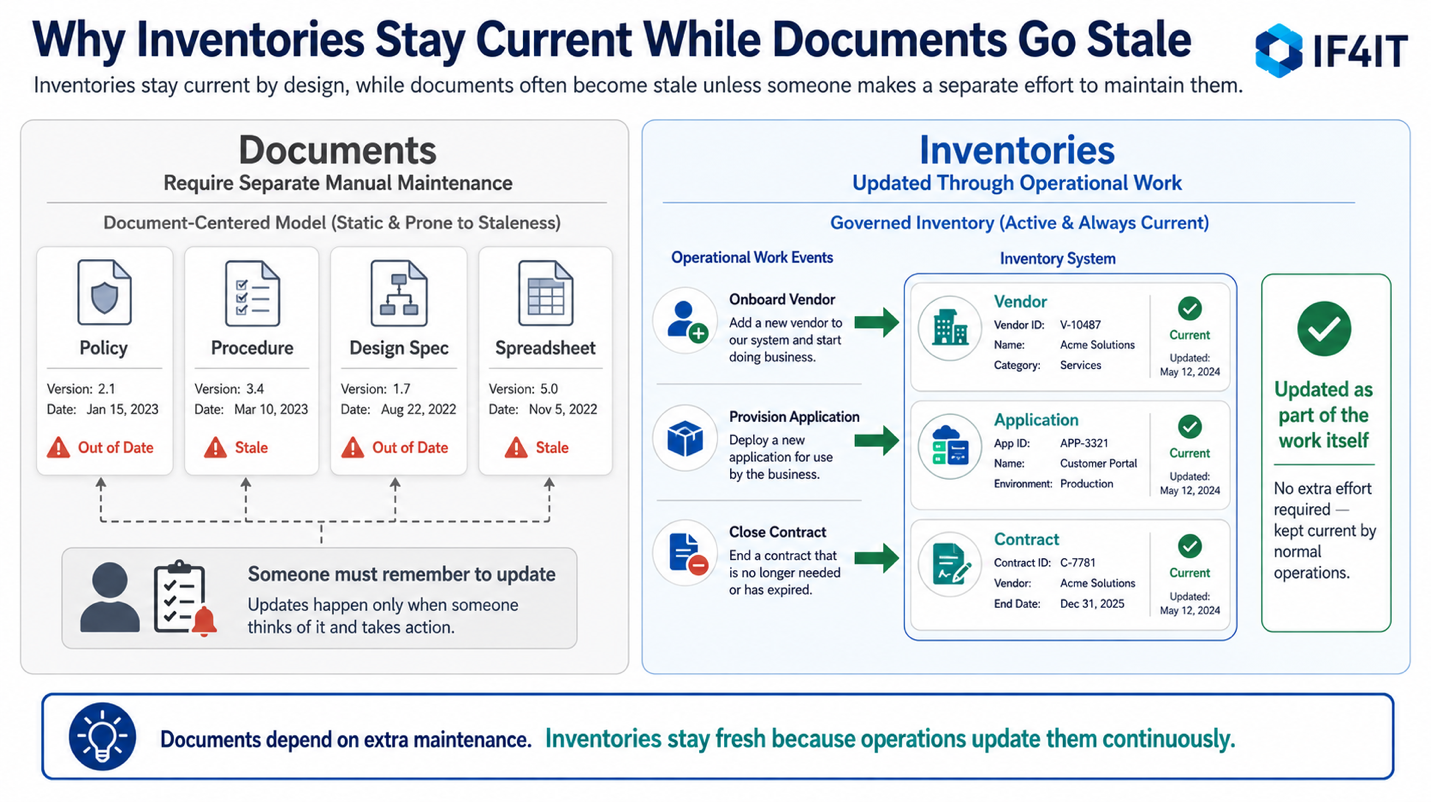
Knowledge Management has always struggled with one problem more than any other: knowledge decays. A document is accurate the day it is written and less accurate every day after, as the systems, policies, and people it describes continue to change while the document itself does not. Inventories stay fresh because they are part of daily operations, unlike documents which very often go stale, especially when their authors move on to new opportunities.
That structural advantage exists because inventories are touched as a byproduct of the work itself. Onboarding a new vendor updates the Vendor inventory. Provisioning a new application updates the Application inventory. Closing a contract updates the Contract inventory. None of these updates happen because someone remembered to maintain documentation; they happen because the operational task itself required touching the record. A document requires someone to choose, separately from their operational work, to go back and update it — and that choice competes with every other demand on their time.
That same operational involvement also means an inventory is rarely watched by only one person. A document typically has a single author and relatively few readers checking it for accuracy. An inventory record is used by everyone who touches the operational process it supports — the team provisioning the application, the team supporting it, the team budgeting for it, the team auditing it — and each of them has a reason to notice when the record is wrong. More eyes and more hands on the same data make errors and staleness far more likely to be caught and corrected than they would be in a document only one person is responsible for maintaining.
Knowledge Management has spent decades fighting document staleness as an unavoidable cost of doing business. Inventories offer a knowledge asset class where that fight is, at minimum, a fairer one.
Every Inventory Instance Is an Efficient Mini-Document
There is a second advantage to inventories that Knowledge Management has generally overlooked: efficiency of form. A typical document — a policy, a design specification, a reference guide — carries substantial prose overhead: context-setting, transitions, qualifications, and narrative structure that exist to make the document readable as a piece of writing. Much of that prose is necessary for a document meant to be read start to finish, and much of it is also, from a pure knowledge-density standpoint, wasted space.
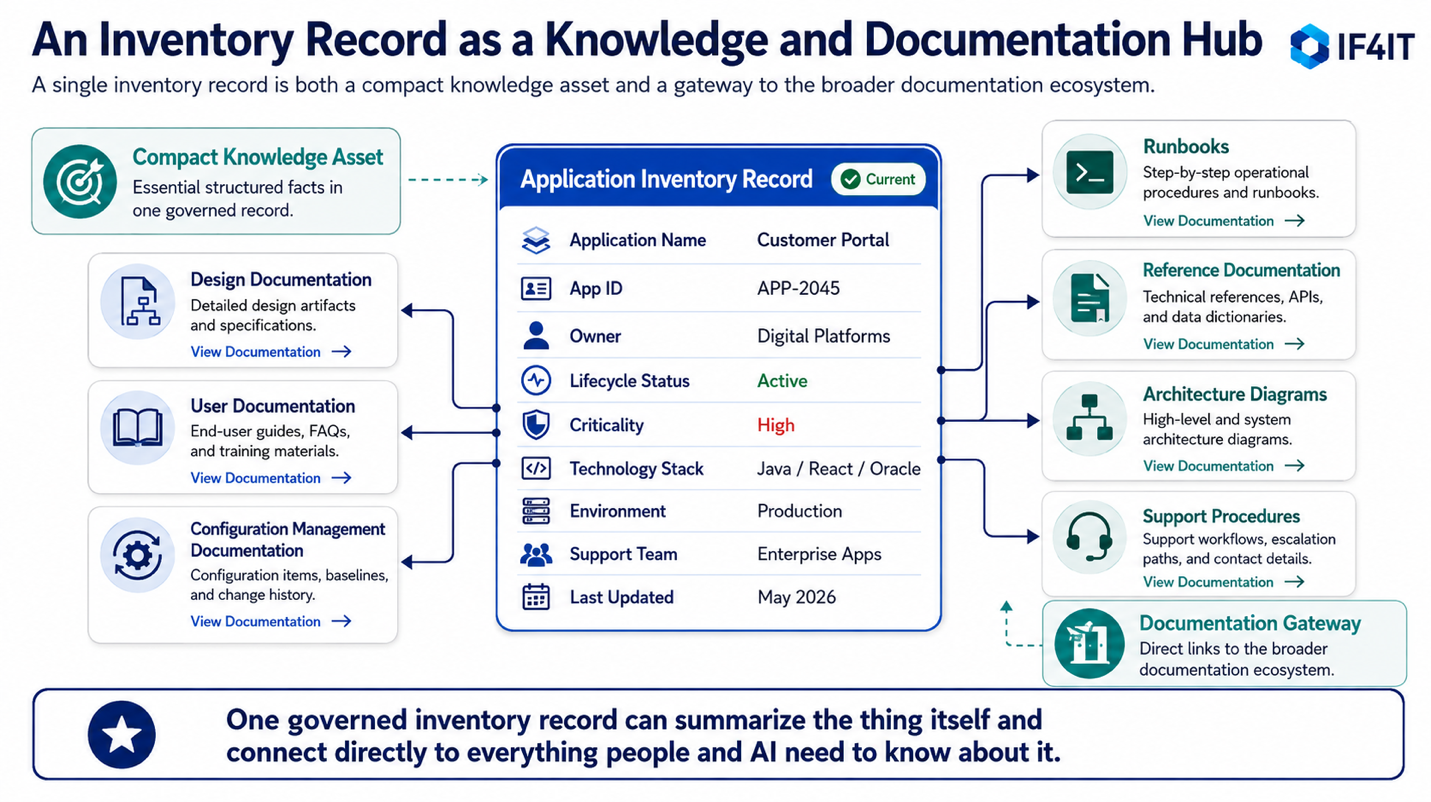
An inventory instance carries none of that overhead. Each record in a governed inventory is, in effect, a mini-document: it holds exactly the structured facts a reader needs to know about that specific instance — an Application’s owner, technology stack, lifecycle status, and criticality; a Contract’s counterparty, term, and renewal date — with no narrative padding required to make it readable. The record is not a lesser or informal substitute for documentation. It is documentation, compressed to its essential, structured content.
For a Knowledge Management discipline increasingly concerned with the volume of content it is responsible for governing, that compression matters. An inventory of a thousand instances is a thousand efficient knowledge records maintained at a fraction of the authoring and maintenance cost of a thousand equivalent narrative documents.
Inventories as Documentation Hubs
Inventories do more than replace some of the work documents used to do. They also make the documents that remain easier to find and use — a role that matters more, not less, as AI systems become a primary way people and tools locate information.
Consider a Contracts inventory. Each Contract instance is a mini-document holding the key data and information about that specific contract — counterparty, term, obligations, renewal date — and it also carries pointers to the full contract documentation itself. A reader, or an AI system traversing the inventory, does not need to search for the underlying contract; the inventory record leads directly to it.
The same pattern holds for an Applications inventory. Each Application instance is a mini-document describing that application’s essential facts, and it also points to that application’s Design Documentation, User Documentation, Reference Documentation, Configuration Management Documentation, and any other artifacts associated with it. A single inventory record becomes something closer to a table of contents for everything related to that application — kept current because the inventory itself is operationally maintained, not because someone remembered to update a documentation index.
This matters because finding existing documentation is itself a significant and well-documented cost. Research from the McKinsey Global Institute has found that knowledge workers can lose a substantial share of their workweek simply searching for and gathering information that already exists somewhere in the organization. An inventory that connects each governed record to its associated documentation directly addresses that cost — and does so in a form that is not just human-navigable but machine-traversable, which is precisely the structure AI systems need to locate and reason over an organization’s documentation reliably.
The Inventory of Inventories Is the Taxonomy
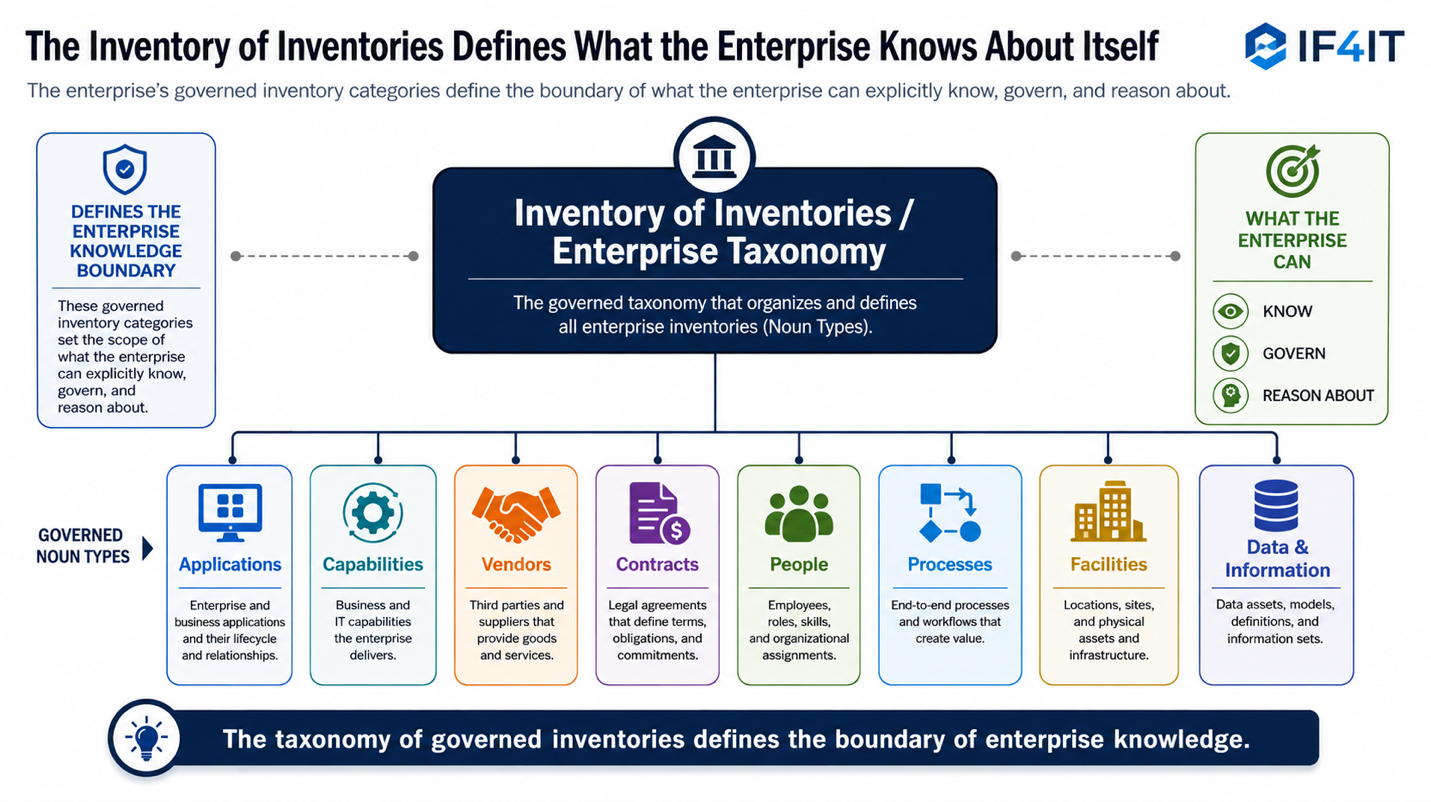
IF4IT has a formal name for the complete catalog of an enterprise’s governed inventories: the Inventory of Inventories. Because every inventory realizes one Noun Type — one category of thing the enterprise has chosen to govern — the Inventory of Inventories is structurally equivalent to the enterprise’s Taxonomy: the catalog that defines the scope of everything the enterprise has chosen to know about itself.
The list of Noun Types an enterprise might govern is broad and representative rather than fixed. It commonly includes People, Internal Organizations, Applications, Capabilities, Vendors, Contracts, Facilities, Data and Information, Processes, and dozens of other categories — the specific set varies by enterprise, industry, and maturity, and no single list is authoritative for every organization. What matters for Knowledge Management is not memorizing a fixed catalog, but recognizing that this catalog — whatever its exact membership at a given enterprise — defines the boundary of what the organization can reliably reason about itself.
A Knowledge Management program that has not mapped itself against its enterprise’s Inventory of Inventories does not know the full boundary of the knowledge it is responsible for. Expanding Knowledge Management’s scope to include inventories starts with recognizing that this catalog exists, that it is already governed elsewhere in the enterprise, and that it belongs inside Knowledge Management’s remit rather than outside it.
From Inventories to the Enterprise Model
The individual advantages of inventories — freshness, efficiency, documentation linkage — compound once inventories are connected to one another. Connected inventories form what IF4IT calls the Enterprise Model: a governed, queryable representation of the enterprise in which inventory instances are nodes and their semantic relationships are edges. The Enterprise Model is where inventories stop being individually useful and start being collectively powerful — capable of answering questions that no single inventory, and no single document, could answer alone.
Consider three examples of the kind of cross-inventory question a connected Enterprise Model makes answerable.
Which applications support a regulated business capability, run on a vendor whose contract expires in the next 90 days, and have an open security vulnerability? Answering this draws on four inventories — Applications, Capabilities, Vendors and Contracts, and Security Vulnerabilities — and is answerable only because each inventory shares consistent, governed attributes tied together through semantic relationships. No single document holds this answer; it has to be assembled live, from four different domains.
Which critical applications have only one person with the skills to support them, and is that person also assigned to any project ending in the next quarter? This one links Applications, Personnel and Skills, and Projects and Initiatives — a direct hit on a fear central to Knowledge Management itself: undocumented tribal knowledge walking out the door. It is answerable only through inventory linkage, not through a wiki page someone forgot to update.
Which technical debt items are tied to applications used by the highest-revenue business capabilities, and which vendors or contracts would be affected by remediating them? Answering this traces a path through Technical Debt, Applications, Capabilities, and Vendors and Contracts — showing how a purely technical inventory becomes strategically meaningful the moment it is linked to business-facing inventories.
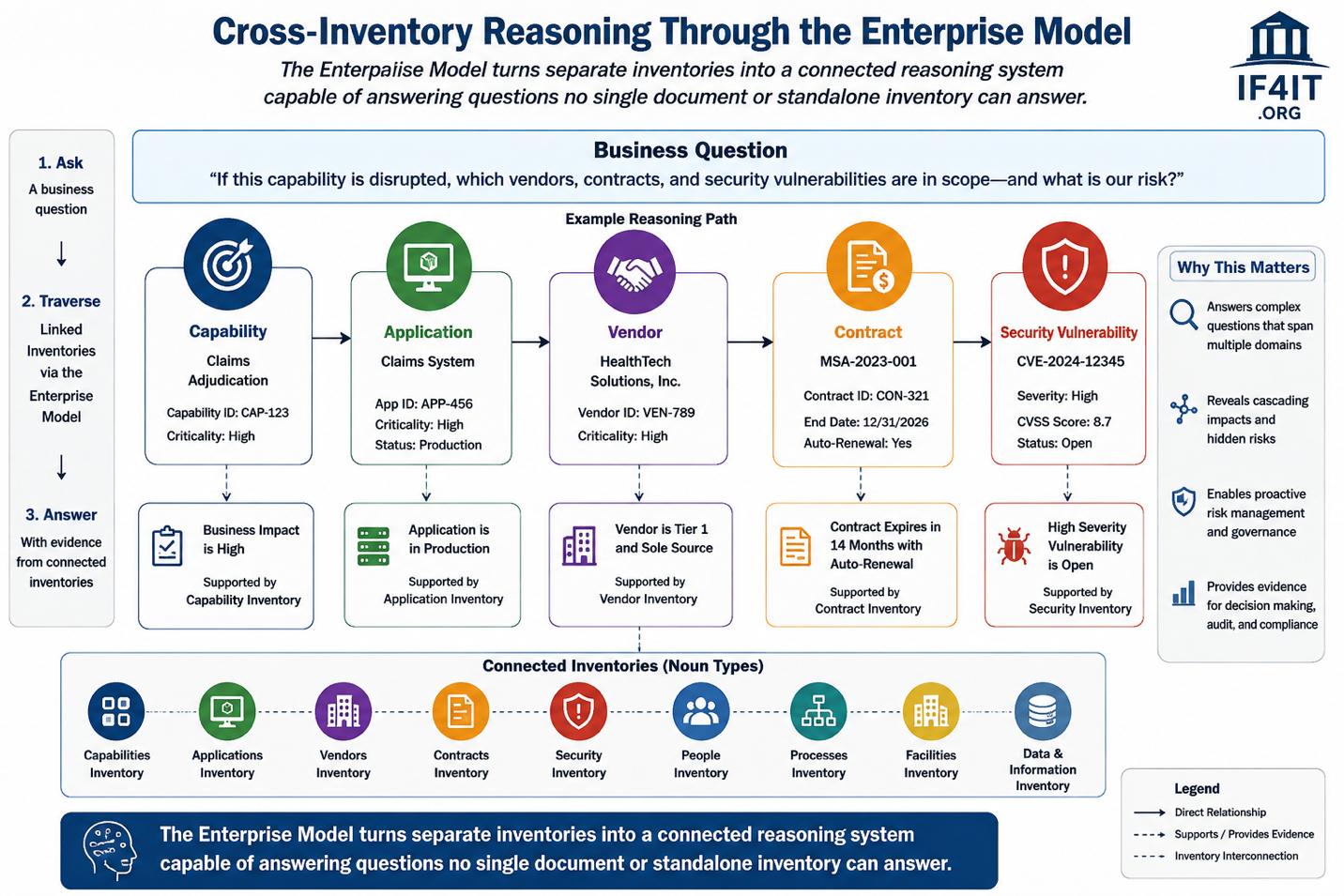
All three questions follow the same shape: a question that sounds like ordinary business reasoning, but that requires cross-Noun-Type linkage to actually answer. This is the payoff a connected Enterprise Model offers Knowledge Management, and it is not available from any collection of documents, however well governed. It is available only from governed, connected inventories.
Learn More
Knowledge Managers ready to extend their discipline’s scope should start with the Enterprise Inventory Management Best Practices document, which covers inventory ownership, governance, and quality practices in full.
The IF4IT Enterprise Model and Modeling Best Practices document covers the Taxonomy, the Inventory of Inventories, and the Enterprise Model in formal detail, including how AI compiles and reasons over the resulting graph.
For the financial, risk, and operational case for enterprise inventories at executive scale, see What You Don’t Know About Your Own Enterprise Is Costing You: Understanding Why Enterprise Inventories Are Critical Knowledge Assets.
For the governance discipline that keeps inventories from going stale despite their structural advantage, see Stale Data Lies — Why an Inventory Is Never “Done”.
For more on how connected inventories compound in value, see Inventories Are Worth More Together — The Network Effect of a Connected Enterprise Model.
And for how a specific inventory type becomes strategically significant once connected to the rest of the enterprise, see Governing Technical Debt as an Enterprise Discipline.
How to cite this page
When referencing this page in academic work, internal standards, or external publications, include the page title, IF4IT as author and publisher (The International Foundation for Information Technology (IF4IT), LLC), the URL, and your access date.
Example (informal web citation):
The International Foundation for Information Technology (IF4IT), LLC. Successful Knowledge Management Requires Enterprise Inventories. https://if4it.org/articles/2026-08-20-successful-knowledge-management-requires-enterprise-inventories/ (accessed 2026-10-16).
See About Us for content governance and site-wide citation guidance.