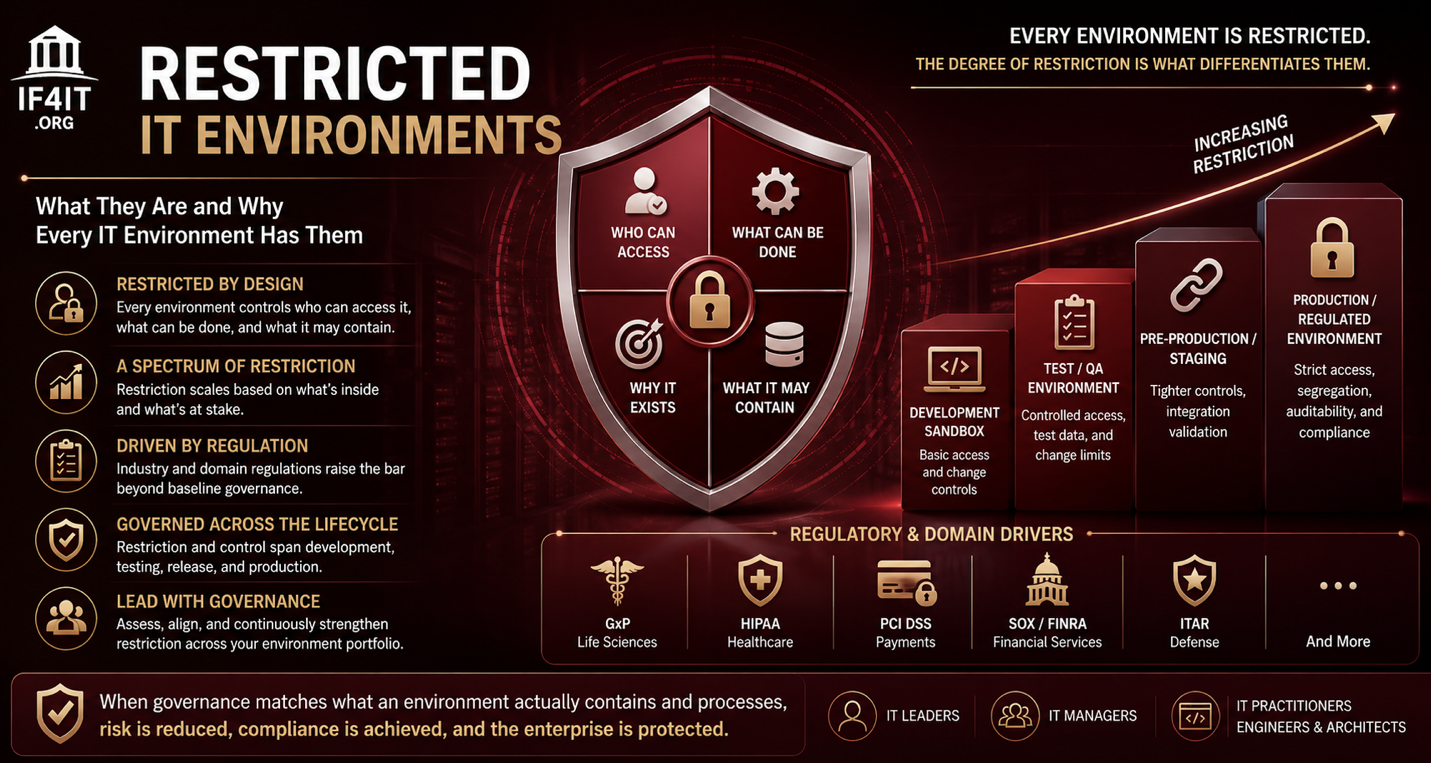
Restricted IT Environments — What They Are and Why Every IT Organization Has Them
Executive Summary: Article Overview
IF4ITThe Bottom Line
Core Article Pillars
| Article Pillar / Focus Area | Strategic Business Outcome & Intent |
|---|---|
| Restriction Is Foundational, Not Exceptional | Establish that every IT environment restricts access, roles, and content by design, reframing “restricted” from a special category into a universal governance property. |
| Restriction Exists on a Spectrum | Show how the baseline governance present in every environment scales upward based on what the environment contains or processes. |
| Regulatory and Domain Drivers Raise the Bar | Demonstrate how industry-specific regulations and compliance obligations push specific environment types toward heightened restriction. |
| Restricted Environments Across the SDLC and Release Lifecycle | Connect restricted environment governance to how software is tested, promoted, and released into production. |
| A Starting Framework for IT Leaders & Practitioners | Give IT leaders and practitioners concrete governance steps for assessing and strengthening restriction across their environment portfolio. |
Quick Q&A (Macro Executive Reference)
Question: What makes an IT environment restricted?
Question: What happens when a restricted IT environment is not properly governed?
Question: How do industry regulations affect IT environment restrictions?
Read Full Article Below
Every IT environment is restricted. This is true whether the environment is a developer’s local sandbox, a shared testing environment, or a production system processing regulated financial transactions — each one controls who can access it, what actions can be performed within it, and what it is permitted to contain. Restriction is not a special governance category reserved for a handful of sensitive systems; it is a defining property of what an IT environment is.
Practitioners searching for guidance on restricted IT environments are often looking for something specific: how to govern an environment that handles regulated data, classified systems, or other high-stakes content. That guidance exists, but understanding it starts from a broader foundation — recognizing that restriction is not an exception applied on top of an otherwise open environment. It is present in every environment by design, and it scales upward based on what that environment contains and what is at stake if its governance fails.
What Makes an IT Environment Restricted
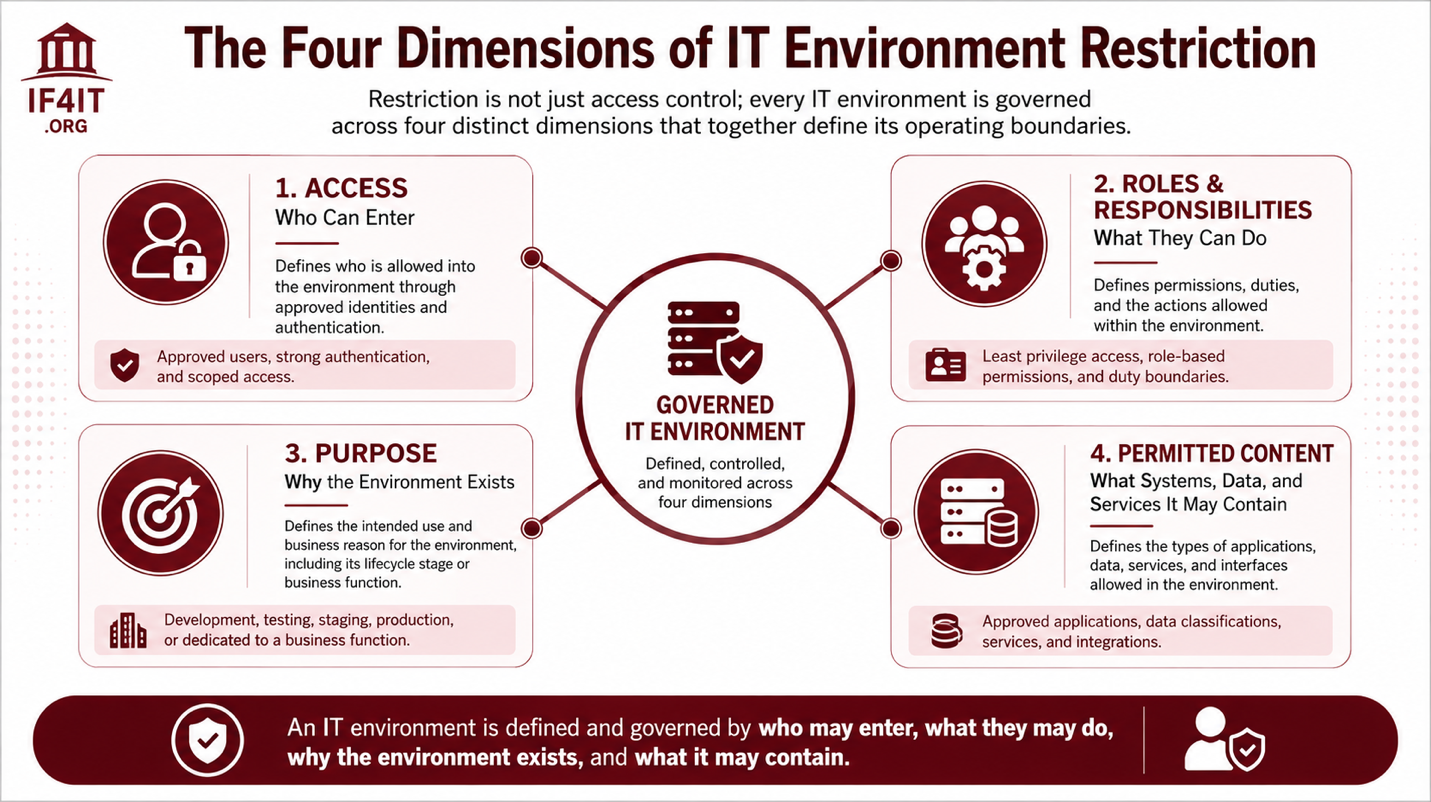
An IT environment restricts four things, in every case: who can access it, what roles and responsibilities govern activity within it, what purpose it serves, and what systems, data, and services it is permitted to contain. These four elements are present in a lightly governed development sandbox just as they are present in a tightly governed production environment handling regulated data — what differs between them is not whether these elements exist, but how strictly each one is enforced.
Access determines who may enter an environment and under what conditions. Even the most permissive development environment restricts access to authorized team members; a production environment simply narrows that access further, often to a small, formally approved group. Once inside, roles and responsibilities determine what a given person is permitted to do — a developer, a tester, and a release manager typically hold different permissions even within the same environment, and that separation exists everywhere, not only in high-stakes systems. The environment’s purpose shapes every other restriction placed on it, since an environment built for testing carries different content and access rules than one built for regulated production processing, precisely because its purpose differs. And what the environment may contain is its own restriction: what data can be loaded into it, what systems can run within it, and what services it may call or expose.
The IF4IT IT Operating Environments Best Practices document is the authoritative source for how these four elements apply across the full range of standard IT environment types, from development through staging to production. It defines the baseline restrictions appropriate to and for each environment type across the Dev, Test, QA, UAT, Staging, and Production lifecycle. IT leaders or practitioners establishing or reviewing environment governance should treat it as the primary reference for that baseline model.
Restriction Is a Matter of Degree, Not Presence
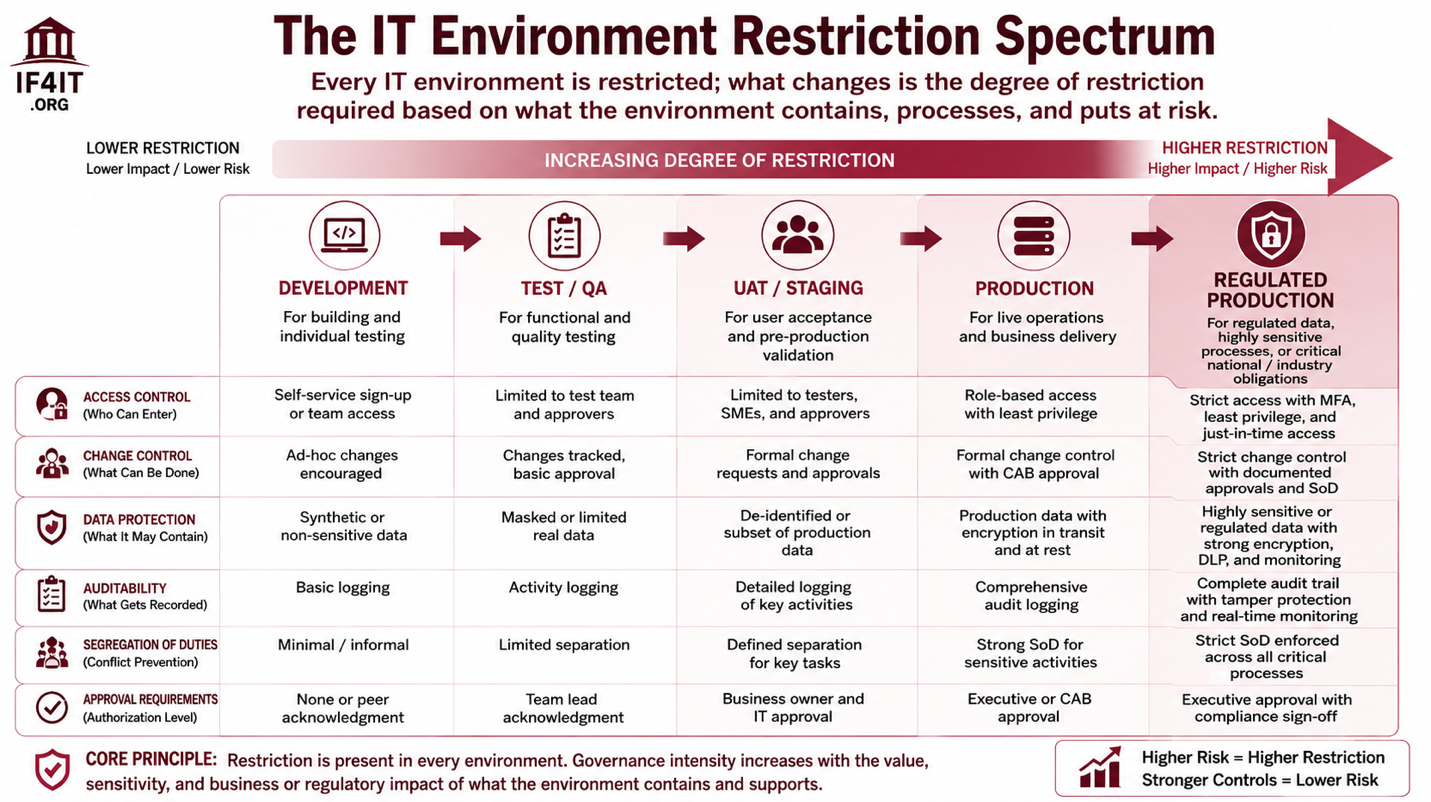
If every IT environment restricts access, roles, purpose, and content, then the meaningful question is never whether an environment is restricted — it always is — but how much restriction a given environment requires. That degree is not arbitrary. It rises in direct proportion to what the environment contains and what would happen if its governance failed.
A development environment used to prototype an internal reporting tool warrants a comparatively light degree of restriction: access limited to the development team, straightforward change tracking, and modest data protection, because the consequences of a lapse are limited. A production environment processing customer financial data warrants a far higher degree: tightly scoped access reviewed on a regular cadence, formal change approval before any modification, comprehensive audit logging, and strict controls over what data may enter or leave the environment — because the consequences of a lapse are severe, and often carry legal or regulatory weight.
This is the spectrum every IT leader or practitioner should have in view when governing their environment portfolio: not a binary choice between restricted and unrestricted environments, but a continuous scale where the appropriate degree of restriction is set by what the environment contains, what it processes, and who or what could be harmed if its governance failed. Understanding where a given environment falls on that scale is the first step toward governing it correctly.
When Restriction Becomes Regulatory
For many environments, the degree of restriction required is set internally, based on an organization’s own risk tolerance and operational needs. For others, it is set externally, by industry or domain-specific regulations that mandate a particular level of governance regardless of an organization’s own preferences. When that happens, restriction stops being a matter of internal judgment and becomes a matter of compliance.
The specific regulations that apply vary widely by industry and domain, and IT leaders and practitioners should identify the ones relevant to their own organization rather than assume any general list is complete. The following examples illustrate how different industries encounter this pattern:
| Industry or Domain | Regulatory or Governance Driver |
|---|---|
| Life Sciences and Pharmaceutical | GxP |
| Financial Reporting | SOX |
| Healthcare | HIPAA |
| Payment Card Processing | PCI DSS |
| Government and Defense | Government and defense-specific security frameworks |
| AI and Sensitive Data Processing | Data protection and AI governance obligations |
This list is illustrative, not exhaustive. IT leaders and practitioners should research and confirm the specific regulations, standards, and other drivers that apply to their own industry and domain, since regulatory obligations vary by jurisdiction, sector, and the specific nature of the data or systems involved. What holds across every one of these examples is the same underlying pattern: a regulatory or compliance framework identifies a category of environment as carrying elevated risk, and mandates a degree of restriction beyond what the organization might otherwise choose on its own.
Why Ungoverned Restriction Fails
When the degree of restriction an environment receives does not match the degree it actually requires, the consequences follow predictable patterns. Access controls looser than what the environment’s content demands open the door to unauthorized access. Monitoring and data handling controls that are not scaled to match what the environment contains make data exfiltration easier to accomplish and harder to catch. Audit logging that is not comprehensive enough to reconstruct who did what, when, lets insider threats go undetected inside a sensitive environment. A regulated environment governed as though it were an ordinary one produces compliance violations as a direct result. And every one of these gaps compounds into audit failure, since an organization cannot demonstrate the very controls it failed to apply.
None of these failure modes result from restriction being applied incorrectly in principle — they result from the degree of restriction falling short of what the environment’s content and context actually require. This is why the assessment described in the previous sections matters in practice: an IT leader or practitioner who correctly identifies where an environment falls on the restriction spectrum, and what regulatory or domain-specific drivers apply to it, is positioned to close these gaps before they become incidents rather than after.
How Restricted Environments Connect to the Systems Development Lifecycle
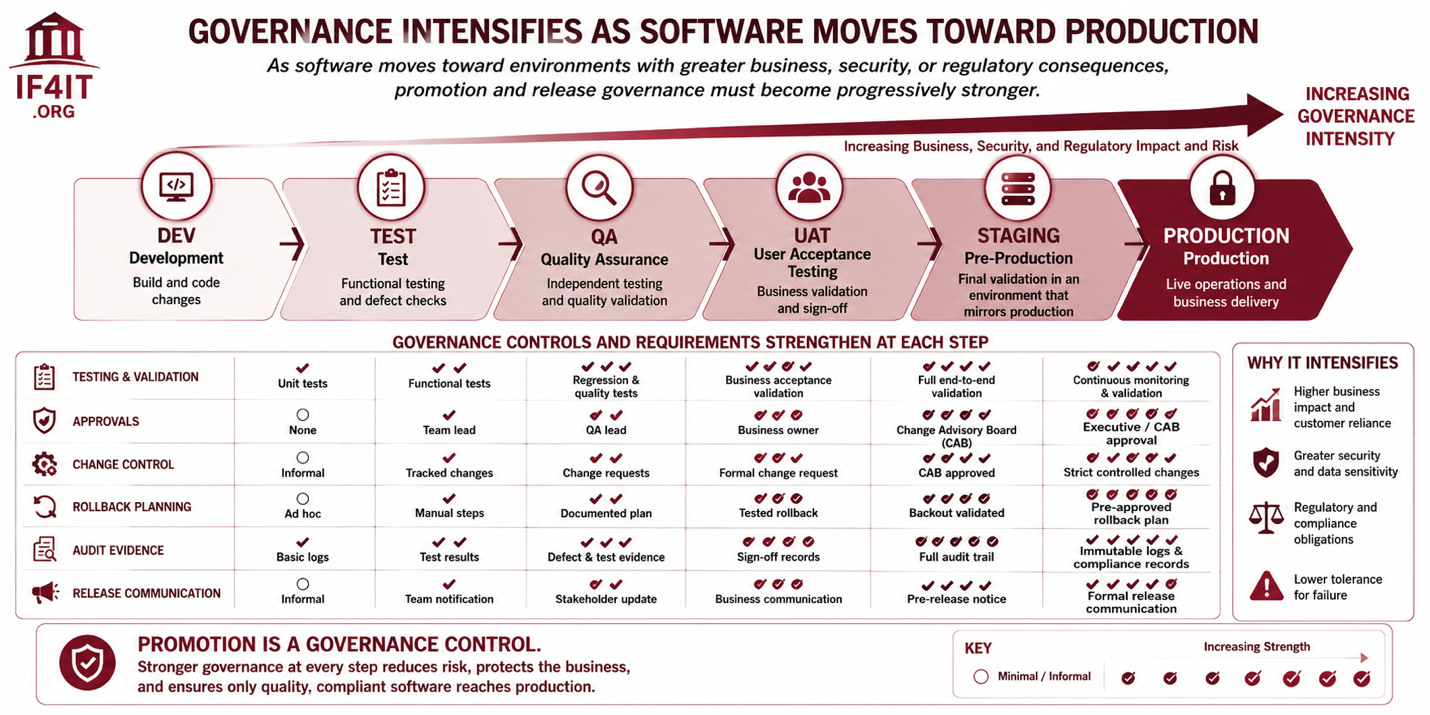
Software does not arrive in a restricted production environment fully formed. It moves there through the stages defined by the organization’s systems development lifecycle, and each stage carries its own environment with its own appropriate degree of restriction. Code developed in a lightly restricted development environment must be tested, validated, and reviewed before it is promoted toward an environment with a higher degree of restriction, and that promotion process is itself a governance control — one that prevents insufficiently vetted software from reaching an environment where a defect or vulnerability would carry far greater consequences.
The IF4IT Systems Development Lifecycle Best Practices document defines how software moves through these stages in detail, including the testing, validation, and review practices that should govern promotion into a restricted environment. IT leaders and practitioners working to strengthen restricted environment governance should treat SDLC promotion controls as a companion discipline to environment governance itself, not a separate concern.
How Restricted Environments Connect to Release Management
Promoting software into a restricted environment is not the same as releasing it into active use, and the governance requirements around a release intensify further in a restricted environment. A release into a lightly restricted development environment might require little more than a completed build. A release into a restricted production environment — particularly one subject to regulatory oversight — typically requires additional approval gates before the release proceeds, a documented rollback plan in case the release fails, and clear communication protocols so that everyone affected by the release knows what changed, when, and how to respond if something goes wrong.
The IF4IT Release Management Best Practices document defines these governance requirements in full. IT leaders and practitioners establishing or reviewing release governance for restricted environments should treat it as the primary reference for how approval, rollback, and communication requirements should scale to match an environment’s degree of restriction.
A Starting Framework for IT Leaders and Practitioners
IT leaders and practitioners looking to establish or strengthen restricted environment governance can start with a focused set of leadership-level actions, most of which the IF4IT IT Operating Environments Best Practices document supports with detailed guidance:
Inventory every IT environment across the organization’s Dev, Test, QA, UAT, Staging, and Production lifecycle, and identify the current degree of restriction applied to each one.
Assess what each environment actually contains and processes, and compare that against the degree of restriction currently in place, looking specifically for environments where the two do not match.
Identify which industry-specific or domain-specific regulations apply to each environment, and confirm that the environment’s restriction level meets those obligations.
Establish clear ownership for the access, roles, and responsibilities governing every restricted environment, so that no environment’s governance depends on informal or undocumented practice.
Align promotion and release processes with each environment’s degree of restriction, ensuring that testing, validation, and approval requirements scale appropriately as software moves toward more restricted environments.
Review restricted environment governance on a regular cadence, since what an environment contains, and the regulations that apply to it, can both change over time.
None of these steps require a large program to begin. They require an accurate, current picture of what each environment contains, what governs it today, and where that governance falls short of what the environment actually requires.
Learn More
IT leaders and practitioners ready to govern restricted IT environments in full should start with the IF4IT IT Operating Environments Best Practices document, which defines the baseline governance model for every standard IT environment type across the full Dev, Test, QA, UAT, Staging, and Production lifecycle, along with the restrictions appropriate to each.
For guidance on how software should be tested, validated, and promoted toward a restricted environment, see the IF4IT Systems Development Lifecycle Best Practices document. For guidance on how release governance — including approval gates, rollback planning, and communication protocols — should scale to match a restricted environment’s requirements, see the IF4IT Release Management Best Practices document.
Back to Articles PageHow to cite this page
When referencing this page in academic work, internal standards, or external publications, include the page title, IF4IT as author and publisher (The International Foundation for Information Technology (IF4IT), LLC), the URL, and your access date.
Example (informal web citation):
The International Foundation for Information Technology (IF4IT), LLC. Restricted IT Environments — What They Are and Why Every IT Organization Has Them. https://if4it.org/articles/2026-08-25-restricted-it-environments/ (accessed 2026-10-16).
See About Us for content governance and site-wide citation guidance.