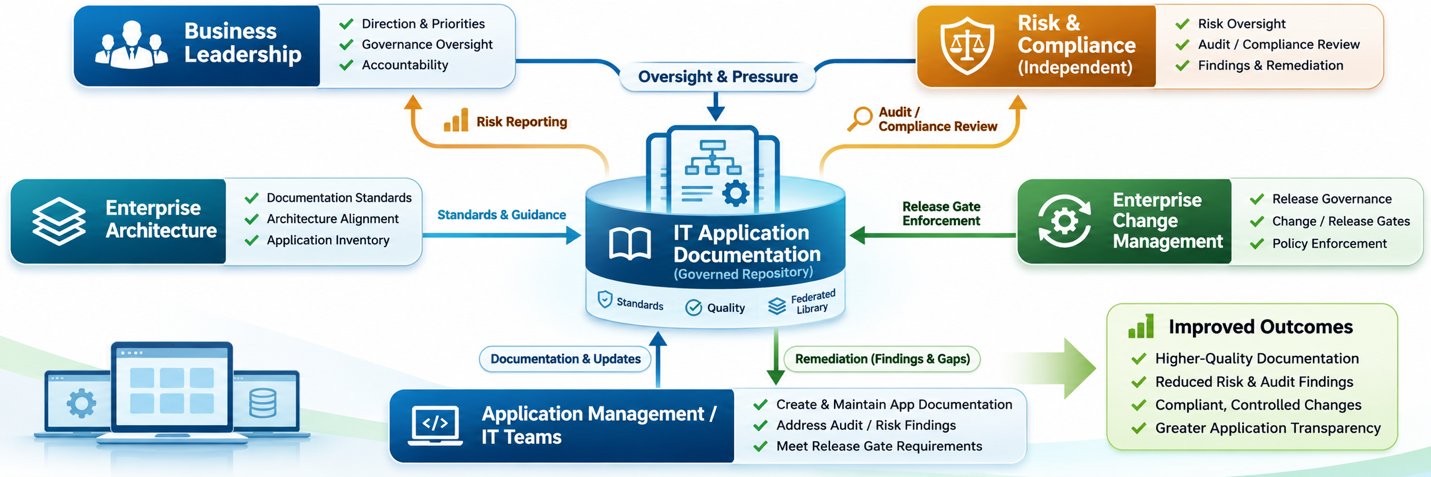
Use Business-Side Risk & Compliance to Drive Better IT Documentation
Executive Summary: Article Overview
IF4ITThe Bottom Line
Core Article Pillars
| Article Pillar / Focus Area | Strategic Business Outcome & Intent |
|---|---|
| Independent Oversight and Business Sponsorship | Removes IT’s conflict of interest by having business-side Risk & Compliance audit Application documentation against the Applications Inventory, log gaps in the enterprise risk register, and report compliance and non-compliance to business leaders in red-amber-green form. Continuous communication turns those leaders into sponsors whose pressure moves IT. |
| One Enterprise Documentation Standard | Establishes, through Enterprise Application Management, one minimum documentation standard for every Application, scaled by criticality and staged through each SDLC phase and IT Operating Environment. Enterprise Architecture defines, publishes, and audits the standard, and every Release includes a review that keeps documentation current rather than merely present. |
| Production Gate Enforcement | Enforces “No Documentation, No Deployment” through Enterprise Change Management at the Production gate, holds Application Managers (often also the Release Managers) accountable on behalf of Product Owners and Service Owners, and requires those owners to formally accept the risk of any exception. |
| Knowledge and AI Payoff | Turns Application documentation into enterprise knowledge that outlives any individual, strengthening Knowledge Management and retiring Knowledge Debt before departing staff take critical knowledge with them. Because AI works on natural language, the same documentation improves AI-assisted incident response, change impact analysis, and modernization, instead of leaving them dependent on what a few people remember. |
Quick Q&A (Macro Executive Reference)
Question: Why shouldn't IT govern its own Application documentation?
Question: Where should an enterprise start when its Application documentation is already poor?
Question: Won't a "No Documentation, No Deployment" policy slow down delivery?
Read Full Article Below
Every enterprise has at least one critical Application that only one or two engineers truly understand. It keeps orders flowing, claims paid, or patients scheduled, yet almost everything known about how it works lives in their heads. Its documentation, if it exists at all, describes a version that was replaced years ago. Nobody outside IT knows this, and most people inside IT have simply learned to live with it.
Then one of those engineers leaves or retires, or cannot be reached on the night the Application fails. The outage that follows runs for hours instead of minutes, not because the problem is hard, but because nobody who remains can explain what the Application depends on, how it is deployed, or how to roll it back. The post-incident review lists many causes. Missing documentation is rarely one of them, even though it is often the reason the incident lasted as long as it did.
This is the dirty secret of IT organizations across every industry: Applications routinely go into a business’s most critical operating environment, Production, without the documentation needed to operate, support, change, recover, or audit them. The business assumes IT has it covered. IT knows it often does not. And because almost no one measures it, the risk stays invisible until it becomes an outage, an audit finding, or a failed modernization program.
Undocumented Applications Are an Enterprise Risk, Not IT Housekeeping
Most businesses treat IT documentation as an internal IT matter, somewhere between “nice to have” and housekeeping. That framing is the problem. An undocumented Application is a business exposure, and it shows up in places the business cares about:
Slower recovery. Incidents last longer when responders have to rediscover how an Application works while it is down.
Key-person dependency. When knowledge lives only in people’s heads, every resignation, retirement, or reassignment becomes an operational risk.
Unsafe change. Teams that cannot see what an Application depends on, or what depends on it, make changes that break things they did not know were connected.
Audit and regulatory findings. Auditors and regulators expect evidence of how critical systems are controlled, supported, and recovered. “Ask the one person who knows” is not evidence.
Weak business continuity. Disaster recovery plans that rest on undocumented Applications are plans in name only.
Stalled modernization and AI adoption. Enterprises cannot migrate, retire, consolidate, or apply AI to what they do not understand. Undocumented Applications carry Knowledge Debt, and that debt comes due at the worst possible time.
It helps to be concrete about what Application documentation means, because a business-side reader cannot audit an abstraction. At a minimum, it covers the Application’s record and its accountable owners; its architecture, interfaces, and dependencies; the infrastructure it requires in each IT Operating Environment; the data it handles and the security controls that protect it; how it is built, deployed, and rolled back; the tests it must pass and their expected outcomes; its user, reference, administrative, and support documentation, including runbooks and escalation contacts; its Business Continuity and Disaster Recovery (BC-DR) documentation; and its Known Defects. The Application Management Best Practices describes this minimum in detail.
Knowledge Debt: The Risk That Walks Out the Door
Every undocumented Application carries Knowledge Debt: the growing gap between what has actually been written down and what the enterprise needs to know to operate, support, change, and recover its technology assets, data, and information. Like financial debt, it accumulates quietly. Each undocumented change, workaround, configuration, or data rule adds to it, and it grows fastest once an Application reaches steady state, when the original team moves on and what remains of the knowledge settles in fewer and fewer heads.
The debt comes due when an IT resource leaves. Resignations, retirements, layoffs, reorganizations, and the end of a contractor’s or vendor’s engagement all take knowledge out the door, and that knowledge is not limited to how an Application works. It includes what its data means, where that data comes from and where it goes, which business rules the Application enforces, and which reports and decisions depend on it. When the person who leaves was the only one who held that knowledge, and the Application is critical to the business, the enterprise has lost more than an employee; it has lost part of its ability to run its own business safely.
Knowledge Debt is therefore a business risk, and it should be managed like one. The time to retire it is while the people who hold the knowledge are still there: through documentation built and reviewed with every Release, and through knowledge transfer that is completed and verified before a key person on a critical Application leaves, not attempted in their last week. Key-person dependencies on critical Applications belong in the same risk register, and the same Risk & Compliance reports, as any other documentation gap.
Letting IT Govern Its Own Documentation Is a Conflict of Interest
Why hasn’t IT fixed this on its own? It is not that IT professionals don’t value documentation; most do. The problem is structural: in most enterprises, the same organization that produces the documentation also decides whether it is needed, how good it must be, and when it can be skipped.
That is a conflict of interest. Under delivery pressure, documentation is always the easiest thing to trade away. Features ship, deadlines are met, and documentation is deferred in the name of self-proclaimed “higher priorities.” The promise that it will be written later is rarely kept, because there is always another higher priority. Over the years, this has led far too many IT organizations to sacrifice documentation almost entirely. Poor documentation is not an accident or a skills gap; it is the predictable result of letting the producer grade its own work.
Enterprises already know how to handle conflicts like this. The people who spend money do not audit their own books. Developers do not approve their own changes into Production. Separation of duties exists precisely because self-governance fails under pressure. IT documentation deserves the same independence, and the business already has the right organization to provide it.
The Mechanism: Enterprise Application Management and “No Documentation, No Deployment”
The single change with the biggest impact for the least effort is to manage Application documentation within an established Enterprise Application Management practice. Enterprise Application Management is Application Management applied consistently to every Application the enterprise owns, operates, licenses, or depends upon, using the same practices, standards, templates, and policies for all of them. Instead of each team deciding for itself what “documented” means, the enterprise sets one minimum standard.
One standard, scaled by criticality. The documentation required for an Application scales with how critical it is. A customer-facing, revenue-critical Application needs far more than an internal utility. Proportional standards keep the effort aligned to the risk and head off the predictable complaint that documentation is bureaucracy.
Enterprise Architecture defines and audits the standard. Enterprise Architecture is well placed to define, set, and publish the documentation standard and its templates, and to help review and audit documentation for quality and currency, not just existence. A document that exists but no longer describes the Application is not documentation.
“No Documentation, No Deployment” at the Production gate. Enterprise Change Management controls the gate into Production through its Change Review Board, which some enterprises call a Change Advisory Board. No Release reaches Production unless the Application’s minimum documentation is in place. Because every team that delivers Applications, including software development and software engineering teams, must pass through that gate, it drives all of them toward better documentation.
Graduated blocking and justified exceptions. Enforcement can escalate in steps rather than starting with a hard stop. A genuinely urgent Release can proceed under a justified exception, with its documentation delivered as a fast follower by a fixed date. What matters is who signs: the Product Owner or Service Owner formally accepts the risk of deploying without documentation. The exception stops being an IT shortcut and becomes a business decision on the record.
Clear accountability. On behalf of the Product Owners and Service Owners, the Application Manager, who is often also the Application’s Release Manager, is accountable for making sure the required documentation is in place before anything is released to Production. Documentation work is planned and funded as part of each Release, because pressure without capacity only teaches teams to game the gate.
Documentation stays current with every Release. Each Release is the moment to review and correct the Application’s documentation, so it keeps pace with the Application instead of slowly drifting out of date.
Acquired, Software as a Service (SaaS), and vendor Applications count too. Third-party Applications are still the enterprise’s risk. Documentation obligations should be written into contracts and onboarding rather than handled as an afterthought.
The Application Management Best Practices describes the minimum documentation policy and “No Documentation, No Deployment” in depth, and the Release Management Best Practices describes the Readiness Gates through which every Release must pass.
Use the SDLC to Decide What Documentation Is Required — and When
A minimum standard answers what must be documented; the Systems Development Lifecycle (SDLC) answers when. As an Application moves through each SDLC phase, and through each IT Operating Environment that phase uses, it should accumulate the documentation that phase produces. For every phase, the enterprise defines what must exist before the Application can move on and what should exist, both scaled by the Application’s criticality.
A gate then checks that phase’s must-haves each time the Application moves from one Environment to the next: from Development to System Integration Testing (SIT), from SIT to User Acceptance Testing (UAT), and from UAT to Production. By the time a Release reaches the Production gate, “No Documentation, No Deployment” confirms documentation that was built and verified along the way rather than demanding all of it at the last minute. And because gaps are caught where they start, Risk & Compliance can see whether documentation is breaking down in design, in testing, or at handover, which is far more actionable than a single red mark against an Application.
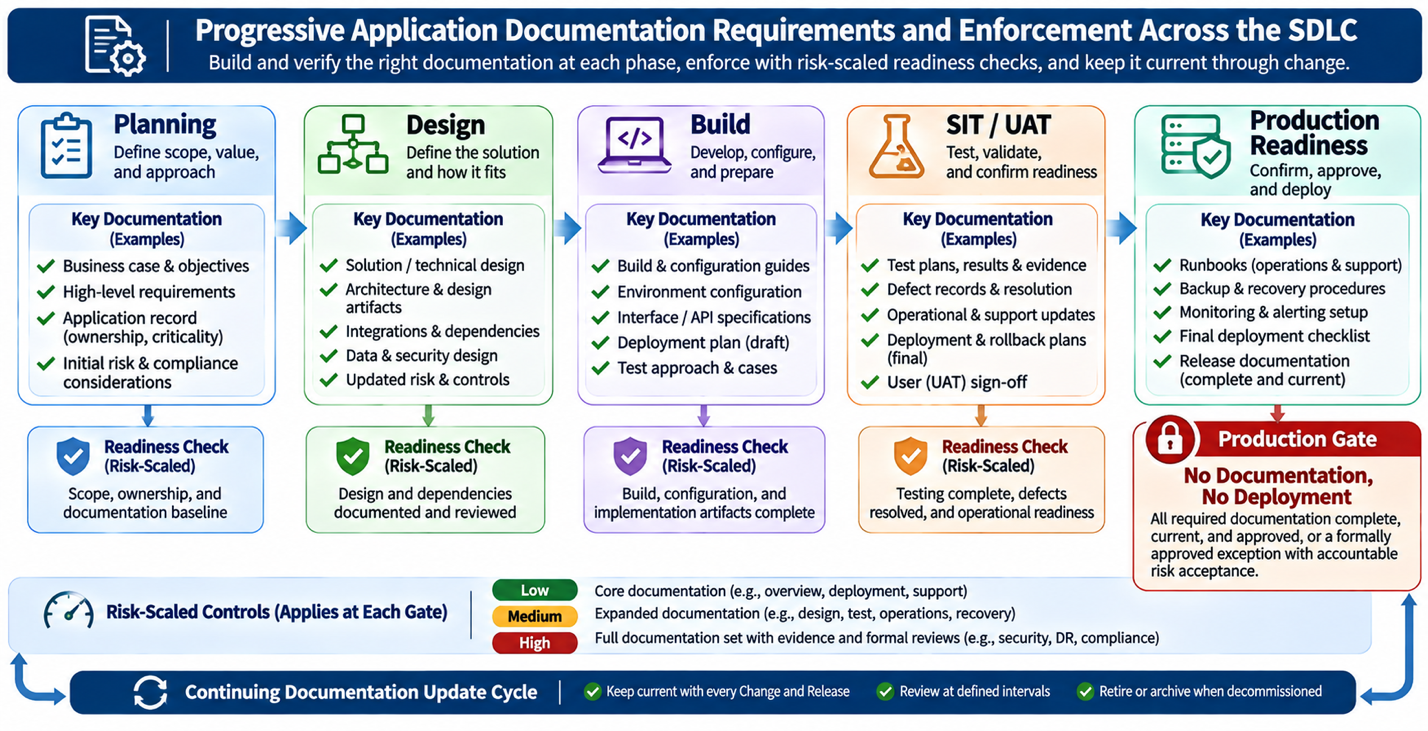
Some documentation spans every phase. The infrastructure an Application requires should be documented for each Environment it runs in, not only Production. The tests that prove each phase, along with their expected outcomes, are as much a part of the Application’s documentation as its runbooks. The table below illustrates the pattern; it is not an official list. The minimum documentation policy in the Application Management Best Practices and the phases in the Systems Development Lifecycle (SDLC) Best Practices remain the authorities, and the IT Operating Environments Best Practices describes the Environments themselves.
| SDLC Phase and Environment | Must Exist to Move On | Should Exist |
|---|---|---|
| Planning and Requirements (no deployment target) | Accountable owners; purpose and scope; key business and non-functional requirements; criticality tier | Business case; stakeholder map |
| Design (no deployment target) | Architecture; interfaces and dependencies; data handled; security controls; required infrastructure for each IT Operating Environment | Design decisions and alternatives considered |
| Implementation/Build (Development) | Build, packaging, and configuration procedures; Development infrastructure | Developer setup guide; coding conventions |
| SIT and UAT | Test plans; test cases with expected outcomes; actual results; known defects; SIT and UAT infrastructure | Performance and security test evidence |
| Production Readiness (Production) | Production infrastructure; deployment and rollback procedures; runbooks; support and escalation contacts; user, reference, and administrative documentation; BC-DR plans, recovery objectives, and evidence of tested recovery | Training materials; frequently asked questions |
| Operate and Retire | Documentation reviewed and corrected with every Release; decommissioning record when the Application or any of its Instances is retired | Lessons learned |
One item in that table needs no defense. If an Application the business depends on cannot be recovered after an outage or a disaster, nothing else in its documentation matters. BC-DR documentation, including recovery objectives, recovery procedures, and evidence that those procedures have actually been tested, should be mandatory for every critical Application and among the first things Risk & Compliance checks.
Risk & Compliance Applies the Pressure; the Business Sponsors It
A standard and a gate are necessary, but on their own they are still governed by IT. The missing ingredient is independent pressure, and that is the role of the business-side Risk Management & Compliance organization. Its job is to identify, measure, and report enterprise risks to the business, and undocumented Applications are exactly that kind of risk.
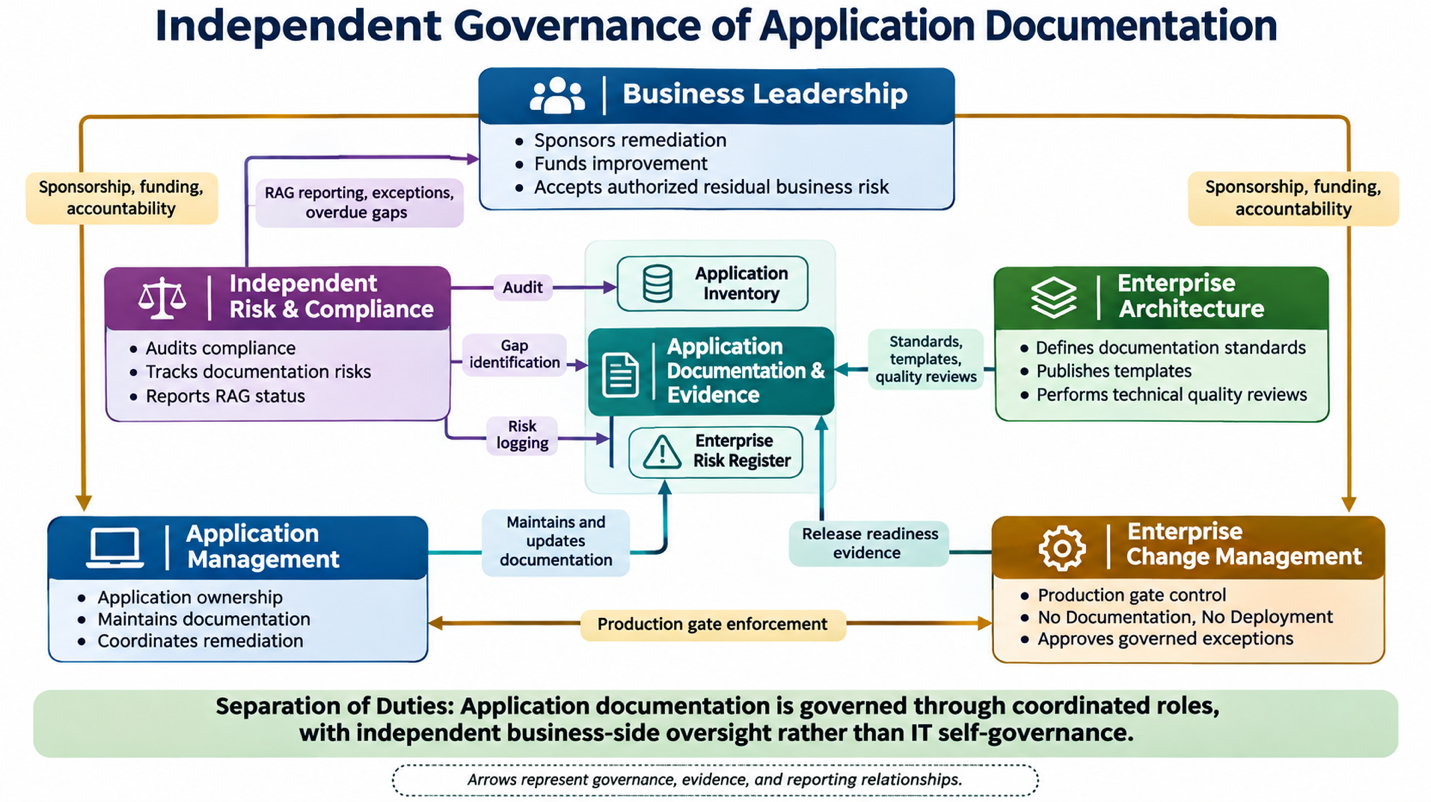
Audit against the inventory. Risk & Compliance audits IT Applications against the documentation standard, using the enterprise’s Applications Inventory as the baseline. An enterprise cannot audit what it has not inventoried, which is one more reason a complete, current inventory of Applications matters.
Put the gaps in the risk register. Missing or stale documentation for a critical Application is logged in the enterprise risk register like any other material risk, with an owner and a remediation date.
Report to business leaders. Compliance and non-compliance reports, by Application and by owner, go up to business-side leaders in red-amber-green form. Violations, overdue exceptions, and chronic gaps are made visible to the people who fund and own those Applications.
Track the right measures. Coverage (how many critical Applications meet the standard), currency (how recently their documentation was reviewed), and exceptions (how many are open and overdue) are tracked as risk metrics, alongside the other indicators the business already watches.
Keep communicating. Risk & Compliance should continuously explain to the business why good IT documentation matters and what poor documentation costs. Informed business leaders become its sponsors, and their pressure is what moves IT.
To be candid, IT will not like this. Having an independent organization audit IT’s work and report shortfalls by name to business leaders is uncomfortable. That discomfort is the point. Visibility to the people who own the risk is what creates accountability, and it is exactly the pressure that self-governance has never produced. The aim is not to shame individuals but to end the silence that has let the problem persist. IT leaders who act first can make sure their reports stay green.
Answering the Objections — and What IT Gains
Pushback is predictable, and the common objections have good answers.
“It will slow delivery.” Proportional standards, documentation planned into each Release, and standard templates keep the effort small. What slows delivery far more is the outage, the failed change, or the audit remediation that undocumented Applications eventually cause.
“Agile values working software over documentation.” Preferring working software over documentation was never a license to skip documentation altogether. Software that cannot be safely operated, changed, or recovered does not keep working for the business for long.
“Documentation goes stale anyway.” Only when nobody owns its currency. Reviewing and correcting documentation with every Release, and auditing currency rather than mere existence, keeps it alive.
IT also has a great deal to gain. Better documentation means fewer late-night escalations, less dependence on a handful of key people, faster onboarding of new staff, safer changes, and shorter incidents. And for IT leaders who have long wanted the time and funding to document properly, business-side pressure is leverage: it turns documentation from a cost IT has to justify into a risk the business has asked IT to retire.
The Payoff: Better Knowledge Management and Better AI
Good Application documentation is more than a control. It is how an enterprise knows itself. Every runbook, dependency map, and architectural decision that is written down becomes enterprise knowledge that outlives any individual, can be searched and shared, and can be reused across teams. Better IT documentation, and especially better Application documentation, drives better Knowledge Management.
Good documentation is also the foundation for AI. AI works on natural language: large language models and AI assistants reason over written text. For IT, Application documentation is the primary written record of what each Application is, how it works, what it depends on, and how to support and change it. Knowledge that lives only in people’s heads is invisible to AI. Outdated or wrong documentation is worse, because AI will repeat it with confidence.
The effects show up quickly. AI-assisted incident response, change impact analysis, coding and modernization assistants, onboarding, and answers to business questions about Applications all get better, or worse, in direct proportion to the quality of the documentation they can read. Enterprises are investing heavily in AI, and as “AI Right Isn’t About the Model You Buy — It’s About What You Give It to Reason Over” argues, the return on that investment depends on the knowledge the AI is given. Poor IT documentation quietly caps that return, which gives business leaders one more reason to sponsor the push.
Where to Start: Crawl, Walk, Run
None of this requires a big-bang program, but it does require attention on two fronts: the Releases still to come, which the gate protects, and the Applications already in Production, which it does not. Most of the risk sits in the second group, so remediating existing Applications should be planned and tracked as deliberately as new Releases are gated. Both fronts can be phased in.
Crawl. Inventory the enterprise’s Applications, identify the most critical ones and the key people they depend on, and measure how much of their documentation exists and is current. Set the minimum standard by criticality, and have Risk & Compliance publish the first report to business leaders. Expect it to be mostly red; that is the baseline.
Walk. Enforce “No Documentation, No Deployment” at the Production gate through Enterprise Change Management, require business risk acceptance for every exception, and start remediating the Applications already in Production, most critical first. Treat each documentation gap as a tracked risk until it is closed.
Run. Report coverage, currency, and exceptions enterprise-wide on a regular cadence, automate checks wherever documentation can be validated automatically, and make compliance easy with standard templates and AI-drafted first versions that people review and correct.
Treat IT Documentation Like the Business Control It Is
For decades, enterprises have left IT documentation to IT, and IT has repeatedly traded it away for higher priorities. The result is critical Applications running in Production on knowledge nobody wrote down. The fix is not another reminder to IT to do better. It is to treat Application documentation as what it is, a business control, and govern it like one: a consistent standard through Enterprise Application Management, a hard gate through Enterprise Change Management, and clear accountability through Application Managers.
Each of those pieces matters, but on its own each is still IT governing IT. Business-side Risk & Compliance is what makes the rest hold. It is the one function independent of IT whose job is to find enterprise risk before it materializes and to put that risk in front of the people who own it. Every risk this article describes starts the same way: as a documentation gap that nobody outside IT could see. The hours-long outage nobody can diagnose, the change that breaks something no one knew was connected, the failed audit, the critical Application that cannot be recovered after a disaster, and the Knowledge Debt that walks out the door with a departing engineer all begin there. Risk & Compliance makes those gaps visible, measured, and owned while they are still inexpensive to close.
Most enterprises discover the cost of poor IT documentation in the middle of a crisis. With business-side Risk & Compliance applying steady, independent pressure and business leaders sponsoring it, they can discover it on a report instead. Governed this way, documentation stops being the first thing sacrificed and becomes the knowledge base the enterprise, and its AI, can depend on.
Learn More
The Application Management Best Practices is the source of record for everything this article recommends. These chapters cover its key practices in depth:
Why Missing, Poor, or Outdated Application Documentation Is a Critical Enterprise Risk
What Is Knowledge Debt, and How Does It Accumulate Around Applications?
Use Application Documentation to Transfer Knowledge and Reduce Key-Person Risk
Establish, Publish, and Regularly Communicate a Minimum Application Documentation Policy
Have Risk and Compliance Regularly Audit Application Documentation for Completeness and Accuracy
Record Application Documentation Gaps in the Enterprise Risk Register
Why AI Makes Application Documentation More Critical Than Ever
The Release Management Best Practices describes the gates every Release passes through in its chapter Release Readiness Gates — Entry and Exit Criteria for Every Environment. The Applications Inventory and Attributes defines the inventory that Risk & Compliance audits against. Related articles include The Cost of Not Knowing — Why Enterprise Inventories Are Critical; Stale Data Lies — Why an Inventory Is Never “Done”; AI Exposes the Knowledge Debt Enterprises Can No Longer Ignore; and Your Enterprise AI Is Only as Good as Your Enterprise Inventories.
Back to Articles PageHow to cite this page
When referencing this page in academic work, internal standards, or external publications, include the page title, IF4IT as author and publisher (The International Foundation for Information Technology (IF4IT), LLC), the URL, and your access date.
Example (informal web citation):
The International Foundation for Information Technology (IF4IT), LLC. Use Business-Side Risk & Compliance to Drive Better IT Documentation. https://if4it.org/articles/2026-11-28-risk-and-compliance-drive-it-documentation/ (accessed 2026-11-28).
See About Us for content governance and site-wide citation guidance.