Inventories Are Worth More Together — The Network Effect of a Connected Enterprise Model
International Foundation for Information Technology (IF4IT)
Abstract
The standard way to justify an enterprise inventory is to count what it can tell you on its own. That standard understates the value, sometimes drastically. The real power of inventories emerges not from any one of them but from the connections among them — and the value grows non-linearly as more inventories connect. Each new inventory increases the worth of every inventory already in place. This article makes the network effect visible, explains why it changes how enterprises should sequence and justify inventory investments, and points the reader to the IF4IT Enterprise Inventory Management Best Practices document for the foundation that makes a connected Enterprise Model possible.
Author: The International Foundation for Information Technology (IF4IT)
Enterprise Inventory Types
Examples of Inventory Types can be found in the Enterprise Inventory Management Best Practices document. Consider that many inventories are common, regardless of the industry and enterprise operates in. However, it is clear that enterprises in different industries will also require the use and governance of industry-specific inventories that are obviously different between industries. For example, enterprises that work in the automotive industry will share some inventory types with enterprises that work in healthcare. However, there will clearly be inventories in each that do not exist in the other.
The Wrong Way to Measure an Inventory
The standard way to make the business case for an enterprise inventory is to enumerate what it can tell you. An applications inventory can tell you what applications the enterprise runs. A vendors inventory can tell you who supplies it. A contracts inventory can tell you what the enterprise has agreed to and when those agreements expire. Each inventory’s case is made on its own merits, against the cost of building and maintaining it, and approved or declined on those terms.
This framing is intuitive. It is also the reason so many enterprise inventory programs underdeliver. The framing treats each inventory as an island, evaluated only for what it contains in isolation. And isolation is precisely the condition under which inventories are least valuable.
The questions that matter most to an enterprise — the ones that drive risk, strategy, and investment decisions — almost never concern a single kind of thing. They span many. If this vendor fails, which of our applications are affected? That question cannot be answered by an applications inventory alone, or a vendors inventory alone. It can only be answered by both, connected to one another. Which business capabilities are at risk if this technology reaches end of life? Same shape: no single inventory holds the answer; the answer lives in the connections.
This is the part the per-inventory business case misses. It counts what each inventory holds inside its rows. It does not count what becomes possible when the rows of one inventory point at the rows of another.
How Value Compounds
The compounding is easy to demonstrate, and worth doing concretely because the pattern is unfamiliar to most people who think about inventories.
Start with one inventory in isolation — say, the applications inventory. It answers exactly one class of question: what applications do we have, and what is true about each of them? Useful, but bounded. Build a second inventory — vendors — and the value does not just double. It expands into a new class of questions neither inventory could answer alone: which vendors back which applications? If this vendor fails, which applications go with it? Which applications depend on multiple vendors, and which on only one? That new class of question is invisible inside either single inventory; it exists in the joins between them.
Now add a third connected inventory — say, business capabilities. The questions that become answerable now span three: if this vendor fails, which applications go down, and through them, which business capabilities are at risk? Add a fourth — regulatory obligations — and a new tier of question opens up: which regulated obligations rely on which capabilities, which depend on which applications, which depend on which vendors? The questions are not arithmetically larger; they are categorically richer. They reach across more of the enterprise and require more layers of connection to answer.
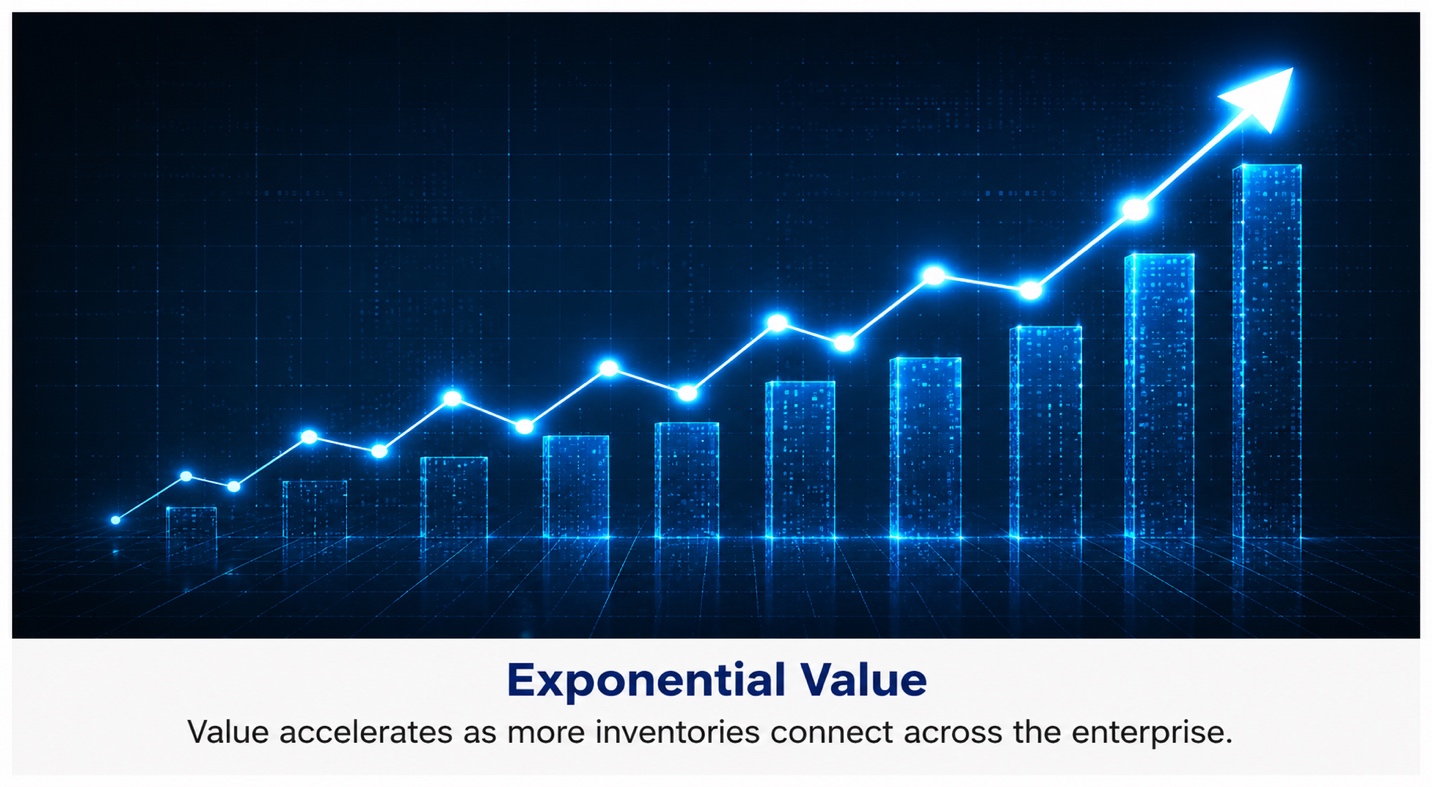
This is the network effect at work. Each new inventory does not just add its own value. It increases the value of every inventory it can connect to, because it unlocks a new layer of cross-cutting questions. The total worth of the connected set grows faster than the sum of the parts, and the curve gets steeper, not shallower, as more inventories join.
What the Network Effect Changes About Strategy
This shifts the calculus of inventory investment in a way most enterprises have not yet recognized.
If inventories were independent goods, the right strategy would be to fund the ones with the highest standalone value and decline the ones whose standalone value seemed modest. This is exactly how most inventory portfolios are built today — one business case at a time, each evaluated in isolation.
If inventories compound — if their value depends on what they connect to — then the strategy is different. An inventory’s full worth is no longer just its own data; it is also the questions it unlocks across the inventories it can connect to, including inventories that do not yet exist. An inventory whose standalone case looks modest may be highly valuable as a connector that joins two or three already-built inventories and lets the enterprise ask cross-cutting questions that none of them could answer alone. A modest-looking inventory that touches many others may be more valuable than an impressive-looking inventory that touches none.
Three practical implications follow from this.
First, sequence matters more than individual business cases. An enterprise that builds its first three inventories in isolation gets three inventories. An enterprise that builds the same three inventories with their connections deliberately designed gets three inventories plus the cross-cutting questions those connections unlock — and those questions are often the highest-value output of the entire program. The same investment, sequenced differently, produces dramatically different value.
Second, inventories that look like infrastructure are often the most strategic. The inventories that connect many other inventories — the People inventory, the Organizations inventory, the Capabilities inventory — tend to look least interesting in isolation. Each row is a thin record. The standalone case for them often loses to flashier-looking competitors. But these connector inventories are the ones that make every other inventory more valuable. Treating them as low-priority infrastructure is a strategic mistake that compounds over time.
Third, the case for each inventory must include its connections. A business case that justifies an inventory only on its own merits underestimates the value the enterprise will eventually realize, sometimes by an order of magnitude. The right case names not only what the inventory holds, but the cross-cutting questions it will help answer once it is connected to its neighbors. That framing turns the conversation from “is this inventory worth its cost?” to “what becomes possible when this inventory joins the others we already have?” — which is the question that actually predicts return on investment.
The Connected Enterprise Model
The end state this strategy points toward is what the IF4IT framework calls the Enterprise Model: the aggregate of all the enterprise’s inventories, governed and connected, treated as a single coherent representation of the enterprise. The Enterprise Model is not a single system or a single database. It is what emerges when an enterprise maintains its inventories with the network effect in mind — when each one is built and connected so that the whole becomes more valuable than the sum.
An organization that operates from a connected Enterprise Model can answer questions across the entire enterprise that no isolated inventory could touch. It can trace a regulatory obligation down through capabilities, applications, systems, and vendors to know exactly what supports it. It can model the impact of a vendor failure, a technology end-of-life, or an organizational change across every inventory it touches. It can ask new questions as they arise and find that the answers are already latent in the connections, waiting to be assembled.
None of this is hypothetical, and none of it requires a single technology choice. It requires that the enterprise stop thinking of inventories as independent artifacts and start thinking of them as parts of a connected whole, with the network effect deliberately cultivated rather than incidentally hoped for.
Where to Go Next
The full treatment of how to build and connect inventories so that their combined value compounds — including the principles that make connection possible, the discipline of maintaining the connections over time, and the practices that turn a set of inventories into an Enterprise Model — is in the IF4IT Enterprise Inventory Management Best Practices document. The document devotes a specific section, “Understand that inventories compound in value as they connect”, to the argument this article distills.
The enterprises that get the most out of their inventory investments are not the ones that build the most inventories. They are the ones that build the right inventories, in the right sequence, and connect them with the care that makes the network effect possible. The investment in each inventory is repaid not once, but every time a new inventory joins the model and finds something to connect to.
Published by IF4IT.com — The International Foundation for Information Technology
Back to Articles PageHow to cite this page
When referencing this page in academic work, internal standards, or external publications, include the page title, IF4IT as publisher, the URL, and your access date.
Example (informal web citation):
International Foundation for Information Technology (IF4IT). Inventories Are Worth More Together — The Network Effect of a Connected Enterprise Model. https://if4it.org/articles/2024-03-19-inventories-are-worth-more-together-the-effect-of-a-connected-enterprise-model/ (accessed 2026-06-23).
See About Us for content governance and site-wide citation guidance.