The following materials represent common, industry-tested knowledge that the IF4IT has worked to identify, document, curate, and publish for use by IT leaders and practitioners to build and operate better IT organizations. Each topic area contains and represents IF4IT-suggested, structured guidance that we believe helps professionals design, implement, deploy, operate, and support better IT organizations and solutions. This being said, we also acknowledge that every enterprise is somewhat different in areas like their industry, size, scope, regions, skills, funding, products & services, and the technologies they use. So while our materials help identify and address common issues, the details of final design and implementation are always the responsibility of the implementing practitioner. Browse or use Search to help find what’s available. We hope you find the materials useful.
Application Portfolio Management
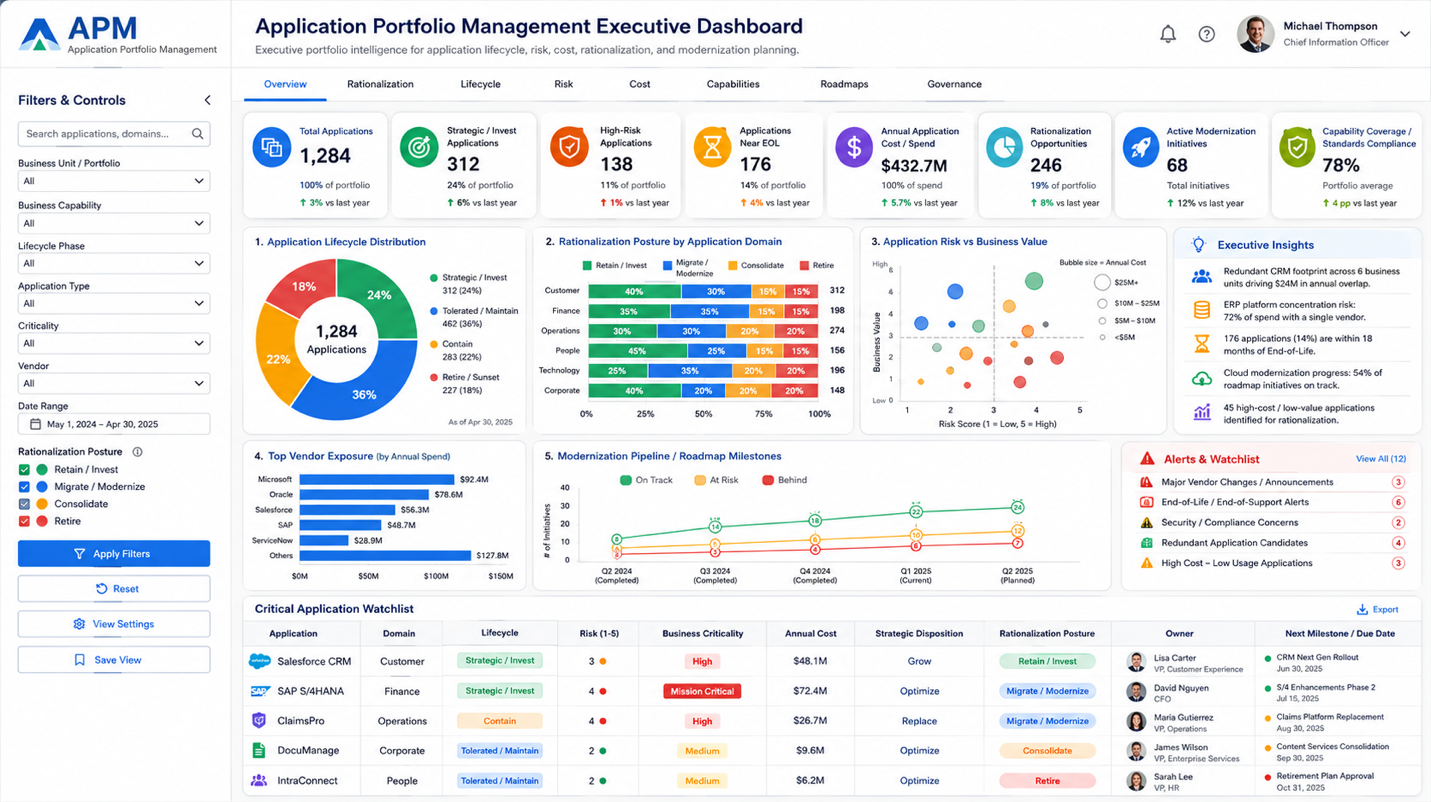
Application Portfolio Management (APM) Best Practices
Application Portfolio Management (APM) is not an inventory spreadsheet or a purchased tool; it is the enterprise discipline that governs, funds, rationalizes, and strategically evolves every application the organization …
read more
Applications Inventory and Attributes
The Applications Inventory is the governed enterprise record of every application the organization owns, operates, licenses, or depends on — the authoritative application-level data foundation for the enterprise. Without …
read more
Integrations Inventory and Attributes
The Integrations Inventory is the governed record of every data and information flow, making integration complexity, dependency risk, data sensitivity, technology usage, and cross-boundary movement visible across the …
read more
Technical Debt Management Best Practices
Technical Debt Management is the IT Management discipline for governing technical conditions and unresolved obligations that make governed Assets more costly, difficult, risky, or constrained to change, operate, secure, …
read moreArtificial Intelligence

AI Agents Inventory and Attributes
The AI Agents Inventory is the enterprise’s single governed record of the AI agents it builds, buys, or runs — the autonomous, model-driven software actors that take action on systems and data, or communicate with …
read more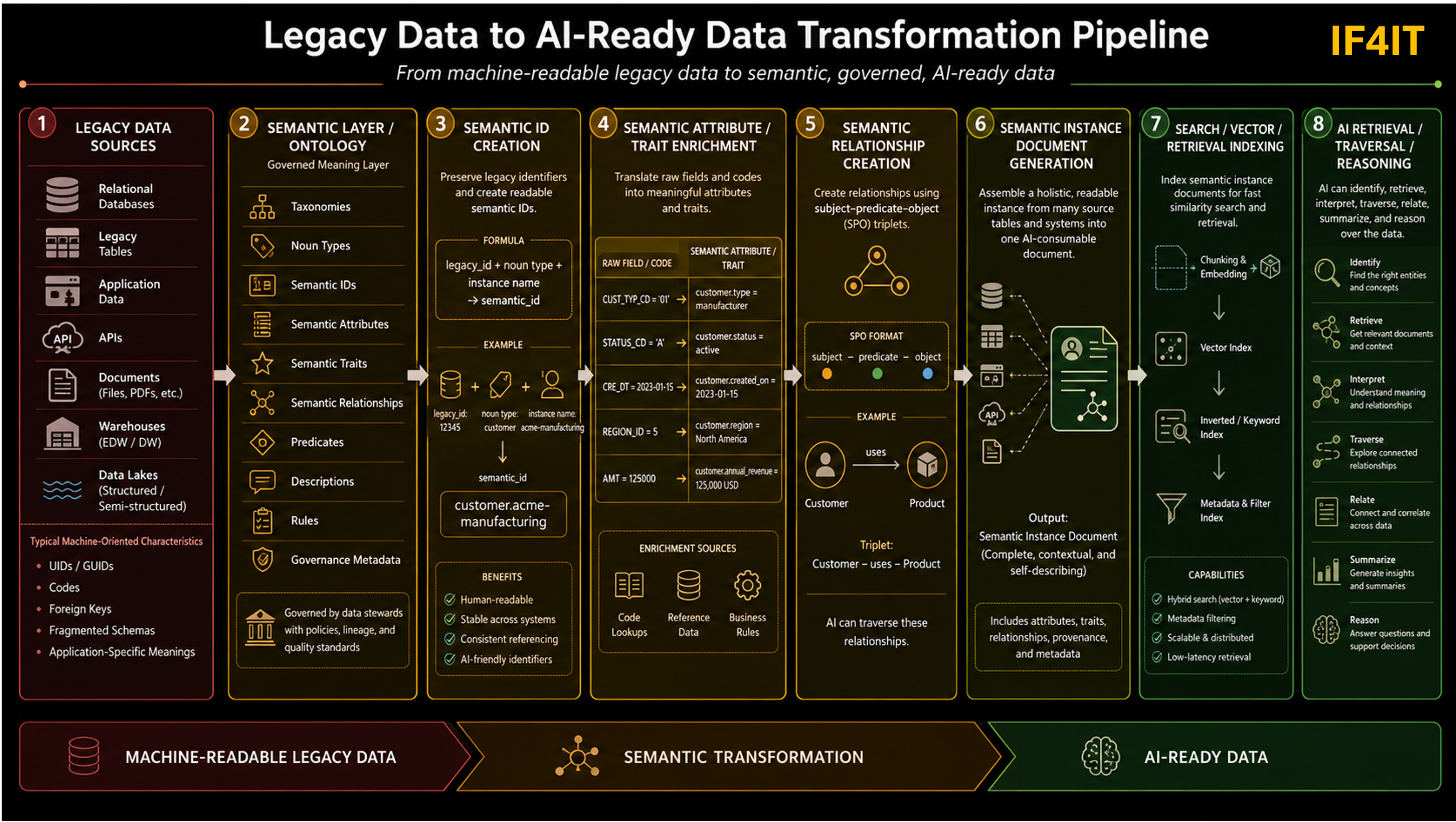
Best Practices for Making Legacy Data Semantic and AI-Ready
Making legacy data semantic and AI-ready is an enterprise knowledge discipline that preserves source integrity while adding governed meaning, relationships, lineage, and retrieval context. When enterprises treat …
read more
Enterprise AI Governance Best Practices
Enterprise AI Governance is not a standalone tool or committee; it is the enterprise operating discipline that makes artificial intelligence visible, accountable, controlled, evidenced, and improvable across business, …
read moreAsset Management
AI Agents Inventory and Attributes
The AI Agents Inventory is the enterprise’s single governed record of the AI agents it builds, buys, or runs — the autonomous, model-driven software actors that take action on systems and data, or communicate with …
read moreApplication Portfolio Management (APM) Best Practices
Application Portfolio Management (APM) is not an inventory spreadsheet or a purchased tool; it is the enterprise discipline that governs, funds, rationalizes, and strategically evolves every application the organization …
read more
Capabilities Inventory and Attributes
The Capabilities Inventory is the governed enterprise record of the business and IT capabilities the enterprise performs, intends to perform, or has decided to exit. It provides the stable capability vocabulary that lets …
read more
Data and Information Inventory and Attributes
The Data and Information Inventory is not a data catalog or a list of files; it is the governed logical vocabulary for every named data and information type the enterprise produces, consumes, stores, or transmits. …
read moreIntegrations Inventory and Attributes
The Integrations Inventory is the governed record of every data and information flow, making integration complexity, dependency risk, data sensitivity, technology usage, and cross-boundary movement visible across the …
read more
Regulatory Agencies Inventory and Attributes
The Regulatory Agencies Inventory is the governed root of the enterprise compliance hierarchy, identifying every body whose authority, standards, or market-access requirements create formal obligations for the …
read more
Services Inventory and Attributes
The Services Inventory is not a Service Catalog or a list of request forms; it is the governed enterprise registry of every Service the enterprise has chosen to govern as a managed value-delivery asset across every …
read more
Software Technologies Inventory and Attributes
The Software Technologies Inventory is the authoritative, governed record of every software technology the enterprise procures, deploys, operates, or depends on — the database engines, runtimes, middleware, platforms, …
read more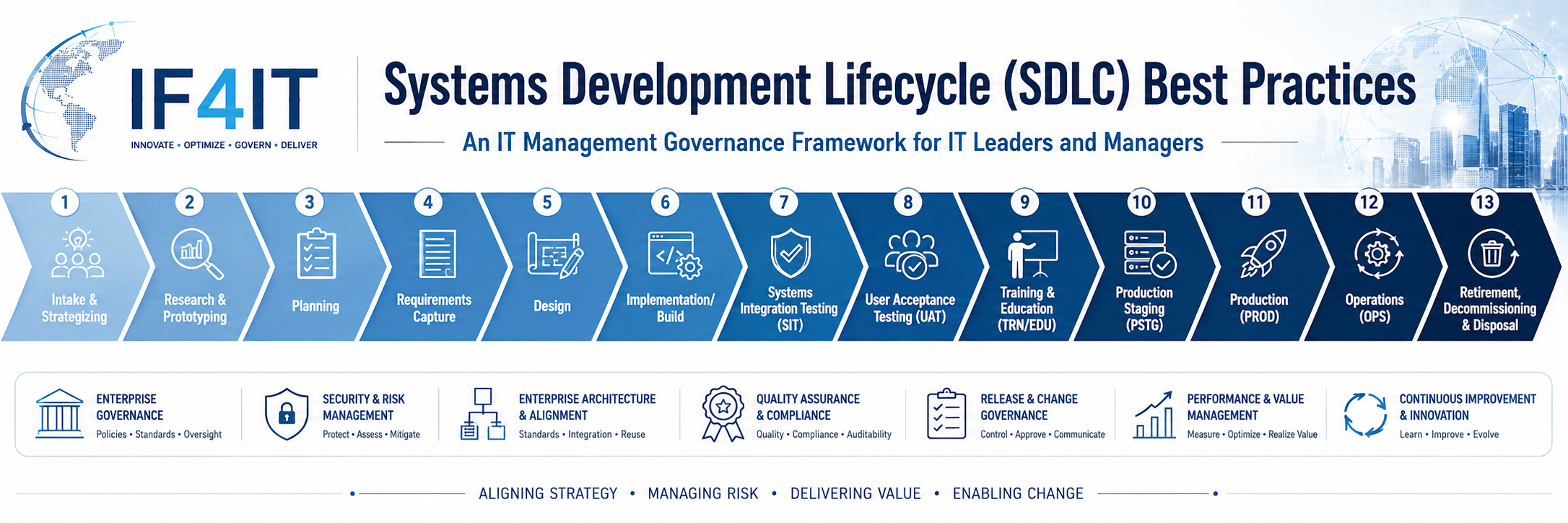
Systems Development Lifecycle (SDLC) Best Practices
The IF4IT Systems Development Lifecycle (SDLC) is an IT management governance framework for leaders and managers—not merely a software-development process. It provides a comprehensive, tailorable 13-phase lifecycle for …
read more
Technical Debt Inventory and Attributes
The Technical Debt Inventory is the governed record of the Technical Debt Items an enterprise identifies across the Assets it owns, operates, or depends on. Without a governed inventory, Technical Debt remains fragmented …
read more
Technology Portfolio Management (TPM) Best Practices
Technology Portfolio Management is the enterprise discipline for governing technologies as strategic assets through connected inventories, explicit ownership, lifecycle and standards controls, evidence-based assessment, …
read more
Value Streams Inventory and Attributes
The Value Streams Inventory is the governed enterprise record of the end-to-end flows through which the organization delivers value to stakeholders. Without it, enterprises cannot reliably see how value is delivered, …
read more
Vendors Inventory and Attributes
The Vendors Inventory is the governed enterprise record of third-party organizations that provide technology, services, data, or capabilities to the enterprise. Without a reliable Vendors Inventory, leaders cannot …
read moreAutomation Management
Business Analysis
Capabilities Inventory and Attributes
The Capabilities Inventory is the governed enterprise record of the business and IT capabilities the enterprise performs, intends to perform, or has decided to exit. It provides the stable capability vocabulary that lets …
read more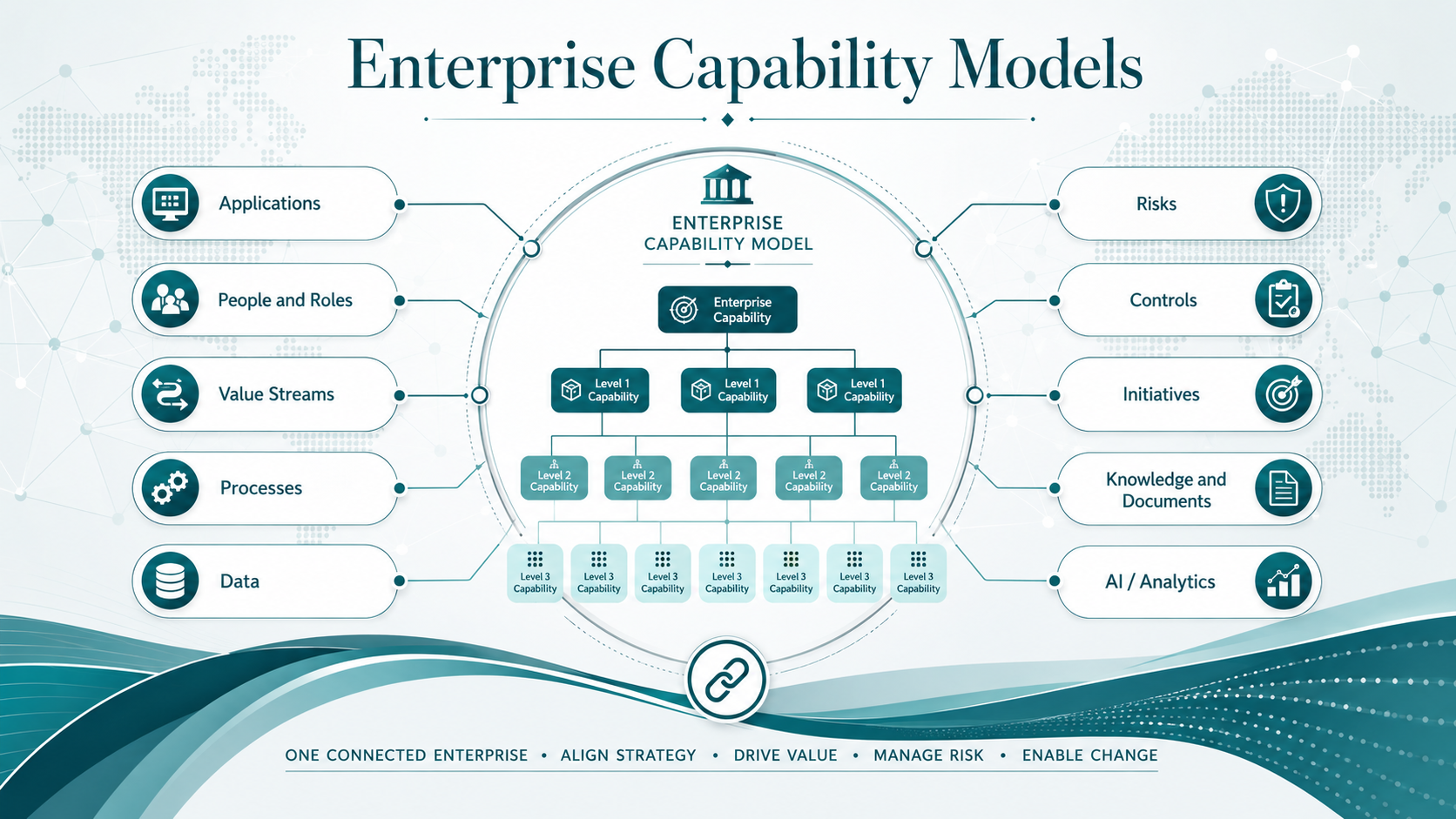
Designing, Building, and Maintaining Comprehensive and Usable Enterprise Capability Models
A comprehensive Enterprise Capability Model is a governed, inventory-backed knowledge asset that represents the durable abilities an enterprise performs, intends to perform, or has decided to exit. This document explains …
read more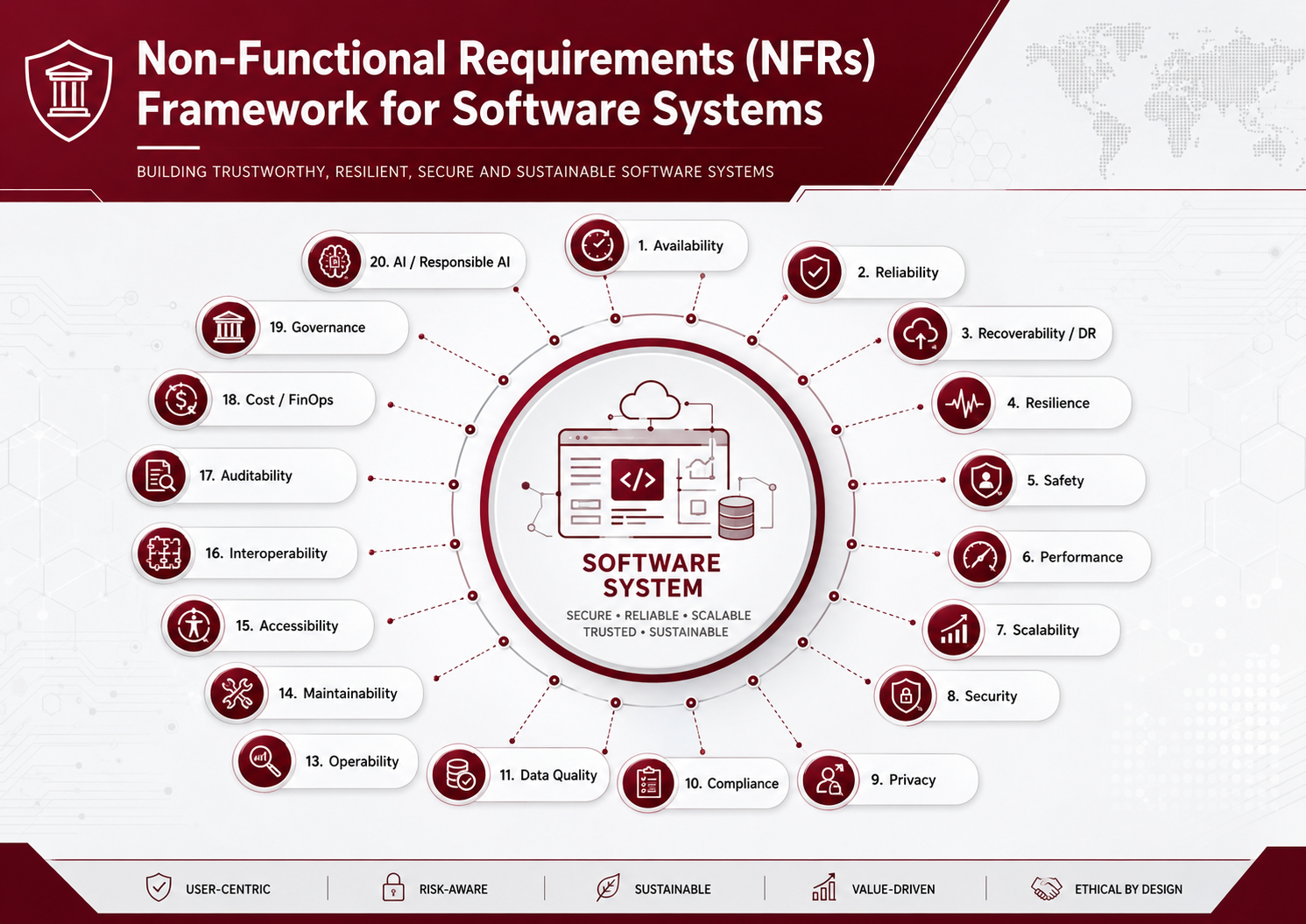
Non-Functional Requirements (NFRs) Framework for Software Systems
Non-Functional Requirements (NFRs) define the software qualities, operating expectations, validation methods, and assurance evidence that determine whether a system is fit for purpose. When NFRs are vague, missing, or …
read more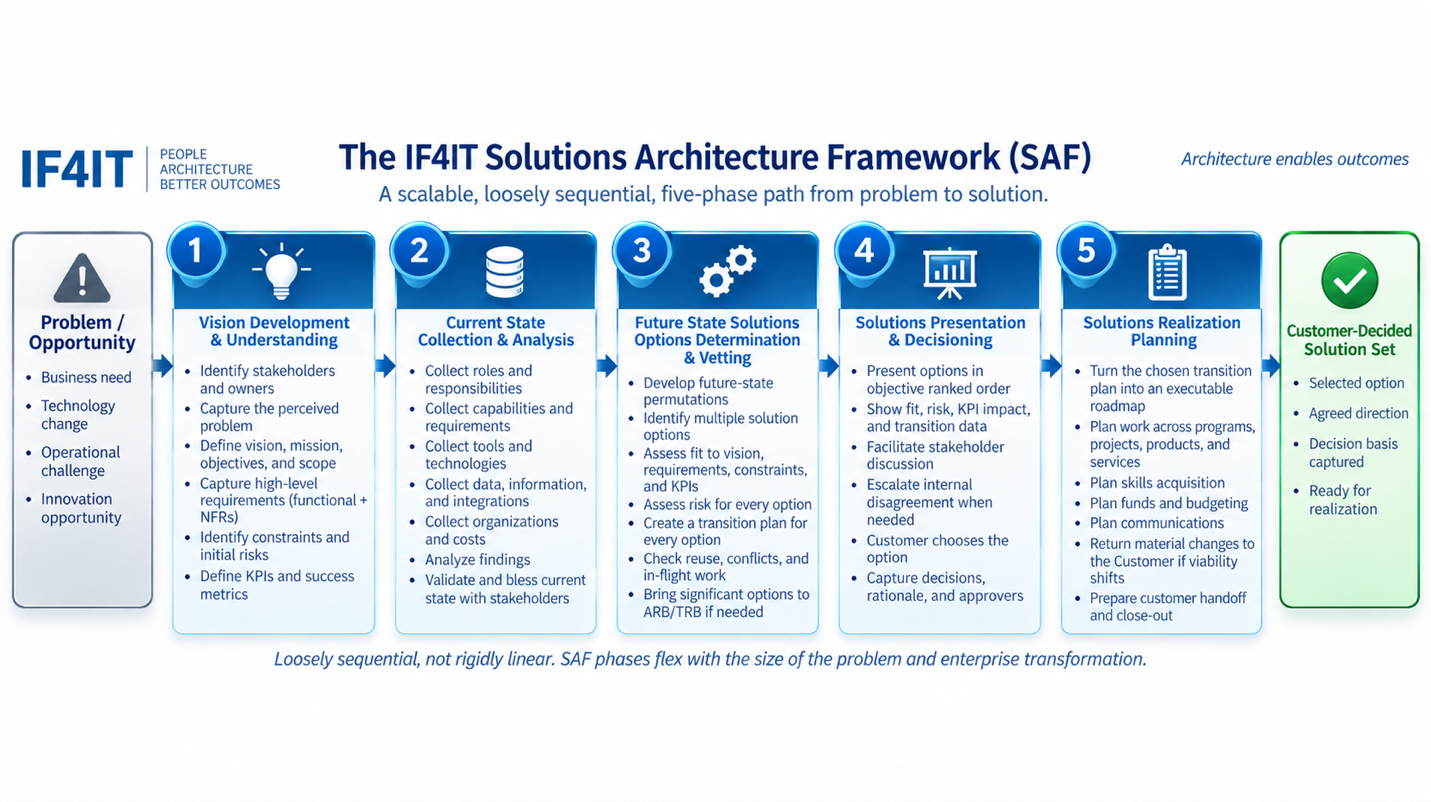
Solutions Architecture Best Practices and Framework
Solutions Architecture is not a new invention or a technology-selection exercise; it is a decades-proven consulting pattern, now standardized into one repeatable, governed discipline that turns an IT or Business problem …
read more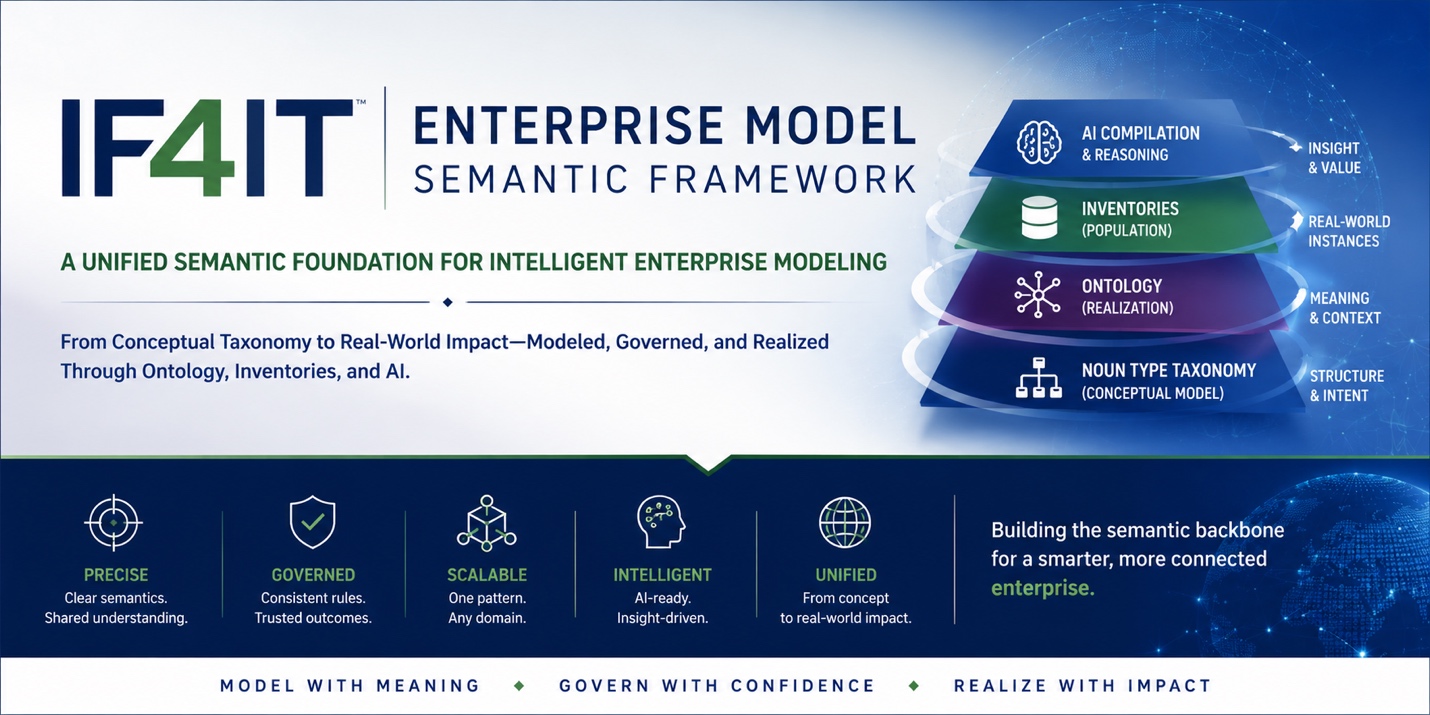
The IF4IT Enterprise Model and Modeling Best Practices
The IF4IT Enterprise Model and Modeling Best Practices explains how enterprises can design, govern, and use an AI-consumable semantic Enterprise Model that represents what the enterprise has, how those things relate, and …
read moreBusiness Architecture
Capabilities Inventory and Attributes
The Capabilities Inventory is the governed enterprise record of the business and IT capabilities the enterprise performs, intends to perform, or has decided to exit. It provides the stable capability vocabulary that lets …
read moreDesigning, Building, and Maintaining Comprehensive and Usable Enterprise Capability Models
A comprehensive Enterprise Capability Model is a governed, inventory-backed knowledge asset that represents the durable abilities an enterprise performs, intends to perform, or has decided to exit. This document explains …
read moreNon-Functional Requirements (NFRs) Framework for Software Systems
Non-Functional Requirements (NFRs) define the software qualities, operating expectations, validation methods, and assurance evidence that determine whether a system is fit for purpose. When NFRs are vague, missing, or …
read moreRegulatory Agencies Inventory and Attributes
The Regulatory Agencies Inventory is the governed root of the enterprise compliance hierarchy, identifying every body whose authority, standards, or market-access requirements create formal obligations for the …
read more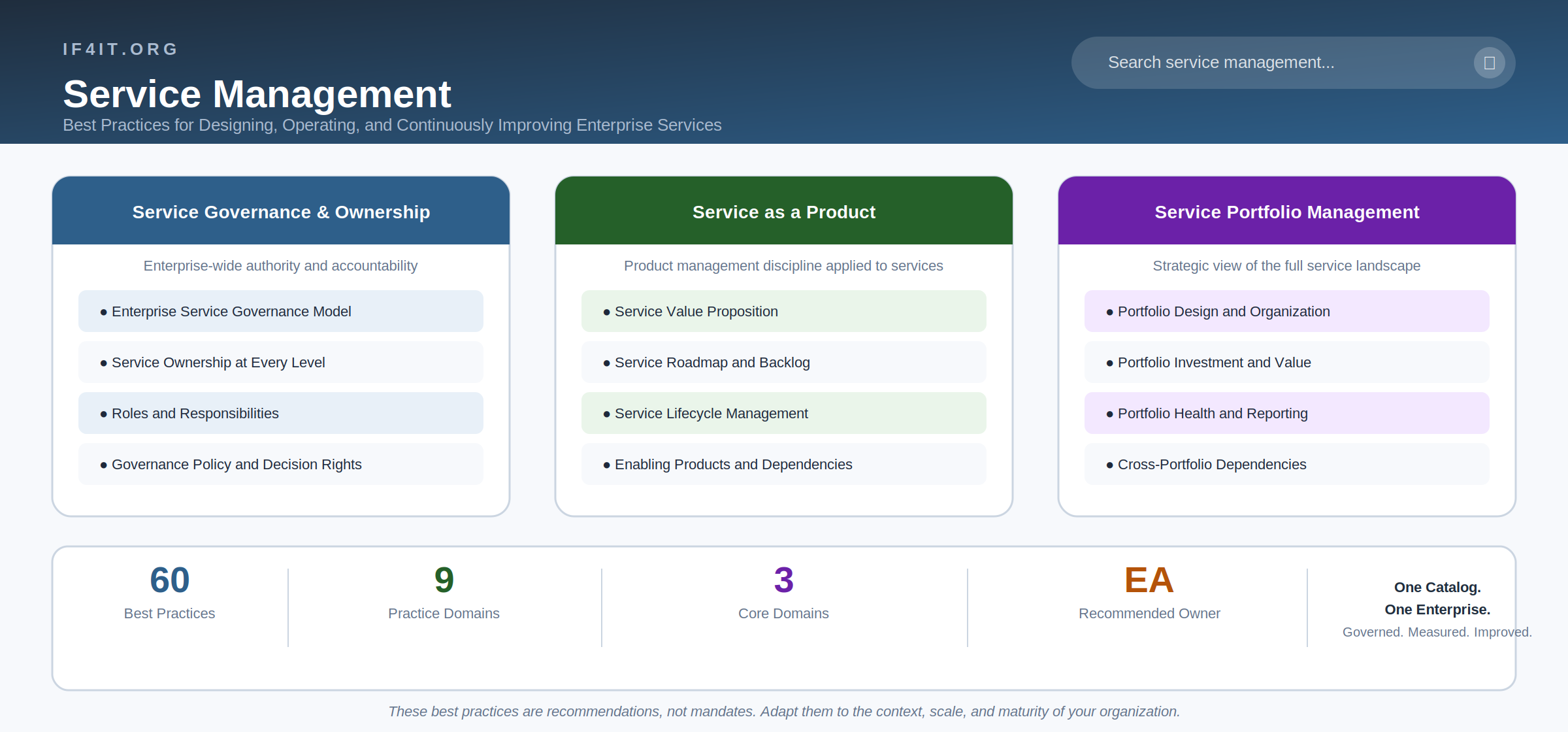
Service Management Best Practices
Service Management is not a ticketing tool or a help desk queue; it is the enterprise discipline for defining, owning, exposing, fulfilling, measuring, governing, and improving services as managed value-delivery assets. …
read moreServices Inventory and Attributes
The Services Inventory is not a Service Catalog or a list of request forms; it is the governed enterprise registry of every Service the enterprise has chosen to govern as a managed value-delivery asset across every …
read moreSolutions Architecture Best Practices and Framework
Solutions Architecture is not a new invention or a technology-selection exercise; it is a decades-proven consulting pattern, now standardized into one repeatable, governed discipline that turns an IT or Business problem …
read moreThe IF4IT Enterprise Model and Modeling Best Practices
The IF4IT Enterprise Model and Modeling Best Practices explains how enterprises can design, govern, and use an AI-consumable semantic Enterprise Model that represents what the enterprise has, how those things relate, and …
read moreValue Streams Inventory and Attributes
The Value Streams Inventory is the governed enterprise record of the end-to-end flows through which the organization delivers value to stakeholders. Without it, enterprises cannot reliably see how value is delivered, …
read moreVendors Inventory and Attributes
The Vendors Inventory is the governed enterprise record of third-party organizations that provide technology, services, data, or capabilities to the enterprise. Without a reliable Vendors Inventory, leaders cannot …
read moreCapability Management
Capabilities Inventory and Attributes
The Capabilities Inventory is the governed enterprise record of the business and IT capabilities the enterprise performs, intends to perform, or has decided to exit. It provides the stable capability vocabulary that lets …
read moreDesigning, Building, and Maintaining Comprehensive and Usable Enterprise Capability Models
A comprehensive Enterprise Capability Model is a governed, inventory-backed knowledge asset that represents the durable abilities an enterprise performs, intends to perform, or has decided to exit. This document explains …
read moreChange Management
Compliance Management
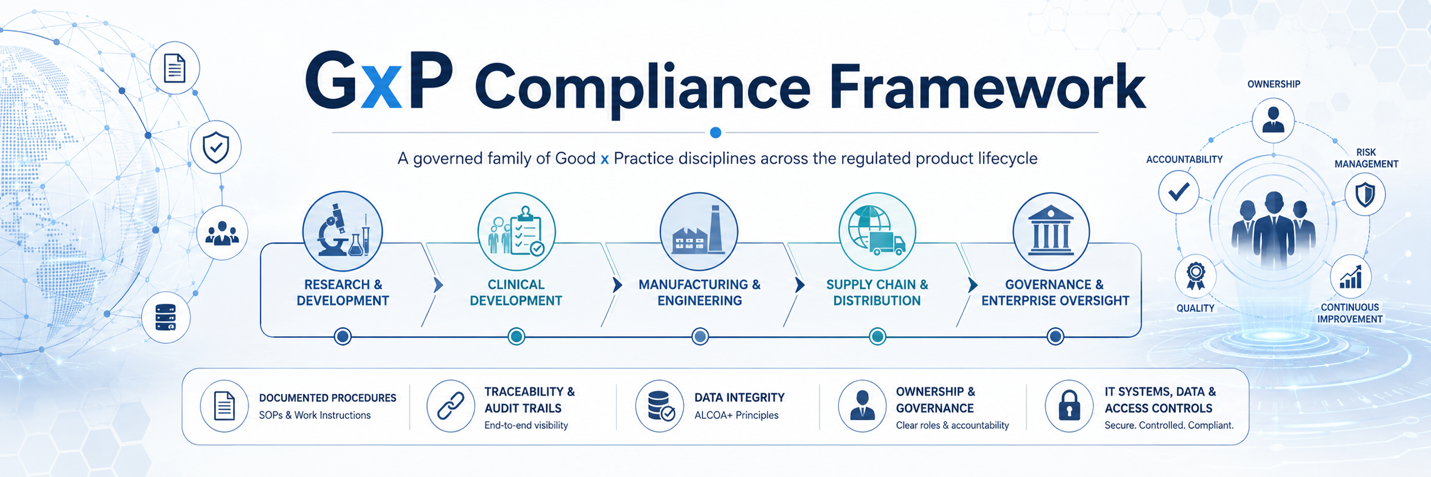
GxP Compliance Framework
GxP is not a single regulation to satisfy once — it is a governed family of over twenty "Good x Practice" disciplines, each defined by its own regulatory body, spanning an enterprise's product lifecycle from research …
read moreRegulatory Agencies Inventory and Attributes
The Regulatory Agencies Inventory is the governed root of the enterprise compliance hierarchy, identifying every body whose authority, standards, or market-access requirements create formal obligations for the …
read moreSystems Development Lifecycle (SDLC) Best Practices
The IF4IT Systems Development Lifecycle (SDLC) is an IT management governance framework for leaders and managers—not merely a software-development process. It provides a comprehensive, tailorable 13-phase lifecycle for …
read moreData & Information Management
Best Practices for Making Legacy Data Semantic and AI-Ready
Making legacy data semantic and AI-ready is an enterprise knowledge discipline that preserves source integrity while adding governed meaning, relationships, lineage, and retrieval context. When enterprises treat …
read moreData and Information Inventory and Attributes
The Data and Information Inventory is not a data catalog or a list of files; it is the governed logical vocabulary for every named data and information type the enterprise produces, consumes, stores, or transmits. …
read moreDesigning, Building, and Maintaining Comprehensive and Usable Enterprise Capability Models
A comprehensive Enterprise Capability Model is a governed, inventory-backed knowledge asset that represents the durable abilities an enterprise performs, intends to perform, or has decided to exit. This document explains …
read more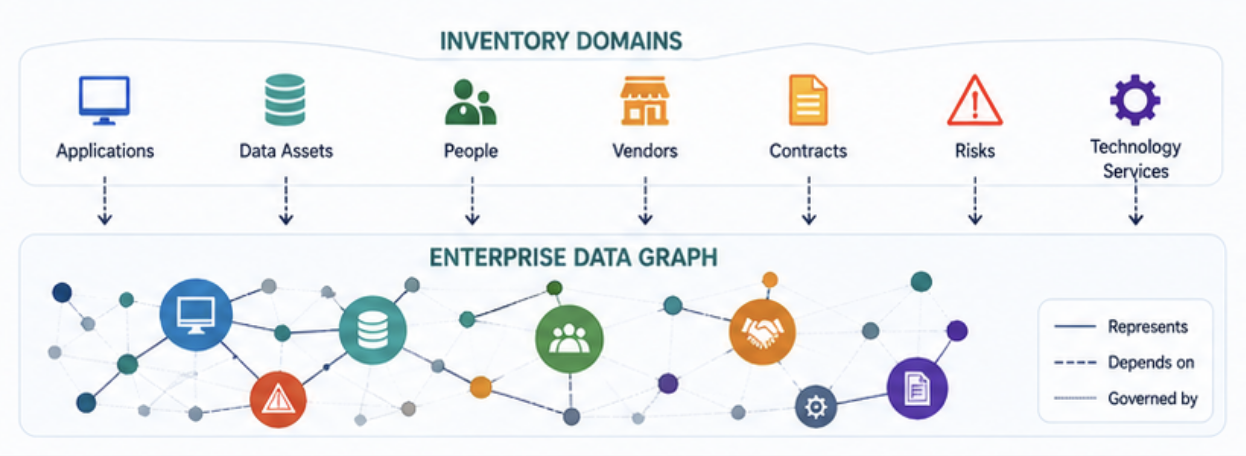
Enterprise Inventory Management Best Practices
Enterprise Inventory Management establishes governed, authoritative inventories that collectively form a connected Enterprise Model. The practices in this document help organizations define ownership, improve accuracy …
read moreRegulatory Agencies Inventory and Attributes
The Regulatory Agencies Inventory is the governed root of the enterprise compliance hierarchy, identifying every body whose authority, standards, or market-access requirements create formal obligations for the …
read moreThe IF4IT Enterprise Model and Modeling Best Practices
The IF4IT Enterprise Model and Modeling Best Practices explains how enterprises can design, govern, and use an AI-consumable semantic Enterprise Model that represents what the enterprise has, how those things relate, and …
read moreValue Streams Inventory and Attributes
The Value Streams Inventory is the governed enterprise record of the end-to-end flows through which the organization delivers value to stakeholders. Without it, enterprises cannot reliably see how value is delivered, …
read moreVendors Inventory and Attributes
The Vendors Inventory is the governed enterprise record of third-party organizations that provide technology, services, data, or capabilities to the enterprise. Without a reliable Vendors Inventory, leaders cannot …
read moreData Governance
Best Practices for Making Legacy Data Semantic and AI-Ready
Making legacy data semantic and AI-ready is an enterprise knowledge discipline that preserves source integrity while adding governed meaning, relationships, lineage, and retrieval context. When enterprises treat …
read moreEnterprise Inventory Management Best Practices
Enterprise Inventory Management establishes governed, authoritative inventories that collectively form a connected Enterprise Model. The practices in this document help organizations define ownership, improve accuracy …
read moreDeployment Management
Enterprise Architecture
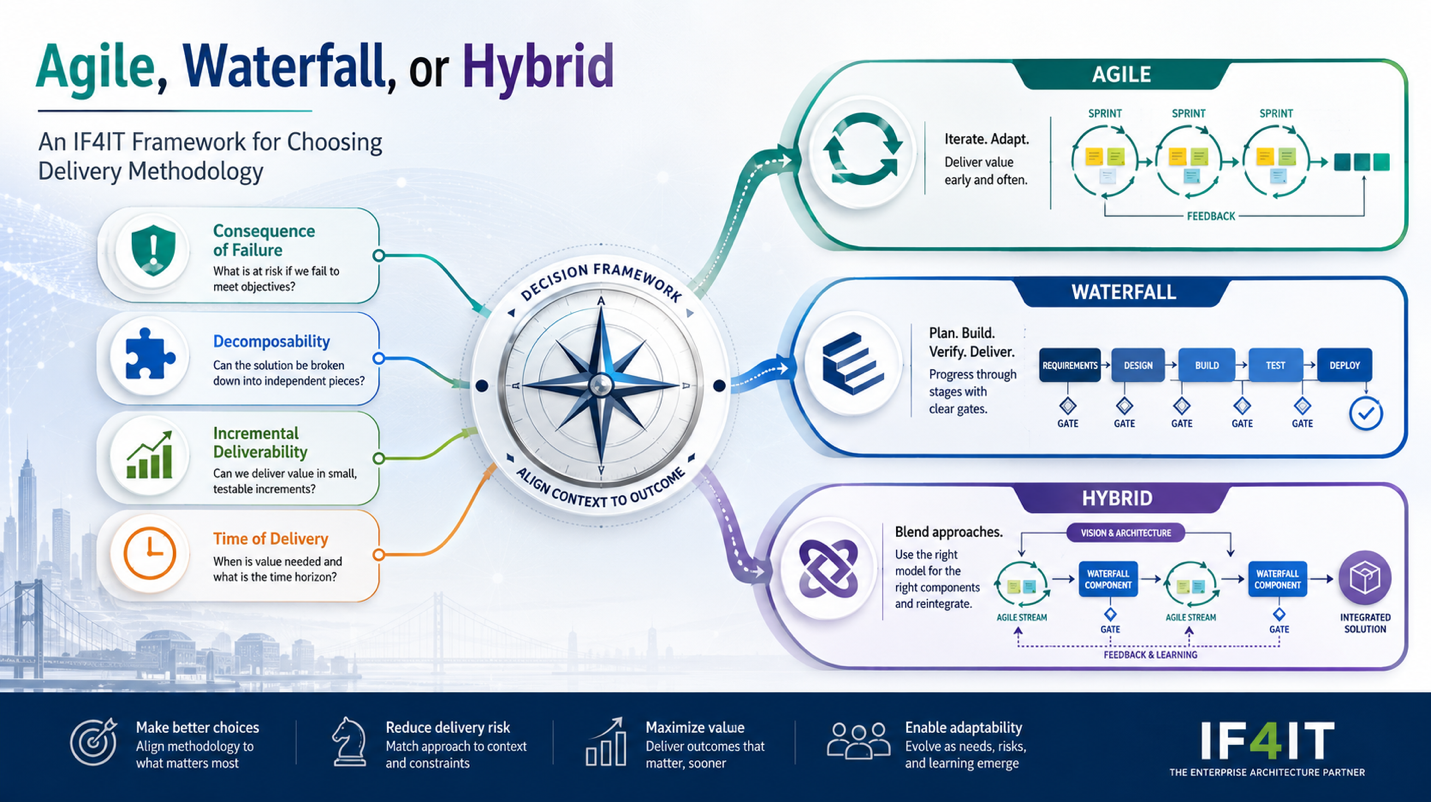
Agile, Waterfall, or Hybrid: An IF4IT Framework for Choosing Delivery Methodology
Delivery methodology is not an enterprise preference; it is a fit decision determined by the nature of the Product or Service being delivered. When organizations force all work through Agile, Waterfall, or a convenient …
read moreBest Practices for Making Legacy Data Semantic and AI-Ready
Making legacy data semantic and AI-ready is an enterprise knowledge discipline that preserves source integrity while adding governed meaning, relationships, lineage, and retrieval context. When enterprises treat …
read moreCapabilities Inventory and Attributes
The Capabilities Inventory is the governed enterprise record of the business and IT capabilities the enterprise performs, intends to perform, or has decided to exit. It provides the stable capability vocabulary that lets …
read moreData and Information Inventory and Attributes
The Data and Information Inventory is not a data catalog or a list of files; it is the governed logical vocabulary for every named data and information type the enterprise produces, consumes, stores, or transmits. …
read moreDesigning, Building, and Maintaining Comprehensive and Usable Enterprise Capability Models
A comprehensive Enterprise Capability Model is a governed, inventory-backed knowledge asset that represents the durable abilities an enterprise performs, intends to perform, or has decided to exit. This document explains …
read more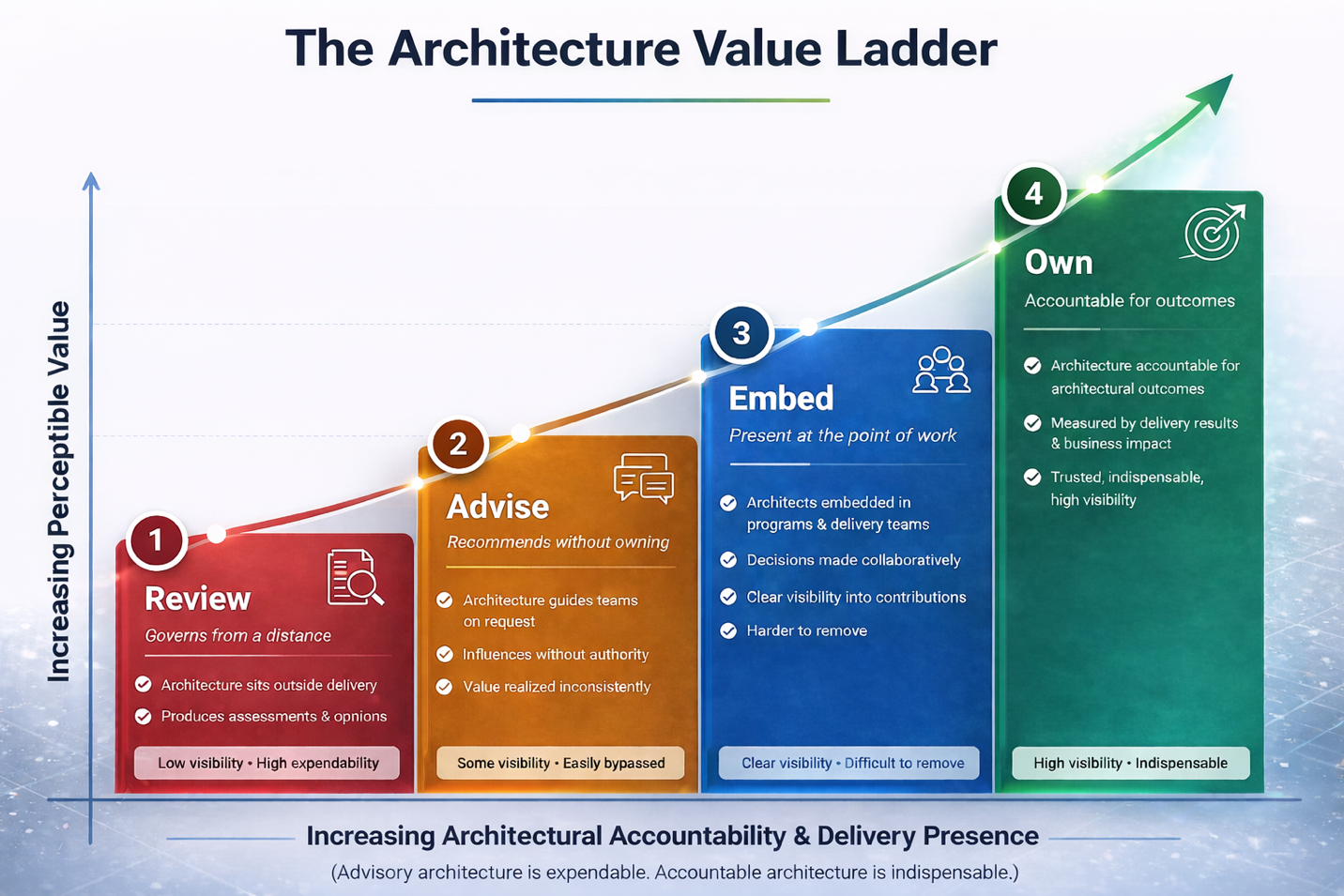
Enterprise Architecture Value Model
The Enterprise Architecture Value Model explains that an architecture function becomes strategically valuable when it moves beyond review and advice into accountable delivery and ownership. It gives CIOs, CTOs, Chief …
read moreIntegrations Inventory and Attributes
The Integrations Inventory is the governed record of every data and information flow, making integration complexity, dependency risk, data sensitivity, technology usage, and cross-boundary movement visible across the …
read moreNon-Functional Requirements (NFRs) Framework for Software Systems
Non-Functional Requirements (NFRs) define the software qualities, operating expectations, validation methods, and assurance evidence that determine whether a system is fit for purpose. When NFRs are vague, missing, or …
read moreRegulatory Agencies Inventory and Attributes
The Regulatory Agencies Inventory is the governed root of the enterprise compliance hierarchy, identifying every body whose authority, standards, or market-access requirements create formal obligations for the …
read more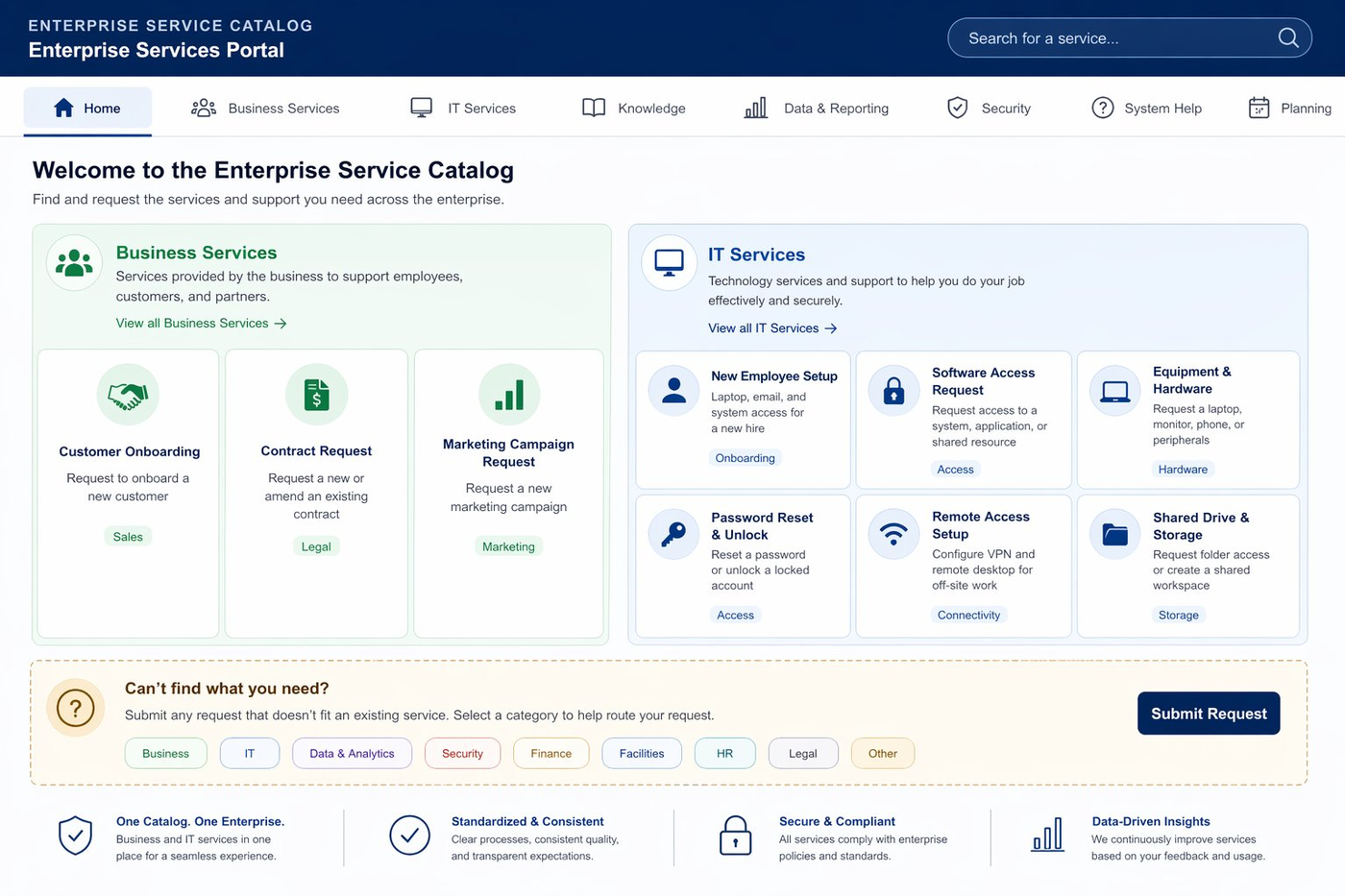
Service Catalog Best Practices
A Service Catalog is the enterprise-facing service publication and request interface that makes services discoverable, understandable, requestable, governable, and continuously improvable across business and technology …
read moreService Management Best Practices
Service Management is not a ticketing tool or a help desk queue; it is the enterprise discipline for defining, owning, exposing, fulfilling, measuring, governing, and improving services as managed value-delivery assets. …
read moreServices Inventory and Attributes
The Services Inventory is not a Service Catalog or a list of request forms; it is the governed enterprise registry of every Service the enterprise has chosen to govern as a managed value-delivery asset across every …
read moreSolutions Architecture Best Practices and Framework
Solutions Architecture is not a new invention or a technology-selection exercise; it is a decades-proven consulting pattern, now standardized into one repeatable, governed discipline that turns an IT or Business problem …
read moreSystems Development Lifecycle (SDLC) Best Practices
The IF4IT Systems Development Lifecycle (SDLC) is an IT management governance framework for leaders and managers—not merely a software-development process. It provides a comprehensive, tailorable 13-phase lifecycle for …
read moreTechnical Debt Management Best Practices
Technical Debt Management is the IT Management discipline for governing technical conditions and unresolved obligations that make governed Assets more costly, difficult, risky, or constrained to change, operate, secure, …
read moreTechnology Portfolio Management (TPM) Best Practices
Technology Portfolio Management is the enterprise discipline for governing technologies as strategic assets through connected inventories, explicit ownership, lifecycle and standards controls, evidence-based assessment, …
read moreThe IF4IT Enterprise Model and Modeling Best Practices
The IF4IT Enterprise Model and Modeling Best Practices explains how enterprises can design, govern, and use an AI-consumable semantic Enterprise Model that represents what the enterprise has, how those things relate, and …
read more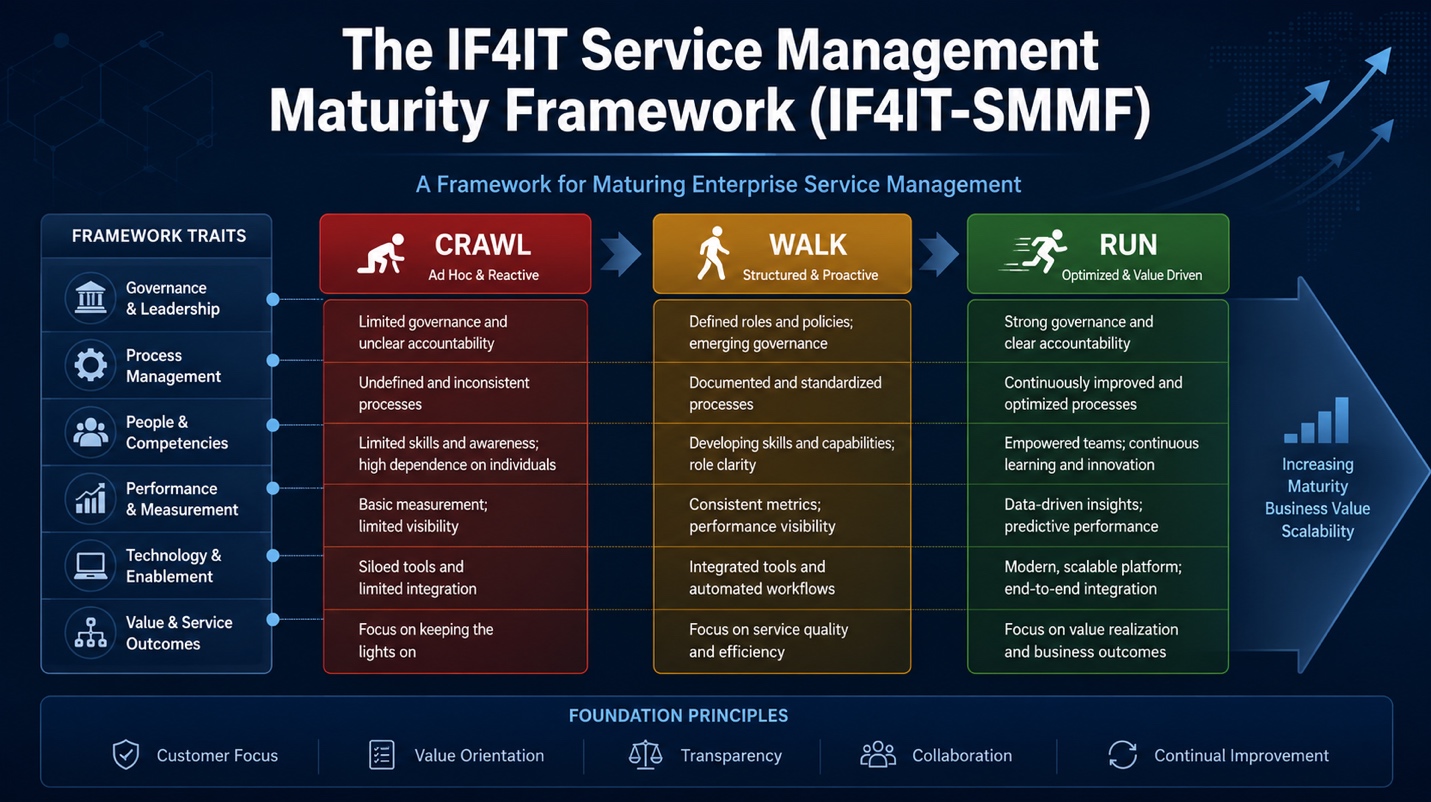
The IF4IT Service Management Maturity Framework (IF4IT-SMMF) for Small, Midsized, and Large Enterprises
The IF4IT Service Management Maturity Framework (IF4IT-SMMF) gives Small, Midsized, and Large Enterprises a rigorous instrument to identify their current Service Management maturity across thirteen traits, prescribe the …
read moreValue Streams Inventory and Attributes
The Value Streams Inventory is the governed enterprise record of the end-to-end flows through which the organization delivers value to stakeholders. Without it, enterprises cannot reliably see how value is delivered, …
read moreVendors Inventory and Attributes
The Vendors Inventory is the governed enterprise record of third-party organizations that provide technology, services, data, or capabilities to the enterprise. Without a reliable Vendors Inventory, leaders cannot …
read moreEnvironment Management
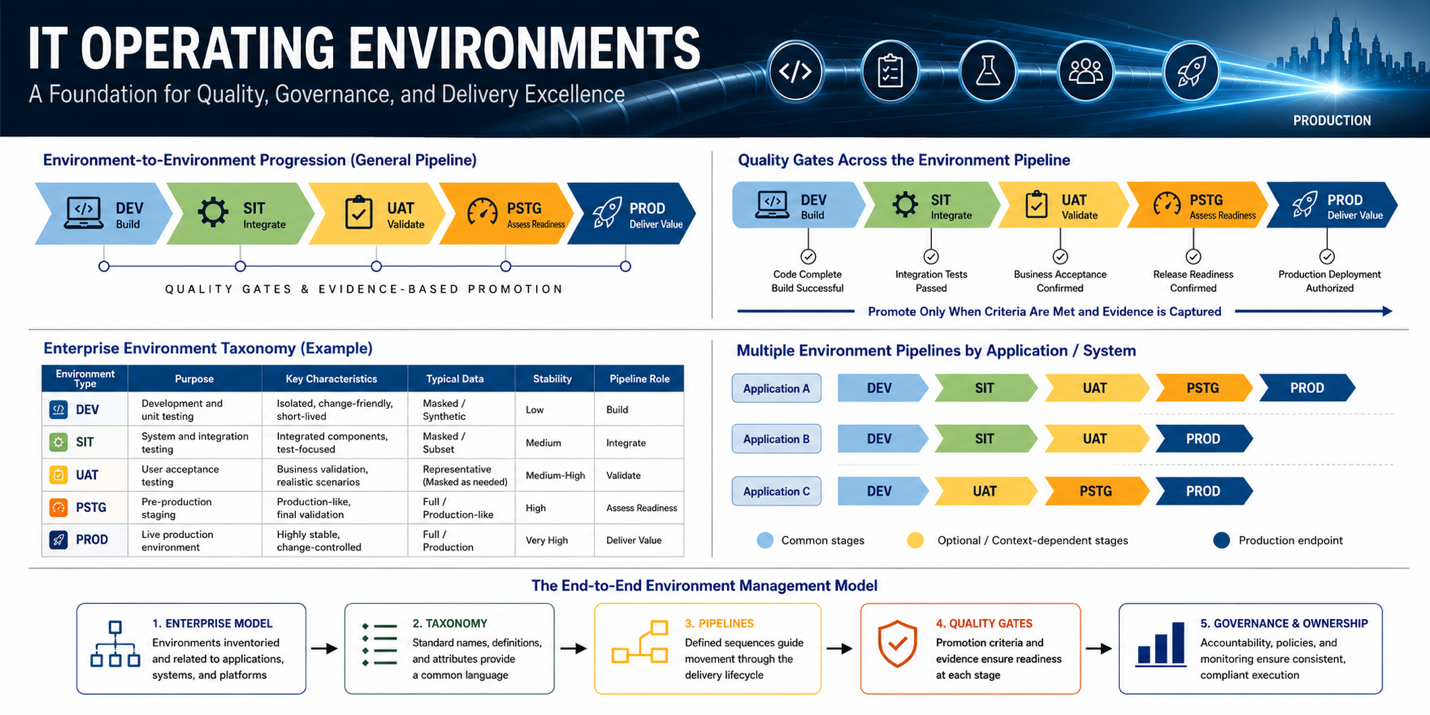
IT Operating Environments Best Practices
IT operating environments are not incidental technical spaces; they are governed enterprise control points that determine how reliably, securely, and cost-effectively solutions move from research and development into …
read more
Release Management Best Practices
Release Management Best Practices defines what a Release is, establishes Release Management as a governance discipline distinct from — but reliant on — its adjacent disciplines (Environment, Deployment, Change, Product, …
read moreGxP
Help Desk
Service Management Best Practices
Service Management is not a ticketing tool or a help desk queue; it is the enterprise discipline for defining, owning, exposing, fulfilling, measuring, governing, and improving services as managed value-delivery assets. …
read moreThe IF4IT Service Management Maturity Framework (IF4IT-SMMF) for Small, Midsized, and Large Enterprises
The IF4IT Service Management Maturity Framework (IF4IT-SMMF) gives Small, Midsized, and Large Enterprises a rigorous instrument to identify their current Service Management maturity across thirteen traits, prescribe the …
read moreInventory Management
AI Agents Inventory and Attributes
The AI Agents Inventory is the enterprise’s single governed record of the AI agents it builds, buys, or runs — the autonomous, model-driven software actors that take action on systems and data, or communicate with …
read moreApplications Inventory and Attributes
The Applications Inventory is the governed enterprise record of every application the organization owns, operates, licenses, or depends on — the authoritative application-level data foundation for the enterprise. Without …
read moreCapabilities Inventory and Attributes
The Capabilities Inventory is the governed enterprise record of the business and IT capabilities the enterprise performs, intends to perform, or has decided to exit. It provides the stable capability vocabulary that lets …
read moreData and Information Inventory and Attributes
The Data and Information Inventory is not a data catalog or a list of files; it is the governed logical vocabulary for every named data and information type the enterprise produces, consumes, stores, or transmits. …
read moreEnterprise Inventory Management Best Practices
Enterprise Inventory Management establishes governed, authoritative inventories that collectively form a connected Enterprise Model. The practices in this document help organizations define ownership, improve accuracy …
read moreIntegrations Inventory and Attributes
The Integrations Inventory is the governed record of every data and information flow, making integration complexity, dependency risk, data sensitivity, technology usage, and cross-boundary movement visible across the …
read moreRegulatory Agencies Inventory and Attributes
The Regulatory Agencies Inventory is the governed root of the enterprise compliance hierarchy, identifying every body whose authority, standards, or market-access requirements create formal obligations for the …
read moreServices Inventory and Attributes
The Services Inventory is not a Service Catalog or a list of request forms; it is the governed enterprise registry of every Service the enterprise has chosen to govern as a managed value-delivery asset across every …
read moreSoftware Technologies Inventory and Attributes
The Software Technologies Inventory is the authoritative, governed record of every software technology the enterprise procures, deploys, operates, or depends on — the database engines, runtimes, middleware, platforms, …
read moreTechnical Debt Inventory and Attributes
The Technical Debt Inventory is the governed record of the Technical Debt Items an enterprise identifies across the Assets it owns, operates, or depends on. Without a governed inventory, Technical Debt remains fragmented …
read moreValue Streams Inventory and Attributes
The Value Streams Inventory is the governed enterprise record of the end-to-end flows through which the organization delivers value to stakeholders. Without it, enterprises cannot reliably see how value is delivered, …
read moreVendors Inventory and Attributes
The Vendors Inventory is the governed enterprise record of third-party organizations that provide technology, services, data, or capabilities to the enterprise. Without a reliable Vendors Inventory, leaders cannot …
read moreIT Delivery
Agile, Waterfall, or Hybrid: An IF4IT Framework for Choosing Delivery Methodology
Delivery methodology is not an enterprise preference; it is a fit decision determined by the nature of the Product or Service being delivered. When organizations force all work through Agile, Waterfall, or a convenient …
read moreIT Operating Environments Best Practices
IT operating environments are not incidental technical spaces; they are governed enterprise control points that determine how reliably, securely, and cost-effectively solutions move from research and development into …
read moreRelease Management Best Practices
Release Management Best Practices defines what a Release is, establishes Release Management as a governance discipline distinct from — but reliant on — its adjacent disciplines (Environment, Deployment, Change, Product, …
read moreSystems Development Lifecycle (SDLC) Best Practices
The IF4IT Systems Development Lifecycle (SDLC) is an IT management governance framework for leaders and managers—not merely a software-development process. It provides a comprehensive, tailorable 13-phase lifecycle for …
read moreIT Governance
Agile, Waterfall, or Hybrid: An IF4IT Framework for Choosing Delivery Methodology
Delivery methodology is not an enterprise preference; it is a fit decision determined by the nature of the Product or Service being delivered. When organizations force all work through Agile, Waterfall, or a convenient …
read moreAI Agents Inventory and Attributes
The AI Agents Inventory is the enterprise’s single governed record of the AI agents it builds, buys, or runs — the autonomous, model-driven software actors that take action on systems and data, or communicate with …
read moreApplication Portfolio Management (APM) Best Practices
Application Portfolio Management (APM) is not an inventory spreadsheet or a purchased tool; it is the enterprise discipline that governs, funds, rationalizes, and strategically evolves every application the organization …
read moreEnterprise AI Governance Best Practices
Enterprise AI Governance is not a standalone tool or committee; it is the enterprise operating discipline that makes artificial intelligence visible, accountable, controlled, evidenced, and improvable across business, …
read moreEnterprise Architecture Value Model
The Enterprise Architecture Value Model explains that an architecture function becomes strategically valuable when it moves beyond review and advice into accountable delivery and ownership. It gives CIOs, CTOs, Chief …
read moreEnterprise Inventory Management Best Practices
Enterprise Inventory Management establishes governed, authoritative inventories that collectively form a connected Enterprise Model. The practices in this document help organizations define ownership, improve accuracy …
read moreGxP Compliance Framework
GxP is not a single regulation to satisfy once — it is a governed family of over twenty "Good x Practice" disciplines, each defined by its own regulatory body, spanning an enterprise's product lifecycle from research …
read moreIntegrations Inventory and Attributes
The Integrations Inventory is the governed record of every data and information flow, making integration complexity, dependency risk, data sensitivity, technology usage, and cross-boundary movement visible across the …
read moreIT Operating Environments Best Practices
IT operating environments are not incidental technical spaces; they are governed enterprise control points that determine how reliably, securely, and cost-effectively solutions move from research and development into …
read moreRegulatory Agencies Inventory and Attributes
The Regulatory Agencies Inventory is the governed root of the enterprise compliance hierarchy, identifying every body whose authority, standards, or market-access requirements create formal obligations for the …
read moreRelease Management Best Practices
Release Management Best Practices defines what a Release is, establishes Release Management as a governance discipline distinct from — but reliant on — its adjacent disciplines (Environment, Deployment, Change, Product, …
read moreService Management Best Practices
Service Management is not a ticketing tool or a help desk queue; it is the enterprise discipline for defining, owning, exposing, fulfilling, measuring, governing, and improving services as managed value-delivery assets. …
read moreServices Inventory and Attributes
The Services Inventory is not a Service Catalog or a list of request forms; it is the governed enterprise registry of every Service the enterprise has chosen to govern as a managed value-delivery asset across every …
read moreTechnical Debt Management Best Practices
Technical Debt Management is the IT Management discipline for governing technical conditions and unresolved obligations that make governed Assets more costly, difficult, risky, or constrained to change, operate, secure, …
read moreTechnology Portfolio Management (TPM) Best Practices
Technology Portfolio Management is the enterprise discipline for governing technologies as strategic assets through connected inventories, explicit ownership, lifecycle and standards controls, evidence-based assessment, …
read moreThe IF4IT Enterprise Model and Modeling Best Practices
The IF4IT Enterprise Model and Modeling Best Practices explains how enterprises can design, govern, and use an AI-consumable semantic Enterprise Model that represents what the enterprise has, how those things relate, and …
read moreThe IF4IT Service Management Maturity Framework (IF4IT-SMMF) for Small, Midsized, and Large Enterprises
The IF4IT Service Management Maturity Framework (IF4IT-SMMF) gives Small, Midsized, and Large Enterprises a rigorous instrument to identify their current Service Management maturity across thirteen traits, prescribe the …
read moreVendors Inventory and Attributes
The Vendors Inventory is the governed enterprise record of third-party organizations that provide technology, services, data, or capabilities to the enterprise. Without a reliable Vendors Inventory, leaders cannot …
read moreIT Service Management
Service Catalog Best Practices
A Service Catalog is the enterprise-facing service publication and request interface that makes services discoverable, understandable, requestable, governable, and continuously improvable across business and technology …
read moreService Management Best Practices
Service Management is not a ticketing tool or a help desk queue; it is the enterprise discipline for defining, owning, exposing, fulfilling, measuring, governing, and improving services as managed value-delivery assets. …
read moreServices Inventory and Attributes
The Services Inventory is not a Service Catalog or a list of request forms; it is the governed enterprise registry of every Service the enterprise has chosen to govern as a managed value-delivery asset across every …
read moreKnowledge Management
Designing, Building, and Maintaining Comprehensive and Usable Enterprise Capability Models
A comprehensive Enterprise Capability Model is a governed, inventory-backed knowledge asset that represents the durable abilities an enterprise performs, intends to perform, or has decided to exit. This document explains …
read moreEnterprise Inventory Management Best Practices
Enterprise Inventory Management establishes governed, authoritative inventories that collectively form a connected Enterprise Model. The practices in this document help organizations define ownership, improve accuracy …
read moreIntegrations Inventory and Attributes
The Integrations Inventory is the governed record of every data and information flow, making integration complexity, dependency risk, data sensitivity, technology usage, and cross-boundary movement visible across the …
read moreSolutions Architecture Best Practices and Framework
Solutions Architecture is not a new invention or a technology-selection exercise; it is a decades-proven consulting pattern, now standardized into one repeatable, governed discipline that turns an IT or Business problem …
read moreThe IF4IT Enterprise Model and Modeling Best Practices
The IF4IT Enterprise Model and Modeling Best Practices explains how enterprises can design, govern, and use an AI-consumable semantic Enterprise Model that represents what the enterprise has, how those things relate, and …
read moreModels and Modeling
Designing, Building, and Maintaining Comprehensive and Usable Enterprise Capability Models
A comprehensive Enterprise Capability Model is a governed, inventory-backed knowledge asset that represents the durable abilities an enterprise performs, intends to perform, or has decided to exit. This document explains …
read moreEnterprise Architecture Value Model
The Enterprise Architecture Value Model explains that an architecture function becomes strategically valuable when it moves beyond review and advice into accountable delivery and ownership. It gives CIOs, CTOs, Chief …
read moreGxP Compliance Framework
GxP is not a single regulation to satisfy once — it is a governed family of over twenty "Good x Practice" disciplines, each defined by its own regulatory body, spanning an enterprise's product lifecycle from research …
read moreThe IF4IT Enterprise Model and Modeling Best Practices
The IF4IT Enterprise Model and Modeling Best Practices explains how enterprises can design, govern, and use an AI-consumable semantic Enterprise Model that represents what the enterprise has, how those things relate, and …
read moreNon-Human Identity
Portfolio Management
Application Portfolio Management (APM) Best Practices
Application Portfolio Management (APM) is not an inventory spreadsheet or a purchased tool; it is the enterprise discipline that governs, funds, rationalizes, and strategically evolves every application the organization …
read moreIntegrations Inventory and Attributes
The Integrations Inventory is the governed record of every data and information flow, making integration complexity, dependency risk, data sensitivity, technology usage, and cross-boundary movement visible across the …
read moreTechnology Portfolio Management (TPM) Best Practices
Technology Portfolio Management is the enterprise discipline for governing technologies as strategic assets through connected inventories, explicit ownership, lifecycle and standards controls, evidence-based assessment, …
read moreProduct Management
Agile, Waterfall, or Hybrid: An IF4IT Framework for Choosing Delivery Methodology
Delivery methodology is not an enterprise preference; it is a fit decision determined by the nature of the Product or Service being delivered. When organizations force all work through Agile, Waterfall, or a convenient …
read moreSystems Development Lifecycle (SDLC) Best Practices
The IF4IT Systems Development Lifecycle (SDLC) is an IT management governance framework for leaders and managers—not merely a software-development process. It provides a comprehensive, tailorable 13-phase lifecycle for …
read moreProject Management
Agile, Waterfall, or Hybrid: An IF4IT Framework for Choosing Delivery Methodology
Delivery methodology is not an enterprise preference; it is a fit decision determined by the nature of the Product or Service being delivered. When organizations force all work through Agile, Waterfall, or a convenient …
read moreRelease Management Best Practices
Release Management Best Practices defines what a Release is, establishes Release Management as a governance discipline distinct from — but reliant on — its adjacent disciplines (Environment, Deployment, Change, Product, …
read moreRegulation Management
AI Agents Inventory and Attributes
The AI Agents Inventory is the enterprise’s single governed record of the AI agents it builds, buys, or runs — the autonomous, model-driven software actors that take action on systems and data, or communicate with …
read moreRegulatory Agencies Inventory and Attributes
The Regulatory Agencies Inventory is the governed root of the enterprise compliance hierarchy, identifying every body whose authority, standards, or market-access requirements create formal obligations for the …
read moreRelease Management
IT Operating Environments Best Practices
IT operating environments are not incidental technical spaces; they are governed enterprise control points that determine how reliably, securely, and cost-effectively solutions move from research and development into …
read moreRelease Management Best Practices
Release Management Best Practices defines what a Release is, establishes Release Management as a governance discipline distinct from — but reliant on — its adjacent disciplines (Environment, Deployment, Change, Product, …
read moreSystems Development Lifecycle (SDLC) Best Practices
The IF4IT Systems Development Lifecycle (SDLC) is an IT management governance framework for leaders and managers—not merely a software-development process. It provides a comprehensive, tailorable 13-phase lifecycle for …
read moreRequirements Management
Designing, Building, and Maintaining Comprehensive and Usable Enterprise Capability Models
A comprehensive Enterprise Capability Model is a governed, inventory-backed knowledge asset that represents the durable abilities an enterprise performs, intends to perform, or has decided to exit. This document explains …
read moreNon-Functional Requirements (NFRs) Framework for Software Systems
Non-Functional Requirements (NFRs) define the software qualities, operating expectations, validation methods, and assurance evidence that determine whether a system is fit for purpose. When NFRs are vague, missing, or …
read moreRisk Management
AI Agents Inventory and Attributes
The AI Agents Inventory is the enterprise’s single governed record of the AI agents it builds, buys, or runs — the autonomous, model-driven software actors that take action on systems and data, or communicate with …
read moreTechnical Debt Inventory and Attributes
The Technical Debt Inventory is the governed record of the Technical Debt Items an enterprise identifies across the Assets it owns, operates, or depends on. Without a governed inventory, Technical Debt remains fragmented …
read moreTechnical Debt Management Best Practices
Technical Debt Management is the IT Management discipline for governing technical conditions and unresolved obligations that make governed Assets more costly, difficult, risky, or constrained to change, operate, secure, …
read moreService Desk
Service Catalog Best Practices
A Service Catalog is the enterprise-facing service publication and request interface that makes services discoverable, understandable, requestable, governable, and continuously improvable across business and technology …
read moreService Management Best Practices
Service Management is not a ticketing tool or a help desk queue; it is the enterprise discipline for defining, owning, exposing, fulfilling, measuring, governing, and improving services as managed value-delivery assets. …
read moreService Management
Service Catalog Best Practices
A Service Catalog is the enterprise-facing service publication and request interface that makes services discoverable, understandable, requestable, governable, and continuously improvable across business and technology …
read moreService Management Best Practices
Service Management is not a ticketing tool or a help desk queue; it is the enterprise discipline for defining, owning, exposing, fulfilling, measuring, governing, and improving services as managed value-delivery assets. …
read moreServices Inventory and Attributes
The Services Inventory is not a Service Catalog or a list of request forms; it is the governed enterprise registry of every Service the enterprise has chosen to govern as a managed value-delivery asset across every …
read moreSystems Development Lifecycle (SDLC) Best Practices
The IF4IT Systems Development Lifecycle (SDLC) is an IT management governance framework for leaders and managers—not merely a software-development process. It provides a comprehensive, tailorable 13-phase lifecycle for …
read moreThe IF4IT Service Management Maturity Framework (IF4IT-SMMF) for Small, Midsized, and Large Enterprises
The IF4IT Service Management Maturity Framework (IF4IT-SMMF) gives Small, Midsized, and Large Enterprises a rigorous instrument to identify their current Service Management maturity across thirteen traits, prescribe the …
read moreSoftware and Systems Delivery
Release Management Best Practices
Release Management Best Practices defines what a Release is, establishes Release Management as a governance discipline distinct from — but reliant on — its adjacent disciplines (Environment, Deployment, Change, Product, …
read moreSoftware Technologies Inventory and Attributes
The Software Technologies Inventory is the authoritative, governed record of every software technology the enterprise procures, deploys, operates, or depends on — the database engines, runtimes, middleware, platforms, …
read moreSystems Development Lifecycle (SDLC) Best Practices
The IF4IT Systems Development Lifecycle (SDLC) is an IT management governance framework for leaders and managers—not merely a software-development process. It provides a comprehensive, tailorable 13-phase lifecycle for …
read moreSoftware Management
Application Portfolio Management (APM) Best Practices
Application Portfolio Management (APM) is not an inventory spreadsheet or a purchased tool; it is the enterprise discipline that governs, funds, rationalizes, and strategically evolves every application the organization …
read moreSoftware Technologies Inventory and Attributes
The Software Technologies Inventory is the authoritative, governed record of every software technology the enterprise procures, deploys, operates, or depends on — the database engines, runtimes, middleware, platforms, …
read moreSystems Development Lifecycle (SDLC) Best Practices
The IF4IT Systems Development Lifecycle (SDLC) is an IT management governance framework for leaders and managers—not merely a software-development process. It provides a comprehensive, tailorable 13-phase lifecycle for …
read moreTechnical Debt Inventory and Attributes
The Technical Debt Inventory is the governed record of the Technical Debt Items an enterprise identifies across the Assets it owns, operates, or depends on. Without a governed inventory, Technical Debt remains fragmented …
read moreTechnical Debt Management Best Practices
Technical Debt Management is the IT Management discipline for governing technical conditions and unresolved obligations that make governed Assets more costly, difficult, risky, or constrained to change, operate, secure, …
read moreTechnology Portfolio Management (TPM) Best Practices
Technology Portfolio Management is the enterprise discipline for governing technologies as strategic assets through connected inventories, explicit ownership, lifecycle and standards controls, evidence-based assessment, …
read moreSolutions Architecture
Systems Development Lifecycle (SDLC)
Release Management Best Practices
Release Management Best Practices defines what a Release is, establishes Release Management as a governance discipline distinct from — but reliant on — its adjacent disciplines (Environment, Deployment, Change, Product, …
read moreSystems Development Lifecycle (SDLC) Best Practices
The IF4IT Systems Development Lifecycle (SDLC) is an IT management governance framework for leaders and managers—not merely a software-development process. It provides a comprehensive, tailorable 13-phase lifecycle for …
read moreTechnical Debt Management
Application Portfolio Management (APM) Best Practices
Application Portfolio Management (APM) is not an inventory spreadsheet or a purchased tool; it is the enterprise discipline that governs, funds, rationalizes, and strategically evolves every application the organization …
read moreTechnical Debt Inventory and Attributes
The Technical Debt Inventory is the governed record of the Technical Debt Items an enterprise identifies across the Assets it owns, operates, or depends on. Without a governed inventory, Technical Debt remains fragmented …
read moreTechnical Debt Management Best Practices
Technical Debt Management is the IT Management discipline for governing technical conditions and unresolved obligations that make governed Assets more costly, difficult, risky, or constrained to change, operate, secure, …
read moreTechnology Portfolio Management (TPM) Best Practices
Technology Portfolio Management is the enterprise discipline for governing technologies as strategic assets through connected inventories, explicit ownership, lifecycle and standards controls, evidence-based assessment, …
read moreTechnology Portfolio Management
Software Technologies Inventory and Attributes
The Software Technologies Inventory is the authoritative, governed record of every software technology the enterprise procures, deploys, operates, or depends on — the database engines, runtimes, middleware, platforms, …
read moreTechnical Debt Management Best Practices
Technical Debt Management is the IT Management discipline for governing technical conditions and unresolved obligations that make governed Assets more costly, difficult, risky, or constrained to change, operate, secure, …
read moreTechnology Portfolio Management (TPM) Best Practices
Technology Portfolio Management is the enterprise discipline for governing technologies as strategic assets through connected inventories, explicit ownership, lifecycle and standards controls, evidence-based assessment, …
read moreVendor Management
Technology Portfolio Management (TPM) Best Practices
Technology Portfolio Management is the enterprise discipline for governing technologies as strategic assets through connected inventories, explicit ownership, lifecycle and standards controls, evidence-based assessment, …
read moreVendors Inventory and Attributes
The Vendors Inventory is the governed enterprise record of third-party organizations that provide technology, services, data, or capabilities to the enterprise. Without a reliable Vendors Inventory, leaders cannot …
read moreWork Management
Release Management Best Practices
Release Management Best Practices defines what a Release is, establishes Release Management as a governance discipline distinct from — but reliant on — its adjacent disciplines (Environment, Deployment, Change, Product, …
read moreService Catalog Best Practices
A Service Catalog is the enterprise-facing service publication and request interface that makes services discoverable, understandable, requestable, governable, and continuously improvable across business and technology …
read moreService Management Best Practices
Service Management is not a ticketing tool or a help desk queue; it is the enterprise discipline for defining, owning, exposing, fulfilling, measuring, governing, and improving services as managed value-delivery assets. …
read moreBrowse all IF4IT content on the Catalog.
Best Practice
Agile, Waterfall, or Hybrid: An IF4IT Framework for Choosing Delivery Methodology
Delivery methodology is not an enterprise preference; it is a fit decision determined by the nature of the Product or Service being delivered. When organizations force all work through Agile, Waterfall, or a convenient …
read moreApplication Portfolio Management (APM) Best Practices
Application Portfolio Management (APM) is not an inventory spreadsheet or a purchased tool; it is the enterprise discipline that governs, funds, rationalizes, and strategically evolves every application the organization …
read moreBest Practices for Making Legacy Data Semantic and AI-Ready
Making legacy data semantic and AI-ready is an enterprise knowledge discipline that preserves source integrity while adding governed meaning, relationships, lineage, and retrieval context. When enterprises treat …
read moreDesigning, Building, and Maintaining Comprehensive and Usable Enterprise Capability Models
A comprehensive Enterprise Capability Model is a governed, inventory-backed knowledge asset that represents the durable abilities an enterprise performs, intends to perform, or has decided to exit. This document explains …
read moreEnterprise AI Governance Best Practices
Enterprise AI Governance is not a standalone tool or committee; it is the enterprise operating discipline that makes artificial intelligence visible, accountable, controlled, evidenced, and improvable across business, …
read moreEnterprise Inventory Management Best Practices
Enterprise Inventory Management establishes governed, authoritative inventories that collectively form a connected Enterprise Model. The practices in this document help organizations define ownership, improve accuracy …
read moreIT Operating Environments Best Practices
IT operating environments are not incidental technical spaces; they are governed enterprise control points that determine how reliably, securely, and cost-effectively solutions move from research and development into …
read moreRelease Management Best Practices
Release Management Best Practices defines what a Release is, establishes Release Management as a governance discipline distinct from — but reliant on — its adjacent disciplines (Environment, Deployment, Change, Product, …
read moreService Catalog Best Practices
A Service Catalog is the enterprise-facing service publication and request interface that makes services discoverable, understandable, requestable, governable, and continuously improvable across business and technology …
read moreService Management Best Practices
Service Management is not a ticketing tool or a help desk queue; it is the enterprise discipline for defining, owning, exposing, fulfilling, measuring, governing, and improving services as managed value-delivery assets. …
read moreSolutions Architecture Best Practices and Framework
Solutions Architecture is not a new invention or a technology-selection exercise; it is a decades-proven consulting pattern, now standardized into one repeatable, governed discipline that turns an IT or Business problem …
read moreSystems Development Lifecycle (SDLC) Best Practices
The IF4IT Systems Development Lifecycle (SDLC) is an IT management governance framework for leaders and managers—not merely a software-development process. It provides a comprehensive, tailorable 13-phase lifecycle for …
read moreTechnical Debt Management Best Practices
Technical Debt Management is the IT Management discipline for governing technical conditions and unresolved obligations that make governed Assets more costly, difficult, risky, or constrained to change, operate, secure, …
read moreTechnology Portfolio Management (TPM) Best Practices
Technology Portfolio Management is the enterprise discipline for governing technologies as strategic assets through connected inventories, explicit ownership, lifecycle and standards controls, evidence-based assessment, …
read moreThe IF4IT Enterprise Model and Modeling Best Practices
The IF4IT Enterprise Model and Modeling Best Practices explains how enterprises can design, govern, and use an AI-consumable semantic Enterprise Model that represents what the enterprise has, how those things relate, and …
read moreFramework
GxP Compliance Framework
GxP is not a single regulation to satisfy once — it is a governed family of over twenty "Good x Practice" disciplines, each defined by its own regulatory body, spanning an enterprise's product lifecycle from research …
read moreNon-Functional Requirements (NFRs) Framework for Software Systems
Non-Functional Requirements (NFRs) define the software qualities, operating expectations, validation methods, and assurance evidence that determine whether a system is fit for purpose. When NFRs are vague, missing, or …
read moreSolutions Architecture Best Practices and Framework
Solutions Architecture is not a new invention or a technology-selection exercise; it is a decades-proven consulting pattern, now standardized into one repeatable, governed discipline that turns an IT or Business problem …
read moreThe IF4IT Service Management Maturity Framework (IF4IT-SMMF) for Small, Midsized, and Large Enterprises
The IF4IT Service Management Maturity Framework (IF4IT-SMMF) gives Small, Midsized, and Large Enterprises a rigorous instrument to identify their current Service Management maturity across thirteen traits, prescribe the …
read moreInventory
AI Agents Inventory and Attributes
The AI Agents Inventory is the enterprise’s single governed record of the AI agents it builds, buys, or runs — the autonomous, model-driven software actors that take action on systems and data, or communicate with …
read moreApplications Inventory and Attributes
The Applications Inventory is the governed enterprise record of every application the organization owns, operates, licenses, or depends on — the authoritative application-level data foundation for the enterprise. Without …
read moreCapabilities Inventory and Attributes
The Capabilities Inventory is the governed enterprise record of the business and IT capabilities the enterprise performs, intends to perform, or has decided to exit. It provides the stable capability vocabulary that lets …
read moreData and Information Inventory and Attributes
The Data and Information Inventory is not a data catalog or a list of files; it is the governed logical vocabulary for every named data and information type the enterprise produces, consumes, stores, or transmits. …
read moreIntegrations Inventory and Attributes
The Integrations Inventory is the governed record of every data and information flow, making integration complexity, dependency risk, data sensitivity, technology usage, and cross-boundary movement visible across the …
read moreRegulatory Agencies Inventory and Attributes
The Regulatory Agencies Inventory is the governed root of the enterprise compliance hierarchy, identifying every body whose authority, standards, or market-access requirements create formal obligations for the …
read moreServices Inventory and Attributes
The Services Inventory is not a Service Catalog or a list of request forms; it is the governed enterprise registry of every Service the enterprise has chosen to govern as a managed value-delivery asset across every …
read moreSoftware Technologies Inventory and Attributes
The Software Technologies Inventory is the authoritative, governed record of every software technology the enterprise procures, deploys, operates, or depends on — the database engines, runtimes, middleware, platforms, …
read moreTechnical Debt Inventory and Attributes
The Technical Debt Inventory is the governed record of the Technical Debt Items an enterprise identifies across the Assets it owns, operates, or depends on. Without a governed inventory, Technical Debt remains fragmented …
read moreValue Streams Inventory and Attributes
The Value Streams Inventory is the governed enterprise record of the end-to-end flows through which the organization delivers value to stakeholders. Without it, enterprises cannot reliably see how value is delivered, …
read moreVendors Inventory and Attributes
The Vendors Inventory is the governed enterprise record of third-party organizations that provide technology, services, data, or capabilities to the enterprise. Without a reliable Vendors Inventory, leaders cannot …
read moreModel
Browse all IF4IT content on the Catalog.