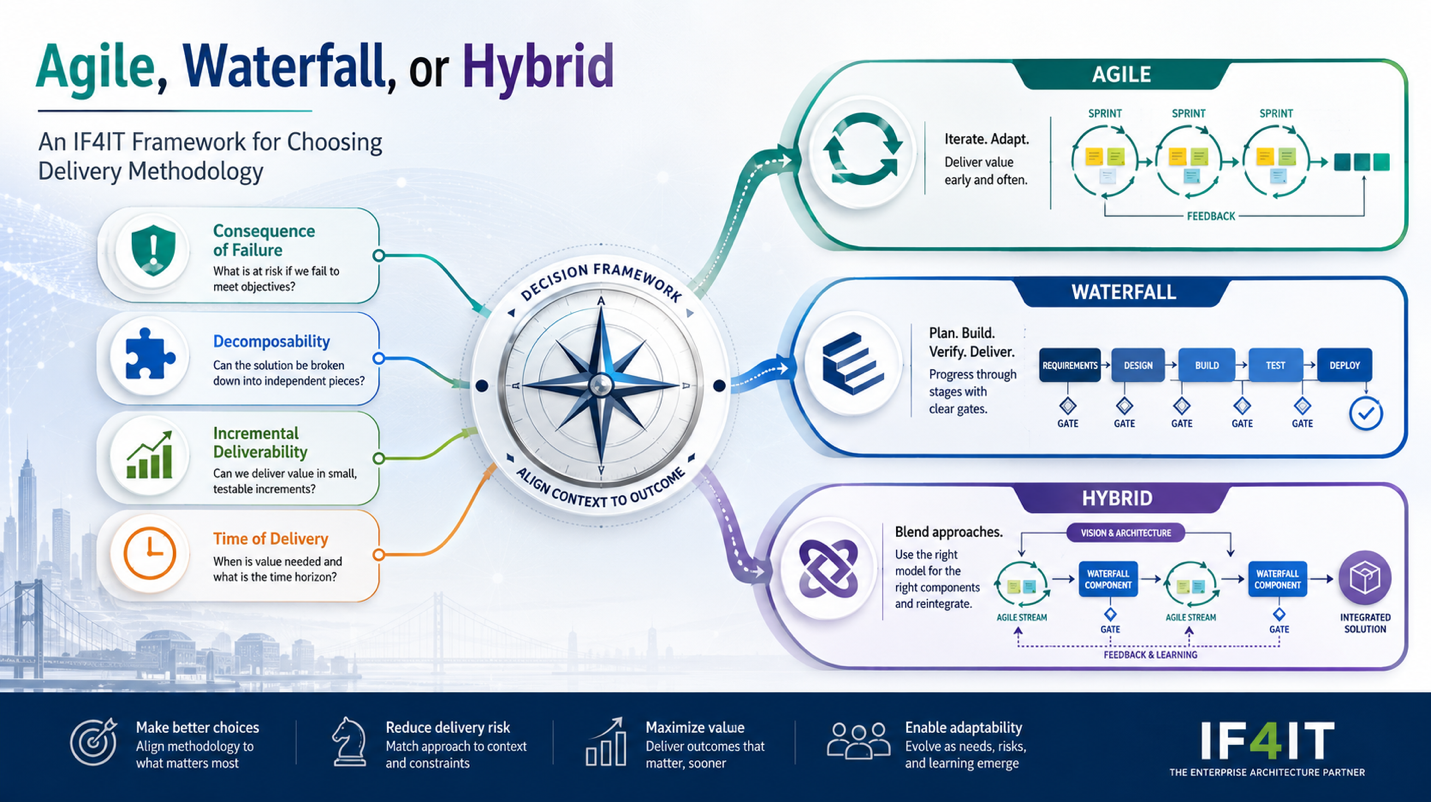
Agile, Waterfall, or Hybrid: An IF4IT Framework for Choosing Delivery Methodology
Executive Summary: Document Overview
IF4ITThe Bottom Line
Delivery methodology is not an enterprise preference; it is a fit decision determined by the nature of the Product or Service being delivered. When organizations force all work through Agile, Waterfall, or a convenient Hybrid by policy, they create failed delivery, wasted investment, unnecessary risk, and governance signals that look disciplined while concealing methodology mismatch. The IF4IT framework gives leaders and practitioners a practical way to classify work by consequence of failure, decomposability, incremental deliverability, and time of delivery so Agile, Waterfall, or Hybrid is chosen deliberately.
Core Pillars & Document Modules
| Document Pillar / Focus Area | Strategic Business Outcome & Intent |
|---|---|
| Methodology Fit | Align delivery approach to the intrinsic characteristics of the Product or Service so governance decisions reflect the work itself rather than organizational preference or methodology fashion. |
| Consequence of Failure | Prevent severe harm, regulatory breach, irreversible loss, brand damage, or unacceptable operational exposure by routing high-consequence work toward staged verification before release. |
| Structural Indicators | Evaluate decomposability, incremental deliverability, and time of delivery to determine whether work can operate as a continuous Agile stream or must be bounded and integrated. |
| Hybrid Discipline | Use Hybrid only when mostly Agile-shaped work contains isolatable Waterfall-shaped components with clean interfaces, separable workstreams, and defined reintegration points. |
| Enterprise Decision Rights | Keep the framework advisory while preserving enterprise accountability for Product or Service boundaries, reassessment triggers, cost tolerance, and final delivery governance decisions. |
Quick Q&A (Macro Executive Reference)
Question: Why can’t an enterprise standardize on one delivery methodology for all work?
Answer: Because methodology fit is determined by the work’s consequence of failure, decomposability, incremental deliverability, and delivery-cycle behavior. Standardizing on one method may look efficient, but it can force inappropriate delivery patterns onto work that cannot safely or economically support them.
Question: When should a Product or Service use Waterfall instead of Agile?
Answer: A Product or Service should use Waterfall when failure in use would be severe or when the work cannot be delivered as small, independent, valuable increments. In those cases, staged verification before release is the responsible fail-fast discipline because production is the wrong place to discover failure.
Question: What makes Hybrid a legitimate outcome rather than a compromise?
Answer: Hybrid is legitimate only when mostly Agile-shaped work contains Waterfall-shaped components that can be isolated behind clean interfaces, distinct workstreams, and defined integration points. It is not a compromise for indecision or a way to avoid choosing the methodology that the work actually requires.
Read Full Table of Contents Below
Table of Contents
Overview and Glossary
Conceptual Foundations
- What a Product or Service Is
- Three Possible Outcomes — Agile, Waterfall, and Hybrid
- Fail Fast — A Shared Principle, Applied Differently
- Methodology Is Determined at Definition
- Calibration Is the Enterprise’s Responsibility
The Framework
- Overview of the Framework
- Indicator 1 — Consequence of Failure (The Gate)
- Indicator 2 — Decomposability
- Indicator 3 — Incremental Deliverability
- Indicator 4 — Time of Delivery
- The Decision Tree
- Recognition Versus Formal Analysis
- The Hybrid Outcome
- The Cost Layer
Applying the Framework
Closing Remarks
Copyright for The International Foundation for Information Technology (IF4IT), LLC: 2008 - Present