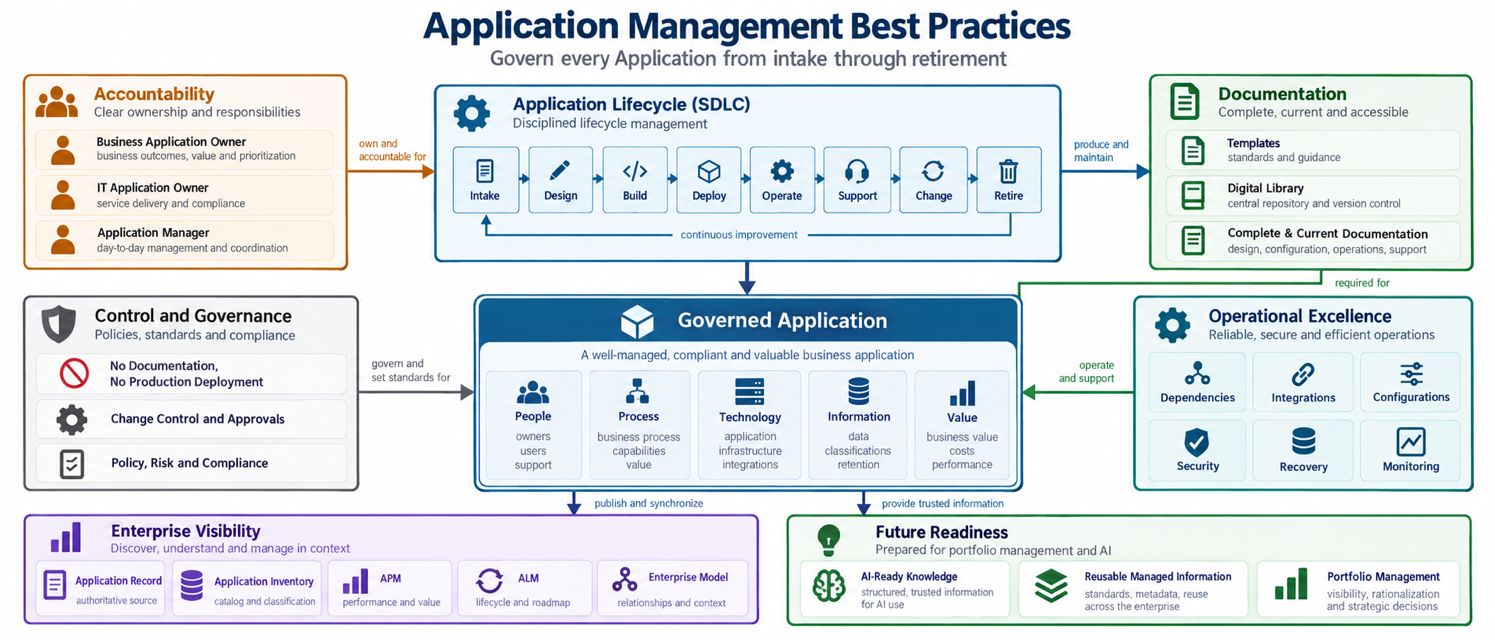
Application Management Best Practices
Executive Summary: Document Overview
IF4ITThe Bottom Line
Application Management is the discipline of establishing clear accountability for every individual Application and of establishing, documenting, and governing everything needed to plan, build, deploy, operate, support, change, and retire it. When enterprises treat Application Documentation as optional, knowledge leaves with people, Knowledge Debt compounds, and outages, audits, security incidents, and replacements become slow, costly, and risky. By enforcing a business- and IT-mandated “No Documentation, No Deployment” policy across every Release of every Application, enterprises gain better-designed, supportable Applications whose knowledge is owned by the enterprise, registered in the Application Inventory, and ready for portfolio management and AI.
Core Pillars & Document Modules
| Document Pillar / Focus Area | Strategic Business Outcome & Intent |
|---|---|
| Foundations and Accountability | Establishes a precise vocabulary for Systems, Applications, Application Instances, and Application Boundaries, and assigns named owners, managers, and organizations, so every Application has a clear identity and clear accountability from intake through retirement. |
| Documentation Mechanisms and Policy | Standardizes documentation through stakeholder-built templates and an open Digital Library, and makes complete, vetted documentation a condition of Production Deployment, enforced by business and IT leadership, Risk Register entries, and independent audits. |
| Application Management Across the SDLC | Embeds what to establish and document in every Systems Development Lifecycle phase and every Release, from intake registration through design, build, deployment, operations, and Full Application Retirement, so knowledge is captured when it is created. |
| Cross-Cutting Practices | Secures consistency across Instances, configurations, dependencies, rules, Issues, vendors, and regulated data, and applies demanding conditional practices only where an Application’s criticality or regulatory classification requires them. |
| Registration, Lifecycle, and Maturity | Connects every Application Record to the Application Inventory, Application Portfolio Management, and the Enterprise Model, sustains Active Application Lifecycle Management, and advances the practice deliberately through measured Crawl, Walk, and Run stages. |
Quick Q&A (Macro Executive Reference)
Question: Why isn't Application Documentation just IT housekeeping that teams can catch up on after a Release?
Answer: Because missing, incomplete, or outdated Application Documentation is an enterprise risk: it prolongs outages, defeats recoveries, exposes data, fails audits, and makes change and retirement slow and costly. That is why Application Management Best Practices place accountability with business and IT leadership together and make complete, vetted documentation a condition of every Production Deployment, rather than work deferred until later.
Question: What should an enterprise do first to put Application Management Best Practices into effect?
Answer: Register every Application in the Application Inventory at intake, name its Business and IT Application Owners and its Application Manager, adopt a stakeholder-built Application Documentation Template published in a Digital Library, and have business and IT leadership jointly publish and enforce a Minimum Application Documentation Policy. The enterprise can then add rigor, automation, and measurement in deliberate stages.
Question: How does Application Management relate to Application Portfolio Management?
Answer: Application Management governs each individual Application, while Application Portfolio Management decides what to do with groups of Applications. Portfolio decisions are only as sound as the information Application Management produces, because each Application’s documentation populates its Application Record, which flows into the Application Inventory, Application Portfolio Management, and the Enterprise Model. Enterprise Application Management, which applies Application Management consistently to every Application, gives portfolio decisions complete, comparable facts.
Read Full Table of Contents Below
Table of Contents
Overview and Orientation
Application Management Foundations
- What Is a System?
- What Is an Application?
- What Is an Application Instance?
- What Is an Application Boundary?
- Application vs. Application Instance — Why the Distinction Matters
- What Is Application Management?
- Application Management vs. Application Portfolio Management vs. Application Lifecycle Management
- What Is Enterprise Application Management?
- Sourcing Type vs. Hosting Model — Who Created an Application vs. Where It Is Hosted
Application Documentation Fundamentals
- What Is Application Documentation?
- What Is an Application Record, and How Does It Differ from Application Documentation?
- Understand the Types of Application Documentation
- What Is a Digital Library, and How Does It Differ from a Document Repository?
Why Application Documentation Matters
- Why Missing, Poor, or Outdated Application Documentation Is a Critical Enterprise Risk
- What Is Knowledge Debt, and How Does It Accumulate Around Applications?
- Why Knowledge Debt Grows Fastest Once an Application Reaches Steady State
- Use Application Documentation to Transfer Knowledge and Reduce Key-Person Risk
- Why Thorough Documentation Leads to Better-Designed, More Stable, and More Supportable Applications
- Why AI Makes Application Documentation More Critical Than Ever
Roles, Responsibilities, and Organizations
- Understand Application Management Roles and Responsibilities
- Establish and Document All Appropriate Application Owners (Business and IT)
- Establish and Document the Application Manager and Application Management Organization
- Establish and Document the Development or Engineering Primary Contact and Organization
- Establish and Document the Operations and Support Primary Contact and Teams
- Establish and Document the Application’s Subject Matter Experts (SMEs)
- Document Other Known Contacts — Data Owners, Security Owners, and Executive Sponsors
Templates, the Digital Library, and Publishing
- Establish and Use an Application Documentation Template
- Build Application Documentation Template Sections from Each Critical Stakeholder’s Requirements
- Derive the Documentation Template’s Application Record Section from the Applications Inventory
- Govern, Version, and Batch Changes to Application Documentation Templates
- Publish All Application Documentation to a Centralized Digital Library
- Practice “All Eyes On The Documentation” — Open Reading and Writing for All Stakeholders
- Keep Application Documentation and the Application Record Aligned
- Use AI to Help Document Applications — With Human Review and Guardrails
Documentation Policy, Enforcement, and Accountability
- What Is a Minimum Application Documentation Policy?
- Establish, Publish, and Regularly Communicate a Minimum Application Documentation Policy
- Make Business and IT Leadership Accountable for Application Documentation
- Define Complete and Vetted Application Documentation with Every Critical Stakeholder
- Enforce “No Documentation, No Deployment” for Every Release
- Review and Correct Application Documentation with Every Release
- Escalate Application Documentation Gaps with Graduated Release Blocking
- Record Application Documentation Gaps in the Enterprise Risk Register
- Approve Only Justifiable Release Exceptions — With Documentation as a Fast Follower
- Track Application Documentation Conformance with Red-Amber-Green (RAG) Reporting
- Maintain Audit Readiness for Application Documentation
- Have Risk and Compliance Regularly Audit Application Documentation for Completeness and Accuracy
- Confront the Cultural Causes of Missing and Outdated Application Documentation
SDLC: Intake, Research, and Planning
- Apply Application Management Across Every Systems Development Lifecycle (SDLC) Phase and Release
- Register Every New Application at Intake — Before It Is Built or Bought
- Establish and Document the Application’s Name, Alternate Names, and Semantic Identifier
- Establish and Document the Application’s Sourcing Type and Hosting Model
- Establish and Document the Application’s Business Criticality, Service Tier, and Service Levels
- Establish and Document the Application’s Regulatory and Compliance Classification
- Plan the Application’s First and Subsequent Releases — Including Documentation Work
SDLC: Requirements and Design
- Establish and Document the Application’s Capabilities, Functions, and Services
- Establish and Document the Application’s Functional and Non-Functional Requirements
- Establish and Document the Application’s Architecture and Design
- Establish and Document the Application’s Architecture Decisions and Their Rationale
- Establish and Document the Application Boundary
- Establish and Document the Application’s IT Operating Environments and Instances
- Establish and Document the Application’s Hosting Infrastructure
- Establish and Document the Application’s Key Data and Information
- Establish and Document the Application’s Data Retention, Archival, and Purge Rules
- Establish and Document the Application’s Published and Consumed APIs
- Establish and Document the Application’s Integrations
- Establish and Document the Application’s Upstream and Downstream Dependencies
- Establish and Document the Application’s Identity and Access Management (IAM)
- Establish and Document Periodic User Access Reviews for the Application
- Establish and Document the Application’s Security Secrets — Without Exposing Them
- Establish and Document the Application’s Design Reviews and Their Outcomes
- Establish and Document the Application’s Test Suites, Test Cases, and Expected Outcomes
SDLC: Build, Test, and Training
- Establish and Document the Technologies and Tools Used to Build the Application
- Establish and Document the Application’s Software Repositories
- Establish and Document the Application’s Configuration and Build Rules
- Establish and Document the Application’s Packaging
- Automate the Application’s Build and Packaging
- Establish and Document the Application’s Software Licenses, Leases, and Subscriptions
- Establish and Document the Technologies and Tools Used to Test the Application
- Establish and Document the Application’s Testing Evidence for Systems Integration Testing (SIT) and User Acceptance Testing (UAT)
- Establish and Document the Application’s User Documentation and Training Materials
- Establish and Document the Application’s Reference Documentation
SDLC: Staging, Deployment, and Release
- Establish and Document the Application’s Deployment, Instantiation, and Rollback Procedures
- Automate the Application’s Deployment to IT Operating Environments
- Establish and Maintain the Application’s Release and Change History
- Establish and Document the Application’s Handover to Operations and Support — Including Hypercare
SDLC: Operations, Maintenance, and Support
- Establish and Document the Application’s Support Model
- Establish and Document the Application’s Incident Management and Escalation Procedures
- Establish and Document the Application’s Monitoring, Observability, and Runbooks
- Establish and Document the Application’s Capacity Plan and Performance Baselines
- Establish and Document the Application’s Backup and Restore Procedures
- Establish and Document the Application’s Disaster Recovery Procedures
- Establish and Document the Application’s Security Reviews and Remediations
- Establish and Document the Application’s Patching and Technology Currency Schedule
SDLC: Retirement, Decommissioning, and Disposal
- Establish and Document the Application’s Tear-down (De-installation) Procedures
- Automate the Application’s Tear-down
- Establish and Document Application Instance Decommissioning
- Application Decommissioning vs. Application Retirement — What Is the Difference?
- Establish and Document Full Application Retirement
Application Instances and Environments
- Establish and Document Application Instance–Specific Information Wherever Instances Differ
- Name Every Application Instance Consistently
- Establish and Document the Application’s Per-Environment Infrastructure, Configurations, and Rules
Configurations, Dependencies, and Rules
- Understand the IF4IT Baseline Framework for Application Configurations, Dependencies, and Rules
- Establish and Document the Application’s Configurations
- Establish and Document the Application’s Security and Access Configuration
- Establish and Document the Application’s Integration and Interface Configuration
- Establish and Document the Application’s AI and Model Configuration
- Establish and Document the Application’s Dependencies
- Track the Application’s Expiring Dependencies — Certificates, Credentials, Licenses, and Vendor Support Dates
- Establish and Document the Application’s Configuration Rules
- Adapt the Configuration, Dependency, and Rules Framework to Your Enterprise
Defects, Risks, Enhancements, and Technical Debt
- Categorize and Track the Application’s Issues Distinctly and Traceably
- Establish and Maintain the Application’s Known Defects
- Establish and Maintain the Application’s Risks
- Capture and Document the Application’s Enhancement Requests from All Stakeholders
- Ensure the Application’s Problems and Known Errors Are Documented
- Establish and Maintain the Application’s Technical Debt Items
Vendors, One-Off Utilities, and Conditional Practices
- Establish and Document the Application’s Vendor Information — Where Applicable
- Document One-Off Utilities Such as Data Migration and Cut-Over Scripts
- Apply Conditional Practices Based on Criticality and Regulatory Classification
- Establish and Document the Application’s Penetration Testing When Required
- Establish and Document the Application’s GxP and Regulatory Validation When Required
- Establish and Document the Application’s Performance and Load Testing When Required
- Establish and Document the Application’s Business Continuity and Disaster Recovery Testing When Required
- Establish and Document How the Application Handles Regulated Data Such as PII, PHI, PCI, and PFI
Registration, Lifecycle Strategy, and Governance
- Register Every Application Record in the Application Inventory
- Practice Active Application Lifecycle Management (ALM) for Every Application
- Use the Applications Inventory and Attributes to Extend Application Documentation
- Connect Application Management to Enterprise Architecture and Change Governance
Maturity, Metrics, and Continuous Improvement
- Advance Application Management Maturity Deliberately — Crawl, Walk, Run
- Define Metrics and KPIs for Application Management and Documentation Health
- Avoid Common Application Management Antipatterns
- A Final Note to Practitioners
Glossary of Terms and Phrases
Copyright for The International Foundation for Information Technology (IF4IT), LLC: 2008 - Present