Advance Application Management Maturity Deliberately — Crawl, Walk, Run - Application Management Best Practices
Advance Application Management Maturity Deliberately — Crawl, Walk, Run
(Chapter 130 of Application Management Best Practices)
Executive Summary: Chapter Overview
IF4ITThe Bottom Line
Core Concepts
| Concept | Definition & Strategic Role |
|---|---|
| Crawl, Walk, Run Stages | The three maturity stages through which an enterprise’s Application Management practice advances, from a solid foundation, through added rigor and consistency, to automation and integration. They are common examples that enterprises can customize. |
| Maturity Dimensions | The areas assessed for maturity: ownership and roles, template, Digital Library, documentation completeness, policy enforcement, conformance reporting, registration, and automation. Each progresses through Crawl, Walk, and Run independently but must remain balanced. |
| Crawl Foundation First | The rule to reach Crawl on every dimension before pushing any dimension to Run. An advanced template is of little use without enforced policy, so balanced progress keeps each improvement supported by the others. |
Quick Q&A
Question: What does the Digital Library look like at each maturity stage?
Question: Why do attempts to adopt every Application Management practice at once tend to fail?
Read More Below
This chapter describes how an enterprise’s Application Management practice as a whole matures from Crawl, through Walk, to Run, and how to advance deliberately.
Why Maturity Must Be Advanced Deliberately
No enterprise can adopt every practice in this document at once. Attempting to do so usually produces elaborate requirements that teams cannot meet, followed by widespread exceptions and loss of credibility. Maturity is better advanced deliberately: establishing a solid foundation first, then adding rigor, consistency, and automation in stages.
The Maturity Stages Across Key Dimensions
| Dimension | Crawl | Walk | Run |
|---|---|---|---|
| Ownership and roles | Every Application has named Business and IT Application Owners. | All roles are assigned, recorded, and reviewed with every Release. | Role assignments are synchronized with the enterprise’s people and organizational data. |
| Template | A standard word-processing document template. | Online forms with required fields and conditional sections. | Validated forms that populate the Application Record automatically. |
| Digital Library | A centralized repository with a consistent structure. | A Digital Library with linked, searchable, version-controlled documentation, open to all stakeholders. | Documentation integrated with inventories, code repositories, and AI tools. |
| Documentation completeness | The minimum required sections exist for every Application. | Documentation is thorough, stakeholder-verified, and reviewed with every Release. | Completeness and currency are checked automatically, and teams routinely exceed the minimum. |
| Policy enforcement | The policy is published and checked manually at the Production gate. | Graduated blocking, Risk Register entries, and fast-follower exceptions are applied consistently. | Gate checks are automated, and independent audits find few gaps. |
| Conformance reporting | Periodic manual reports. | Regular RAG reports by owner and business area. | Continuously updated dashboards. |
| Registration | Every Application is registered at intake. | Records are complete, aligned with documentation, and feed APM and the Enterprise Model. | Records are populated and validated automatically from documentation and discovery. |
| Automation | Scripted, documented Build, Deployment, and Tear-down. | Automated Build, Packaging, Deployment, and Tear-down with recorded results. | End-to-end automation with policy checks, drift detection, and automatic documentation updates. |
These dimensions and stages are common examples that IF4IT recommends; enterprises can customize them to their own needs.
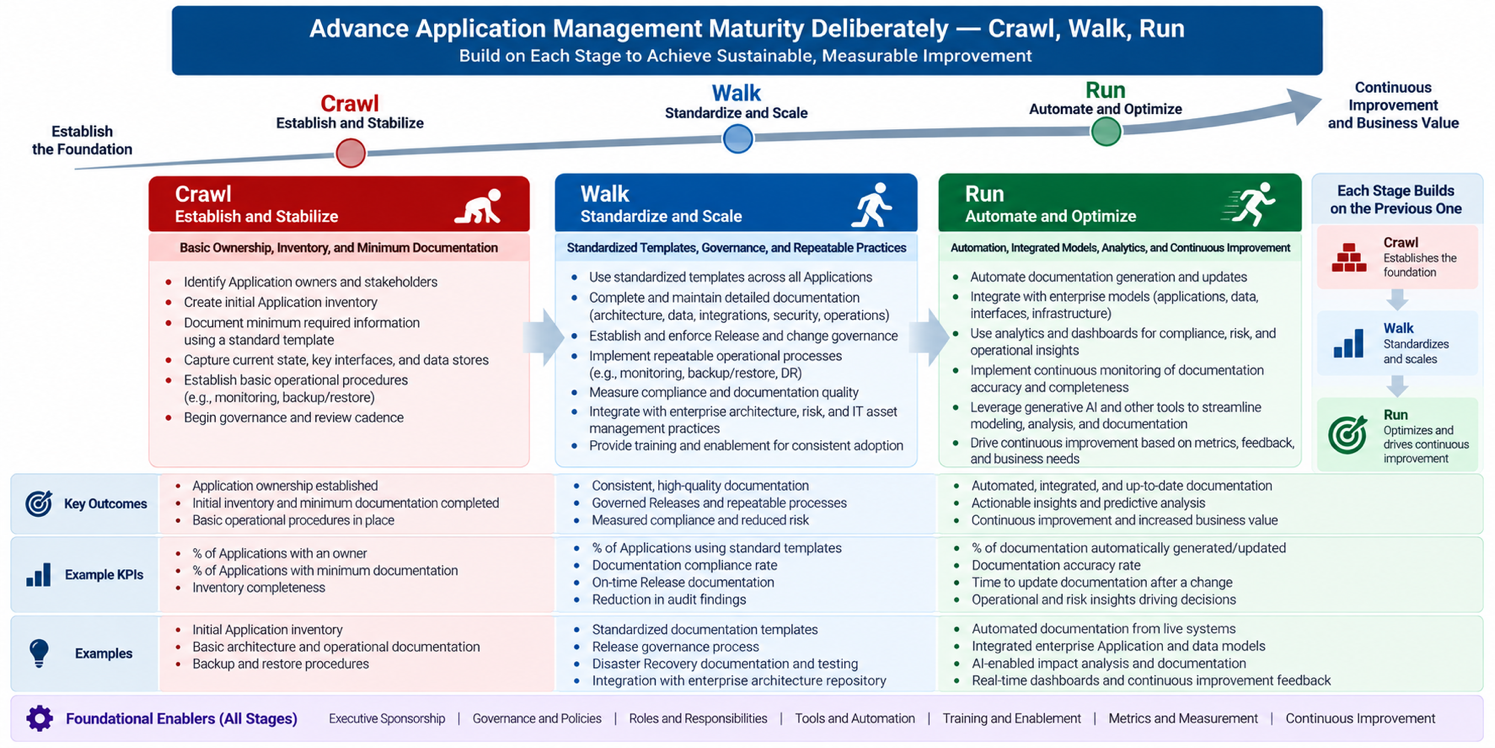
How to Advance
Assess the enterprise’s current stage on each dimension honestly.
Reach Crawl on every dimension before pushing any dimension to Run; an advanced template is of little use without enforced policy, and vice versa.
Set explicit, time-bound targets for moving each dimension to the next stage, and measure progress using the metrics described in the next chapter.
Raise the thoroughness bar of the Minimum Application Documentation Policy as maturity grows.
Best Practice: Advance Application Management Maturity Deliberately
Assess the enterprise’s Application Management maturity across each dimension, establish a solid Crawl foundation everywhere first, then advance dimensions to Walk and Run in deliberate, measured stages with explicit targets.
Benefits: Deliberate advancement builds a practice that teams can actually sustain, avoiding the cycle of overambitious requirements, mass exceptions, and lost credibility. Balanced progress across dimensions ensures that each improvement is supported by the others, rather than one advanced capability sitting on a weak foundation.
Connections to Related IF4IT Practices and Inventories
The Application Portfolio Management (APM) Best Practices describes a Crawl, Walk, Run progression for portfolio management. The IF4IT Service Management Maturity Framework (IF4IT-SMMF) for Small, Midsized, and Large Enterprises illustrates the IF4IT approach to maturity frameworks.
How to cite this page
When referencing this page in academic work, internal standards, or external publications, include the page title, IF4IT as author and publisher (The International Foundation for Information Technology (IF4IT), LLC), the URL, and your access date.
Example (informal web citation):
The International Foundation for Information Technology (IF4IT), LLC. Advance Application Management Maturity Deliberately — Crawl, Walk, Run | Application Management Best Practices. https://if4it.org/best-practices/application-management-best-practices/advance-application-management-maturity-deliberately-crawl-walk-run/ (accessed 2026-10-30).
See About Us for content governance and site-wide citation guidance.
Copyright for The International Foundation for Information Technology (IF4IT), LLC: 2008 - Present
Legal Disclaimers