Build Application Documentation Template Sections from Each Critical Stakeholder's Requirements - Application Management Best Practices
Build Application Documentation Template Sections from Each Critical Stakeholder's Requirements
(Chapter 29 of Application Management Best Practices)
Executive Summary: Chapter Overview
IF4ITThe Bottom Line
Core Concepts
| Concept | Definition & Strategic Role |
|---|---|
| Critical Stakeholders | The groups whose work depends on particular information about every Application, such as Security, Operations and Support, and Risk and Compliance. IF4IT recommends a common list that each enterprise customizes, and their documented requirements are the raw material for the template’s sections. |
| Stakeholder-Owned Template Section | A template section, or set of fields, built from one stakeholder’s requirements and recorded in the template as owned by that stakeholder. The owner reviews only its own section of each Application’s documentation at every Release, keeping reviews focused, fast, and clearly accountable. |
| Challenging Stakeholder Requirements | The template owner’s duty to push back on requests that duplicate information held elsewhere or demand detail no one will use. Unchallenged requests make the template so burdensome that teams complete it superficially, lowering documentation quality. |
Quick Q&A
Question: How do stakeholder reviews of Application Documentation stay focused and fast at each Release?
Question: What goes wrong when the template is designed without consulting the stakeholders who use the documentation?
Read More Below
This chapter explains how to build the Application Documentation Template from the documented requirements of the stakeholders who depend on Application Documentation, and how those stakeholders then review it.
Who the Critical Stakeholders Are
Application Documentation is used by many groups, each of which depends on particular information to do its job. Typical critical stakeholders include:
The business organizations the Application serves.
IT leadership.
Enterprise Architecture.
Software Development and Engineering.
Quality Assurance.
Security.
IT Operations and Support.
Business Continuity and Disaster Recovery.
Risk and Compliance.
Each enterprise should identify its own critical stakeholders; the list above is a common example that IF4IT recommends and that enterprises can customize.
Establish Template Sections from Stakeholder Requirements
Have the template owner collect, from each critical stakeholder, the specific information that stakeholder needs about every Application in order to do its work. Each stakeholder’s requirements then become a section, or a set of fields within a section, of the Application Documentation Template. For example, Operations and Support’s requirements shape the operational sections, Security’s shape the security sections, and Business Continuity and Disaster Recovery’s shape the recovery sections.
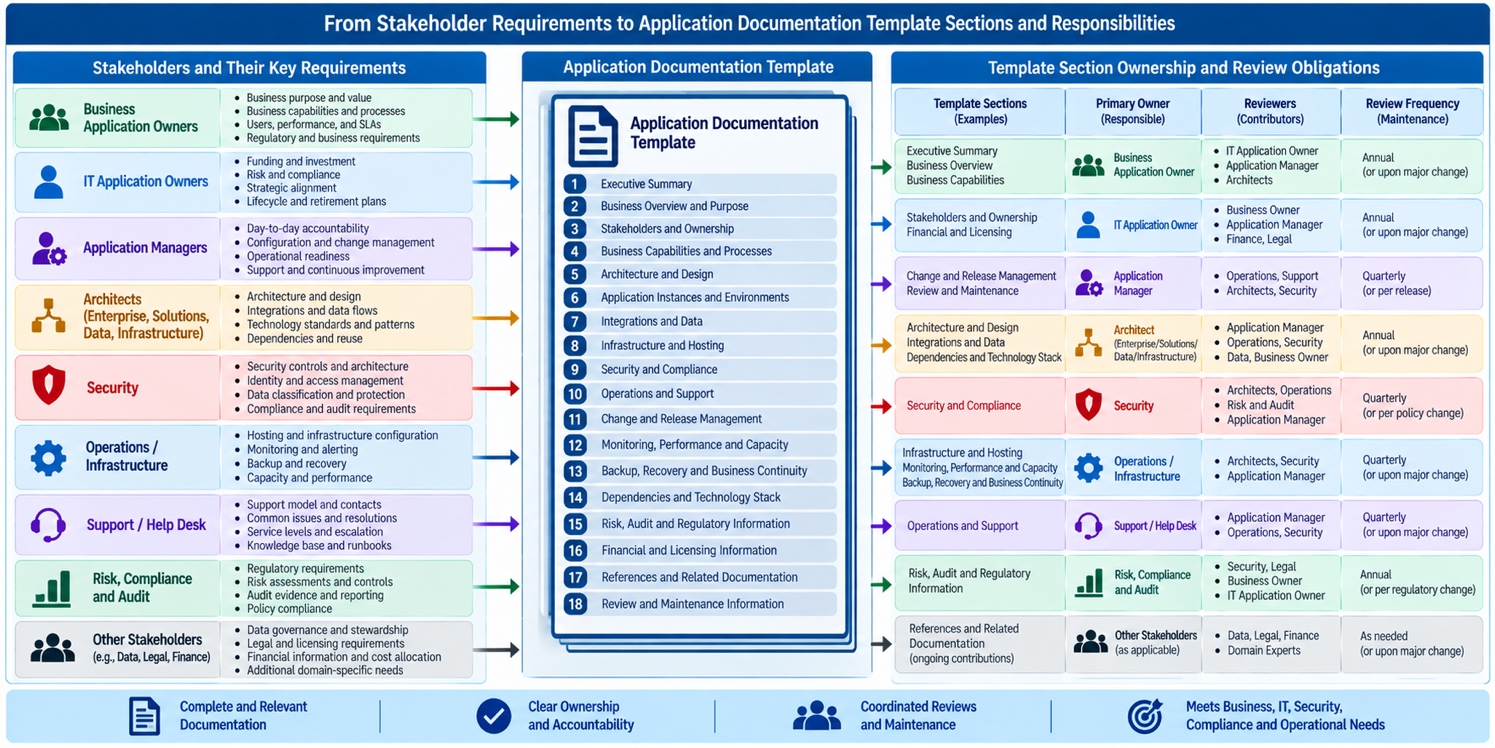
Stakeholders should state what they genuinely need, not everything that might conceivably be useful. Requirements that place an unreasonable burden on Application teams, for example by duplicating information held elsewhere or demanding detail no one will use, should be challenged by the template owner and resolved before they become part of the template.
Document and Share Stakeholder Ownership of Each Section
Record, in the template itself, which stakeholder owns the requirements for each section. That stakeholder then reviews its own section of each Application’s documentation at every Release, to confirm that it has received the information it needs from the Application Manager. Because each stakeholder checks only its own section, reviews stay focused and fast.
Best Practice: Build Template Sections from Documented Stakeholder Requirements
It is a best practice to both establish and document the solution for what the template requires: collect each critical stakeholder’s documentation requirements, turn them into template sections, record which stakeholder owns each section, and have each stakeholder review its own section at every Release.
Benefits: Building the template from stakeholder requirements ensures that it asks for information someone actually depends on, which makes completing it worthwhile rather than bureaucratic. Giving each stakeholder ownership of its own section means that the people best qualified to judge each kind of information are the ones who check it.
Common Antipatterns
| Antipattern | Why It Fails |
|---|---|
| Designing the template without consulting the stakeholders who use the documentation | The template asks for the wrong things and omits what operations, security, or recovery teams actually need. |
| Accepting every stakeholder request without challenge | The template becomes so burdensome that teams complete it superficially, and its quality falls. |
| Having every reviewer review the whole document | Reviews become slow and shallow, and no reviewer is clearly accountable for any particular section. |
Advance Maturity Deliberately: Crawl, Walk, Run
Crawl. Stakeholder requirements are collected informally; each stakeholder signs off manually on its section for each Release.
Walk. Stakeholder requirements are documented and versioned with the template; stakeholder reviews are built into the Release process as checklist items.
Run. Completeness of each stakeholder’s section is checked automatically at each Release, and stakeholders review only the content that has changed.
Connections to Related IF4IT Practices and Inventories
The Release Management Best Practices describes the Release process into which stakeholder reviews are built. The Systems Development Lifecycle (SDLC) Best Practices addresses roles and accountability across the lifecycle.
How to cite this page
When referencing this page in academic work, internal standards, or external publications, include the page title, IF4IT as author and publisher (The International Foundation for Information Technology (IF4IT), LLC), the URL, and your access date.
Example (informal web citation):
The International Foundation for Information Technology (IF4IT), LLC. Build Application Documentation Template Sections from Each Critical Stakeholder's Requirements | Application Management Best Practices. https://if4it.org/best-practices/application-management-best-practices/build-application-documentation-template-sections-from-each-critical-stakeholder-s-requirements/ (accessed 2026-10-30).
See About Us for content governance and site-wide citation guidance.
Copyright for The International Foundation for Information Technology (IF4IT), LLC: 2008 - Present
Legal Disclaimers