Establish and Document the Application's Architecture and Design - Application Management Best Practices
Establish and Document the Application's Architecture and Design
(Chapter 58 of Application Management Best Practices)
Executive Summary: Chapter Overview
IF4ITThe Bottom Line
Core Concepts
| Concept | Definition & Strategic Role |
|---|---|
| Architecture and Design Section | The part of the Application Documentation that records context, logical structure, physical and deployment structure, data design, interface and Integration design, security design, and how the design meets key requirements, with diagrams. It must be updated with every Release that changes the design. |
| Research and Prototyping Record | Documentation of feasibility findings, technology evaluations, rejected approaches, and prototype results that influenced the Application. It explains why the design is what it is and keeps future teams from repeating evaluations or reintroducing approaches already tried and rejected. |
| Design Alternatives | Options considered and recorded during the Design phase, using the enterprise’s architecture standards and reference architectures. Significant choices among them are captured as Architecture Decision Records so that the reasoning behind the chosen design is preserved. |
Quick Q&A
Question: Why should architecture and design documentation describe the Application as it currently is rather than as it was first designed?
Question: What elements does an Application's architecture and design documentation typically cover?
Read More Below
This chapter explains how to establish and document an Application’s architecture and design, including the research and prototyping that shaped them.
What Architecture and Design Documentation Covers
Architecture and design documentation explains how the Application is structured and why. It typically covers:
The Application’s context: its users, the Systems it interacts with, and its place within larger Systems.
Its logical structure: its major components and how they interact.
Its physical and deployment structure: how components are deployed across Instances, environments, and infrastructure.
Its data design: the data it holds and how that data is structured and stored.
Its interface and Integration design.
Its security design.
How the design addresses the key functional and non-functional requirements.
Diagrams that make all of the above understandable at a glance.
Establish the Architecture and Design
Develop the architecture and design during the Design phase, building on the outcomes of any Research and Prototyping. Also document the research and prototyping work that influenced the Application, such as feasibility findings, technology evaluations, rejected approaches, and prototype results, because it explains why the design is what it is. Consider and record design alternatives, and use the enterprise’s architecture standards and reference architectures.
Document and Share the Architecture and Design
Record the architecture and design, with diagrams, in the Architecture and Design section of the Application Documentation, and record significant decisions as described in the chapter “Establish and Document the Application’s Architecture Decisions and Their Rationale.” Update the architecture and design with every Release that changes them, so that they always describe the Application as it currently is, not as it was first designed.
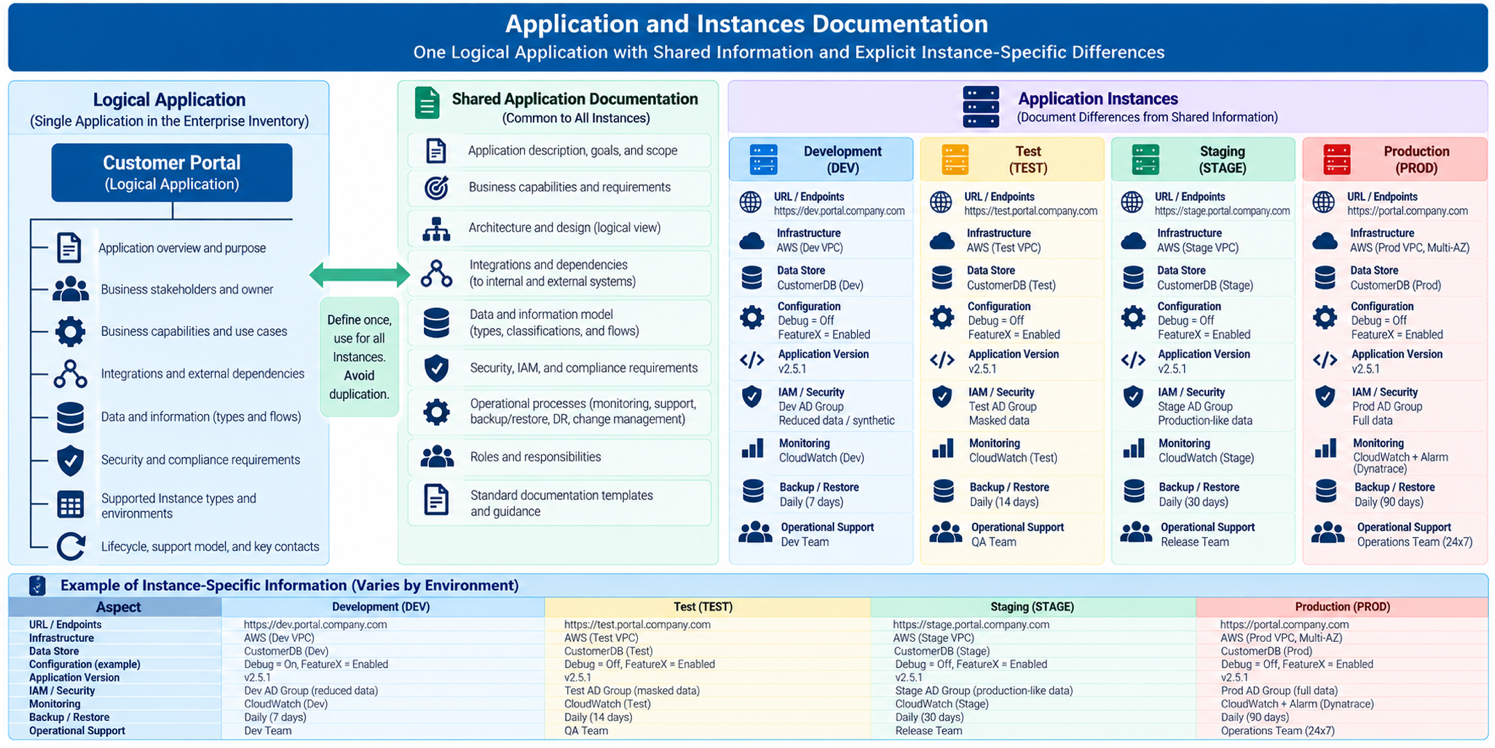
Best Practice: Establish and Document the Application’s Architecture and Design
It is a best practice to both establish and document the solution for how an Application is structured: develop its architecture and design deliberately, document them with clear diagrams and explanations, include the research and prototyping that shaped them, and keep them current with every Release.
Benefits: Current architecture and design documentation lets engineers change an Application safely, architects assess its fit with enterprise direction, and support teams understand what they are troubleshooting. Including the research and prototyping that shaped the design prevents future teams from repeating evaluations, or reintroducing approaches, that were already tried and rejected.
Connections to Related IF4IT Practices and Inventories
The Solutions Architecture Best Practices and Framework describes how solution architectures are created, documented, and reviewed. The Systems Development Lifecycle (SDLC) Best Practices describes the Research and Prototyping and Design phases.
How to cite this page
When referencing this page in academic work, internal standards, or external publications, include the page title, IF4IT as author and publisher (The International Foundation for Information Technology (IF4IT), LLC), the URL, and your access date.
Example (informal web citation):
The International Foundation for Information Technology (IF4IT), LLC. Establish and Document the Application's Architecture and Design | Application Management Best Practices. https://if4it.org/best-practices/application-management-best-practices/establish-and-document-the-application-s-architecture-and-design/ (accessed 2026-10-31).
See About Us for content governance and site-wide citation guidance.
Copyright for The International Foundation for Information Technology (IF4IT), LLC: 2008 - Present
Legal Disclaimers