Establish and Document the Application's Disaster Recovery Procedures - Application Management Best Practices
Establish and Document the Application's Disaster Recovery Procedures
(Chapter 92 of Application Management Best Practices)
Executive Summary: Chapter Overview
IF4ITThe Bottom Line
Core Concepts
| Concept | Definition & Strategic Role |
|---|---|
| Recovery Strategy | How the Application will be restored after a disaster, for example by failing over to a standby Instance, rebuilding in an alternate location, or relying on a vendor’s recovery capability. |
| Recovery Order and Dependencies | Which upstream dependencies must be recovered before the Application, and which downstream Applications depend on it. Correct sequencing prevents restoring an Application that cannot function because what it relies on is still down. |
| Disaster Recovery Instances | The Instances where the Application runs during a disaster, recorded with how they differ from Production, together with how the recovery environment is kept ready for use. |
| Independent Access to Procedures | Keeping a copy of the Disaster Recovery procedures accessible in a way that does not depend on the environment that may be lost, so the instructions survive the disaster they are meant to address. |
Quick Q&A
Question: What steps should an Application's Disaster Recovery procedure cover?
Question: Which changes should prompt an update to an Application's Disaster Recovery procedures?
Read More Below
This chapter explains how to establish and document how an Application is recovered after a disaster that disables its normal operating environment.
Establish Disaster Recovery Procedures
Establish, with the Operations and Support Team(s), Business Continuity and Disaster Recovery, and the Business Application Owner, and consistent with the Application’s Recovery Time Objective and Recovery Point Objective:
Recovery strategy: how the Application will be restored, for example by failing over to a standby Instance, rebuilding in an alternate location, or relying on a vendor’s recovery capability.
Recovery environment: where the Application will run during a disaster, and how that environment is kept ready.
Recovery procedure: the steps to declare a disaster, recover the Application, verify it, and return to normal operation afterward.
Recovery order and dependencies: which upstream dependencies must be recovered first, and which downstream Applications depend on this one.
Roles and contacts: who decides, who acts, and who communicates during a disaster.
Document and Share the Disaster Recovery Procedures
Record the Disaster Recovery procedures in the Operational section of the Application Documentation, and keep a copy accessible in a way that does not depend on the environment that may be lost. Record the Disaster Recovery Instances and how they differ from Production. Testing of Disaster Recovery is addressed in the chapter “Establish and Document the Application’s Business Continuity and Disaster Recovery Testing When Required.” Update the procedures with every Release that changes the Application’s architecture, infrastructure, or dependencies.
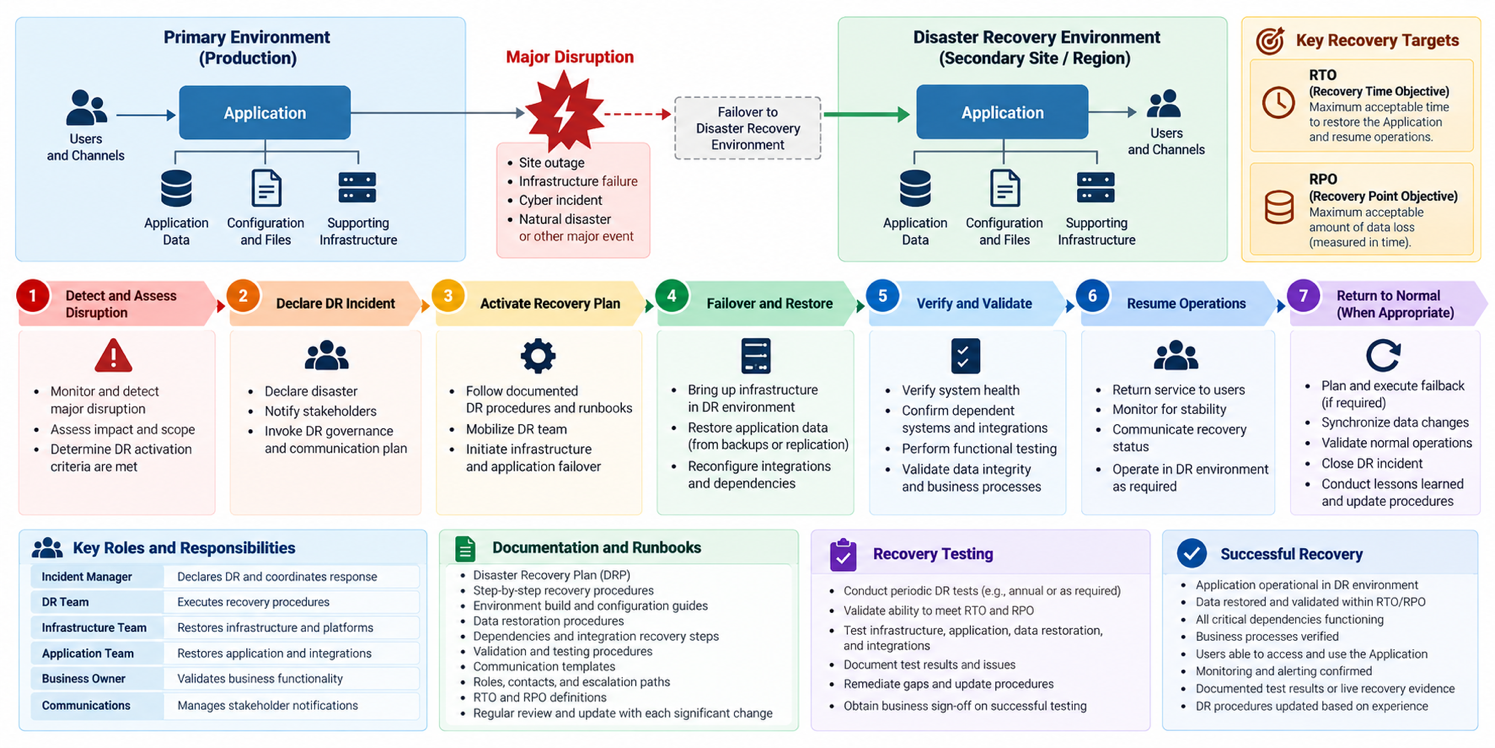
Best Practice: Establish and Document the Application’s Disaster Recovery Procedures
It is a best practice to both establish and document the solution for recovering an Application from disaster: define its recovery strategy, environment, procedure, order, and roles in line with its recovery objectives, and keep the documentation accessible even if the primary environment is lost.
Benefits: Documented Disaster Recovery procedures let the enterprise restore critical Applications within the time and data-loss limits the business requires, instead of improvising during a crisis. Keeping them accessible outside the affected environment ensures that the instructions survive the disaster they are meant to address.
Connections to Related IF4IT Practices and Inventories
The Application Portfolio Management (APM) Best Practices addresses Disaster Recovery readiness across the portfolio. The IT Operating Environments Best Practices addresses mirror environments for Disaster Recovery and Business Continuity Planning.
How to cite this page
When referencing this page in academic work, internal standards, or external publications, include the page title, IF4IT as author and publisher (The International Foundation for Information Technology (IF4IT), LLC), the URL, and your access date.
Example (informal web citation):
The International Foundation for Information Technology (IF4IT), LLC. Establish and Document the Application's Disaster Recovery Procedures | Application Management Best Practices. https://if4it.org/best-practices/application-management-best-practices/establish-and-document-the-application-s-disaster-recovery-procedures/ (accessed 2026-10-30).
See About Us for content governance and site-wide citation guidance.
Copyright for The International Foundation for Information Technology (IF4IT), LLC: 2008 - Present
Legal Disclaimers