Establish and Document the Application's Handover to Operations and Support — Including Hypercare - Application Management Best Practices
Establish and Document the Application's Handover to Operations and Support — Including Hypercare
(Chapter 86 of Application Management Best Practices)
Executive Summary: Chapter Overview
IF4ITThe Bottom Line
Core Concepts
| Concept | Definition & Strategic Role |
|---|---|
| Operational Readiness Review | A pre-go-live review in which the Operations and Support Team(s) examine the Application’s Operational Documentation, monitoring, alerting, runbooks, backup and recovery procedures, support model, and access, and confirm they are ready to support it. |
| Hypercare | A defined period after go-live during which the building team stays closely engaged, providing heightened support while the Application stabilizes. It has defined responsibilities, escalation paths, and exit criteria. |
| Hypercare Exit Criteria | Conditions for ending hypercare, such as an agreed period without severe incidents, closure or acceptance of open Defects, and support-team confirmation of readiness. Without them, the building team leaves too early or stays indefinitely. |
| Formal Acceptance | The point at the end of hypercare when the Operations and Support Team(s) formally accept the Application into Steady State support, making the transfer of responsibility clear to everyone. |
Quick Q&A
Question: What should happen to documentation gaps discovered during an Application's handover to Operations and Support?
Question: What does knowledge transfer involve in the handover of an Application or significant Release?
Read More Below
This chapter explains how to establish and document the handover of an Application, or a significant Release, from those who built it to those who will run and support it, including the period of heightened support immediately after go-live, often called hypercare.
Why Handover Matters
Go-live is one of the points at which an Application’s knowledge is most at risk. The team that built it is about to move on to other work, while the Operations and Support Team(s) are about to become responsible for it. If the handover is informal, support teams inherit an Application they do not understand, with documentation they have never reviewed, and the first serious incident becomes a frantic search for the people who built it.
Establish the Handover
The enterprise’s SDLC and Release Management practices should establish a consistent handover approach that every Application follows. For each Application or significant Release, that approach should include:
An operational readiness review. Before go-live, the Operations and Support Team(s) review the Application’s Operational Documentation, monitoring, alerting, runbooks, backup and recovery procedures, support model, and access, and confirm they are ready to support it.
Knowledge transfer. The building team walks the receiving teams through the Application, its known issues, and its procedures, and the receiving teams confirm that they can work from the documentation.
Hypercare. For a defined period after go-live, the building team remains closely engaged, providing heightened support while the Application stabilizes. The period has defined responsibilities, escalation paths, and exit criteria, such as an agreed period without severe incidents, the closure or acceptance of open Defects, and confirmation from the support teams that they are ready to take full ownership.
Formal acceptance. At the end of hypercare, the Operations and Support Team(s) formally accept the Application into Steady State support.
Document and Share the Handover
In the Application Documentation, record the operational readiness review and its outcome, the knowledge transfer performed, the hypercare period with its exit criteria and results, the open issues transferred, and the formal acceptance. Any documentation gaps found during handover should be closed before acceptance, or recorded as Knowledge Debt Items with owners and deadlines.
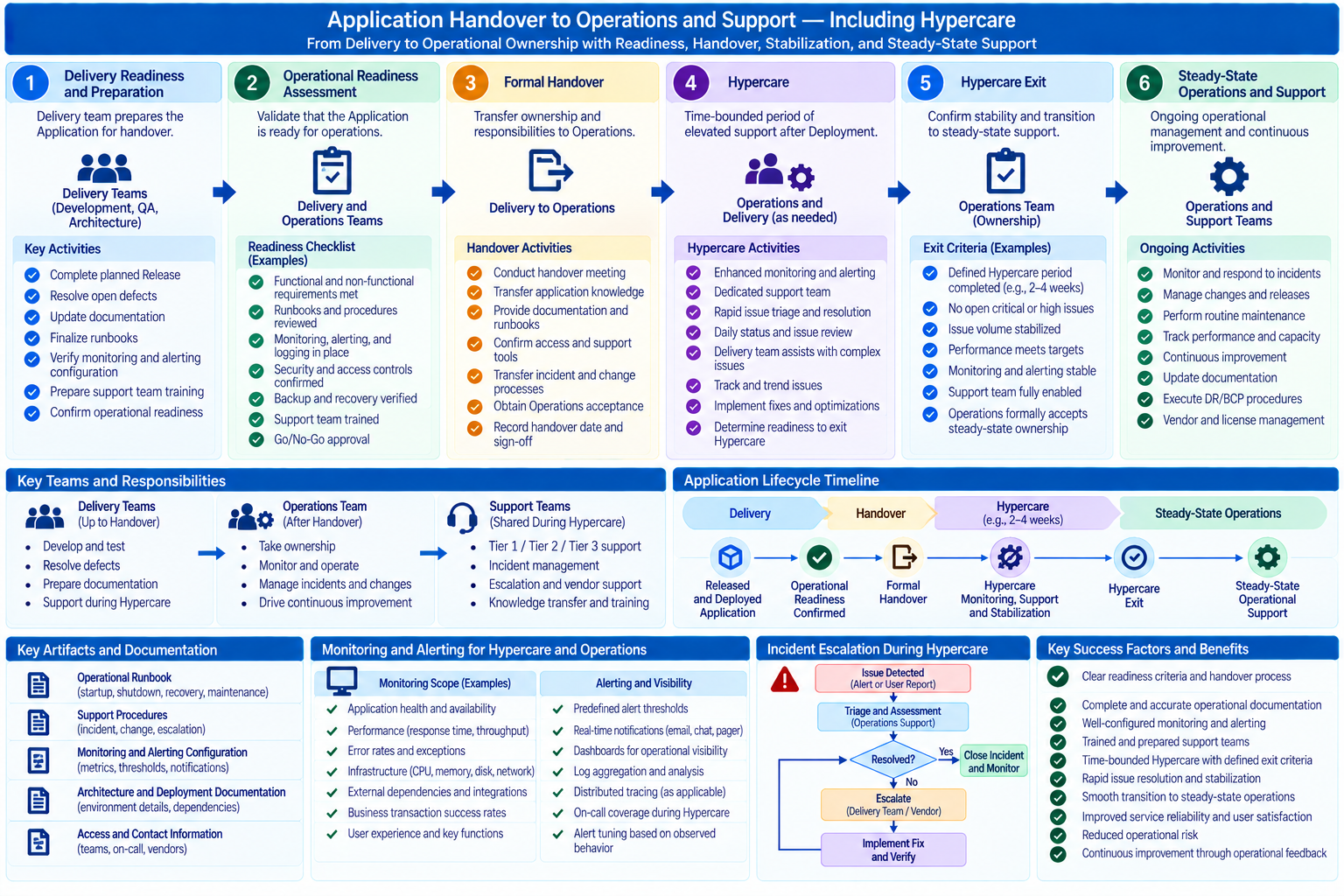
Best Practice: Establish and Document the Application’s Handover to Operations and Support, Including Hypercare
It is a best practice to both establish and document the solution for transferring an Application into operation: follow the enterprise’s standard handover approach, hold an operational readiness review, transfer knowledge with confirmation from the receiving teams, provide hypercare with defined exit criteria, and record the formal acceptance.
Benefits: A structured handover ensures that the people who will support an Application are ready to do so before they become responsible for it, rather than learning during their first major incident. Hypercare with defined exit criteria stabilizes the Application with its builders still at hand, and formal acceptance makes the transfer of responsibility clear to everyone.
Common Antipatterns
| Antipattern | Why It Fails |
|---|---|
| Handing over by announcement on the day of go-live | Support teams inherit an Application they have never seen and cannot yet support. |
| Hypercare with no exit criteria | The building team either leaves too early or remains indefinitely, and responsibility is never clearly transferred. |
| Accepting the handover without reviewing the documentation | Gaps surface only during incidents, when they are most costly. |
Connections to Related IF4IT Practices and Inventories
The Systems Development Lifecycle (SDLC) Best Practices describes the Production phase and the transition to Operations and Maintenance. The Release Management Best Practices addresses Release closure and transition into use. The Service Management Best Practices addresses the service transition and support processes that receive the Application.
How to cite this page
When referencing this page in academic work, internal standards, or external publications, include the page title, IF4IT as author and publisher (The International Foundation for Information Technology (IF4IT), LLC), the URL, and your access date.
Example (informal web citation):
The International Foundation for Information Technology (IF4IT), LLC. Establish and Document the Application's Handover to Operations and Support — Including Hypercare | Application Management Best Practices. https://if4it.org/best-practices/application-management-best-practices/establish-and-document-the-application-s-handover-to-operations-and-support-including-hypercare/ (accessed 2026-10-31).
See About Us for content governance and site-wide citation guidance.
Copyright for The International Foundation for Information Technology (IF4IT), LLC: 2008 - Present
Legal Disclaimers