Establish and Document the Application's Patching and Technology Currency Schedule - Application Management Best Practices
Establish and Document the Application's Patching and Technology Currency Schedule
(Chapter 94 of Application Management Best Practices)
Executive Summary: Chapter Overview
IF4ITThe Bottom Line
Core Concepts
| Concept | Definition & Strategic Role |
|---|---|
| Patching Schedule by Layer | How often each technology layer, such as the operating system, database, middleware, and Application components, is patched. A defined cadence closes known vulnerabilities promptly instead of letting them accumulate. |
| Urgent Security Patches | Critical security patches applied quickly, using the justifiable exception process where documentation cannot keep pace. Expediting them guards against attacks that exploit vulnerabilities for which patches are already available. |
| Technology Currency Plan | The record of when each component reaches end of support and the plan to upgrade or replace it beforehand, preventing the Application from drifting into unsupported, high-risk states that are expensive to escape. |
| Unsupported Components as Risks | Components running unsupported versions, recorded as Risks or Technical Debt Items until they are upgraded. This keeps the remaining exposure visible to leadership rather than hidden in the Application’s technology layers. |
Quick Q&A
Question: What happens to Applications that fall behind on patching and technology currency?
Question: How should patch cycles and patching roles be defined across an Application's Instances?
Read More Below
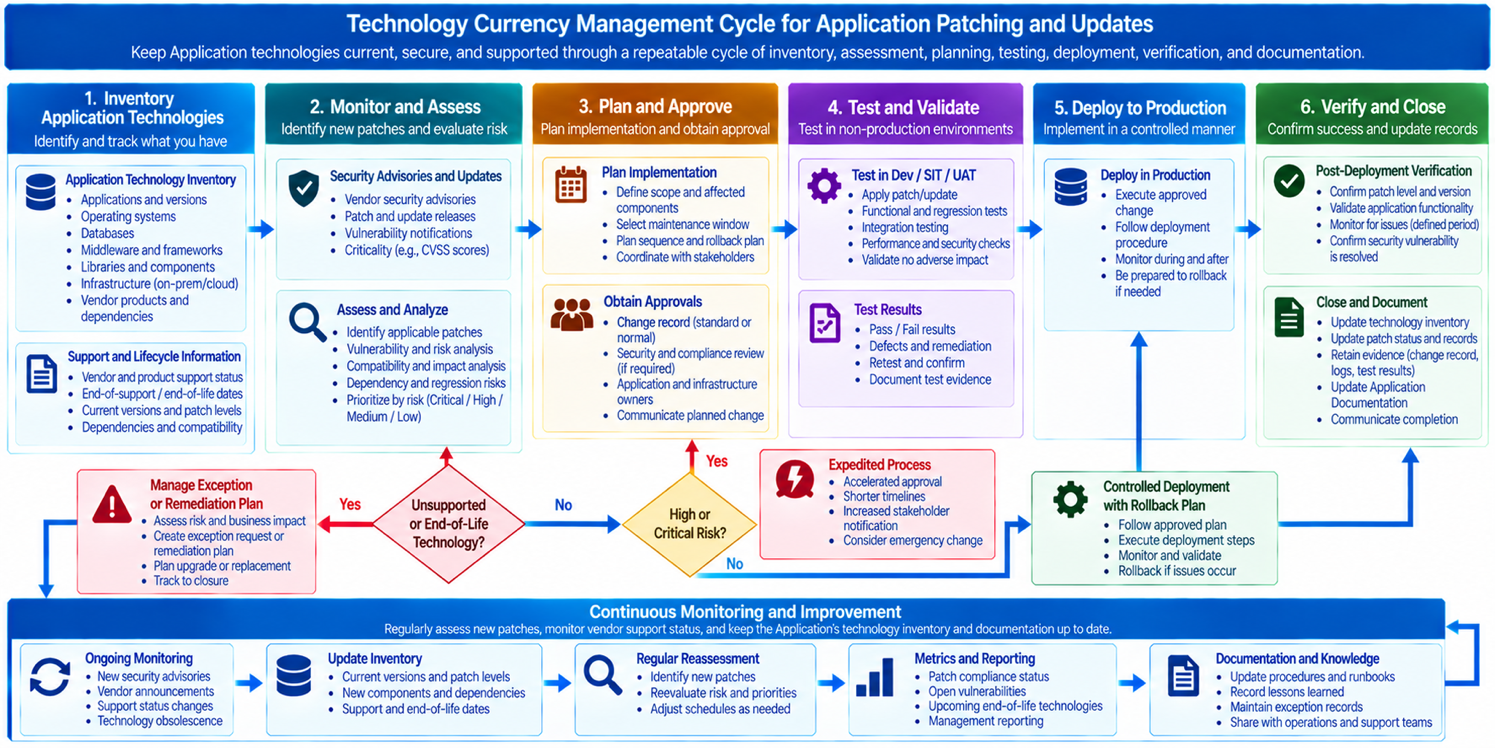
This chapter explains how to establish and document how an Application and its underlying technologies are kept patched and current.
Why Patching and Currency Matter
Every Application sits on layers of technology, such as operating systems, databases, middleware, frameworks, and libraries, each of which receives security patches and eventually reaches end of support. Applications that fall behind accumulate known vulnerabilities, lose vendor support, and become progressively harder and riskier to upgrade. Some of the most damaging security incidents exploit vulnerabilities for which patches had long been available.
Establish the Patching and Technology Currency Schedule
Establish, with the IT Application Owner, the Operations and Support Team(s), and Security:
Patching schedule by layer: how often each layer is patched, for example the operating system, database, middleware, and Application components.
Roles: who approves patches, who applies them, and who verifies the Application afterward.
Urgent security patches: how critical security patches are applied quickly, using the justifiable exception process where documentation cannot keep pace.
Technology currency plan: when each component reaches end of support, and the plan to upgrade or replace it before then.
Instance differences: how patch cycles differ between Instances, for example patching non-production environments first.
Document and Share the Schedule and History
Record the patching schedule, roles, currency plan, and a history of patches applied in the Application Documentation. Track end-of-support dates as described in the chapter “Track the Application’s Expiring Dependencies — Certificates, Credentials, Licenses, and Vendor Support Dates.” Record components running unsupported versions as Risks or Technical Debt Items until they are upgraded.
Best Practice: Establish and Document the Application’s Patching and Technology Currency Schedule
It is a best practice to both establish and document the solution for keeping an Application current: define how often each technology layer is patched and by whom, how urgent security patches are expedited, and when each component must be upgraded before end of support, and record unsupported components as Risks or Technical Debt Items.
Benefits: A defined patching and currency schedule closes known vulnerabilities promptly and prevents Applications from drifting into unsupported, high-risk states that are expensive to escape. Recording unsupported components as Risks or Technical Debt Items keeps the remaining exposure visible to leadership until it is resolved.
Connections to Related IF4IT Practices and Inventories
The IT Operating Environments Best Practices addresses managing vulnerabilities, patches, and technology currency across all governed environments. The Technology Portfolio Management (TPM) Best Practices addresses technology lifecycle and currency across the enterprise. The Technical Debt Management Best Practices addresses Technical Debt Items.
How to cite this page
When referencing this page in academic work, internal standards, or external publications, include the page title, IF4IT as author and publisher (The International Foundation for Information Technology (IF4IT), LLC), the URL, and your access date.
Example (informal web citation):
The International Foundation for Information Technology (IF4IT), LLC. Establish and Document the Application's Patching and Technology Currency Schedule | Application Management Best Practices. https://if4it.org/best-practices/application-management-best-practices/establish-and-document-the-application-s-patching-and-technology-currency-schedule/ (accessed 2026-11-09).
See About Us for content governance and site-wide citation guidance.
Copyright for The International Foundation for Information Technology (IF4IT), LLC: 2008 - Present
Legal Disclaimers