Establish and Document the Application's Support Model - Application Management Best Practices
Establish and Document the Application's Support Model
(Chapter 87 of Application Management Best Practices)
Executive Summary: Chapter Overview
IF4ITThe Bottom Line
Core Concepts
| Concept | Definition & Strategic Role |
|---|---|
| Support Levels | The assignment of support levels to teams, for example a service desk for first-level, an application support team for second-level, and engineering or vendor teams for third-level support. Enterprises can customize these recommended structures. |
| Support Routing | How requests and incidents reach the right team, including the categories, queues, or assignment groups used. Clear routing stops requests from bouncing between teams and urgent problems waiting in the wrong queue. |
| Response and Resolution Targets | How quickly requests and incidents must be responded to and resolved, consistent with the Application’s service tier and service levels. Documenting them gives users, support teams, and vendors shared expectations. |
| Vendor Support Arrangements | The vendor support contracts, contacts, entitlements, and the procedure for raising a case with the vendor. Recording them in the support model makes vendor involvement predictable when it is needed. |
Quick Q&A
Question: How should support differences between an Application's Instances be handled in the support model?
Question: Who should be involved in establishing an Application's support model?
Read More Below
This chapter explains how to establish and document how an Application is supported once it is in Production.
Why the Support Model Matters
When users have a problem with an Application, they need to know where to go, and the people who receive their request need to know where to send it next. A support model makes this predictable. Without one, requests bounce between teams, urgent problems wait in the wrong queue, and the same few experts are interrupted for everything.
Establish the Support Model
Establish, with the Operations and Support Team(s), the Application Manager, and any vendors:
Support levels: which team handles each level of support, for example a service desk for first-level support, an application support team for second-level support, and engineering or vendor teams for third-level support.
Support hours and coverage: when each level is available, and how out-of-hours and on-call support work.
Routing: how requests and incidents reach the right team, including the categories, queues, or assignment groups used.
Response and resolution targets: how quickly requests and incidents must be responded to and resolved, consistent with the Application’s service tier and service levels.
Vendor support: the vendor support arrangements, contracts, contacts, entitlements, and how to raise a case with the vendor.
User help channels: how users ask for help, and where they find self-help.
The support levels, team names, and structures mentioned here are common examples that IF4IT recommends; enterprises can customize them.
Document and Share the Support Model
Record the support model in the Operational section of the Application Documentation, with current contacts for each level and for vendor support, and make it prominent and easy to find. Record differences in support between Instances, such as non-production environments supported only during business hours. Review the support model with every Release and whenever support arrangements change.
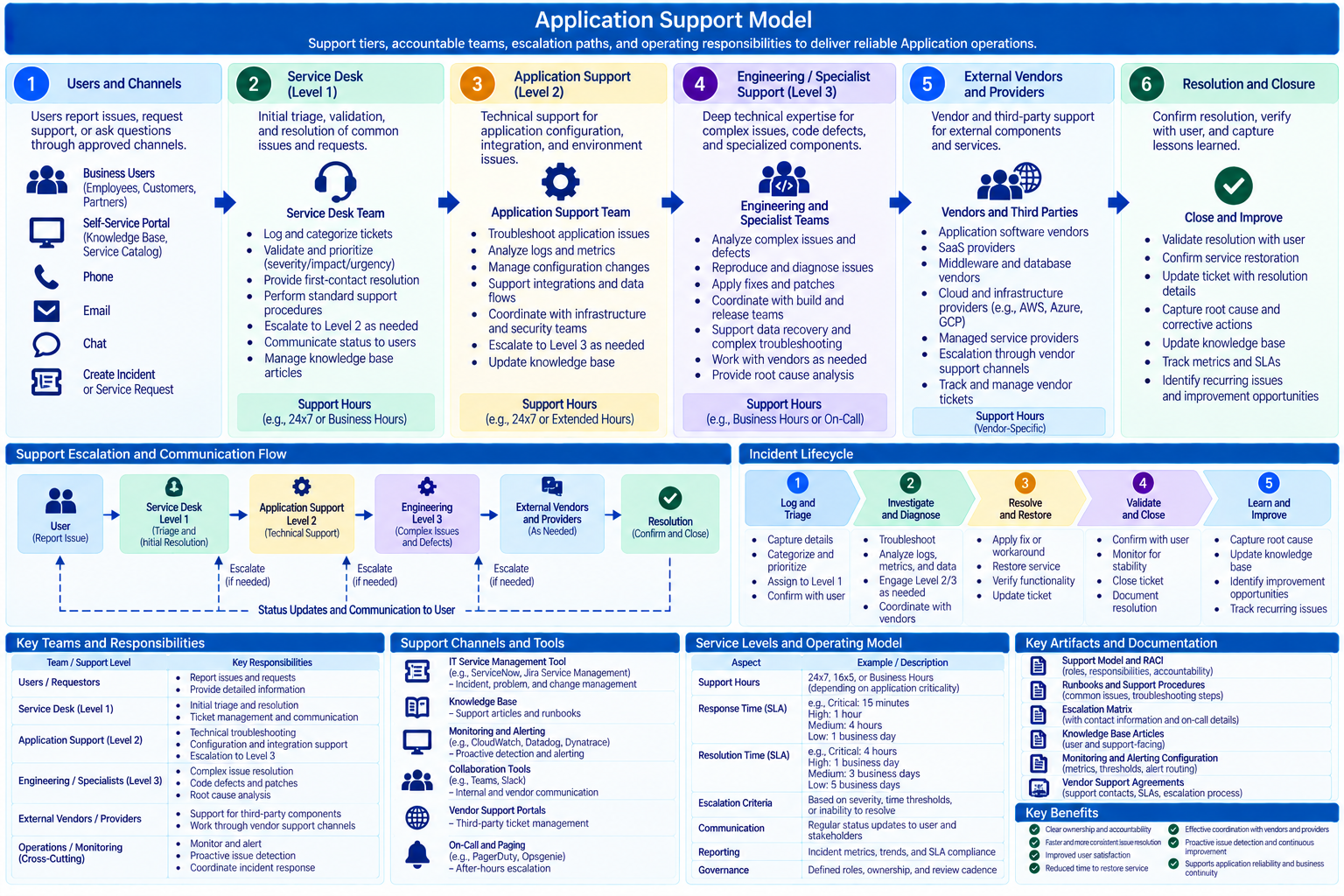
Best Practice: Establish and Document the Application’s Support Model
It is a best practice to both establish and document the solution for supporting an Application: define its support levels, hours, routing, targets, vendor support, and user help channels, and record them prominently with current contacts.
Benefits: A documented support model sends every request to the right team the first time, shortening resolution times and protecting experts from avoidable interruptions. It also makes support commitments explicit, so that users, support teams, and vendors share the same expectations.
Connections to Related IF4IT Practices and Inventories
The Service Management Best Practices addresses support processes and service levels. The Services Inventory and Attributes and the Service Catalog Best Practices address how supported services are recorded and offered.
How to cite this page
When referencing this page in academic work, internal standards, or external publications, include the page title, IF4IT as author and publisher (The International Foundation for Information Technology (IF4IT), LLC), the URL, and your access date.
Example (informal web citation):
The International Foundation for Information Technology (IF4IT), LLC. Establish and Document the Application's Support Model | Application Management Best Practices. https://if4it.org/best-practices/application-management-best-practices/establish-and-document-the-application-s-support-model/ (accessed 2026-10-31).
See About Us for content governance and site-wide citation guidance.
Copyright for The International Foundation for Information Technology (IF4IT), LLC: 2008 - Present
Legal Disclaimers