Establish and Document the Application's Upstream and Downstream Dependencies - Application Management Best Practices
Establish and Document the Application's Upstream and Downstream Dependencies
(Chapter 67 of Application Management Best Practices)
Executive Summary: Chapter Overview
IF4ITThe Bottom Line
Core Concepts
| Concept | Definition & Strategic Role |
|---|---|
| Upstream Dependencies | The Applications, Systems, services, technologies, vendors, and other resources the Application relies on in order to work. If one fails or changes, the Application may be affected, so knowing them tells support teams where to look when a failure originates outside the Application. |
| Downstream Dependencies | The Applications, Systems, business processes, and users that rely on the Application. Knowing them identifies who must be warned before a change or outage and lets the enterprise judge the true business impact of each Application. |
| Non-Integration Dependency | A dependency that does not necessarily appear as a data Integration, such as a shared identity service, scheduler, certificate authority, reference data feed, or vendor support. Because such dependencies exist, an Application’s dependencies overlap with, but are broader than, its APIs and Integrations. |
Quick Q&A
Question: Where should identification of upstream and downstream dependencies start, and how far should it extend?
Question: How does dependency documentation mature from Crawl to Run?
Read More Below
This chapter explains how to establish and document what an Application depends on, and what depends on it. It addresses the dependency chain identified during design; the full baseline of dependency types, applied across the Application’s life, is addressed in the chapter “Establish and Document the Application’s Dependencies.”
Upstream and Downstream Dependencies
Upstream dependencies are the Applications, Systems, services, technologies, vendors, and other resources the Application relies on in order to work. If an upstream dependency fails or changes, the Application may be affected.
Downstream dependencies are the Applications, Systems, business processes, and users that rely on the Application. If the Application fails or changes, they may be affected.
Dependencies overlap with, but are broader than, APIs and Integrations. An Application may depend on a shared identity service, a scheduler, a certificate authority, a reference data feed, or a vendor’s support, none of which necessarily appears as a data Integration.
Establish the Dependencies
Identify the Application’s upstream and downstream dependencies, starting from its APIs, Integrations, and hosting infrastructure, and extending to shared platforms, technologies, vendors, and the business processes and users that rely on it. For each, establish the nature of the dependency and the impact if it fails.
Document and Share the Dependencies
Record upstream and downstream dependencies, with their impact, in the Application Documentation, preferably with a dependency diagram, and link each one to its own record where it has one.
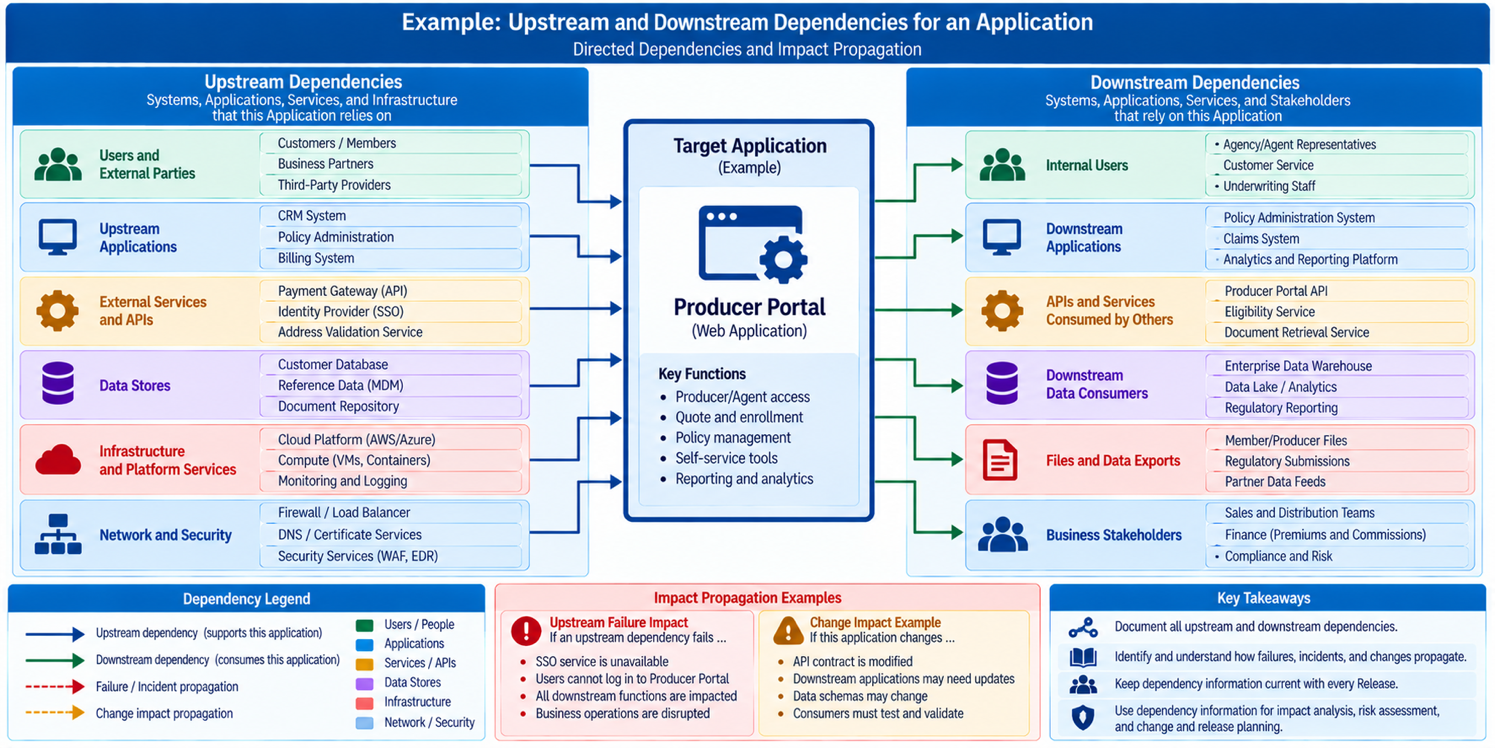
Remember to review dependencies with every Release.
Best Practice: Establish and Document the Application’s Upstream and Downstream Dependencies
It is a best practice to both establish and document the solution for an Application’s dependency chain: identify what it relies on and what relies on it, with the impact of each failing, and keep that record current.
Benefits: Knowing upstream dependencies tells support teams where to look when an Application fails for reasons outside itself. Knowing downstream dependencies tells everyone who must be warned before a change or outage, and lets the enterprise judge the true business impact of each Application.
Advance Maturity Deliberately: Crawl, Walk, Run
Crawl. Dependencies are listed manually from the knowledge of the Application team.
Walk. Dependencies are recorded consistently, linked to the records of the dependent and depended-upon Applications and technologies, and reviewed with every Release.
Run. Dependency records are validated against automatically discovered connections and enterprise models, and impact analysis across all Applications is available on demand.
Connections to Related IF4IT Practices and Inventories
The IF4IT Enterprise Model and Modeling Best Practices describes how relationships between Applications and other enterprise entities are modeled. The Software Technologies Inventory and Attributes and the Vendors Inventory and Attributes describe two of the most common kinds of upstream dependency.
How to cite this page
When referencing this page in academic work, internal standards, or external publications, include the page title, IF4IT as author and publisher (The International Foundation for Information Technology (IF4IT), LLC), the URL, and your access date.
Example (informal web citation):
The International Foundation for Information Technology (IF4IT), LLC. Establish and Document the Application's Upstream and Downstream Dependencies | Application Management Best Practices. https://if4it.org/best-practices/application-management-best-practices/establish-and-document-the-application-s-upstream-and-downstream-dependencies/ (accessed 2026-10-30).
See About Us for content governance and site-wide citation guidance.
Copyright for The International Foundation for Information Technology (IF4IT), LLC: 2008 - Present
Legal Disclaimers