Establish and Maintain the Application's Technical Debt Items - Application Management Best Practices
Establish and Maintain the Application's Technical Debt Items
(Chapter 117 of Application Management Best Practices)
Executive Summary: Chapter Overview
IF4ITThe Bottom Line
Core Concepts
| Concept | Definition & Strategic Role |
|---|---|
| Technical Debt Item | A specific, recorded instance of Technical Debt in an Application, such as an unsupported technology version, deferred refactoring, a temporary workaround that became permanent, missing automated tests, or a design compromise made to meet a deadline. |
| Technical Debt vs. Knowledge Debt | Technical Debt makes the Application harder to change and operate, while Knowledge Debt makes knowledge about it harder to find, trust, and use. Keeping them distinct ensures each kind of debt is recorded and remediated on its own terms. |
| Technical Debt Inventory | The enterprise inventory where each Application’s Technical Debt Items are kept, linked from the Application Documentation, with attributes such as cause, affected components, impact and Risks, owner, remediation plan, estimated effort, and status. |
Quick Q&A
Question: When should a new Technical Debt Item be recorded for an Application?
Question: How does linking Technical Debt Items to Risks and incidents help prioritize remediation?
Read More Below
This chapter explains how to establish and maintain the record of an Application’s Technical Debt.
Technical Debt Items
Technical Debt is the accumulated set of shortcuts, deficiencies, and outdated elements that make an Application harder, riskier, or more costly to change and operate. Each specific instance is recorded as a Technical Debt Item. Technical Debt is distinct from Knowledge Debt: Technical Debt makes the Application harder to change and operate, while Knowledge Debt makes knowledge about it harder to find, trust, and use.
Establish the Record of Technical Debt Items
Identify the Application’s Technical Debt, for example unsupported technology versions, deferred refactoring, temporary workarounds that became permanent, missing automated tests, and design compromises made to meet deadlines. For each Technical Debt Item, record the attributes the enterprise requires, typically including its description and cause, the Application and components affected, its impact and the Risks it creates, its owner, the remediation plan and estimated effort, and its status. Record new Technical Debt Items whenever a Release knowingly takes a shortcut.
Maintain and Share the Record
Keep Technical Debt Items in the enterprise’s Technical Debt inventory, linked from the Application Documentation, and link each to related Risks, Defects, incidents, and plans. Review them with every Release, reassess them when conditions change, and include their remediation in Release planning.
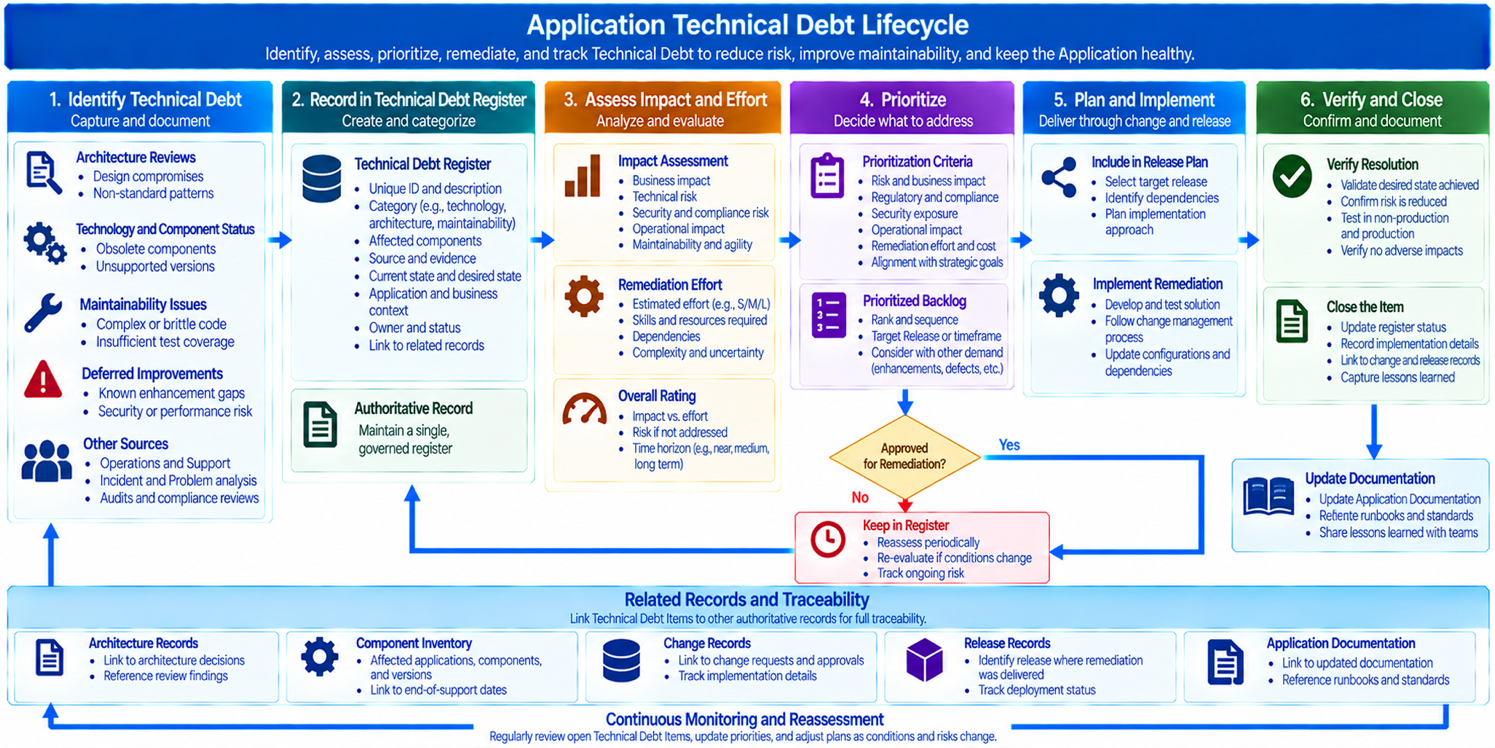
Best Practice: Establish and Maintain the Application’s Technical Debt Items
It is a best practice to both establish and maintain the solution for an Application’s Technical Debt: record each Technical Debt Item with its cause, impact, owner, remediation plan, and status in the enterprise’s Technical Debt inventory, link it to related Issues, and plan its remediation into Releases.
Benefits: Recorded Technical Debt Items make the hidden cost of past shortcuts visible and comparable, so owners can decide deliberately which debt to repay and when. Linking them to Risks and incidents shows which debt is actually causing harm, focusing remediation where it pays off most.
Connections to Related IF4IT Practices and Inventories
The Technical Debt Management Best Practices addresses establishing a Technical Debt Inventory, defining the required attributes of a Technical Debt Item, and managing the Technical Debt Item lifecycle. The Technical Debt Inventory and Attributes describes the attributes recorded for each item.
How to cite this page
When referencing this page in academic work, internal standards, or external publications, include the page title, IF4IT as author and publisher (The International Foundation for Information Technology (IF4IT), LLC), the URL, and your access date.
Example (informal web citation):
The International Foundation for Information Technology (IF4IT), LLC. Establish and Maintain the Application's Technical Debt Items | Application Management Best Practices. https://if4it.org/best-practices/application-management-best-practices/establish-and-maintain-the-application-s-technical-debt-items/ (accessed 2026-11-06).
See About Us for content governance and site-wide citation guidance.
Copyright for The International Foundation for Information Technology (IF4IT), LLC: 2008 - Present
Legal Disclaimers