Establish and Use an Application Documentation Template - Application Management Best Practices
Establish and Use an Application Documentation Template
(Chapter 28 of Application Management Best Practices)
Executive Summary: Chapter Overview
IF4ITThe Bottom Line
Core Concepts
| Concept | Definition & Strategic Role |
|---|---|
| Application Documentation Template | A standardized, reusable structure defining the sections, fields, and expected content of an Application’s Documentation. It separates minimum required content, including everything needed for the Application Record, from recommended content, and includes conditional and Instance-specific sections. |
| Conditional Template Sections | Sections that apply only in certain circumstances, such as Vendor information or regulatory validation, and that state when they apply. They let one template, or a family of related templates, fit every Sourcing Type without forcing irrelevant content on every Application. |
| Template Version Conformance | Each template carries a version number, and each Application’s completed documentation records which template version it conforms to. This makes it possible to tell which Applications are current and which have fallen behind the enterprise’s latest expectations. |
| AI-Generated Baseline Template | A first draft of the enterprise’s template produced by AI from these best practices plus enterprise inputs such as branding, terminology, policies, and stakeholder requirements. It is treated as a draft that the template owner and critical stakeholders review, approve, and improve. |
Quick Q&A
Question: Why does this document deliberately omit a sample Application Documentation Template?
Question: What form should the Application Documentation Template take as an enterprise matures?
Question: When in an Application's life should teams start using the template?
Read More Below
This chapter explains why every Application should be documented from a common Application Documentation Template, what such a template should contain, what form it can take, and how enterprises can use AI to create their own baseline template from these best practices.
Definition
An Application Documentation Template is a standardized, reusable structure that defines the sections, fields, and expected content of an Application’s Documentation, so that every Application is documented consistently, completely, and in a way that is easy to find, read, and compare. It distinguishes the minimum required content (including everything needed to populate the Application Record) from additional recommended content, includes conditional sections that apply only where relevant (such as Vendor information), and provides for Application Instance–specific information wherever Instances differ. At a minimum, it is a templated document (such as a word-processing template); preferably, it is implemented as an online form, or set of forms, within the enterprise’s Digital Library.
Why a Template Matters
Without a common template, every Application team decides for itself what to document and how to organize it. The result is documentation that varies wildly in completeness and structure, so that a reader who knows where to find something for one Application has no idea where to find it for the next. Important topics are omitted not because anyone decided they did not matter, but because no one thought to include them.
A common template fixes this. It tells every team what must be documented, it puts the same information in the same place for every Application, and it makes documentation checkable: anyone can compare an Application’s documentation with the template and see what is missing.
Establish the Application Documentation Template
An effective Application Documentation Template:
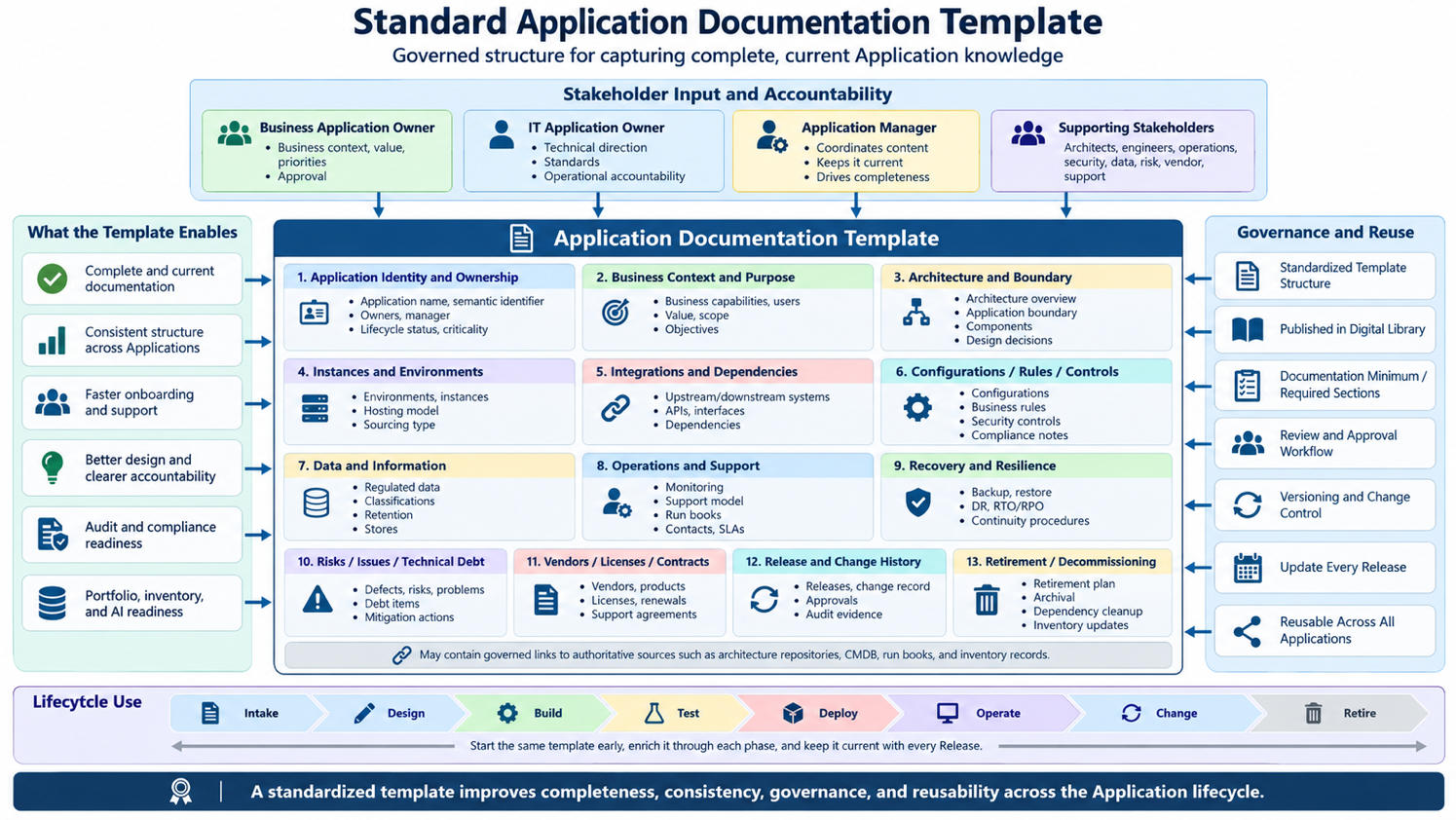
Covers every documentation type. Its sections should span the full range of Application knowledge, for example the baseline documentation types described in the chapter “Understand the Types of Application Documentation.”
Reflects what each critical stakeholder needs. Its sections should be built from the documented requirements of the stakeholders who depend on the documentation, as described in the chapter “Build Application Documentation Template Sections from Each Critical Stakeholder’s Requirements.”
Includes everything needed for the Application Record. One section should capture the information required to populate the Application Record, as described in the chapter “Derive the Documentation Template’s Application Record Section from the Applications Inventory.”
Separates required from recommended content. It should make clear which content is required by the enterprise’s Minimum Application Documentation Policy and which is recommended beyond that minimum.
Includes conditional sections. Sections that apply only in some circumstances, such as vendor information or regulatory validation, should state when they apply.
Provides for Instance differences. It should include places to record what differs between the Application’s Instances.
Records its own version. The template carries a version number, and each Application’s completed documentation records which template version it conforms to.
Enterprises may implement this as one template with conditional sections or as a family of related templates, for example one per Sourcing Type or per Application type. Either approach works, provided that every Application’s documentation is captured in the same structure, linked to related documentation, and stored in the same place.
The template should be owned by Enterprise Architecture or Software Engineering, which publishes it and keeps it current according to the needs of the enterprise’s stakeholders. The chapter “Govern, Version, and Batch Changes to Application Documentation Templates” describes how changes are managed.
Use AI to Create a Baseline Template for Your Enterprise
This document deliberately does not include a sample template, because every enterprise’s template should reflect its own stakeholders, policies, vocabulary, and branding. Instead, enterprises can use AI to create a baseline template from these best practices. Provide an AI assistant with this document, together with the enterprise’s own inputs, such as its branding and document standards, its terminology, its documentation policies, its stakeholders’ requirements, and any customizations it has made to the recommended attributes and value sets, and ask it to produce a baseline template. The enterprise then reviews, approves, and improves that template over time.
An example prompt follows. It is a starting point, and it should be adapted to the enterprise’s own circumstances and AI tools.
| Example AI Prompt: Create a Baseline Application Documentation Template |
|---|
| You are helping our enterprise create a baseline Application Documentation Template. Use the attached IF4IT Application Management Best Practices as the primary source of structure and content. Also use the attached enterprise inputs: our branding and document standards, our glossary of terms, our Minimum Application Documentation Policy, the documentation requirements provided by each of our critical stakeholders, and our customized Application attributes and value sets. Produce a template organized into sections that cover every documentation type, with one section containing all fields needed for our Application Record. For each section, state its purpose, the stakeholder or stakeholders who review it, whether it is required or recommended, and any conditions under which it applies. Include places to record Application Instance–specific information wherever Instances may differ. Use our terminology wherever it differs from IF4IT’s, and list every such substitution separately. Flag any best practice you could not map to a section, and any stakeholder requirement that conflicts with another, so that we can resolve them. Do not invent enterprise-specific policies, names, or values that are not in the inputs. |
AI-generated templates must be reviewed and approved by the template owner and by each critical stakeholder before use, and the same human review applies to every subsequent revision.
Use the Template for Every Application
A template only helps if it is used. Require that every Application, whatever its Sourcing Type or Hosting Model, be documented using the current template, starting at the beginning of its design rather than at the end of its delivery.
Best Practice: Establish and Use an Application Documentation Template
It is a best practice to both establish and document the solution for how Applications are documented: establish an Application Documentation Template owned by Enterprise Architecture or Software Engineering, publish it, and require that every Application be documented using it.
Benefits: A common template makes every Application’s documentation predictable to read and straightforward to check, so readers find information in the same place every time, and gaps are visible at a glance. It also embeds the enterprise’s accumulated experience of what matters into every new Application, rather than relying on each team to rediscover it.
Best Practice: Use AI to Accelerate Creation of the Enterprise’s Baseline Template, with Human Approval
Use AI, together with these best practices and the enterprise’s own inputs, to produce a first baseline Application Documentation Template, and treat that output as a draft to be reviewed, approved, and continuously improved by the template owner and the critical stakeholders.
Benefits: AI can turn a large body of best-practice guidance and enterprise-specific inputs into a usable first draft in a fraction of the time it would take by hand, letting the template owner spend their effort on judgment and stakeholder agreement rather than on assembling structure. Requiring human approval ensures that the result reflects the enterprise’s real needs rather than plausible-sounding generalities.
Advance Maturity Deliberately: Crawl, Walk, Run
Crawl. The template is a templated word-processing document, published in a known location, that every Application team copies and completes.
Walk. The template is implemented as an online form, or set of forms, in the Digital Library, with required fields enforced and conditional sections shown only when they apply.
Run. The online forms validate their content, automatically populate the Application Record, and report each Application’s completeness against the current template version.
Connections to Related IF4IT Practices and Inventories
The Applications Inventory and Attributes describes the attributes that feed the template’s Application Record section and that advanced enterprises can use to extend their templates. The Enterprise AI Governance Best Practices addresses the governance of AI used for tasks such as template creation.
How to cite this page
When referencing this page in academic work, internal standards, or external publications, include the page title, IF4IT as author and publisher (The International Foundation for Information Technology (IF4IT), LLC), the URL, and your access date.
Example (informal web citation):
The International Foundation for Information Technology (IF4IT), LLC. Establish and Use an Application Documentation Template | Application Management Best Practices. https://if4it.org/best-practices/application-management-best-practices/establish-and-use-an-application-documentation-template/ (accessed 2026-10-31).
See About Us for content governance and site-wide citation guidance.
Copyright for The International Foundation for Information Technology (IF4IT), LLC: 2008 - Present
Legal Disclaimers