Sourcing Type vs. Hosting Model — Who Created an Application vs. Where It Is Hosted - Application Management Best Practices
Sourcing Type vs. Hosting Model — Who Created an Application vs. Where It Is Hosted
(Chapter 10 of Application Management Best Practices)
Executive Summary: Chapter Overview
IF4ITThe Bottom Line
Core Concepts
| Concept | Definition & Strategic Role |
|---|---|
| Sourcing Type | The characteristic describing who created an Application. Recommended values are Custom-Built (Internal), Vendor, Open Source Community, and Composite, a material combination such as a vendor product extended with custom-built components; enterprises can customize these values. |
| Hosting Model | The characteristic describing where an Application is hosted and who operates it. Recommended values are On-Premise, Cloud |
| Multiple Hosting Models | An Application may record more than one Hosting Model, one per hosting location in use, with per-Instance documentation showing which Instance runs where. Hybrid hosting is expressed this way, so there is no separate “Hybrid” value. |
Quick Q&A
Question: Does an Application's Sourcing Type determine whether Build and Packaging must be documented?
Question: How does SaaS <Vendor Name> differ from Hosted <Vendor Name> as a Hosting Model?
Read More Below
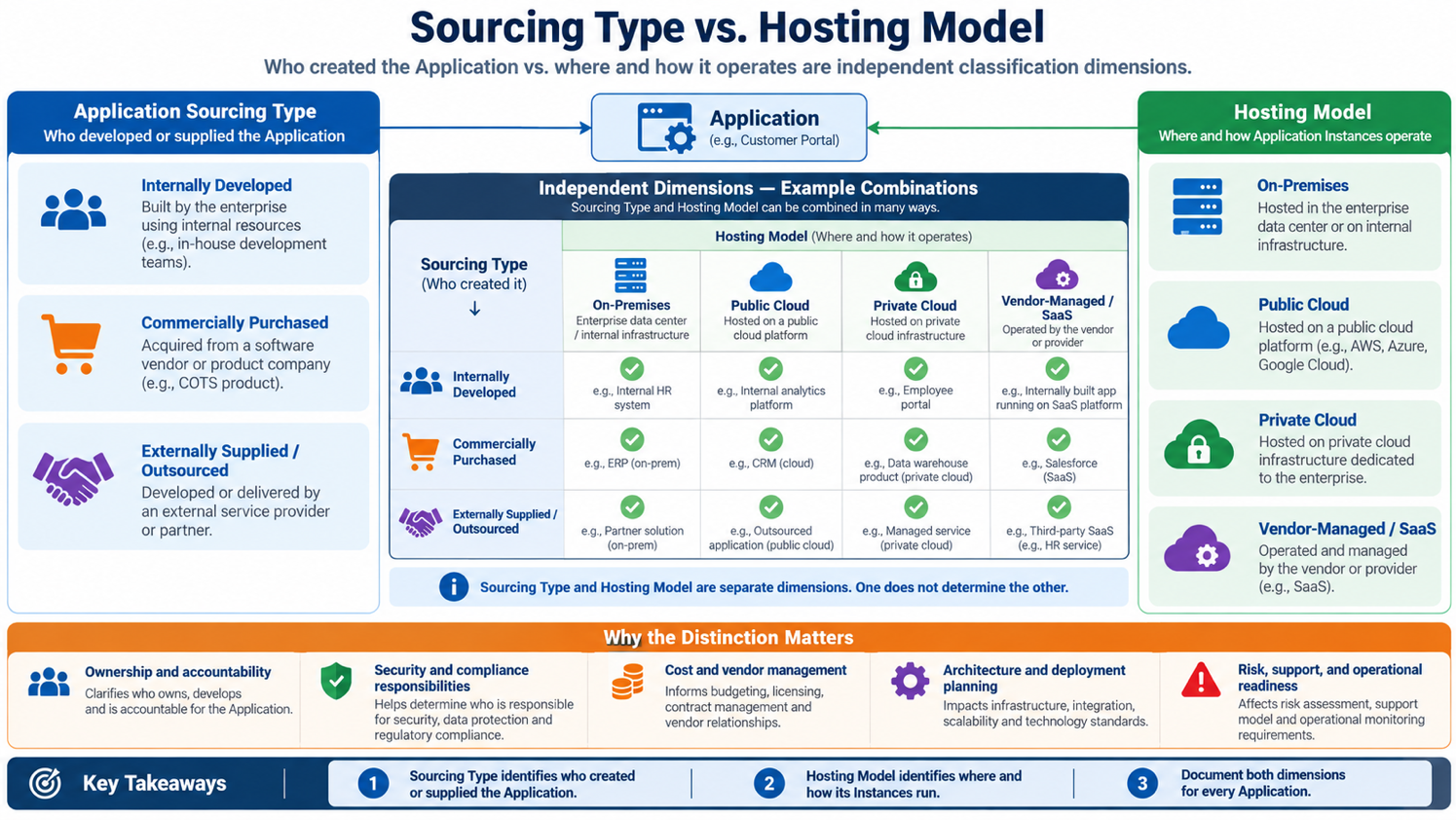
This chapter distinguishes two characteristics of every Application that are frequently confused: its Sourcing Type, which describes who created it, and its Hosting Model, which describes where it is hosted and who operates it.
Two Separate Questions
Every Application raises two separate questions:
Who created the Application? This is its Sourcing Type.
Where is the Application hosted, and who operates it? This is its Hosting Model.
The two are independent. An Application the enterprise built itself may be hosted in its own data center or in its own cloud account. A vendor’s Application may be installed in the enterprise’s own data center, hosted by the vendor as a dedicated installation, or provided as Software as a Service (SaaS). Recording the two characteristics separately avoids forcing combinations into a single, confusing category.
Recommended Sourcing Types
The following Sourcing Types are common examples that IF4IT recommends; enterprises can customize them to their own needs:
| Sourcing Type | Description |
|---|---|
| Custom-Built (Internal) | Designed and built by or for the enterprise, including by contractors working to its specifications, with the enterprise owning the result. |
| Vendor | Created and owned by a commercial vendor; the enterprise uses it under license or subscription. |
| Open Source Community | Created and maintained by an open-source community; the enterprise uses it under an open-source license. |
| Composite | A material combination of the above, such as a vendor or open-source product extended with custom-built components. |
Recommended Hosting Models
The following Hosting Models are also common examples that IF4IT recommends; enterprises can customize them to their own needs. Each value except On-Premise is qualified with the name of the platform or vendor involved:
| Hosting Model | Description |
|---|---|
| On-Premise | Hosted on infrastructure in facilities the enterprise owns or directly controls, such as its own data centers or colocation space it operates. |
| Cloud <Platform Name> | Hosted on the named cloud platform within the enterprise’s own cloud account or tenancy; the enterprise, not the platform provider, installs, configures, and operates the Application. |
| SaaS <Vendor Name> | Provided by the named vendor as Software as a Service; the vendor hosts, operates, and upgrades a shared, typically multi-tenant, Application in its own cloud, and the enterprise subscribes to it and configures it within the vendor’s limits. |
| Hosted <Vendor Name> | Hosted and operated by the named vendor on infrastructure the vendor controls, as a dedicated installation for the enterprise; the vendor runs it, but the enterprise usually has more control over versions, upgrade timing, and configuration than with SaaS. |
An Application may have more than one Hosting Model, one for each hosting location in use. For example, an Application whose Production Instance runs in the enterprise’s data center while its test Instances run on a cloud platform would record both On-Premise and Cloud <Platform Name>. The Application’s per-Instance documentation then shows which Instance runs where. There is therefore no separate “Hybrid” value: hybrid hosting is expressed by recording each Hosting Model that applies.
Why the Distinction Matters for Documentation
Sourcing Type and Hosting Model each shape what must be documented, and how. A Custom-Built Application requires documentation of its source code: where the code lives, how it is structured, and how it is built and packaged. AI can help construct much of this documentation from the code itself, subject to human review. A Vendor Application requires documentation of the vendor, its contracts, its support arrangements, and its Releases. A SaaS Application requires documentation of the enterprise’s own configuration, its Integrations, its data, and the vendor’s obligations, even though the enterprise never installs it.
Sourcing Type does not, however, decide whether Build and Packaging must be documented. Custom-Built Applications always require it, but enterprises also frequently combine vendor or open-source products with other software and custom configuration to create enterprise-specific software sets, and those require Build and Packaging. Build and Packaging documentation applies to whatever the enterprise builds, assembles, extends, configures, or integrates within the Application Boundary, whatever the Sourcing Type. Where a vendor fully controls a part of the Application, document the vendor’s Releases and the enterprise’s own configuration of that part.
Best Practice: Record Sourcing Type and Hosting Model as Separate Characteristics
Record every Application’s Sourcing Type and Hosting Model separately, using the enterprise’s adopted value sets, and use the combination to determine which documentation the Application requires. The chapter “Establish and Document the Application’s Sourcing Type and Hosting Model” describes how to do this in practice.
Benefits: Keeping the two characteristics separate lets the enterprise answer distinct questions precisely: which Applications it depends on vendors to create, and which ones it depends on vendors to run. Those answers drive different decisions about contracts, exit strategies, security reviews, and Disaster Recovery, and they ensure that each Application’s documentation covers what its particular combination actually requires.
Connections to Related IF4IT Practices and Inventories
The Vendors Inventory and Attributes describes how vendors are recorded. The Applications Inventory and Attributes describes the Application attributes in which Sourcing Type and Hosting Model are recorded. The IT Operating Environments Best Practices describes how vendor-hosted and SaaS contexts fit within the enterprise’s IT Operating Environments.
How to cite this page
When referencing this page in academic work, internal standards, or external publications, include the page title, IF4IT as author and publisher (The International Foundation for Information Technology (IF4IT), LLC), the URL, and your access date.
Example (informal web citation):
The International Foundation for Information Technology (IF4IT), LLC. Sourcing Type vs. Hosting Model — Who Created an Application vs. Where It Is Hosted | Application Management Best Practices. https://if4it.org/best-practices/application-management-best-practices/sourcing-type-vs-hosting-model-who-created-an-application-vs-where-it-is-hosted/ (accessed 2026-10-30).
See About Us for content governance and site-wide citation guidance.
Copyright for The International Foundation for Information Technology (IF4IT), LLC: 2008 - Present
Legal Disclaimers