Understand Application Management Roles and Responsibilities - Application Management Best Practices
Understand Application Management Roles and Responsibilities
(Chapter 21 of Application Management Best Practices)
Executive Summary: Chapter Overview
IF4ITThe Bottom Line
Core Concepts
| Concept | Definition & Strategic Role |
|---|---|
| Application Owners | The Business Application Owner, who holds ultimate accountability and owns the Application’s lifecycle strategy, and the IT Application Owner, who is accountable for its design, development, and engineering. For Applications used mainly within IT, the two are commonly the same person, yet each role is recorded separately. |
| Associated Organizations | The Application Management Organization, the Development or Engineering Organization, and the Operations and Support Team(s): the three organizations tied to an Application’s roles, accountable respectively for its day-to-day operation, for building and changing it, and for supporting it in Production. |
| Establishing and Documenting a Role | The four-step practice of identifying who holds or should hold a role, ensuring the right authority actually makes the assignment, documenting the holder in the Application Documentation, and registering them in the Application Record in the Application Inventory. |
| Accountability Gap | A role that cannot be filled for an Application. It is recorded as a Knowledge Debt Item and as a Risk, reported as Red in documentation conformance reporting, and escalated until someone with the proper authority fills it. |
Quick Q&A
Question: Why should each Application Management role be recorded separately even when one person holds several of them?
Question: Are Data Owners, Security Owners, Executive Sponsors, and governance leaders such as the CIO treated as Application Management roles?
Read More Below
This chapter introduces the roles and organizations involved in managing an individual Application, how they relate to one another, and what it means to establish and document them.
The Application Management Roles
The following roles are the core of Application Management for any individual Application. They are common roles that IF4IT recommends; enterprises can rename or extend them to fit their own organizational vocabulary, provided each responsibility remains clearly assigned.
| Role | Also Known As | Responsibility |
|---|---|---|
| Application Portfolio Owner | Portfolio Owner (for example, Sales Application Portfolio Owner) | Owns a defined group of Applications, and is often also the Business Application Owner of those Applications. |
| Business Application Owner | Business Owner, Product Owner | Holds ultimate accountability for the Application and owns its lifecycle strategy, known as Application Lifecycle Management (ALM). |
| IT Application Owner | Technical Owner | Accountable for the design, development, and engineering of the Application, including its architecture, configuration, automation, deployment, technical validation, and technical Releases. |
| Application Manager | Product Manager | Accountable, on behalf of the Business Application Owner, for the day-to-day management of the Application, including its operation, changes, and support. |
| Development or Engineering Primary Contact | Development or Engineering Lead | The primary contact within the Development or Engineering Organization that builds and changes the Application. |
| Operations and Support Primary Contact | Operations or Support Lead | The primary contact within the Operations and Support Team(s) that run and support the Application in Production. |
| Subject Matter Expert (SME) | Not applicable | A person with expert knowledge of some aspect of the Application on whom others rely. |
The Business Application Owner and the IT Application Owner are referred to collectively as an Application’s Application Owners.
The Associated Organizations
Three organizations are associated with these roles:
The Application Management Organization is the organization, or organizational unit, to which the Application Manager belongs and which is accountable for the Application’s day-to-day operation, including work performed on its behalf by other organizations or vendors. It may be a sub-organization within the broader business organization the Application serves.
The Development or Engineering Organization is the organization that designs, builds, and changes the Application.
The Operations and Support Team(s) are the teams that run and support the Application’s Instances in Production.
How the Roles Fit Together
A typical chain of accountability looks like this. The head of a business area, such as Sales, owns that area’s Application Portfolio and is often the Business Application Owner of the Applications within it. The Business Application Owner sets each Application’s strategy and holds ultimate accountability for it. An Application Manager runs each Application day to day on the Business Application Owner’s behalf. The IT Application Owner is accountable for the Application’s technical design and engineering, carried out by the Development or Engineering Organization. The Operations and Support Team(s) run and support it in Production. SMEs provide expertise others depend on.
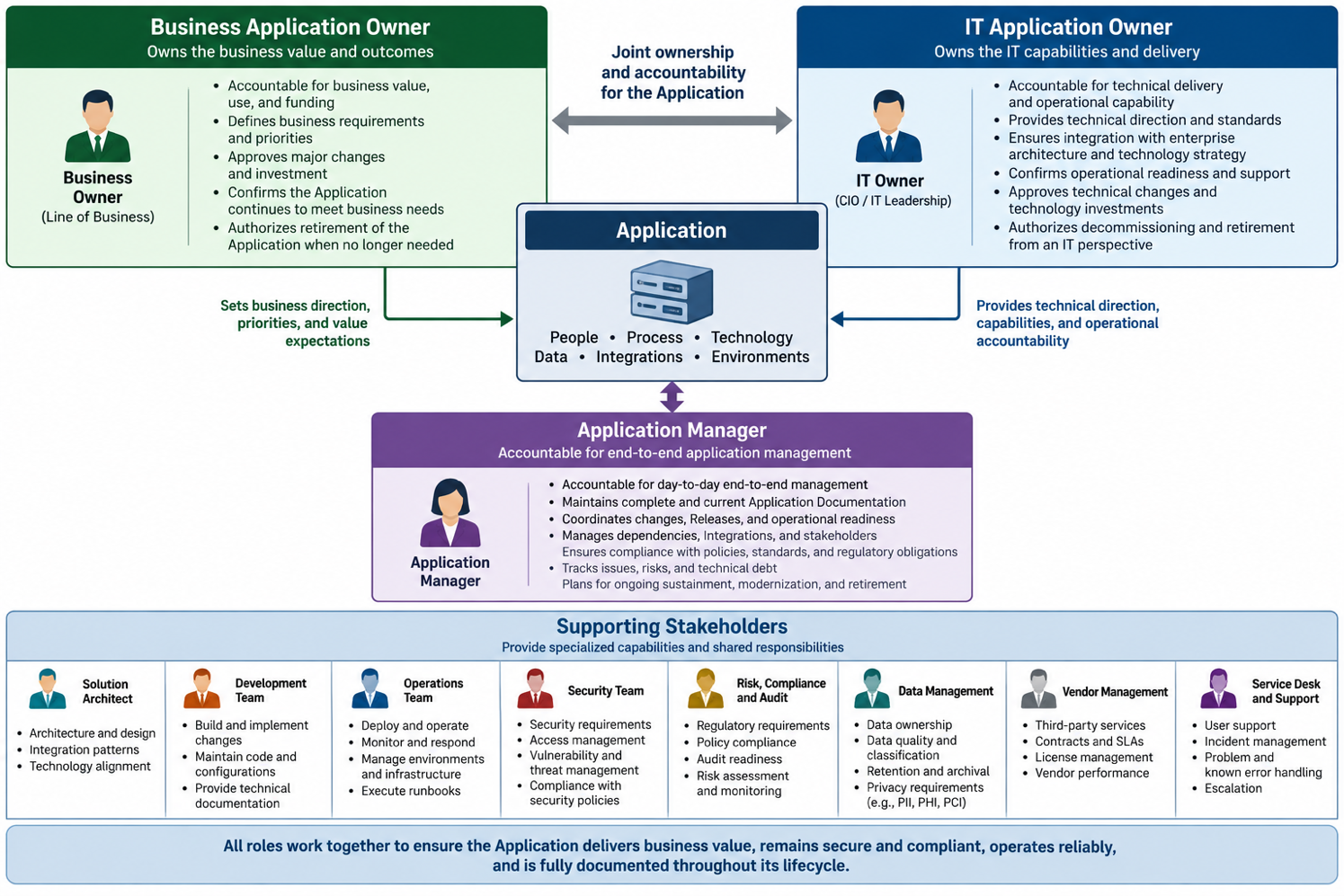
A Business Application Owner typically owns many Applications, and an Application Manager may manage one Application or several.
One Person May Hold Several Roles
One person may hold several of these roles where it makes sense; in smaller enterprises, this is common. For an Application whose primary users are within IT, such as an internal IT tool, the IT Application Owner is commonly the same person as the Business Application Owner. The IT Application Owner and the Application Manager are also frequently the same person. Even so, each role should be recorded explicitly and separately, so that the responsibilities remain visible and can be reassigned independently if circumstances change.
A Note on “Product Owner” and “Product Manager”
In this document, “Product Owner” means the Business Application Owner, and “Product Manager” means the Application Manager: just as a Product Manager works on behalf of a Product Owner, an Application Manager works on behalf of the Business Application Owner. In teams that use Scrum, the Scrum Product Owner is a team-level role that works on the Business Application Owner’s behalf and is often filled by the Application Manager or a delegate.
Documented Contacts That Are Not Application Management Roles
Some contacts are important to record when they are known, but they are not Application Management roles defined by this document. They include Data Owners, Security Owners, and Executive Sponsors, addressed in the chapter “Document Other Known Contacts — Data Owners, Security Owners, and Executive Sponsors.” Similarly, governance bodies and leaders, such as the Chief Information Officer (CIO), the Chief Technology Officer (CTO), Enterprise Architecture, and a Change Review Board, govern Applications but are not roles assigned to an individual Application; they are addressed in the chapter “Connect Application Management to Enterprise Architecture and Change Governance.”
What It Means to Establish and Document a Role
Most of the chapters that follow address one role or group of roles under a title beginning “Establish and Document.” For a role, establishing and documenting it means four things:
Identify who currently holds, or should hold, the role.
Ensure the role is assigned by the right authority. The person documenting the Application often does not have the authority to assign a role. Establishing a role therefore means making sure the person or body with that authority actually makes the assignment, and escalating if it does not, rather than assigning it oneself.
Document the role holder in the Application Documentation.
Register the role holder in the Application Record in the Application Inventory.
A role that cannot be filled is an accountability gap. It should be recorded as a Knowledge Debt Item and as a Risk, reported as Red in documentation conformance reporting, and escalated until it is filled.
Best Practice: Recognize Every Application Management Role and Assign Each One Explicitly
Adopt a defined set of Application Management roles, such as those in this chapter, and require that every role be explicitly assigned and recorded for every Application, even when one person holds several of them.
Benefits: A shared set of roles gives every Application the same answer to the question “who is responsible for what?”, so that no one has to discover an Application’s accountability structure from scratch. Recording each role separately, even when one person holds several, keeps every responsibility visible, so that none is silently dropped when that person moves on.
Connections to Related IF4IT Practices and Inventories
The Application Portfolio Management (APM) Best Practices addresses Application ownership across the portfolio, including assigning a named Application Owner to every Application in the portfolio. The Applications Inventory and Attributes describes the ownership and stakeholder attributes recorded for each Application.
How to cite this page
When referencing this page in academic work, internal standards, or external publications, include the page title, IF4IT as author and publisher (The International Foundation for Information Technology (IF4IT), LLC), the URL, and your access date.
Example (informal web citation):
The International Foundation for Information Technology (IF4IT), LLC. Understand Application Management Roles and Responsibilities | Application Management Best Practices. https://if4it.org/best-practices/application-management-best-practices/understand-application-management-roles-and-responsibilities/ (accessed 2026-10-30).
See About Us for content governance and site-wide citation guidance.
Copyright for The International Foundation for Information Technology (IF4IT), LLC: 2008 - Present
Legal Disclaimers