Understand the IF4IT Baseline Framework for Application Configurations, Dependencies, and Rules - Application Management Best Practices
Understand the IF4IT Baseline Framework for Application Configurations, Dependencies, and Rules
(Chapter 103 of Application Management Best Practices)
Executive Summary: Chapter Overview
IF4ITThe Bottom Line
Core Concepts
| Concept | Definition & Strategic Role |
|---|---|
| Configurations | The settings that determine how an Application is built, packaged, deployed, and run, and how it behaves. The framework organizes them into fifteen categories, each documented as a baseline common to all Instances plus each Instance’s differences. |
| Dependencies | The things an Application relies on, inside and outside its boundary, organized into twelve dependency types. Unlike configurations, they are governed through tracking and review; when left undocumented, they tend to be discovered only when they fail. |
| Rules | The ten rule types that govern how configurations are managed: where they live, who may change them, and how changes are controlled. Without them, practices such as how values are promoted between environments often exist only as habit. |
| Foundational Baseline | IF4IT’s characterization of the framework as a suggested starting point rather than a complete enumeration. Enterprises are encouraged to rename, merge, split, and extend its categories and types to fit their Applications, technologies, and regulatory obligations. |
Quick Q&A
Question: Why should every Application address each configuration category and dependency type, even those that do not apply?
Question: How does the framework expect configurations and dependencies to account for differences between Instances?
Read More Below
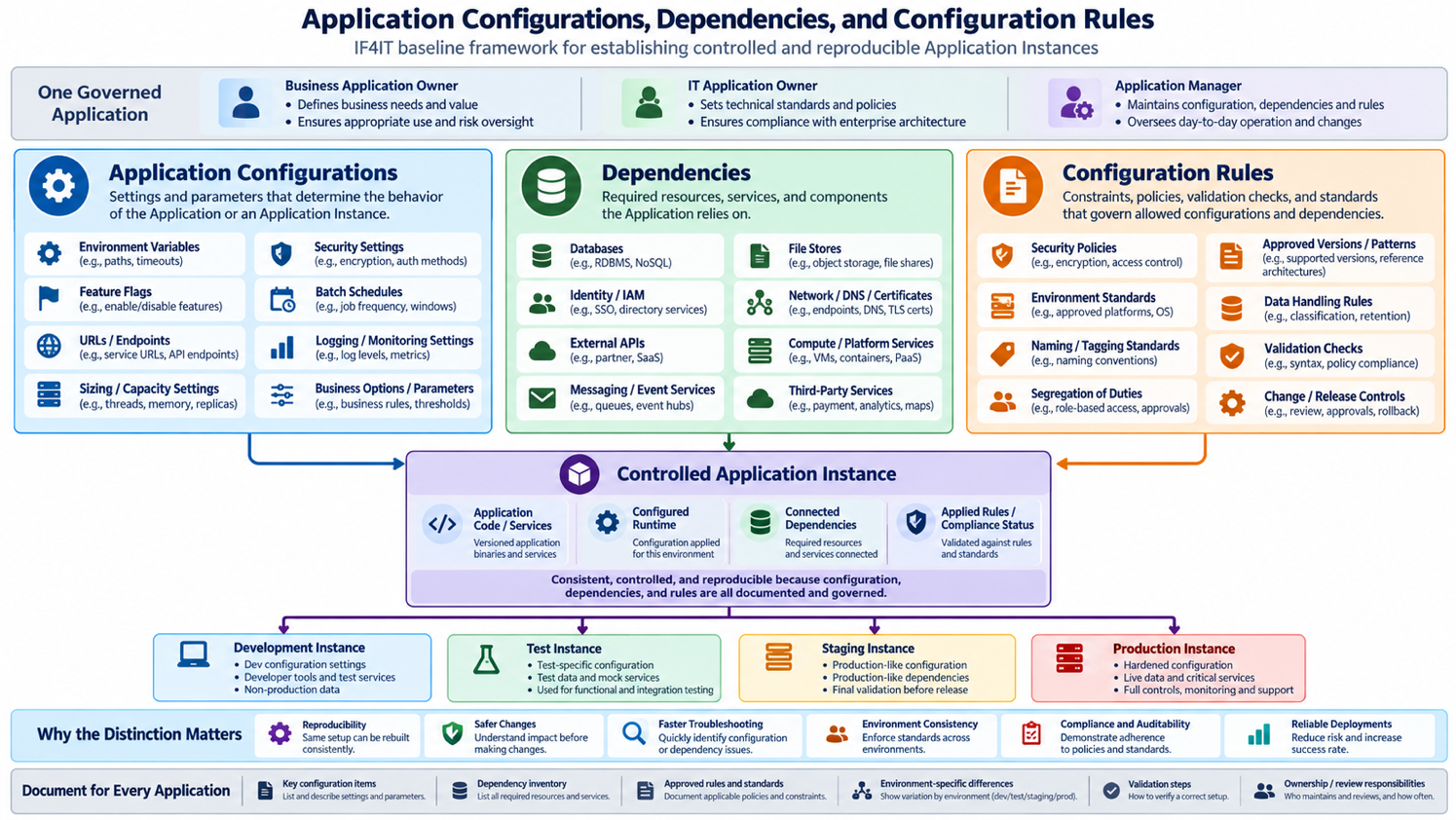
This chapter introduces a baseline framework for documenting three closely related aspects of every Application: its configurations, its dependencies, and the rules that govern how its configurations are managed.
Why a Framework Is Needed
Configurations, dependencies, and rules are among the most important and most poorly documented aspects of Applications. Configuration is scattered across files, consoles, pipelines, and databases. Dependencies are often discovered only when they fail. Rules, such as who may change a setting or how values are promoted between environments, often exist only as habit. A shared framework gives every Application team the same checklist of what to consider, and gives readers the same structure in every Application’s documentation.
The Three Parts of the Framework
Configurations are the settings that determine how an Application is built, packaged, deployed, and run, and how it behaves. The framework identifies fifteen configuration categories.
Dependencies are the things an Application relies on, inside and outside its boundary. The framework identifies twelve dependency types.
Rules govern how configurations are managed: where they live, who may change them, and how changes are controlled. Dependencies, by contrast, are governed through the tracking and review described in the dependency chapters. The framework identifies ten rule types.
The following chapters describe each part. Every configuration and dependency is documented as a baseline common to all Instances, plus the differences for each Instance, as described in the chapter “Establish and Document Application Instance–Specific Information Wherever Instances Differ.”
A Foundational Baseline, Not a Complete Enumeration
The framework is a foundational, suggested baseline that IF4IT recommends; it is not a complete enumeration. Enterprises can, and are encouraged to, rename, merge, split, and extend its categories and types to fit their Applications, technologies, and regulatory obligations. The chapter “Adapt the Configuration, Dependency, and Rules Framework to Your Enterprise” describes how, including how to use AI to help.
Best Practice: Adopt a Common Framework for Configurations, Dependencies, and Rules
Adopt a common framework, such as this baseline, for documenting every Application’s configurations, dependencies, and rules, adapt it deliberately to the enterprise, and require every Application to address each category and type, even if only to record that it does not apply.
Benefits: A common framework turns an Application’s most scattered and implicit knowledge into a predictable, checkable structure. Requiring each category to be addressed, even as “not applicable,” exposes the configuration and dependency knowledge most likely to have been overlooked before it causes an outage.
Connections to Related IF4IT Practices and Inventories
The Systems Development Lifecycle (SDLC) Best Practices addresses configuration, baseline, and technical-data management, and proving that the tested and approved configuration is the configuration deployed. The IT Operating Environments Best Practices addresses documenting configuration differences between environments.
How to cite this page
When referencing this page in academic work, internal standards, or external publications, include the page title, IF4IT as author and publisher (The International Foundation for Information Technology (IF4IT), LLC), the URL, and your access date.
Example (informal web citation):
The International Foundation for Information Technology (IF4IT), LLC. Understand the IF4IT Baseline Framework for Application Configurations, Dependencies, and Rules | Application Management Best Practices. https://if4it.org/best-practices/application-management-best-practices/understand-the-if4it-baseline-framework-for-application-configurations-dependencies-and-rules/ (accessed 2026-10-31).
See About Us for content governance and site-wide citation guidance.
Copyright for The International Foundation for Information Technology (IF4IT), LLC: 2008 - Present
Legal Disclaimers