What Is an Application Instance? - Application Management Best Practices
What Is an Application Instance?
(Chapter 4 of Application Management Best Practices)
Executive Summary: Chapter Overview
IF4ITThe Bottom Line
Core Concepts
| Concept | Definition & Strategic Role |
|---|---|
| Application Instance | A uniquely identifiable, configured, and deployed occurrence of an Application within a specific IT Operating Environment Instance that, when active, runs as one or more in-memory processes. It is the concrete counterpart to the single logical Application. |
| Per-Deployment Counting | Each separately deployed and configured occurrence of an Application is its own Instance, so two regional Production deployments are two Production Instances. Many identical scaled replicas of one deployment, however, together form a single Instance. |
| Inactive Instance | An Instance that is deployed but stopped, such as a cold Disaster Recovery standby, a paused Instance, or one that scales to zero when idle. It remains an Application Instance and must still be identified and documented. |
Quick Q&A
Question: Are scaled replicas or a stopped Disaster Recovery standby counted as Application Instances?
Question: What should be recorded about each Application Instance, and what does that make possible?
Read More Below
This chapter defines an Application Instance and explains how it differs from the Application itself.
Definition
An Application Instance is a uniquely identifiable, configured, and deployed occurrence of an Application within a specific IT Operating Environment Instance that, when active, is instantiated as one or more in-computer-memory processes that may interact with one another and with technical components outside the Application’s own boundary, including other Application Instances.
Understanding Application Instances
An Application is a single logical entity. An Application Instance is one concrete, deployed occurrence of it. A typical Application might have one Instance in each of five environments: development, Systems Integration Testing (SIT), User Acceptance Testing (UAT), Pre-Production Staging, and Production. That is one Application with five Application Instances.
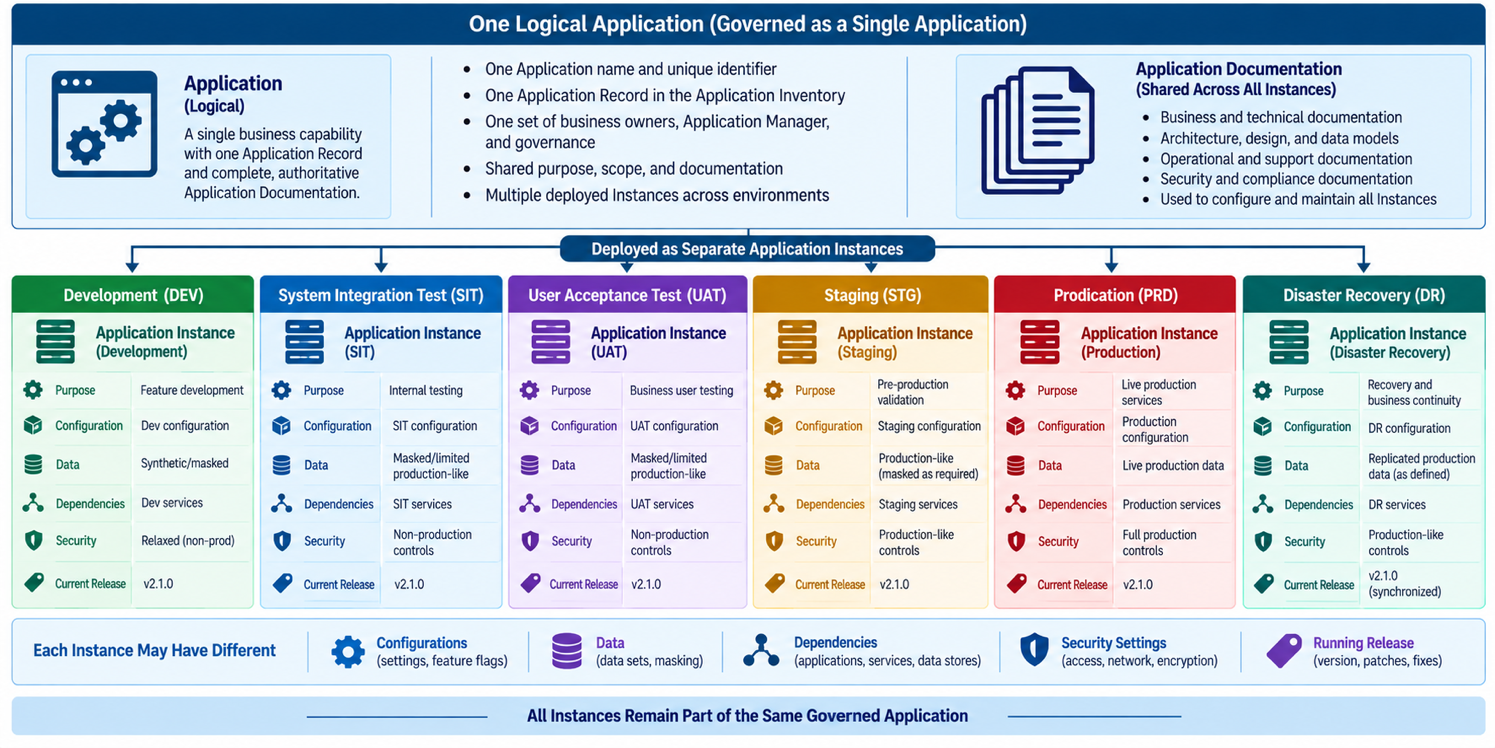
Several points clarify what counts as an Application Instance:
Instances are counted per deployment. Each separately deployed and configured occurrence of the Application is its own Instance. An enterprise that runs two separate Production deployments of the same Application, for example one per region, has two Production Instances.
Scaled replicas are not separate Instances. When a single deployment runs as many identical processes to handle load, those processes together make up one Instance, not many.
Inactive Instances are still Instances. An Instance that is deployed but stopped, such as a cold Disaster Recovery standby, a paused Instance, or one that scales to zero when idle, remains an Application Instance.
Instances differ. Instances of the same Application frequently differ in configuration, infrastructure, data, Integrations, security settings, and the Release they are running. Those differences are exactly what Application Documentation must capture, as later chapters explain.
Best Practice: Identify and Document Every Application Instance
For every Application, identify each of its Application Instances, the IT Operating Environment Instance each one runs in, and the Release each one is running, and document them in the Application Documentation. Later chapters describe how to name Instances consistently and how to document the ways in which Instances differ.
Benefits: Knowing exactly which Instances exist, where they run, and which Release each one is running lets operations staff find the right Instance during an incident, lets security teams confirm that a fix has reached every Instance, and prevents forgotten Instances from lingering unpatched and unmonitored.
Connections to Related IF4IT Practices and Inventories
The IT Operating Environments Best Practices defines IT Operating Environments and Environment Instances, the settings in which Application Instances are deployed. The Release Management Best Practices describes how Releases move through those environments.
How to cite this page
When referencing this page in academic work, internal standards, or external publications, include the page title, IF4IT as author and publisher (The International Foundation for Information Technology (IF4IT), LLC), the URL, and your access date.
Example (informal web citation):
The International Foundation for Information Technology (IF4IT), LLC. What Is an Application Instance? | Application Management Best Practices. https://if4it.org/best-practices/application-management-best-practices/what-is-an-application-instance/ (accessed 2026-10-30).
See About Us for content governance and site-wide citation guidance.
Copyright for The International Foundation for Information Technology (IF4IT), LLC: 2008 - Present
Legal Disclaimers