What Is Knowledge Debt, and How Does It Accumulate Around Applications? - Application Management Best Practices
What Is Knowledge Debt, and How Does It Accumulate Around Applications?
(Chapter 16 of Application Management Best Practices)
Executive Summary: Chapter Overview
IF4ITThe Bottom Line
Core Concepts
| Concept | Definition & Strategic Role |
|---|---|
| Knowledge Debt | The backlog of missing, hidden, fragmented, implicit, outdated, inconsistent, inaccessible, or poorly governed enterprise meaning and know-how that must eventually be remediated. Around Applications it compounds like financial debt, growing costlier to repay as the people and context needed disappear. |
| Knowledge Gap | A specific, identifiable piece of knowledge needed to understand, operate, support, change, or govern an Application that is missing, inaccessible, or unreliable. An undocumented procedure for recovering an Application’s nightly batch jobs after a failure is a typical example. |
| Knowledge Debt Item | A recorded entry in the enterprise’s inventory of Knowledge Debt that identifies one or more Knowledge Gaps, together with the information needed to govern their remediation, such as the affected Application, impact, owner, remediation plan, deadline, and status. |
| Knowledge Debt vs. Technical Debt | Technical Debt makes Systems harder, riskier, and costlier to change and operate, while Knowledge Debt makes enterprise meaning harder to discover, interpret, transfer, and use. A well-engineered but undocumented Application carries little Technical Debt yet substantial Knowledge Debt. |
Quick Q&A
Question: In what ways does Knowledge Debt accumulate around an Application?
Question: Does fixing an Application's Technical Debt also eliminate its Knowledge Debt?
Read More Below
This chapter defines Knowledge Debt and two related terms, Knowledge Gap and Knowledge Debt Item, and explains how Knowledge Debt accumulates around Applications.
Definitions
Knowledge Debt is the backlog of missing, hidden, fragmented, implicit, outdated, inconsistent, inaccessible, or poorly governed enterprise meaning and know-how that must eventually be remediated because it increases cost, risk, complexity, delay, misunderstanding, and poor decision-making.
A Knowledge Gap is a specific, identifiable piece of knowledge needed to understand, operate, support, change, or govern an Application that is missing, inaccessible, or unreliable.
A Knowledge Debt Item is a recorded entry in the enterprise’s inventory of Knowledge Debt that identifies one or more Knowledge Gaps, together with the information needed to govern their remediation, such as the affected Application, impact, owner, remediation plan, deadline, and status.
How the Three Terms Relate
Knowledge Gaps are the individual pieces of missing or unreliable knowledge. Knowledge Debt is their accumulated backlog. A Knowledge Debt Item is the governed record that makes one or more Knowledge Gaps visible and manageable. For example, the fact that no one has documented how an Application’s nightly batch jobs recover after a failure is a Knowledge Gap. Recording that gap, with its affected Application, its potential impact, an owner, and a deadline for closing it, creates a Knowledge Debt Item. All such gaps across the enterprise’s Applications, recorded or not, make up its Application-related Knowledge Debt.
Knowledge Debt vs. Technical Debt
Knowledge Debt is related to, but distinct from, Technical Debt. Technical Debt makes Systems harder, riskier, and more costly to change and operate. Knowledge Debt makes enterprise meaning harder to discover, interpret, validate, transfer, govern, and use. The two can overlap, since inadequate documentation may contribute to both, but they are not interchangeable, and fixing one does not fix the other. A well-engineered Application that no one has documented carries little Technical Debt but substantial Knowledge Debt.
How Knowledge Debt Accumulates Around Applications
Undocumented and under-documented Applications are among the largest sources of Knowledge Debt in most enterprises. Knowledge Debt accumulates around an Application in several ways:
Knowledge is never captured. Decisions, configurations, workarounds, and procedures exist only in the heads of the people who made them.
Knowledge is captured in scattered places. Pieces of the truth sit in emails, chat threads, personal notes, ticket comments, and individual file shares, where no one else can reliably find them.
Knowledge goes stale. Documentation written for an early Release is never updated, so it describes an Application that no longer exists.
Knowledge is concentrated in a few people. When only one or two people understand an Application, the enterprise’s knowledge of it is only as durable as their tenure.
Knowledge contradicts itself. Different documents, written at different times by different people, give conflicting answers.
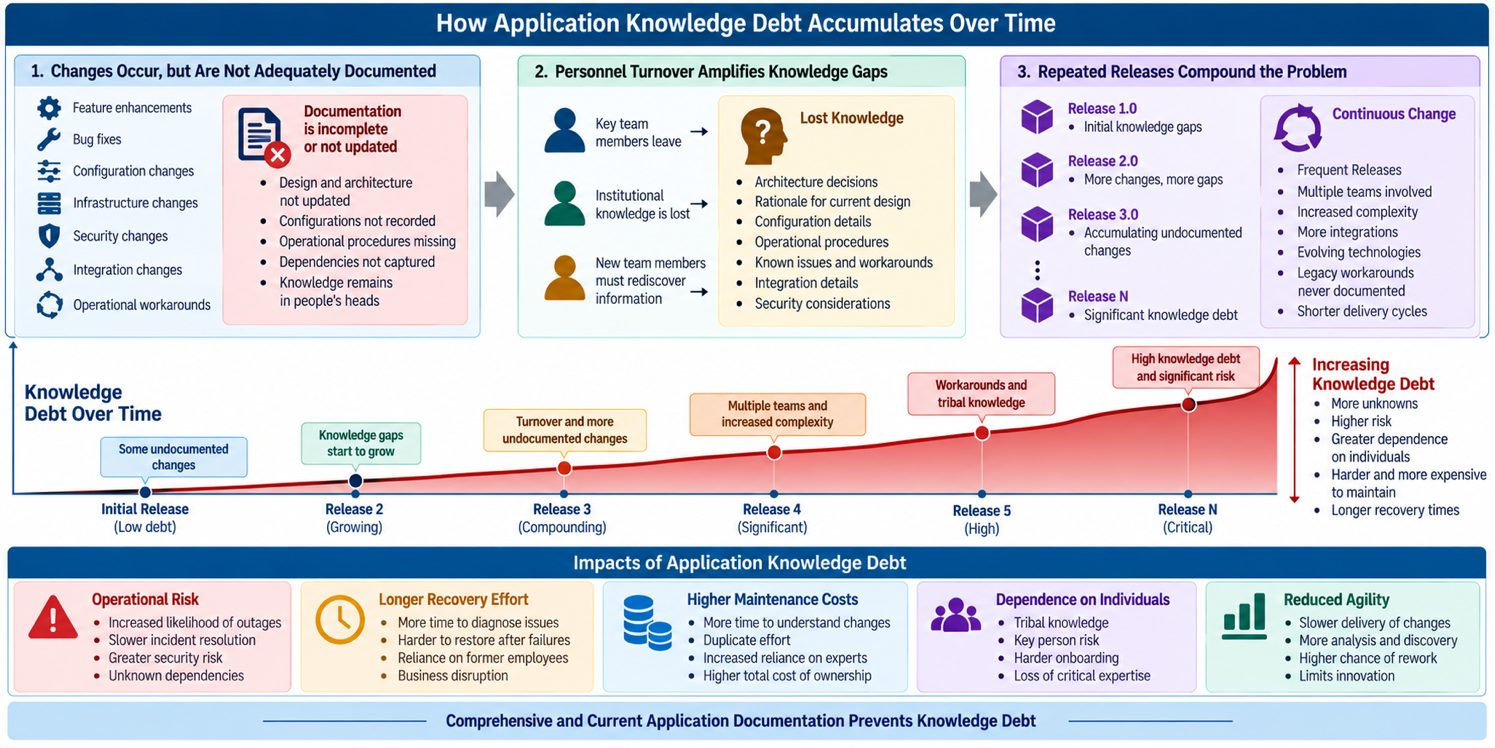
Each new Release that changes an Application without updating its documentation adds to the debt. Like financial debt, Knowledge Debt compounds: the longer it goes unpaid, the more expensive it becomes to repay, because the people and context needed to repay it disappear over time.
Best Practice: Make Application Knowledge Gaps Visible and Govern Them as Knowledge Debt Items
When an Application Knowledge Gap is discovered, record it as a Knowledge Debt Item with an owner, an impact, a remediation plan, and a deadline, rather than leaving it as an informal complaint. Prevent new gaps by tying documentation updates to every Release, as described in the chapter “Review and Correct Application Documentation with Every Release.”
Benefits: Recorded Knowledge Debt Items turn a vague sense that “nobody really understands this Application” into a specific, owned, and schedulable list of work. That lets leaders see the size of the problem, prioritize the gaps that carry the most risk, and confirm that they are actually being closed.
Connections to Related IF4IT Practices and Inventories
The IF4IT articles “AI Exposes the Knowledge Debt Enterprises Can No Longer Ignore” and “Making Legacy Data AI-Ready Is Knowledge Debt Remediation” explore Knowledge Debt across the enterprise. The Technical Debt Management Best Practices and the Technical Debt Inventory and Attributes address the related but distinct problem of Technical Debt.
How to cite this page
When referencing this page in academic work, internal standards, or external publications, include the page title, IF4IT as author and publisher (The International Foundation for Information Technology (IF4IT), LLC), the URL, and your access date.
Example (informal web citation):
The International Foundation for Information Technology (IF4IT), LLC. What Is Knowledge Debt, and How Does It Accumulate Around Applications? | Application Management Best Practices. https://if4it.org/best-practices/application-management-best-practices/what-is-knowledge-debt-and-how-does-it-accumulate-around-applications/ (accessed 2026-10-31).
See About Us for content governance and site-wide citation guidance.
Copyright for The International Foundation for Information Technology (IF4IT), LLC: 2008 - Present
Legal Disclaimers