Why AI Makes Application Documentation More Critical Than Ever - Application Management Best Practices
Why AI Makes Application Documentation More Critical Than Ever
(Chapter 20 of Application Management Best Practices)
Executive Summary: Chapter Overview
IF4ITThe Bottom Line
Core Concepts
| Concept | Definition & Strategic Role |
|---|---|
| AI Exposes Knowledge Debt | The observation that AI working inside an enterprise can only answer from the information available to it. Where Application knowledge was never documented, AI has nothing reliable to draw on, so missing documentation surfaces directly as unreliable AI answers and actions. |
| Confidently Wrong Answers at Scale | The danger that AI working from outdated or incorrect Application Documentation presents it as fact to many people at once, and may act on it if permitted. Unlike a person, it may not notice that something looks wrong and check with a colleague. |
| AI-Ready Application Documentation | Documentation that is complete, current, consistent, and structured well enough for both people and AI to use reliably. It lets AI answer questions that would otherwise require interrupting an expert, and lets AI agents perform routine work safely and consistently. |
| AI as a Documentation Contributor | Using AI to draft documentation from source code, configurations, and tickets, to identify gaps and inconsistencies, and to flag documentation that appears outdated after a change. It lowers maintenance effort, provided people remain accountable for the documentation’s accuracy. |
Quick Q&A
Question: Why is outdated Application Documentation often more dangerous than missing documentation once AI is involved?
Question: What happens to enterprises that apply AI to poorly documented Applications?
Read More Below
This chapter explains how the growing use of Artificial Intelligence (AI) raises the importance of Application Documentation, and why enterprises should therefore strive for the highest levels of documentation quality.
AI Depends on What the Enterprise Has Written Down
Enterprises increasingly use AI assistants and AI agents to answer questions, troubleshoot incidents, generate and review code, plan changes, and support users. To do this well inside a specific enterprise, AI must draw on that enterprise’s own knowledge: its Applications, their configurations, their dependencies, their data, their procedures, and their history. Much of that knowledge can only come from documentation.
AI cannot use knowledge that was never written down. An AI agent asked how to recover an Application, which systems a change will affect, or which Application holds a particular kind of regulated data can only answer from the information available to it. Where that information is missing, the AI has nothing reliable to work from. AI does not create Knowledge Debt; it exposes it.
Why Poor Documentation Is More Dangerous with AI
Missing documentation is a problem; outdated or incorrect documentation is often a worse one when AI is involved. A person reading an old document may notice that something looks wrong and check with a colleague. An AI working from the same document may confidently present outdated or incorrect information as fact, to many people at once, and may act on it if it is permitted to take actions. Gaps and errors in documentation can therefore produce confidently wrong answers at scale.
At the same time, AI amplifies the value of good documentation. Complete, current, well-structured Application Documentation lets AI instantly answer questions that would otherwise require finding and interrupting an expert, and lets AI agents perform routine work safely and consistently.
AI Can Also Help Create and Maintain Documentation
AI is not only a consumer of Application Documentation; it can also help produce it, for example by drafting documentation from source code, configurations, and tickets, by identifying gaps and inconsistencies, and by flagging documentation that appears outdated after a change. Used this way, AI can lower the effort of keeping documentation complete and current, provided that people remain accountable for its accuracy. The chapter “Use AI to Help Document Applications — With Human Review and Guardrails” describes how.
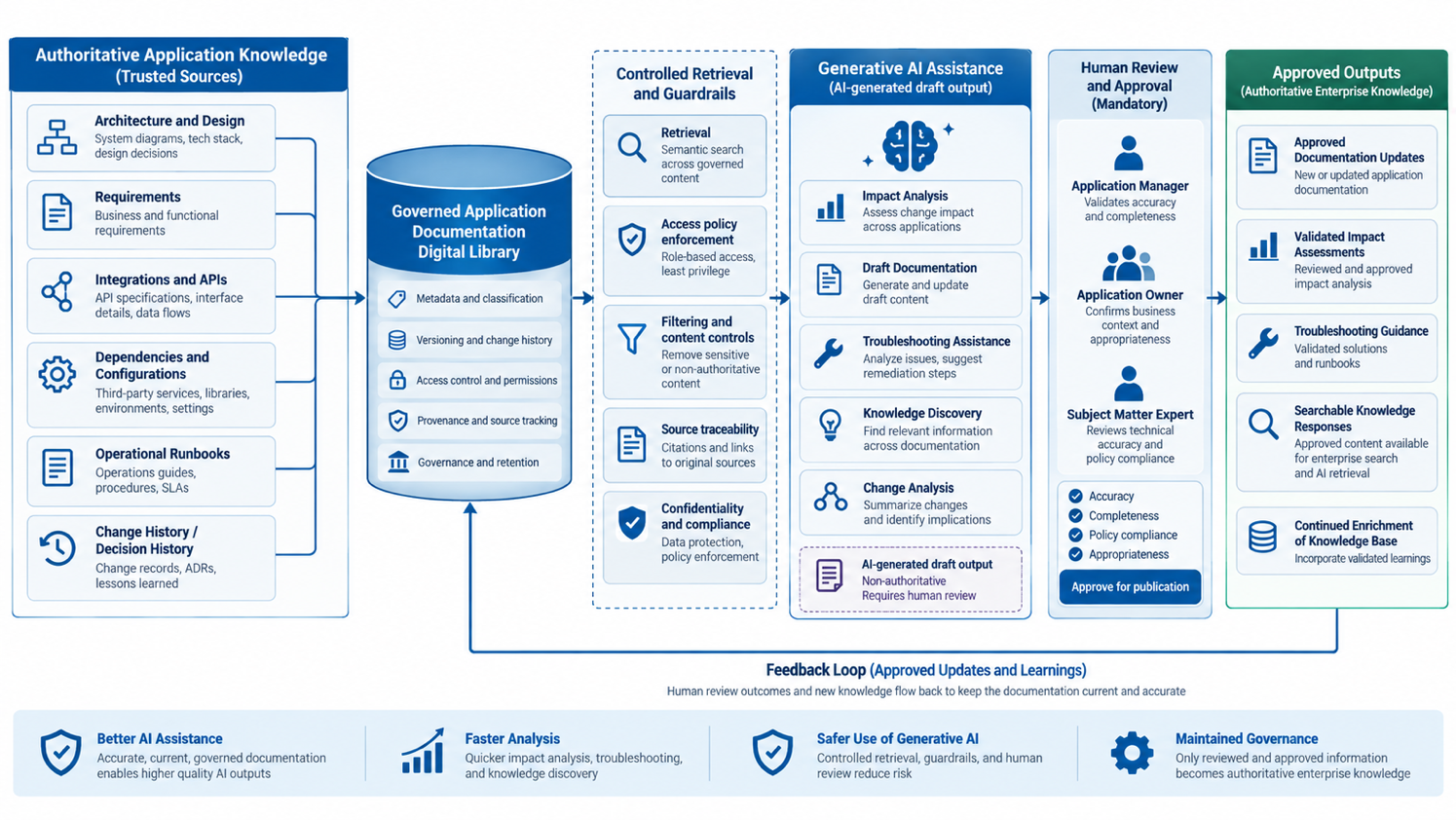
Best Practice: Strive for the Highest Level of Application Documentation, Because AI Will Rely on It
Set documentation expectations with AI in mind: aim for documentation that is complete, current, consistent, and structured well enough for both people and AI to use reliably, and treat outdated documentation as a risk to be corrected promptly rather than a harmless historical record.
Benefits: Enterprises that document their Applications well can apply AI to them safely and productively, gaining faster answers, faster troubleshooting, and safer automation. Enterprises that do not will find that their AI investments underdeliver, or worse, spread confident errors, because AI can only be as reliable as the knowledge it is given.
Connections to Related IF4IT Practices and Inventories
The Enterprise AI Governance Best Practices addresses how the enterprise governs its use of AI. The Best Practices for Making Legacy Data Semantic and AI-Ready addresses how existing enterprise data and knowledge can be prepared for use by AI. The AI Agents Inventory and Attributes describes how AI agents, which may themselves rely on Application Documentation, are recorded.
How to cite this page
When referencing this page in academic work, internal standards, or external publications, include the page title, IF4IT as author and publisher (The International Foundation for Information Technology (IF4IT), LLC), the URL, and your access date.
Example (informal web citation):
The International Foundation for Information Technology (IF4IT), LLC. Why AI Makes Application Documentation More Critical Than Ever | Application Management Best Practices. https://if4it.org/best-practices/application-management-best-practices/why-ai-makes-application-documentation-more-critical-than-ever/ (accessed 2026-10-31).
See About Us for content governance and site-wide citation guidance.
Copyright for The International Foundation for Information Technology (IF4IT), LLC: 2008 - Present
Legal Disclaimers