Why Missing, Poor, or Outdated Application Documentation Is a Critical Enterprise Risk - Application Management Best Practices
Why Missing, Poor, or Outdated Application Documentation Is a Critical Enterprise Risk
(Chapter 15 of Application Management Best Practices)
Executive Summary: Chapter Overview
IF4ITThe Bottom Line
Core Concepts
| Concept | Definition & Strategic Role |
|---|---|
| Documentation as Enterprise Risk | The position that the absence, poor quality, or staleness of Application Documentation exposes the enterprise to outages, failed recoveries, audit findings, and costly change. Framing it this way moves documentation out of optional paperwork and into the enterprise’s risk conversation. |
| Shared Leadership Accountability | The principle that business and IT leadership together hold the highest accountability for Application Documentation. Neither side should allow an Application into Production without complete and vetted documentation, because tolerating undocumented Applications accepts risk by default. |
| No Documentation, No Production Deployment | The enterprise policy that missing or incomplete documentation blocks an Application’s Production Deployment. It turns the shared leadership accountability described here into an enforceable gate rather than an aspiration that schedules can quietly override. |
Quick Q&A
Question: What specific business harms result from missing, poor, or outdated Application Documentation?
Question: Why should documentation gaps be recorded in enterprise risk management processes instead of being left to individual teams?
Read More Below
This chapter explains why the absence, poor quality, or staleness of Application Documentation should be treated as a critical enterprise risk, and who is ultimately accountable for that risk.
Documentation Is a Matter of Enterprise Risk
Documentation is primarily a matter of enterprise risk and secondarily a matter of IT housekeeping and Knowledge Management, and the highest form of accountability for documentation sits with both business and IT leadership.
That statement runs against a common habit. In many enterprises, Application Documentation is treated as optional paperwork: something a team produces if time allows, after the “real” work of building and deploying is finished. Because it is treated as optional, it is often the first thing quietly sacrificed when schedules tighten, and its absence is rarely reported to the business leaders or the Risk and Compliance organizations that would care most about it.
The consequences, however, are not optional. An enterprise that cannot quickly and reliably answer basic questions about an Application it depends on is exposed in every situation where those answers suddenly matter.
How Documentation Gaps Turn into Business Harm
Missing, poor, or outdated Application Documentation causes harm in predictable ways:
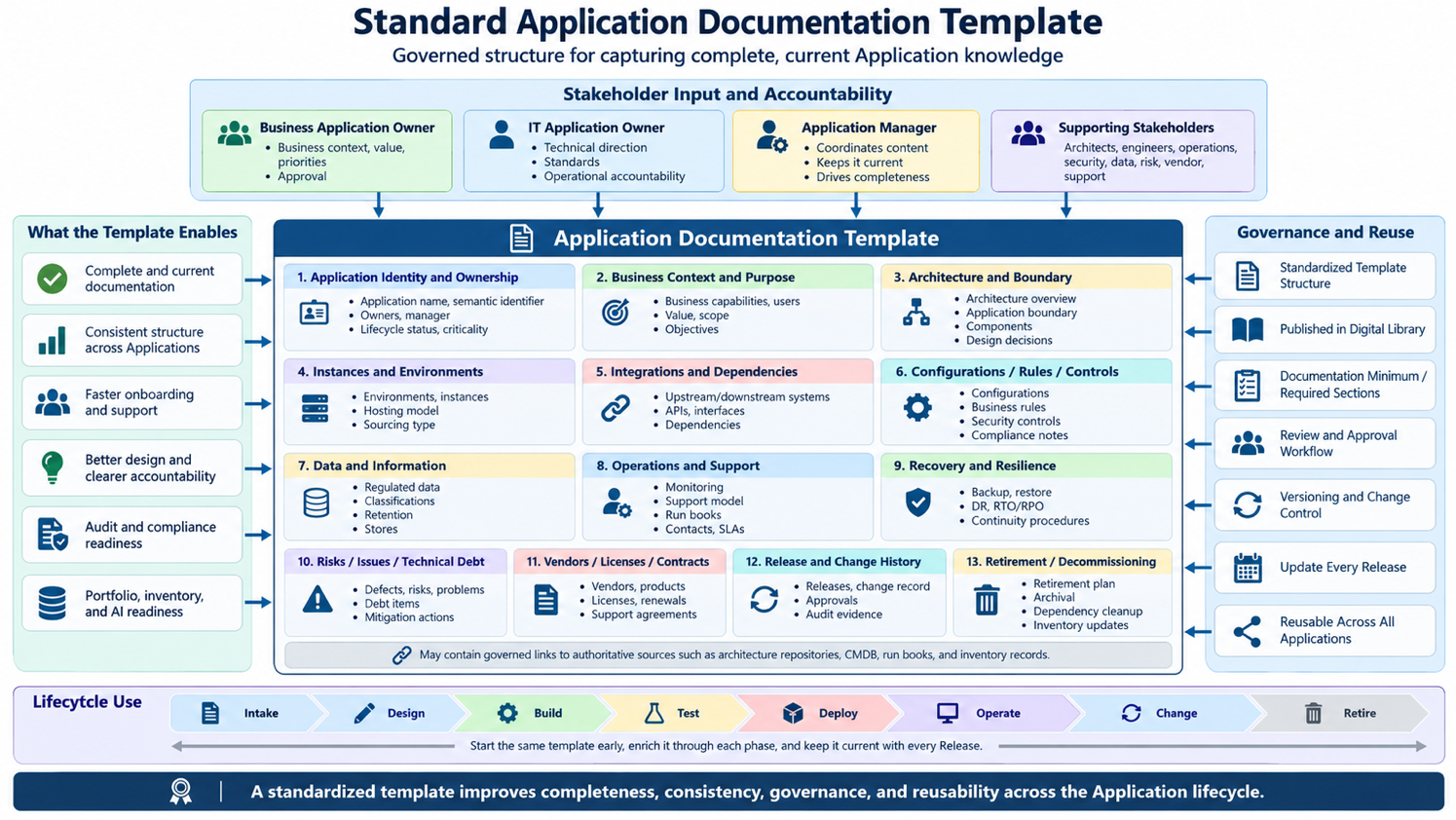
Longer and more damaging outages. When an Application fails, support teams that lack current runbooks, dependency maps, configuration details, and escalation contacts spend the first hours of an incident rediscovering what should have been written down. Every one of those hours extends the business impact.
Failed recoveries. Backup and restore procedures and Disaster Recovery procedures that are missing, untested, or out of date often fail exactly when the enterprise needs them most.
Security and compliance exposure. An enterprise cannot protect data it does not know an Application holds, cannot rotate credentials it does not know exist, and cannot show auditors or regulators evidence of controls that were never recorded.
Costly and risky change. Engineers who cannot see an Application’s Integrations, dependencies, configurations, and rules make changes that break things they did not know were connected.
Slow, expensive replacement and retirement. When an Application must be replaced, migrated, or retired, undocumented behavior, data, and dependencies must be reverse-engineered under time pressure, often after the people who understood them have left.
Wasted time every day. Without documentation, routine questions, such as who owns an Application, which environment it runs in, or whom to call about it, send people hunting for the one person who knows, interrupting that person’s work as well as their own.
None of these harms is primarily an IT problem. Each one affects revenue, customers, regulatory standing, or the enterprise’s ability to change. That is why documentation belongs in the enterprise’s risk conversation, not only in IT’s housekeeping.
Why Accountability Sits with Business and IT Leadership Together
Because the harm is to the enterprise, accountability for preventing it must sit at the level that answers for the enterprise. No business leader should allow IT to deploy an Application into the business’s Production environment without complete and vetted documentation, and no IT leader should allow any Application into Production without it either. When either side tolerates undocumented Applications, the risk is accepted by default, without anyone having consciously decided to accept it.
This is the reasoning behind the enterprise policy described later in this document: no documentation, or incomplete documentation, means no Production Deployment. The chapters “What Is a Minimum Application Documentation Policy?” and “Make Business and IT Leadership Accountable for Application Documentation” describe that policy and its accountability in detail.
Best Practice: Treat Documentation Gaps as Enterprise Risks, Not as IT Housekeeping
Treat missing, incomplete, or outdated Application Documentation as an enterprise risk: make it visible to business and IT leadership, record known gaps in the enterprise’s risk management processes, and require that they be closed rather than silently tolerated. The chapter “Record Application Documentation Gaps in the Enterprise Risk Register” describes how.
Benefits: Framing documentation gaps as enterprise risks moves the decision to tolerate them from individual teams, who bear little of the consequence, to leaders who answer for the enterprise as a whole. Gaps that are visible to leadership get funded and fixed; gaps that are hidden accumulate until an outage, audit, or breach exposes them at the worst possible time.
Connections to Related IF4IT Practices and Inventories
The Application Portfolio Management (APM) Best Practices addresses how application risk, including security, compliance, vendor, and operational risk, is assessed across the portfolio. The Service Management Best Practices addresses the incident and recovery processes that depend on accurate Application Documentation.
How to cite this page
When referencing this page in academic work, internal standards, or external publications, include the page title, IF4IT as author and publisher (The International Foundation for Information Technology (IF4IT), LLC), the URL, and your access date.
Example (informal web citation):
The International Foundation for Information Technology (IF4IT), LLC. Why Missing, Poor, or Outdated Application Documentation Is a Critical Enterprise Risk | Application Management Best Practices. https://if4it.org/best-practices/application-management-best-practices/why-missing-poor-or-outdated-application-documentation-is-a-critical-enterprise-risk/ (accessed 2026-10-31).
See About Us for content governance and site-wide citation guidance.
Copyright for The International Foundation for Information Technology (IF4IT), LLC: 2008 - Present
Legal Disclaimers