Allocate application costs to the business capabilities and units they serve - Application Portfolio Management (APM) Best Practices
Allocate application costs to the business capabilities and units they serve
(Chapter 93 of Application Portfolio Management (APM) Best Practices)
Executive Summary: Chapter Overview
IF4ITThe Bottom Line
Core Concepts
| Concept | Definition & Strategic Role |
|---|---|
| Cost Allocation | The mechanism by which application costs are attributed to the business capabilities and organizational units that consume them — using the Application-to-Capability mapping and defined allocation methods for shared applications. |
| Business Cost Visibility | The outcome of cost allocation — business leaders can see what their capabilities cost and can make informed decisions about consumption, investment, and rationalization based on business cost-benefit rather than opaque IT charge-backs. |
Quick Q&A
Question: Why allocate application costs rather than reporting them in IT aggregate?
Question: How are shared applications allocated?
Read More Below
Overview
Technology costs managed as a centralized IT overhead without allocation to the business capabilities and organizational units they serve create persistent governance problems that undermine both portfolio quality and business-IT relationships. Business leaders do not understand the true cost of the technology that supports their operations, creating neither the financial accountability nor the informed demand management that rational technology investment requires. IT investment prioritization is disconnected from business priority because the cost of serving different business capabilities is invisible. Technology cost reduction opportunities are missed because the business impact of cost reduction is unknown when costs are not allocated to the business outcomes they enable.
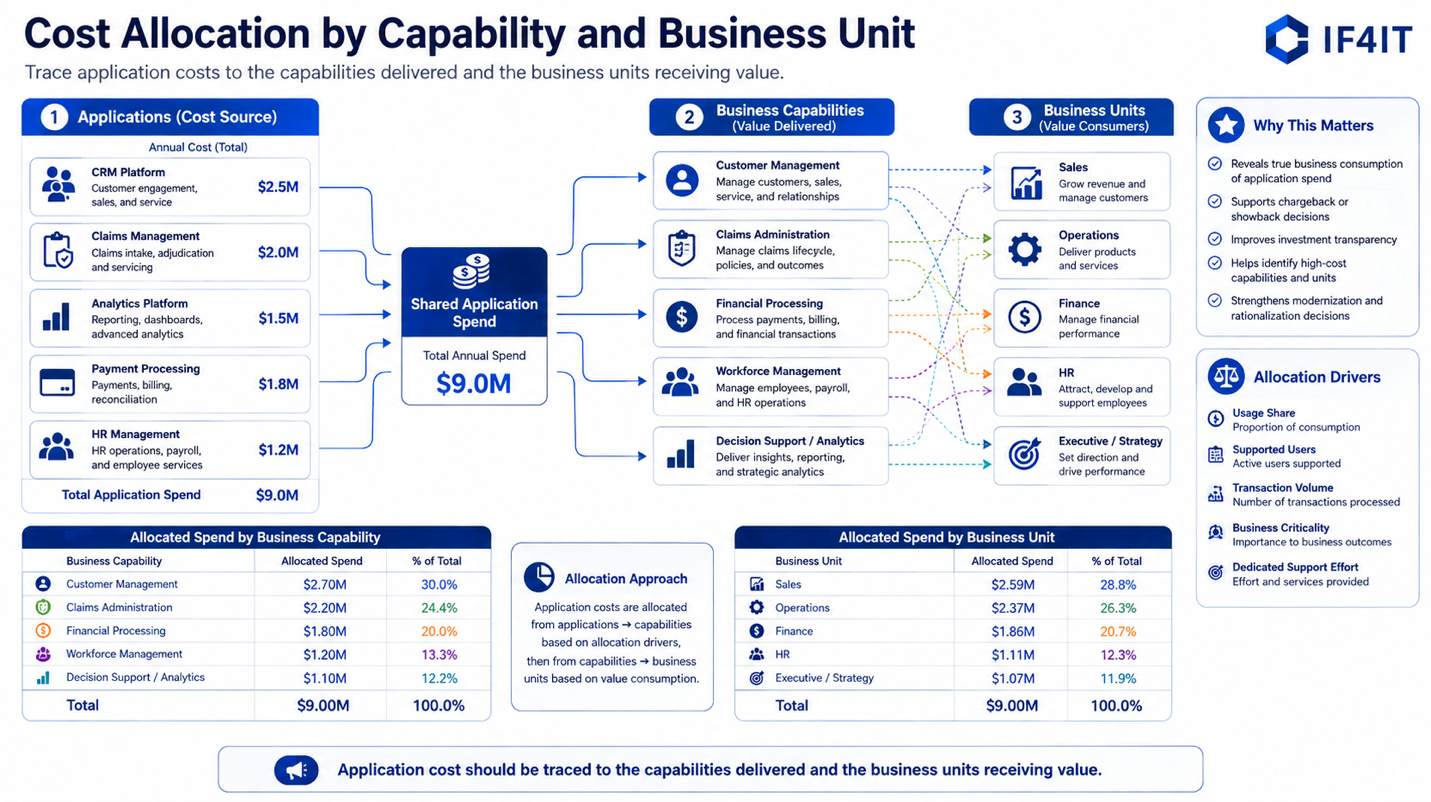
Best Practice
Allocate the cost of every application in the portfolio to the business capabilities and organizational units it serves. Use the business capability mapping established in the Application Portfolio Data and Inventory subsection as the allocation framework. Where an application serves multiple capabilities or business units, allocate its cost proportionally based on the best available proxy for usage, value contribution, or user population. Present the allocated cost view to business unit leadership alongside the total technology cost view - business leaders who can see the technology cost attributed to their capabilities are better positioned to make informed, responsible decisions about technology investment, rationalization, and right-sizing.
Benefit(s)
Cost allocation to business capabilities and organizational units creates the financial accountability that drives rational technology demand and informed investment. Business leaders make more considered requests for technology investment when they can see the current cost of the technology serving their capabilities and understand what they are already spending. Cost reduction opportunities are identified by business leaders who have both the cost visibility and the incentive to optimize their technology spend. The relationship between IT and business leadership improves when technology costs are transparent and business-attributed rather than opaque and centrally absorbed in a way that makes the cost invisible to those who drive the demand.
How to cite this page
When referencing this page in academic work, internal standards, or external publications, include the page title, IF4IT as author and publisher (The International Foundation for Information Technology (IF4IT), LLC), the URL, and your access date.
Example (informal web citation):
The International Foundation for Information Technology (IF4IT), LLC. Allocate application costs to the business capabilities and units they serve | Application Portfolio Management (APM) Best Practices. https://if4it.org/best-practices/application-portfolio-management-apm/allocate-application-costs-to-the-business-capabilities-and-units-they-serve/ (accessed 2026-10-22).
See About Us for content governance and site-wide citation guidance.
Copyright for The International Foundation for Information Technology (IF4IT), LLC: 2008 - Present
Legal Disclaimers