Assess Application Resilience and Recoverability - Business Impact Analysis, RTO, RPO, and Disaster Recovery Readiness - Application Portfolio Management (APM) Best Practices
Assess Application Resilience and Recoverability - Business Impact Analysis, RTO, RPO, and Disaster Recovery Readiness
(Chapter 88 of Application Portfolio Management (APM) Best Practices)
Executive Summary: Chapter Overview
IF4ITThe Bottom Line
Core Concepts
| Concept | Definition & Strategic Role |
|---|---|
| Business Impact Analysis (BIA) | A structured assessment of the operational, financial, and reputational consequences if a given application becomes unavailable, used to determine how much resilience investment the application actually warrants. |
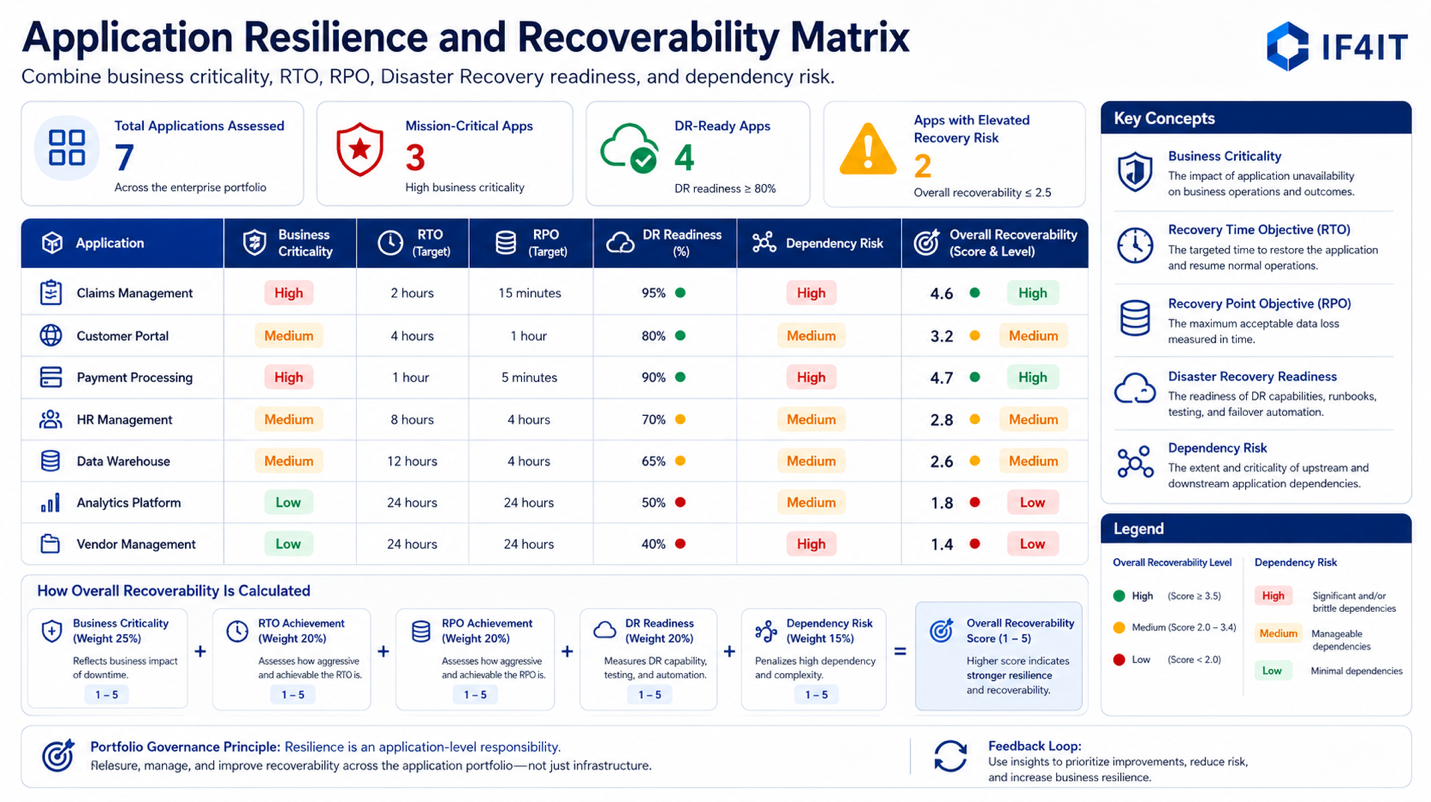
| RTO and RPO | RTO is the maximum acceptable time an application can be unavailable before the business impact becomes unacceptable; RPO is the maximum acceptable amount of data loss, measured in time, if the application must be restored from backup. Together they define what “recovered” actually means for a given application. |
| Maturity-Staged Resilience Capture | The progression from capturing BIA and target RTO/RPO for only the most critical applications using existing knowledge (Crawl), to extending capture across the full portfolio and tracking actual backup posture against target (Walk), to continuously validating recovery capability through regular testing (Run). |
Quick Q&A
Question: Why does resilience assessment need to be distinct from business value or technical fitness assessment?
Question: What should be captured for every application?
Question: How does this connect to APM’s use for business continuity and disaster recovery planning?
Read More Below
Overview
Technical fitness and business value assessment tell an organization whether an application is well-built and worth investing in — but neither answers how quickly the organization needs it back after a disruption, or how much data loss it can tolerate if it fails. Applications treated as equally resilient by default, without an explicit Business Impact Analysis, routinely turn out to have actual recovery capability that is badly mismatched to their true business criticality — some over-invested in resilience they do not need, others critically under-protected.
Best Practice
Capture a Business Impact Analysis for every application whose unavailability would carry meaningful operational, financial, regulatory, or reputational consequence, documenting the specific impact of unavailability rather than a generic criticality label. Define a target Recovery Time Objective and Recovery Point Objective for each application based on that BIA, not on default assumptions or infrastructure convenience.
Record current backup, redundancy, and failover posture, and track whether recovery capability has actually been tested against the target RTO and RPO — an untested recovery plan should be treated as an assumption, not a fact, until it is exercised. Use this data as the evidentiary basis for enterprise business continuity and disaster recovery planning: which applications and their dependencies must recover together, in what sequence, and where actual capability currently falls short of the target.
Best Practice: Advance Maturity Deliberately
| Stage | What This Looks Like |
|---|---|
| Crawl | Capture BIA findings and target RTO/RPO for the organization’s most critical applications only, using existing knowledge rather than a formal BIA exercise for every application. |
| Walk | Extend BIA, RTO, and RPO capture across the full portfolio, and begin tracking actual backup and redundancy posture against the target for each application. |
| Run | Continuously validate recovery capability through regular testing, and use portfolio-wide BIA/RTO/RPO data as a standing input to BCDR planning and resilience investment prioritization. |
Benefit(s)
Explicit BIA, RTO, and RPO capture ensures resilience investment is allocated according to actual business consequence rather than assumption or infrastructure convenience — critical applications receive the recovery capability they require, and non-critical applications are not over-invested in unnecessary redundancy. Testing recovery capability against target RTO/RPO, rather than assuming it works, surfaces gaps before a real disruption does. And because this data captures both the impact of unavailability and the current recovery posture, it becomes one of the most valuable inputs available for enterprise business continuity and disaster recovery planning — eliminating the need to reconstruct this picture from scratch during an actual crisis or exercise.
How to cite this page
When referencing this page in academic work, internal standards, or external publications, include the page title, IF4IT as author and publisher (The International Foundation for Information Technology (IF4IT), LLC), the URL, and your access date.
Example (informal web citation):
The International Foundation for Information Technology (IF4IT), LLC. Assess Application Resilience and Recoverability - Business Impact Analysis, RTO, RPO, and Disaster Recovery Readiness | Application Portfolio Management (APM) Best Practices. https://if4it.org/best-practices/application-portfolio-management-apm/assess-application-resilience-and-recoverability-business-impact-analysis-rto-rpo-and-disaster-recovery-readiness/ (accessed 2026-10-22).
See About Us for content governance and site-wide citation guidance.
Copyright for The International Foundation for Information Technology (IF4IT), LLC: 2008 - Present
Legal Disclaimers