Assess every application on business value and technical fitness as distinct dimensions - Application Portfolio Management (APM) Best Practices
Assess every application on business value and technical fitness as distinct dimensions
(Chapter 68 of Application Portfolio Management (APM) Best Practices)
Executive Summary: Chapter Overview
IF4ITThe Bottom Line
Core Concepts
| Concept | Definition & Strategic Role |
|---|---|
| Business Value Dimension | The assessment of an application’s contribution to business capability, strategic alignment, and user impact — independent of the application’s technical state. |
| Technical Fitness Dimension | The assessment of an application’s technical state — architecture, technology currency, operational stability, security posture, and modernization readiness — independent of its business value. |
Quick Q&A
Question: Why not combine business value and technical fitness into a single overall score?
Question: What does each combination imply for portfolio action?
Question: Do architectural conformance and functional fit count as additional assessment dimensions beyond business value and technical fitness?
Read More Below
Overview
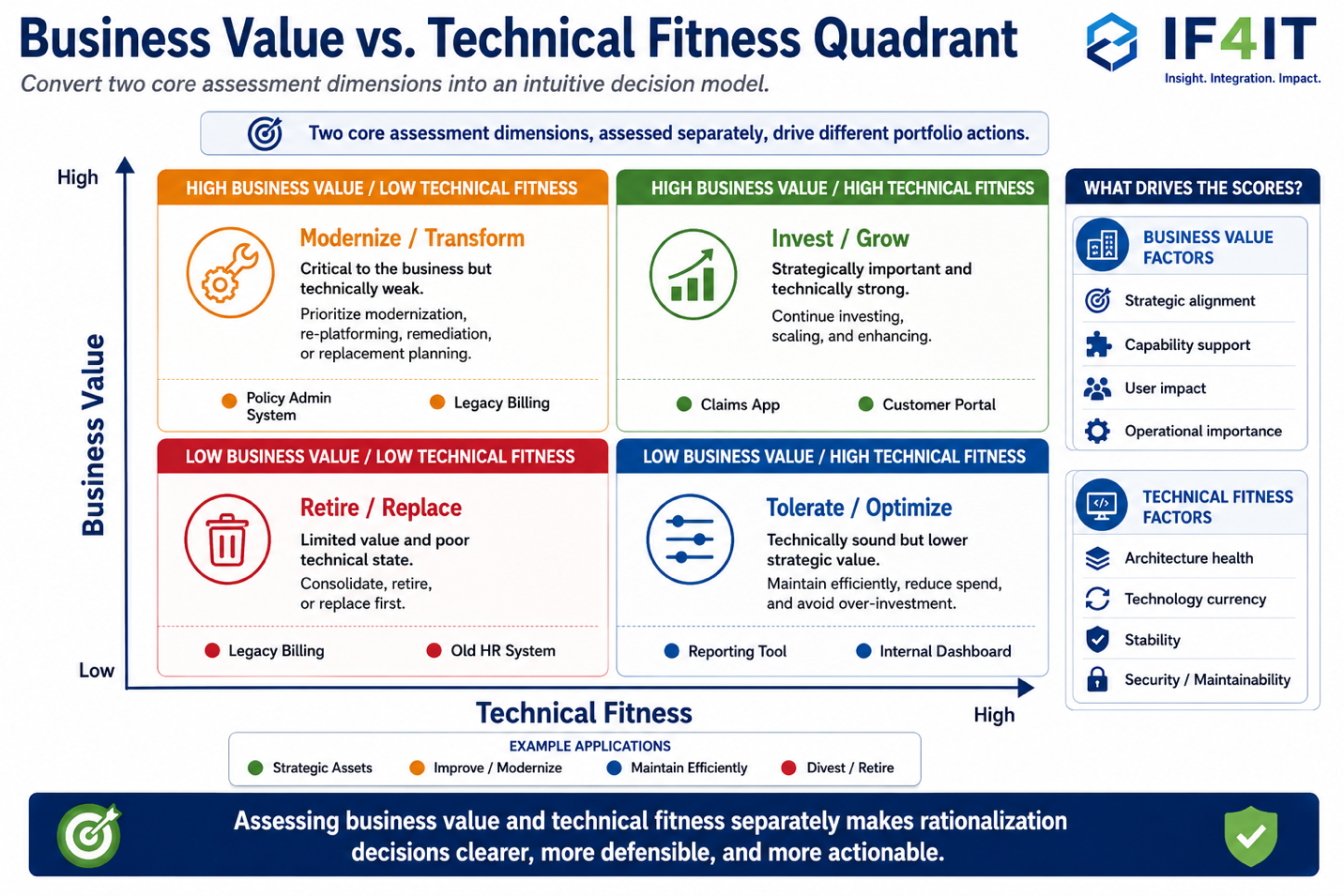
The most common single-dimensional assessment approach - assessing applications only on their technical quality - produces rationalization recommendations that are technically logical but organizationally inappropriate. A technically obsolete application that supports a critical, high-volume business process is not a straightforward retirement candidate - its business importance must be the primary consideration in the rationalization decision. A technically excellent application that supports a deprecated business capability is not a straightforward investment candidate regardless of how well it is built. Business value and technical fitness are two distinct dimensions that must be assessed independently and combined thoughtfully to produce sound portfolio recommendations.
Best Practice
Assess every application on two primary dimensions and treat each as independent until they are combined in the rationalization matrix. Business value assessment addresses how important the application is to the organization: does it support a current and critical business capability? Does it have a significant user base that depends on it? Would its absence materially affect business operations or customer experience? Is it a source of competitive differentiation or merely operational necessity? Technical fitness assessment addresses how well the application is built and maintained: is it running on current, supported technology? What is the extent and cost of its technical debt? Is it secure, compliant, and maintainable by the current team? Can it be evolved to meet foreseeable future requirements without prohibitive investment?
Another useful lens within technical fitness assessment is architectural conformance — whether the application adheres to the organization’s current architectural standards and patterns, or whether it represents a legacy or exception-based architecture that increases integration friction and maintenance cost. An application can be technically fit in isolation (well-built, low technical debt) while still being architecturally non-conformant in a way that makes it harder to integrate with the rest of the portfolio.
A related but distinct question worth asking during technical fitness assessment is functional fit — whether the application still does the right thing for the business, not just whether it is well-built. An application can score well on technical fitness (current technology, low technical debt, strong security posture) while being functionally stale — built for a business process that has since changed, missing capabilities the business now needs, or requiring extensive manual workarounds to serve its current purpose. Treat a functional fit gap as a signal to examine the business value assessment more closely, not as a reason to introduce a third independent scoring dimension — a functionally stale application usually surfaces as declining business value on its own, once the assessment looks past superficial usage continuity to what the application actually delivers today.
Benefit(s)
Assessing business value and technical fitness as distinct dimensions produces assessment results that are both technically sound and organizationally sensible. High-business-value applications with poor technical fitness are identified as modernization or migration priorities rather than retirement candidates. Low-business-value applications with good technical fitness are identified as rationalization candidates rather than investment priorities. The assessment produces a nuanced, actionable portfolio map that reflects the full complexity of the rationalization challenge rather than collapsing it into a single dimension that misses most of the relevant information.
How to cite this page
When referencing this page in academic work, internal standards, or external publications, include the page title, IF4IT as author and publisher (The International Foundation for Information Technology (IF4IT), LLC), the URL, and your access date.
Example (informal web citation):
The International Foundation for Information Technology (IF4IT), LLC. Assess every application on business value and technical fitness as distinct dimensions | Application Portfolio Management (APM) Best Practices. https://if4it.org/best-practices/application-portfolio-management-apm/assess-every-application-on-business-value-and-technical-fitness-as-distinct-dimensions/ (accessed 2026-10-22).
See About Us for content governance and site-wide citation guidance.
Copyright for The International Foundation for Information Technology (IF4IT), LLC: 2008 - Present
Legal Disclaimers