Assess the security posture of every application in the portfolio - Application Portfolio Management (APM) Best Practices
Assess the security posture of every application in the portfolio
(Chapter 80 of Application Portfolio Management (APM) Best Practices)
Executive Summary: Chapter Overview
IF4ITThe Bottom Line
Core Concepts
| Concept | Definition & Strategic Role |
|---|---|
| Portfolio-Level Security Posture | The aggregate view of application security posture across the portfolio — concentration of high-risk applications, coverage gaps in security assessment, remediation status across the portfolio, and trends over time. |
| Security as APM Attribute | The treatment of security posture as an attribute of the Applications Inventory record — populated from security team assessments — rather than as data that lives only in security systems and cannot be seen from portfolio analysis. |
Quick Q&A
Question: What portfolio-level questions require security posture as an inventory attribute?
Question: How does APM incorporate security data without duplicating the security team's work?
Read More Below
Overview
The security posture of the application portfolio is one of the most significant and most poorly governed dimensions of enterprise cybersecurity risk. Individual applications are assessed during procurement and initial deployment, but their security posture is rarely reassessed systematically as the portfolio evolves. Applications that were secure at deployment become security liabilities as their technology ages, their patches fall behind, their access controls drift from their intended configuration, and new vulnerabilities emerge in their underlying components. Without portfolio-level security posture assessment, this accumulated risk is invisible until it materializes through an incident or an audit finding.
Best Practice
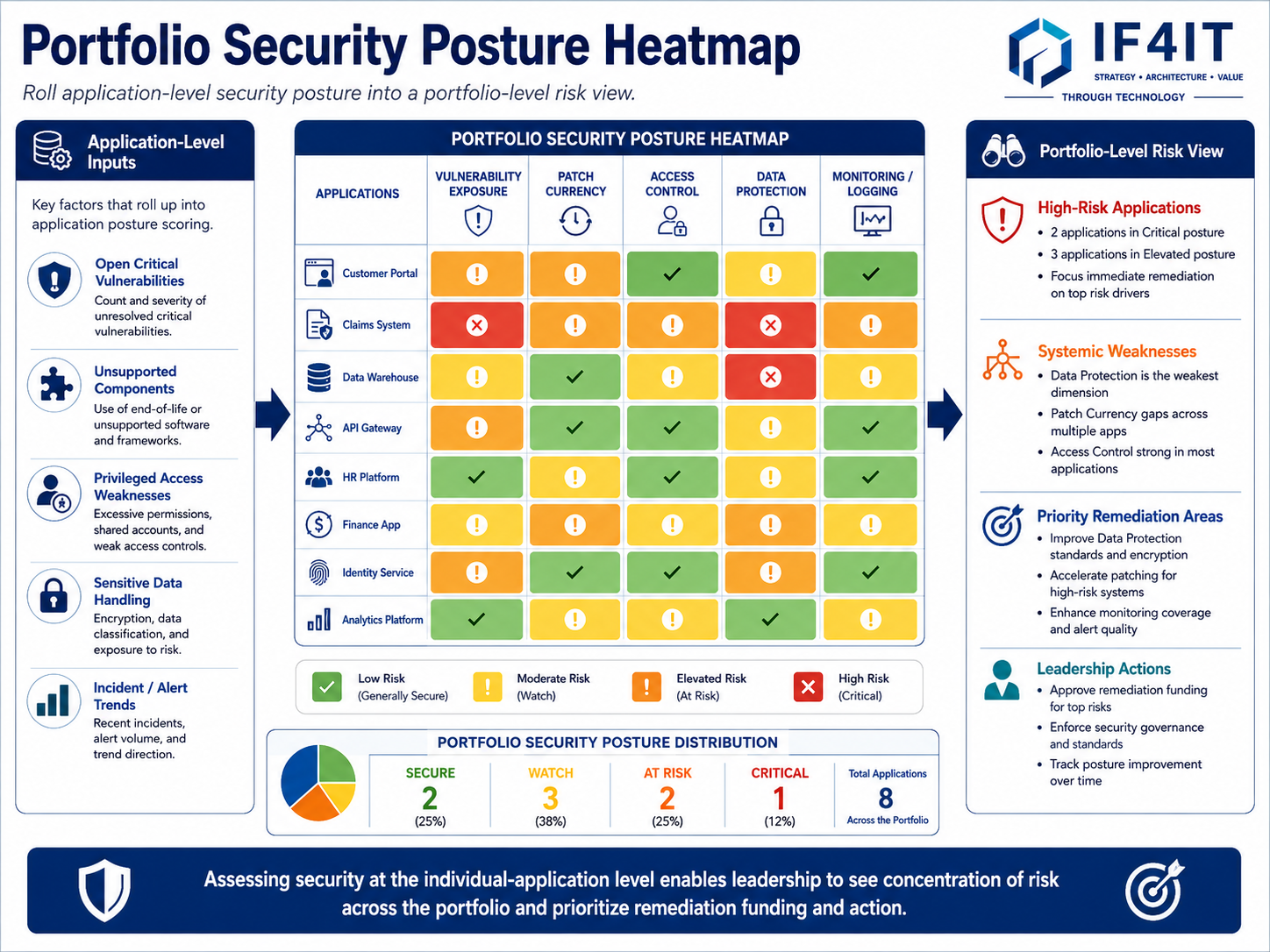
Conduct a security posture assessment for every application in the portfolio on a defined cadence - at minimum annually, and more frequently for applications that handle sensitive or regulated data, customer-facing applications, and applications running on aging technology. The assessment should cover: the currency and patch status of the application’s underlying technology stack; known vulnerabilities in the application or its dependencies; the strength and currency of the application’s access control configuration; the application’s security incident history; and the security practices and contractual security commitments of the vendor who supplies or supports it. Aggregate individual application assessments into a portfolio-level security posture score that leadership can monitor and act on.
Benefit(s)
Portfolio-level security posture assessment transforms cybersecurity from an application-by-application concern that individual teams manage independently into a governance discipline that leadership can see, measure, and direct resources toward. Security risks are surfaced proactively rather than discovered through incidents or audits. The applications with the most significant security liability are visible and prioritizable for remediation investment. Leadership has a defensible, evidence-based understanding of the security risk embedded in the application portfolio - which is increasingly required by boards, auditors, cyber insurers, and regulators who expect organizations to demonstrate systematic security governance rather than reactive incident response.
How to cite this page
When referencing this page in academic work, internal standards, or external publications, include the page title, IF4IT as author and publisher (The International Foundation for Information Technology (IF4IT), LLC), the URL, and your access date.
Example (informal web citation):
The International Foundation for Information Technology (IF4IT), LLC. Assess the security posture of every application in the portfolio | Application Portfolio Management (APM) Best Practices. https://if4it.org/best-practices/application-portfolio-management-apm/assess-the-security-posture-of-every-application-in-the-portfolio/ (accessed 2026-09-08).
See About Us for content governance and site-wide citation guidance.
Copyright for The International Foundation for Information Technology (IF4IT), LLC: 2008 - Present
Legal Disclaimers