Balance the portfolio across run, grow, and transform investment categories - Application Portfolio Management (APM) Best Practices
Balance the portfolio across run, grow, and transform investment categories
(Chapter 137 of Application Portfolio Management (APM) Best Practices)
Executive Summary: Chapter Overview
IF4ITThe Bottom Line
Core Concepts
| Concept | Definition & Strategic Role |
|---|---|
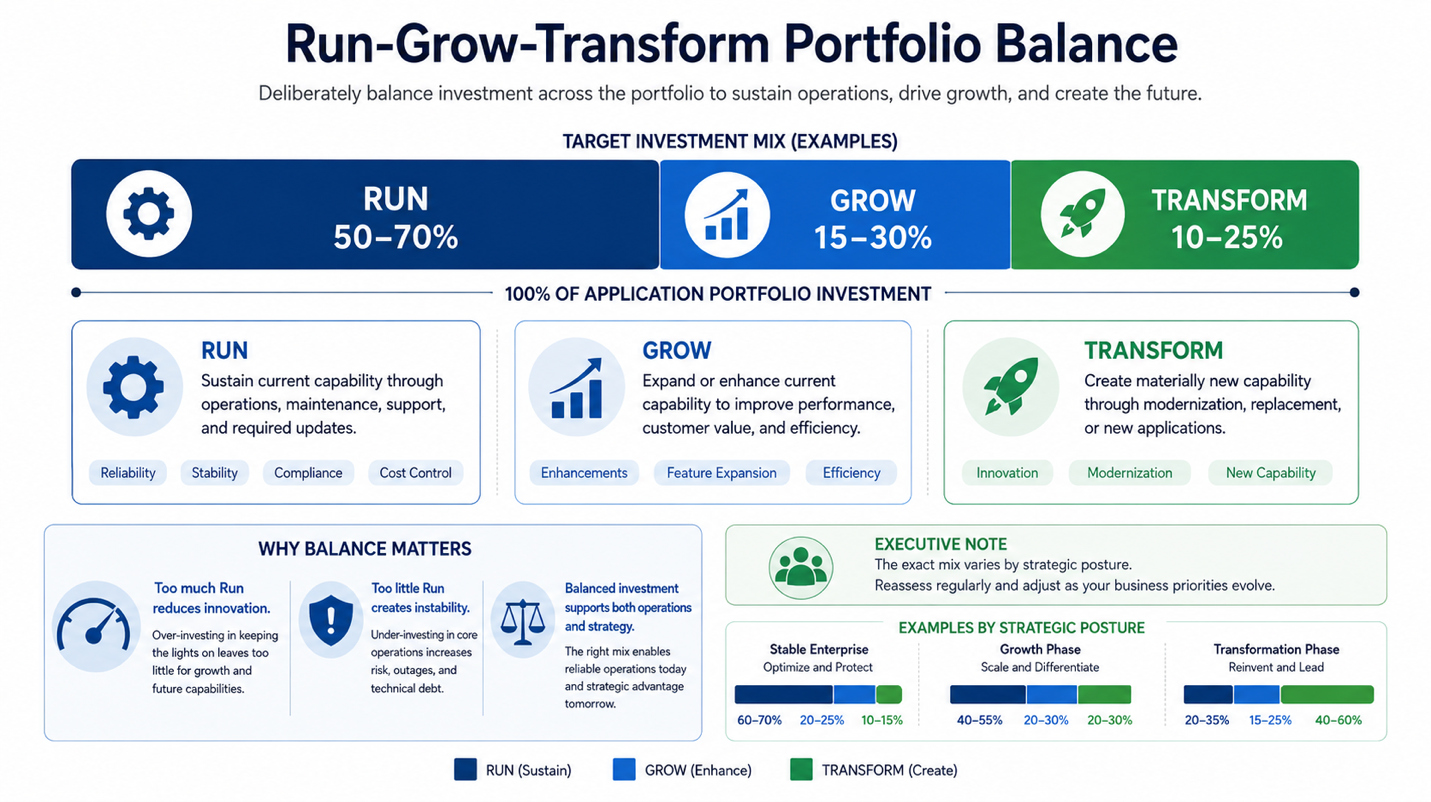
| Run, Grow, Transform Categories | The three portfolio investment categories: run (sustain current capability through maintenance, support, and required updates), grow (expand current capability through enhancement, scale-out, or additional coverage), and transform (build materially new capability through modernization, replacement, or new applications). |
| Portfolio Balance | The deliberate distribution of portfolio investment across the three categories in proportions that match enterprise strategy — with target ranges for each category defined explicitly based on the organization’s current strategic posture, such as an aggressive transformation period warranting a higher transform allocation than a consolidation period. |
Quick Q&A
Question: Why does portfolio investment tend to concentrate in 'run'?
Question: How is the balance maintained deliberately?
Read More Below
Overview
Application portfolio investment naturally concentrates in one of three categories: run investments that maintain existing applications at their current capability level without significant change; grow investments that extend existing applications to serve expanded or evolved business needs; and transform investments that build fundamentally new capabilities or replace existing applications with significantly more capable alternatives. When portfolio investment is heavily concentrated in the run category, the portfolio maintains its current state but does not evolve at the pace that changing business requirements demand. When investment is concentrated in transform, operational quality suffers because run investments that sustain current capabilities are neglected and the organization attempts to change while simultaneously failing to maintain what already exists.
Best Practice
Analyze the distribution of portfolio investment across run, grow, and transform categories and compare it against the investment profile that the organization’s current strategic direction requires. Define target investment ranges for each category that reflect the organization’s strategic intent and current context - an organization in a period of aggressive digital transformation will invest a higher proportion in transform; one in a period of consolidation and operational stabilization will invest more heavily in run and grow. Review the actual investment distribution against the target ranges annually as part of the budget planning cycle, identify where the distribution deviates from strategic intent, and propose specific adjustments to bring the portfolio investment profile into alignment with organizational strategy.
Benefit(s)
Actively managing the run-grow-transform investment balance produces a portfolio that evolves at the pace and in the direction that organizational strategy requires rather than defaulting to whatever investment pattern emerges from individual decisions without aggregate awareness. Run investment maintains the operational quality of existing applications while transform investment builds new capabilities. The organization avoids both failure modes of unbalanced investment: operational quality decline from under-investment in run, and strategic stagnation from over-investment in run at the expense of the transform investment that moves the portfolio forward. Leadership can see and adjust the investment profile of the portfolio as a deliberate strategic lever.
How to cite this page
When referencing this page in academic work, internal standards, or external publications, include the page title, IF4IT as author and publisher (The International Foundation for Information Technology (IF4IT), LLC), the URL, and your access date.
Example (informal web citation):
The International Foundation for Information Technology (IF4IT), LLC. Balance the portfolio across run, grow, and transform investment categories | Application Portfolio Management (APM) Best Practices. https://if4it.org/best-practices/application-portfolio-management-apm/balance-the-portfolio-across-run-grow-and-transform-investment-categories/ (accessed 2026-10-22).
See About Us for content governance and site-wide citation guidance.
Copyright for The International Foundation for Information Technology (IF4IT), LLC: 2008 - Present
Legal Disclaimers