Build and maintain an application cost model that leadership can act on - Application Portfolio Management (APM) Best Practices
Build and maintain an application cost model that leadership can act on
(Chapter 95 of Application Portfolio Management (APM) Best Practices)
Executive Summary: Chapter Overview
IF4ITThe Bottom Line
Core Concepts
| Concept | Definition & Strategic Role |
|---|---|
| Application Cost Model | The structured representation of portfolio spend organized by the dimensions leadership uses — capability, disposition, posture, business unit, cost category — producing on-demand views that support portfolio decisions. |
| Actionable Cost Views | The specific views produced by the cost model that map to leadership’s decisions — spend by capability, spend by strategic disposition, spend concentration by vendor, spend trajectory by posture — each answering a portfolio question leadership actually asks. |
Quick Q&A
Question: What distinguishes a leadership-actionable cost model from a financial report?
Question: What views does the model typically need to produce?
Read More Below
Overview
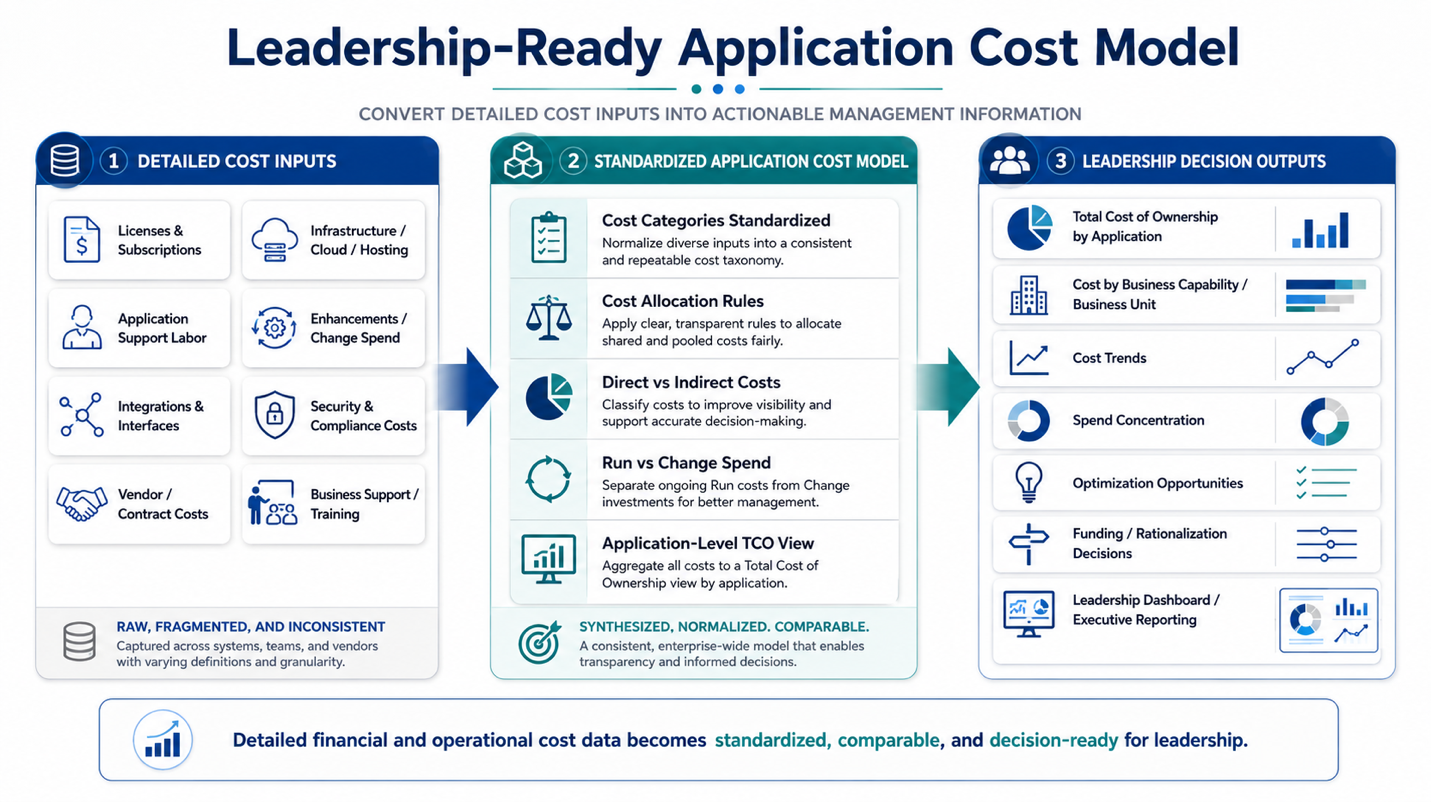
Portfolio financial data that exists in spreadsheets maintained by the APM team, presented in technical formats understood only by technology professionals, does not inform leadership decisions regardless of its accuracy and completeness. Leadership requires financial information presented in formats that connect technology costs to business outcomes, show cost trends over time in ways that reveal whether the portfolio is becoming more or less financially efficient, and identify the specific cost levers available for optimization with enough clarity that non-technical leaders can engage with the decisions those levers require. A cost model that is technically accurate but inaccessible to its intended audience fails to deliver the financial governance value that APM promises.
Best Practice
Build and maintain an application cost model that presents portfolio financial information in a format that non-technical leadership can understand and act on. The cost model should show: total portfolio cost by major category with year-over-year trend; cost allocated to business capabilities and organizational units so that business leaders can see their technology spend; the proportion of cost classified as wasted spend and the trajectory of waste reduction over successive review cycles; and the planned financial impact of rationalization decisions in the pipeline. Use AI to generate natural language cost summaries that translate the financial data into the narrative format that executive and board-level reporting requires. Update the cost model at least quarterly and before every significant budget or planning discussion.
Benefit(s)
A leadership-accessible cost model makes the financial governance value of APM visible and credible to the organizational leaders whose support sustains the APM investment. Leaders who can see and understand the portfolio cost picture engage with portfolio decisions more actively and more responsibly. The cost model becomes an input to budget planning conversations rather than a technical artifact that is consulted only by APM practitioners. APM earns its place at the financial governance table by consistently providing financial clarity that leadership finds useful rather than financial complexity that leadership cannot interpret or act on.
How to cite this page
When referencing this page in academic work, internal standards, or external publications, include the page title, IF4IT as author and publisher (The International Foundation for Information Technology (IF4IT), LLC), the URL, and your access date.
Example (informal web citation):
The International Foundation for Information Technology (IF4IT), LLC. Build and maintain an application cost model that leadership can act on | Application Portfolio Management (APM) Best Practices. https://if4it.org/best-practices/application-portfolio-management-apm/build-and-maintain-an-application-cost-model-that-leadership-can-act-on/ (accessed 2026-10-22).
See About Us for content governance and site-wide citation guidance.
Copyright for The International Foundation for Information Technology (IF4IT), LLC: 2008 - Present
Legal Disclaimers