Build and maintain key mappings between applications and the business capabilities they support - Application Portfolio Management (APM) Best Practices
Build and maintain key mappings between applications and the business capabilities they support
(Chapter 33 of Application Portfolio Management (APM) Best Practices)
Executive Summary: Chapter Overview
IF4ITThe Bottom Line
Core Concepts
| Concept | Definition & Strategic Role |
|---|---|
| Application-to-Capability Mapping | The explicit, governed mapping between each application and the business capabilities it supports — typically many-to-many, maintained on a defined cadence, and used to enable capability-based portfolio analysis. |
| Capability-Based Portfolio Analysis | The examination of portfolio coverage, redundancy, cost, and investment against business capabilities rather than against technical structure — producing insights leadership can act on because they map directly to business language. |
Quick Q&A
Question: Why is Application-to-Capability mapping worth the governance overhead?
Question: What makes the mapping durable rather than a one-time artifact?
Question: Can this same mapping pattern be extended beyond business capabilities?
Read More Below
Overview
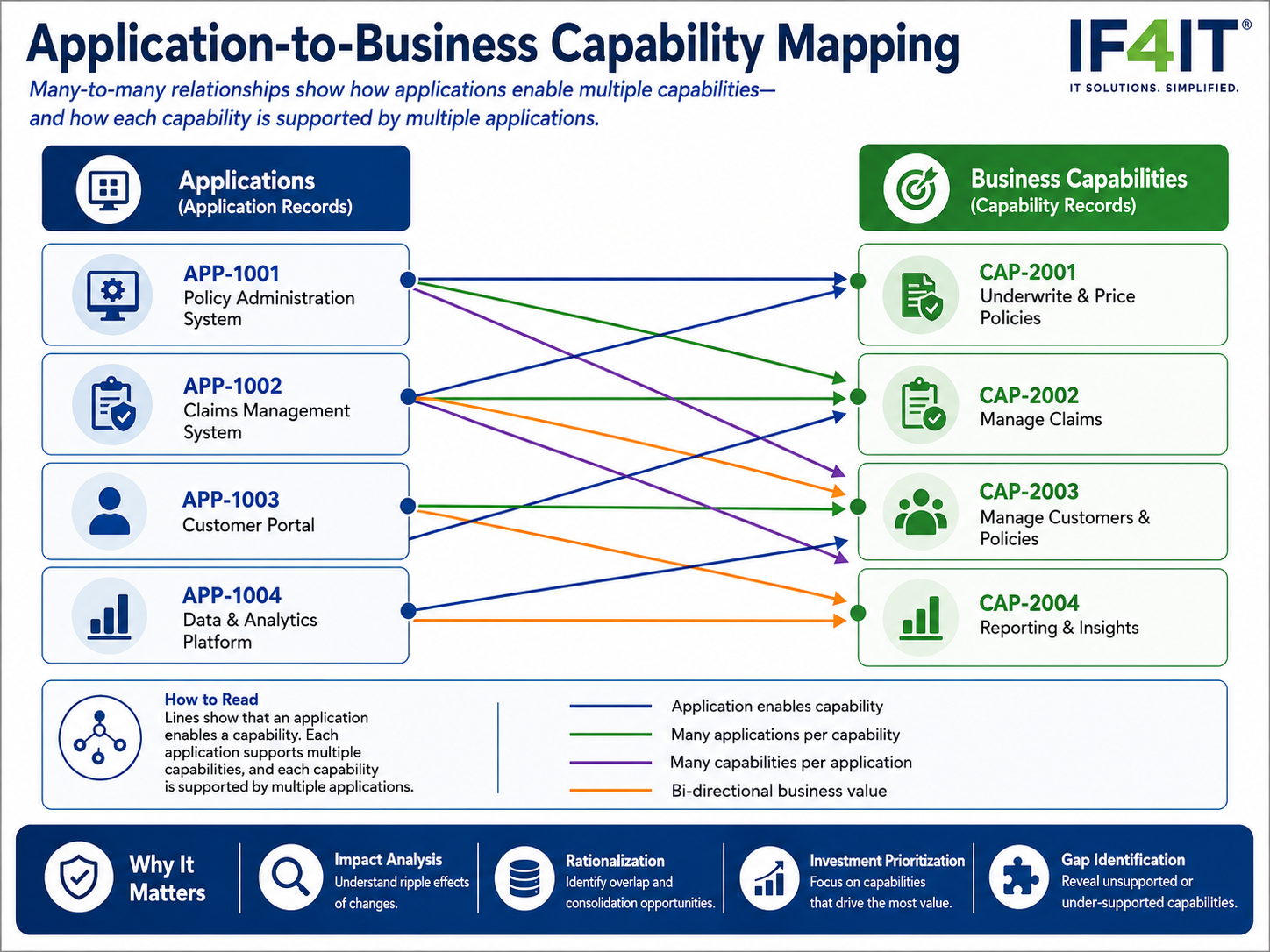
An application inventory that does not connect applications to the business capabilities they support is an IT inventory, not a portfolio management tool. Without the business capability connection, it is impossible to answer the questions that business leadership asks about the portfolio: what technology supports our most critical business capabilities? What happens to our customer service function if we retire this application? Which of our applications are genuinely strategic and which are merely operational? These questions require the capability mapping that most application inventories do not maintain.
Best Practice
Establish and maintain an explicit mapping between every application in the portfolio and the business capabilities it supports. The mapping should capture the degree of support: is the application the primary enabler of the capability, a significant supporting tool, or a peripheral contributor? Review the mapping when a business capability changes in strategic priority or operational definition, and whenever an application’s functional scope changes significantly. Use this mapping as a primary input to rationalization analysis: applications that are the primary or sole enabler of high-criticality capabilities receive heightened protection; applications with low or no capability alignment become candidates for priority review.
Business capability is the primary mapping this document recommends, but organizations that already maintain a formal business process or value stream model can extend this same mapping pattern to processes and value streams as a complementary view — which applications enable which steps of a given value stream, for example. Treat this as an additional lens on the same underlying data, not a separate mapping exercise requiring its own governance.
The same mapping mechanism can also be extended to connect applications directly to business units or organizational structure, for organizations where capability ownership does not cleanly align with org-chart reporting lines. This is particularly useful during reorganizations, when capability ownership may be stable even as the business units responsible for it change.
Benefit(s)
Business capability mapping elevates APM from an IT discipline to a business intelligence tool. Portfolio decisions become grounded in business impact rather than technical preference. Business leaders can see which applications are essential to their most important capabilities and participate meaningfully in portfolio decisions because the connection between technology and business outcome is explicit and traceable. Rationalization efforts become more productive and more credible because applications are assessed in the context of what they enable for the organization rather than in isolation from business purpose.
How to cite this page
When referencing this page in academic work, internal standards, or external publications, include the page title, IF4IT as author and publisher (The International Foundation for Information Technology (IF4IT), LLC), the URL, and your access date.
Example (informal web citation):
The International Foundation for Information Technology (IF4IT), LLC. Build and maintain key mappings between applications and the business capabilities they support | Application Portfolio Management (APM) Best Practices. https://if4it.org/best-practices/application-portfolio-management-apm/build-and-maintain-key-mappings-between-applications-and-the-business-capabilities-they-support/ (accessed 2026-10-22).
See About Us for content governance and site-wide citation guidance.
Copyright for The International Foundation for Information Technology (IF4IT), LLC: 2008 - Present
Legal Disclaimers