Build and maintain key mappings between applications and the people, processes, and data they depend on - Application Portfolio Management (APM) Best Practices
Build and maintain key mappings between applications and the people, processes, and data they depend on
(Chapter 34 of Application Portfolio Management (APM) Best Practices)
Executive Summary: Chapter Overview
IF4ITThe Bottom Line
Core Concepts
| Concept | Definition & Strategic Role |
|---|---|
| People-Process-Data Dependencies | The explicit mappings from each application to the people it depends on (owners, operators, key users), the business processes it enables, and the data assets it produces or consumes — maintained as governed artifacts. |
| Dependency-Aware Portfolio Decisions | Portfolio decisions that account for the human, process, and data consequences of application changes — for example, retirement decisions that consider user migration, process re-mapping, and data disposition. |
Quick Q&A
Question: What kinds of portfolio decisions require these dependency mappings?
Question: How does APM avoid becoming responsible for every dependency inventory?
Read More Below
Overview
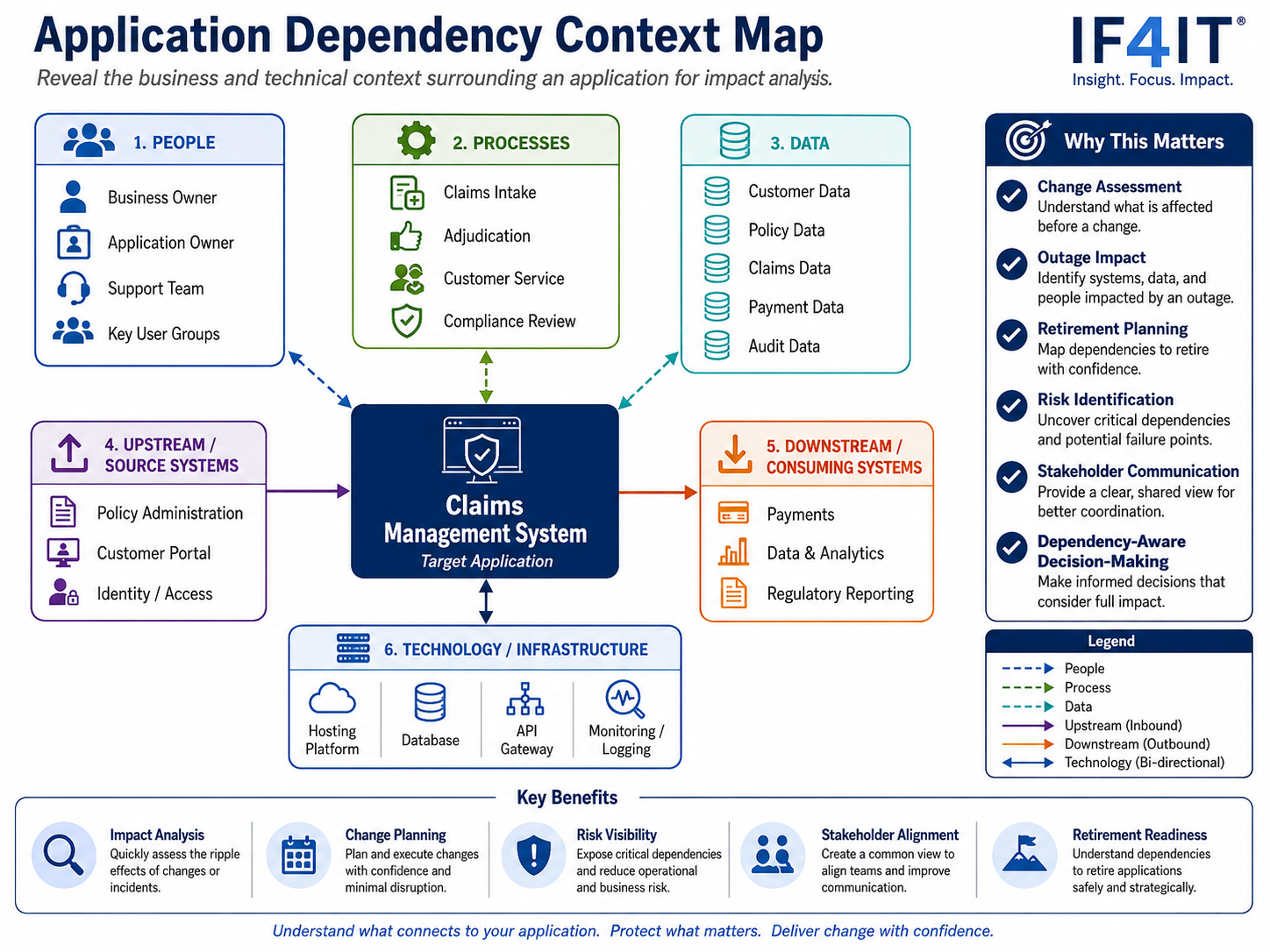
Applications do not operate in isolation. They depend on people who operate and maintain them, processes that they enable or automate, and data that they generate, consume, or store. When these dependencies are not mapped and maintained, portfolio decisions consistently underestimate their consequences. An application that appears straightforward to retire reveals, only after retirement is initiated, that three critical business processes depend on data it generates and that the only person who understands its customization logic left the organization two years ago. These discoveries are avoidable - but only if the dependencies are mapped before decisions are made.
Best Practice
Map and maintain the key dependencies between every application and the people, processes, and data assets it involves. For people dependencies, identify key-person dependencies - situations where specific named individuals hold critical knowledge about an application’s operation, configuration, or data that is not documented anywhere else. For process dependencies, identify the business and technology processes the application enables, automates, or is embedded in. For data dependencies, identify the data assets the application generates, consumes, or stores, including any regulated or sensitive data with specific governance obligations. Treat these dependency maps as required inputs to every significant application assessment, retirement, or change decision.
Benefit(s)
Dependency mapping prevents the most common and most painful consequence of uninformed portfolio decisions: the discovery of critical dependencies only after a change has been committed and is in progress. Retirement costs are estimated more accurately. Risk assessments are more complete. Succession planning for key-person dependencies is informed rather than reactive. The organization develops a realistic picture of the complexity and interconnectedness of its application portfolio that enables better decisions at every stage of the portfolio management lifecycle.
How to cite this page
When referencing this page in academic work, internal standards, or external publications, include the page title, IF4IT as author and publisher (The International Foundation for Information Technology (IF4IT), LLC), the URL, and your access date.
Example (informal web citation):
The International Foundation for Information Technology (IF4IT), LLC. Build and maintain key mappings between applications and the people, processes, and data they depend on | Application Portfolio Management (APM) Best Practices. https://if4it.org/best-practices/application-portfolio-management-apm/build-and-maintain-key-mappings-between-applications-and-the-people-processes-and-data-they-depend-on/ (accessed 2026-09-08).
See About Us for content governance and site-wide citation guidance.
Copyright for The International Foundation for Information Technology (IF4IT), LLC: 2008 - Present
Legal Disclaimers