Capture the full Total Cost of Ownership for every application - not just license costs - Application Portfolio Management (APM) Best Practices
Capture the full Total Cost of Ownership for every application - not just license costs
(Chapter 89 of Application Portfolio Management (APM) Best Practices)
Executive Summary: Chapter Overview
IF4ITThe Bottom Line
Core Concepts
| Concept | Definition & Strategic Role |
|---|---|
| Total Cost of Ownership (TCO) | The full cost of operating an application over its lifecycle — including licenses, infrastructure, integration, support personnel, operational overhead, and end-of-life costs — captured as a portfolio attribute rather than reconstructed on demand. |
| License-Only Cost Distortion | The common failure mode in which portfolio cost analysis relies on license spend alone, systematically understating cost and producing rationalization decisions that fail to deliver projected savings because the excluded cost categories persist after retirement. |
Quick Q&A
Question: Why does license-only cost analysis mislead portfolio decisions?
Question: What cost categories does TCO typically include?
Read More Below
Overview
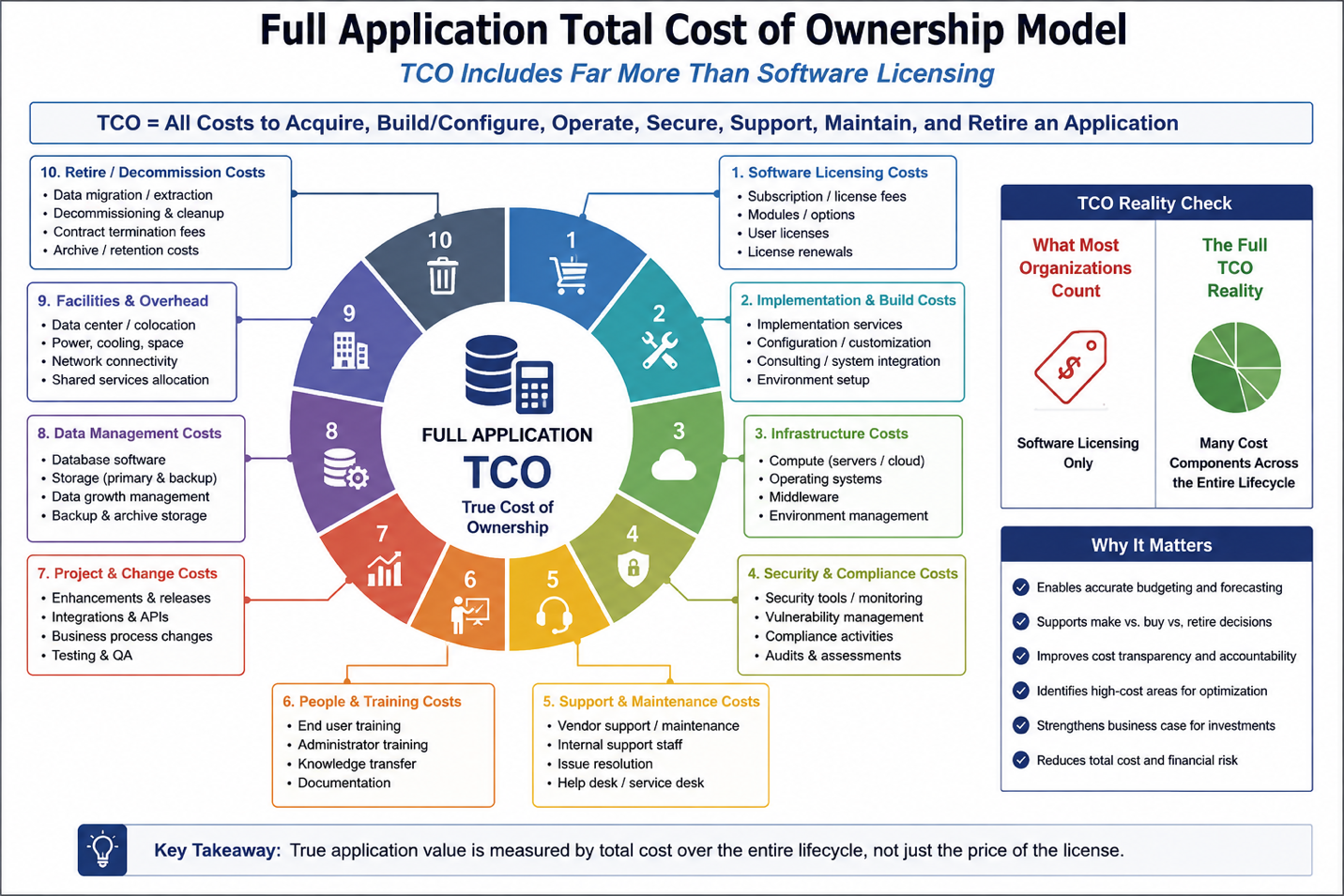
License costs are the most visible component of application cost, but they are rarely the largest. For most enterprise applications, the full Total Cost of Ownership - when all direct and indirect cost categories are accounted for - is two to five times the license cost alone. Infrastructure and hosting costs, integration development and maintenance, vendor support contracts, internal operational staffing, training and change management, incident remediation, and the ongoing cost of managing technical debt all contribute to the real cost of every application in the portfolio. Organizations that make portfolio investment decisions based on license costs alone consistently misallocate resources because they are optimizing against a partial financial picture that systematically understates the true cost of retaining applications and understates the true savings available from rationalizing them.
Best Practice
Define and capture the full Total Cost of Ownership for every application in the portfolio. The TCO framework should include at minimum: license and subscription costs; infrastructure and hosting costs including cloud consumption charges; integration development and ongoing maintenance costs; vendor support and maintenance contract costs; internal operational staffing costs expressed as the FTE-equivalent of engineering, operations, and support time dedicated to the application; training and change management costs associated with the application’s evolution; incident and problem management costs attributable to the application; and the ongoing cost of managing and servicing the application’s technical debt. Where precise figures are not available for every category, use orders of magnitude that represent the best available estimate - a complete but approximate TCO is consistently more useful for portfolio decisions than a precise but incomplete cost picture that only captures what is easy to measure.
Benefit(s)
Full TCO visibility transforms application portfolio financial management from a license tracking exercise into a comprehensive investment governance discipline. Applications that appear inexpensive based on license costs are revealed as significant organizational investments when full TCO is calculated - often revealing that the true cost is two to five times the license cost that appeared in the budget line. Rationalization decisions are grounded in the complete financial picture. Investment cases for modernization or replacement are evaluated against accurate baseline costs rather than underestimates that make the status quo appear more economical than it is. Leadership makes portfolio investment decisions with the financial clarity that executive stewardship requires.
How to cite this page
When referencing this page in academic work, internal standards, or external publications, include the page title, IF4IT as author and publisher (The International Foundation for Information Technology (IF4IT), LLC), the URL, and your access date.
Example (informal web citation):
The International Foundation for Information Technology (IF4IT), LLC. Capture the full Total Cost of Ownership for every application - not just license costs | Application Portfolio Management (APM) Best Practices. https://if4it.org/best-practices/application-portfolio-management-apm/capture-the-full-total-cost-of-ownership-for-every-application-not-just-license-costs/ (accessed 2026-10-22).
See About Us for content governance and site-wide citation guidance.
Copyright for The International Foundation for Information Technology (IF4IT), LLC: 2008 - Present
Legal Disclaimers