Connect APM to the Systems Development Lifecycle (SDLC) to keep the portfolio current as applications are built and changed - Application Portfolio Management (APM) Best Practices
Connect APM to the Systems Development Lifecycle (SDLC) to keep the portfolio current as applications are built and changed
(Chapter 62 of Application Portfolio Management (APM) Best Practices)
Executive Summary: Chapter Overview
IF4ITThe Bottom Line
Core Concepts
| Concept | Definition & Strategic Role |
|---|---|
| SDLC-Sourced Portfolio Data | Application attributes and events — new application proposals, major version changes, technology stack changes, technical debt introduced or resolved — that originate naturally from SDLC activity and can feed the Applications Inventory without duplicate, manually re-entered data collection. |
| Continuous Portfolio Currency | The practice of keeping application records current through the ordinary flow of development work, rather than relying solely on periodic rationalization reviews that leave the portfolio record stale in the intervals between them. |
Quick Q&A
Question: What SDLC events should feed the Applications Inventory?
Question: Why isn’t rationalization-review-cycle data collection sufficient on its own?
Question: Beyond SDLC events themselves, what other systems can strengthen this connection?
Read More Below
Overview
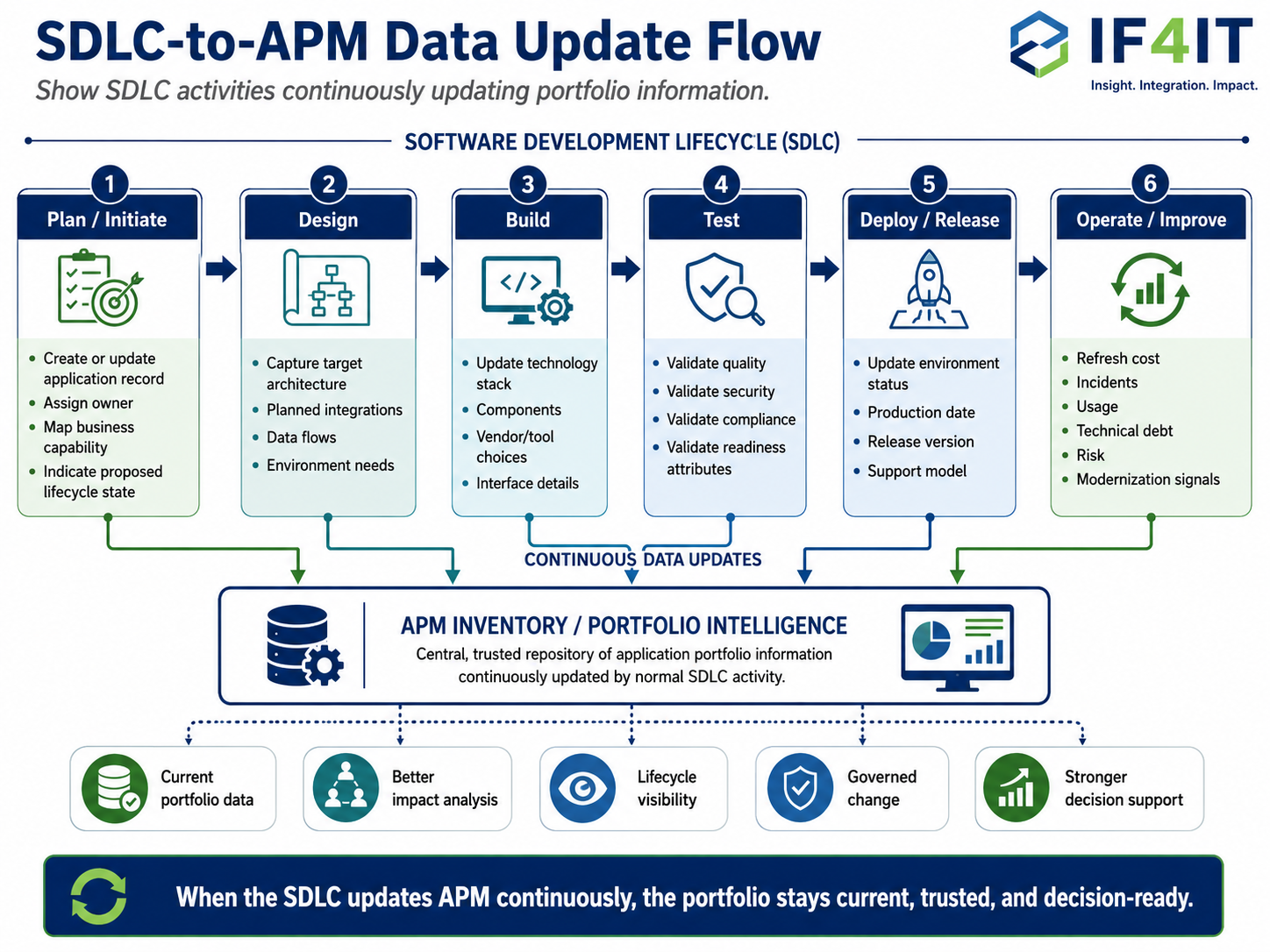
Applications do not change only at the moment of a formal portfolio review — they change continuously, through the ordinary work of the Systems Development Lifecycle. New applications are proposed and built; existing applications receive new versions, new technology dependencies, and new technical debt; and some applications are retired mid-cycle for reasons a periodic review would not surface until much later. An APM program that only updates its portfolio record at rationalization-review time is, by construction, always working from a partially stale picture.
Best Practice
Establish an explicit connection between APM and the Systems Development Lifecycle so that key SDLC events — a new application entering development, a major version or technology-stack change, technical debt introduced or resolved during a release — update the Applications Inventory as they happen, rather than waiting for the next scheduled portfolio review to capture them. This connection should be treated as a primary data source for the application lifecycle stages already governed elsewhere in this document, not as a parallel or duplicate tracking mechanism.
Where the SDLC discipline itself is governed by a separate function or document, name that dependency explicitly rather than assuming APM can observe SDLC activity without a defined data-sharing arrangement. Define what data APM needs from SDLC activity, at what frequency, and through what mechanism, consistent with how this document treats other operationally-homed data sources.
Where the organization manages application-related work through a dedicated product or project management system — tracking features, releases, or initiatives at the product level — treat that system as a complementary data source alongside the SDLC connection described in this chapter: product and project records often capture planned future changes and investment decisions before they reach active development, giving APM early visibility into what is coming rather than only what has already shipped.
Where feasible, link each application record directly to its source code repository and delivery pipeline — not merely to the SDLC process that governs it, but to the specific repository and pipeline identifiers themselves. This concrete linkage lets APM data cross-reference build frequency, deployment frequency, and repository activity as additional signals of whether an application is actively maintained or effectively abandoned, and gives incident responders and architects a direct path from the portfolio record to the actual codebase when they need it.
Benefit(s)
Connecting APM to the SDLC keeps the portfolio record current between formal review cycles, closing the gap where an application’s actual state and its last-recorded state diverge. Technical debt and technology-stack changes are captured as they are introduced rather than discovered retroactively at the next review, giving rationalization and risk assessments a more accurate, more current evidentiary basis. And because this data already exists as a byproduct of ordinary development work, connecting to it requires no additional manual data entry burden on development teams.
How to cite this page
When referencing this page in academic work, internal standards, or external publications, include the page title, IF4IT as author and publisher (The International Foundation for Information Technology (IF4IT), LLC), the URL, and your access date.
Example (informal web citation):
The International Foundation for Information Technology (IF4IT), LLC. Connect APM to the Systems Development Lifecycle (SDLC) to keep the portfolio current as applications are built and changed | Application Portfolio Management (APM) Best Practices. https://if4it.org/best-practices/application-portfolio-management-apm/connect-apm-to-the-systems-development-lifecycle-sdlc-to-keep-the-portfolio-current-as-applications-are-built-and-changed/ (accessed 2026-10-22).
See About Us for content governance and site-wide citation guidance.
Copyright for The International Foundation for Information Technology (IF4IT), LLC: 2008 - Present
Legal Disclaimers