Define a consistent application assessment framework - Application Portfolio Management (APM) Best Practices
Define a consistent application assessment framework
(Chapter 65 of Application Portfolio Management (APM) Best Practices)
Executive Summary: Chapter Overview
IF4ITThe Bottom Line
Core Concepts
| Concept | Definition & Strategic Role |
|---|---|
| Assessment Framework | The documented structure of dimensions, scoring scales, evidence requirements, and cadence that defines how every application in the portfolio is assessed — producing comparable results across applications and across time. |
| Consistency and Comparability | The property that assessment results from one application can be meaningfully compared to results from another application because both were produced against the same framework — the property that makes portfolio-wide analysis possible. |
Quick Q&A
Question: What breaks when assessment is inconsistent across applications?
Question: What dimensions typically belong in the framework?
Read More Below
Overview
Without a consistent assessment framework, rationalization decisions are made subjectively - based on the preferences, priorities, and blind spots of whoever is making them at a given moment. Different assessors evaluate the same applications using incompatible criteria and reach contradictory conclusions. The portfolio rationalization process loses credibility because stakeholders cannot see the logic behind the recommendations, and application owners whose applications are recommended for retirement cannot understand or contest the basis for the decision in any meaningful way.
Best Practice
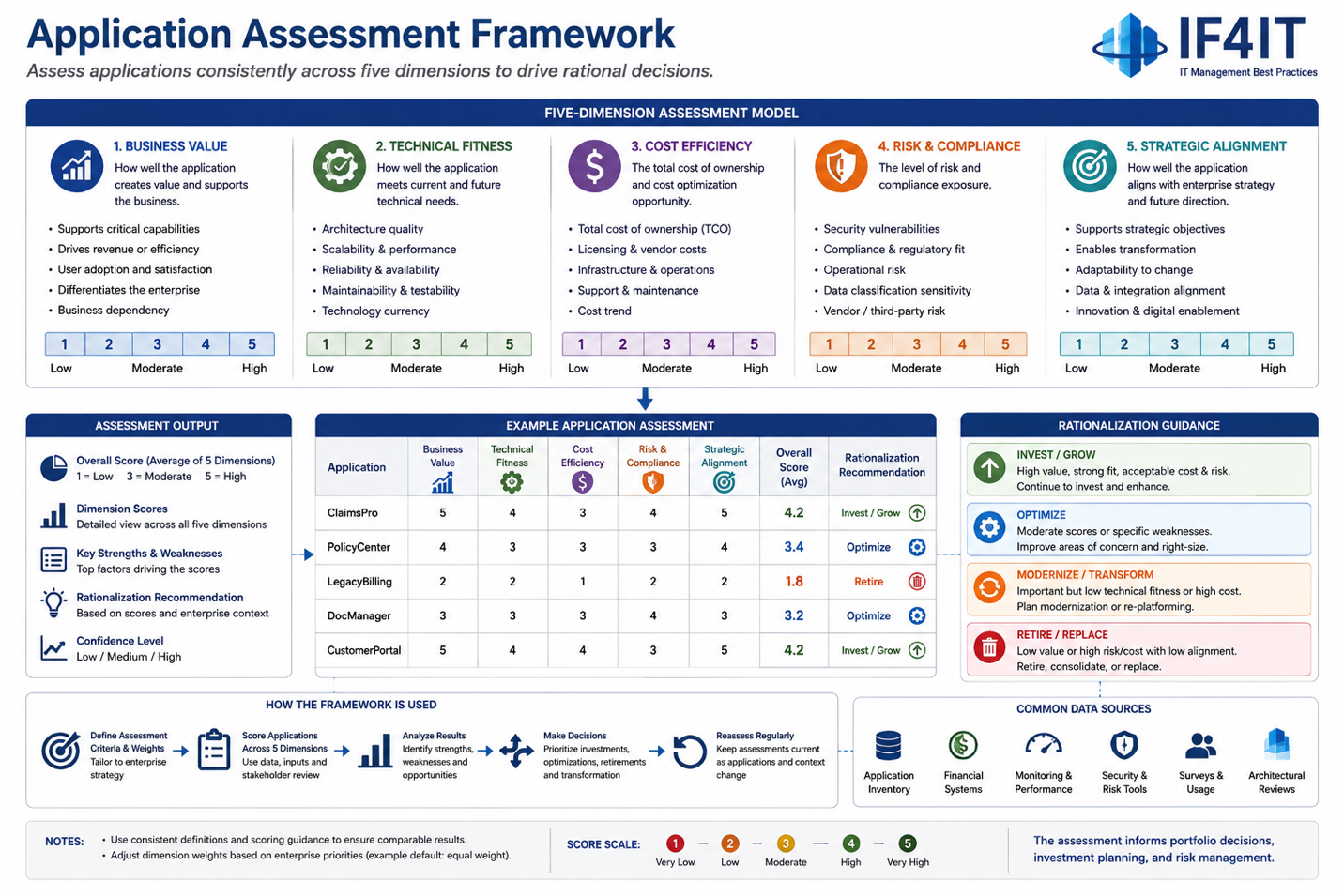
Define a consistent, documented application assessment framework that specifies: the dimensions on which every application will be assessed; the specific criteria used to evaluate each dimension; the scoring approach for each dimension; and the rationalization disposition that corresponds to each combination of scores. The framework should be applied consistently to every application in the portfolio, producing assessment results that are comparable across applications and defensible to stakeholders at every organizational level. Review and update the framework periodically to ensure it reflects current organizational priorities, current architectural standards, and the lessons learned from previous assessment cycles.
Used consistently, this framework functions as the organization’s application portfolio assessment tool - not a purchased product, but a documented, repeatable method any team can apply without additional software investment.
Benefit(s)
A consistent assessment framework produces rationalization recommendations that are credible, comparable, and defensible. Stakeholders can see the logic behind every recommendation. Application owners can understand how their applications were assessed and what would need to change for the recommendation to change. Leadership can compare applications across the portfolio using a common standard rather than competing subjective impressions. The portfolio rationalization process earns the organizational trust that it needs to produce decisions that are actually acted upon.
How to cite this page
When referencing this page in academic work, internal standards, or external publications, include the page title, IF4IT as author and publisher (The International Foundation for Information Technology (IF4IT), LLC), the URL, and your access date.
Example (informal web citation):
The International Foundation for Information Technology (IF4IT), LLC. Define a consistent application assessment framework | Application Portfolio Management (APM) Best Practices. https://if4it.org/best-practices/application-portfolio-management-apm/define-a-consistent-application-assessment-framework/ (accessed 2026-10-22).
See About Us for content governance and site-wide citation guidance.
Copyright for The International Foundation for Information Technology (IF4IT), LLC: 2008 - Present
Legal Disclaimers