Application Portfolio Management (APM) Best Practices - Define and enforce an application lifecycle - Proposed, Active, Deprecated, Retired
Application Portfolio Management (APM) Best Practices
Chapter 109. Define and enforce an application lifecycle - Proposed, Active, Deprecated, Retired
Executive Summary: Chapter Overview
IF4ITThe Bottom Line
Core Concepts
| Concept | Definition & Strategic Role |
|---|---|
| Portfolio Lifecycle Model | The defined set of lifecycle states applications occupy — typically Proposed, Active, Deprecated, Retired — with explicit criteria for each state and defined transitions between them. |
| Lifecycle Enforcement | The mechanism that maintains lifecycle state accuracy — including gate reviews for state transitions, automated flagging of applications whose activity does not match their declared state, and named consequences for applications that drift without state change. |
Quick Q&A
Question: Why enforce a lifecycle model rather than let applications self-describe?
Question: What differentiates the four typical states?
Read More Below
Overview
Applications without a defined lifecycle are applications managed by inertia rather than intention. They are added when someone requests them and they persist indefinitely unless a crisis demands their removal. They accumulate in the portfolio without discipline, consuming license, infrastructure, support, and operational resources long after their business value has declined below any rational justification for continued investment. The portfolio grows without deliberate management, becoming progressively more expensive, more operationally complex, and more difficult to govern with each ungoverned addition.
Best Practice
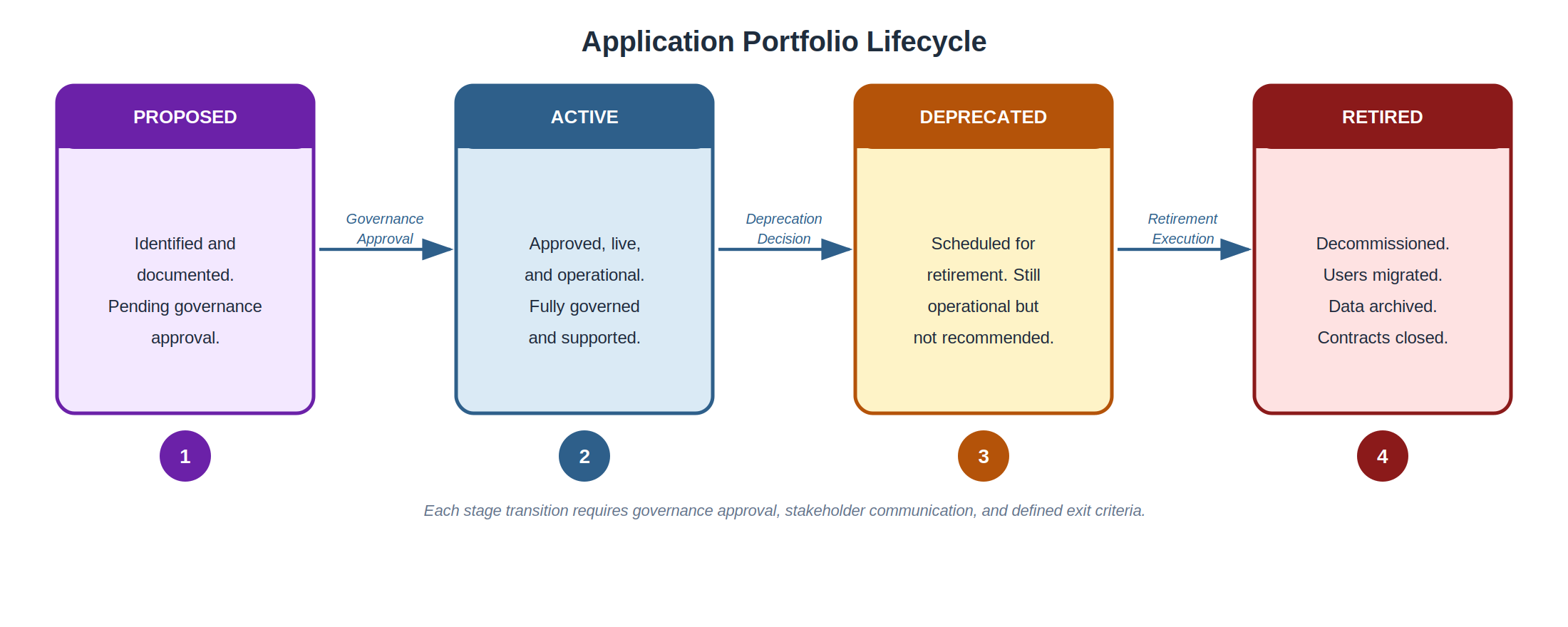
Define and enforce a formal application lifecycle with at minimum four stages, each with clearly defined characteristics and governance requirements. Proposed: identified as a need and under evaluation or development but not yet available for operational use. Active: approved, deployed, and available for its intended users and business purposes. Deprecated: scheduled for retirement and available for current users but no new adoption is permitted; a retirement date and user transition plan are defined and in progress. Retired: decommissioned and no longer available for operational use. Each stage transition requires defined criteria, formal governance approval, and appropriate stakeholder communication before execution.
Benefit(s)
A formal application lifecycle gives the organization deliberate, governed control over the composition of its application portfolio at every stage. Applications enter and exit through governed processes rather than ungoverned accumulation and abandonment. The portfolio remains focused on applications actively delivering value in their current lifecycle stage. Resources are not indefinitely consumed by applications that have passed their useful operational life. Leadership has a clear, current view of what is in the pipeline, what is active, what is being phased out, and what has been retired - enabling better planning, resource allocation, and financial forecasting.
How to cite this page
When referencing this page in academic work, internal standards, or external publications, include the page title, IF4IT as author and publisher (The International Foundation for Information Technology (IF4IT), LLC), the URL, and your access date.
Example (informal web citation):
The International Foundation for Information Technology (IF4IT), LLC. Define and enforce an application lifecycle - Proposed, Active, Deprecated, Retired | Application Portfolio Management (APM) Best Practices. https://if4it.org/best-practices/application-portfolio-management-apm/define-and-enforce-an-application-lifecycle-proposed-active-deprecated-retired/ (accessed 2026-07-23).
See About Us for content governance and site-wide citation guidance.
Copyright for The International Foundation for Information Technology (IF4IT), LLC: 2008 - Present
Legal Disclaimers